Emerging Markets Picking Up

September 20, 2013

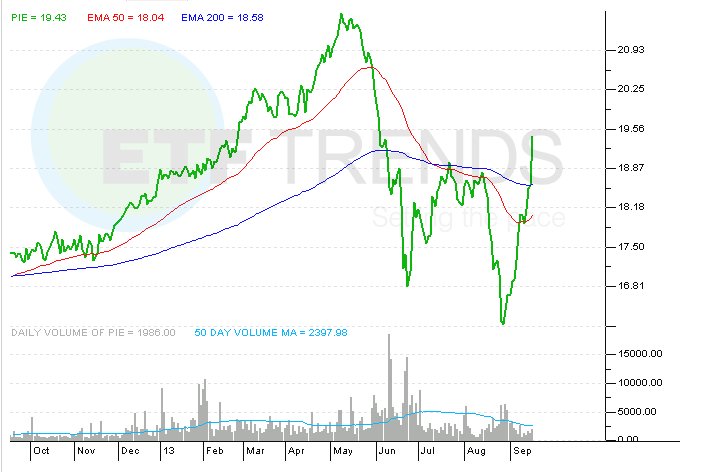
Tom Lydon covers the huge spike in PIE and other Emerging Market ETFs over the last week:

Emerging markets ETFs had been perking up for several weeks, but the group got the lift it really needed Wednesday when the Federal Reserve eschewed tapering. The U.S. central bank said its $85 billion in monthly bond purchases will remain in place and those comments could be just what the doctor ordered when it comes to confirming a significant rally for emerging markets ETFs.

There were multiple examples of the intensity with which emerging markets ETFs rallied on Wednesday. The Vanguard FTSE Emerging Markets ETF (VWO) jumped 4% while the iShares MSCI Brazil Capped ETF (EWZ) soared 5.1% and those are just two examples. With a Wednesday gain of 4.6%, the PowerShares DWA Emerging Markets Technical Leaders Portfolio (PIE) belongs on the list of emerging markets “no tapering” beneficiaries.

PIE does not follow the same cap-weighted methodology used by VWO and other larger, diversified emerging markets ETFs. Rather, PIE tracks the Dorsey Wright Emerging Markets Technical Leaders Index, which ranks its components based on relative strength traits. PIE and its index rebalance quarterly. That methodology previously helped PIE thwart larger rivals like VWO. Earlier this year when the BRIC nations were lagging, PIE was beating its rivals because it had scant BRIC exposure.

However, PIE was left vulnerable to the tapering-induced emerging markets swoon that started in earnest in May. Although PIE was not highly exposed to BRIC, the fund did have large allocations to some developing markets that waned in the face of tapering talk and higher U.S. interest rates. Think Turkey, Indonesia and Thailand as a few examples.

With tapering off the table, PIE could be in a position to thrive again. The ETF can hold stocks from the following countries: Argentina, Brazil, Chile, China, Colombia, Czech Republic, Egypt, Hungary, India, Indonesia, Israel, Malaysia, Mexico, Morocco, Pakistan, Peru, Philippines, Poland, Russia, South Africa, Taiwan, Thailand and Turkey.

PowerShares DWA Emerging Markets Technical Leaders Portfolio
PIE Emerging Markets Picking Up

Past performance is no guarantee of future returns. See www.powershares.com for more information.

Posted by:


Stocks for the Long Run

September 20, 2013

Unlike certain authors, I am not promoting some agenda about where stocks will be at some future date! Instead, I am just including a couple of excerpts from a paper by luminaries David Blanchett, Michael Finke, and Wade Pfau that suggests that stocks are the right investment for the long run—based on historical research. Their findings are actually fairly broad and call market efficiency into question.

We find strong historical evidence to support the notion that a higher allocation to equities is optimal for investors with longer time horizons, and that the time diversification effect is relatively consistent across countries and that it persists for different levels of risk aversion.

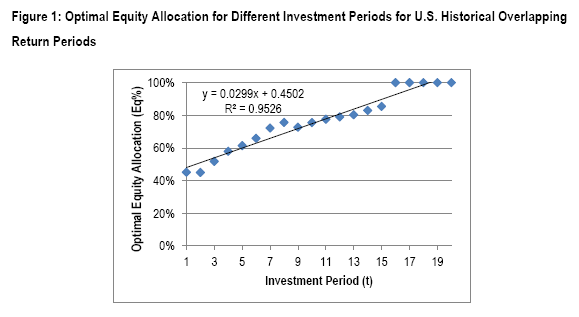
When they examine optimal equity weightings in a portfolio by time horizon, the findings are rather striking. Here’s a reproduction of one of their figures from the paper:

optimalequity zpsa19b1cfd Stocks for the Long Run

Source: SSRN/Blanchett, Finke, Pfau (click to enlarge)

They describe the findings very simply:

Figure 1 also demonstrates how to interpret the results we include later in Tables 2 and 3. In Figure 1 we note an intercept (α) of 45.02% (which we will assume is 45% for simplicity purposes) and a slope (β) of .0299 (which for simplicity purposes we will assume is .03). Therefore the optimal historical allocation to equities for an investor with a 5 year holding period would be 60% stocks, which would be determined by: 45% + 5(3%) = 60%.

In other words, if your holding period is 15-20 years or longer, the optimal portfolio is 100% stocks!

Reality, of course, can be different from statistical probability, but their point is that it makes sense to own a greater percentage of stocks the longer your time horizon is. The equity risk premium—the little extra boost in returns you tend to get from owning stocks—is both persistent and decently high, enough to make owning stocks a good long-term bet.

Posted by:


DWTFX Leading the Pack in 2013

September 20, 2013

Our partners at Arrow Funds have been making the case for some time now that we are generally in a favorable environment for tactical asset allocation (See Relative Strength Environments and Relative Strength Turns). Stable asset class leadership and widening dispersion in performance between the different asset classes have helped the Arrow DWA Tactical Fund rise to the front of the pack in 2013.

dwtfx DWTFX Leading the Pack in 2013

Source: Dorsey Wright, YTD through 9/19/13

morn dwtfx DWTFX Leading the Pack in 2013

Source: Morningstar

Although this fund has wide flexibility to invest in a number of different asset classes, including domestic equities, inverse equities, international equities, currencies, commodities, real estate, and fixed income, this year the allocation has been dominated by equities.


dwtfx hdgs DWTFX Leading the Pack in 2013


Source: Arrow Funds

Past performance is no guarantee of future returns. See www.arrowfunds.com for more information.

Posted by:


Sector Performance

September 20, 2013

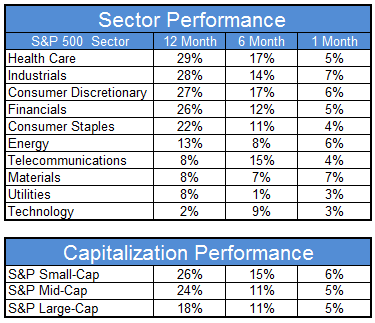
The chart below shows performance of US sectors and capitalizations over the trailing 12, 6, and 1 month(s). Performance updated through 9/19/2013.

gics 09.20.13 Sector Performance

Numbers shown are price returns only and are not inclusive of transaction costs. Source: iShares

Posted by: