Before investors automatically default to a standard 60/40 balanced fund (60% U.S. equity / 40% U.S. fixed income) because it has worked just fine over the past 30 years, the WSJ suggests that they think twice about the returns that bonds may deliver going forward.
Want to bet on what bonds will return over the next decade? You might want to wager on today’s yield—or about 2.7% in the case of the 10-year Treasury note.
It is impossible to know what bonds will return over a short period such as the next 12 months. If interest rates shoot up, for instance, an investor could lose money as the resale value of today’s bonds plummets.
But if you are going to hold bonds for a longer period, the current yield gives you a decent indication of what you might earn over time, says John C. Bogle, founder and former chairman of Vanguard Group. Since 1926, he notes, the entry yield on the 10-year Treasury explains 92% of the annualized return an investor would have earned over the subsequent decade had he or she held the bond to maturity and reinvested the coupon payments at prevailing rates.
Similarly, the entry yield on the Barclays U.S. Aggregate Bond index (of investment-grade U.S. bonds) explains 90% of its 10-year returns for the years 1976 to 2012, says Tony Crescenzi, a portfolio manager and strategist at Pacific Investment Management Co.
By contrast, one figure that doesn’t predict bond returns—and which can lead investors astray—is the past return of a bond index or bond fund.
The article includes the following chart which shows the historic relationship between current yields and annualized bond returns over the next 10 years.

Instead of taking a buy-and-hold approach towards bonds going forward, investors may want to consider using them in the context of a tactical asset allocation strategy. I suspect that during various periods over the next decade there will be times when investors will be glad they have the ability to rotate into bonds to help provide some income and also buffer volatility. However, as the article suggests, a buy-and-hold approach to bonds from these low yields may leave many bond investors disappointed over the next decade.
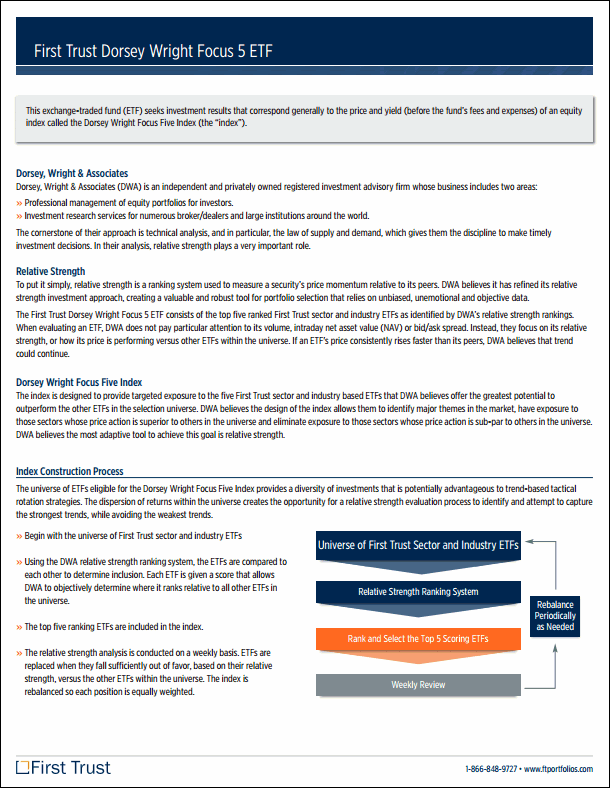
It is likely that one of the reasons that the Arrow DWA Tactical Fund (DWTFX) has been able to outperform 97% of its peers in the Morningstar Tactical Asset Allocation category over the past year is because of its ability to rotate out of bonds while many of its peers have been hampered by their bond exposure:

Relative strength provides, what we believe, is an ideal tool for determining when it is time to own (or overweight) bonds and when it is time to look elsewhere.
Past performance is no guarantee of future returns. See www.arrowfunds.com for a prospectus. A list of all holdings for the trailing 12 months is available upon request.
HT: Abnormal Returns