The Case for Rules-Based Models

April 30, 2014

There is a passage in Steven Pinker’s book The Better Angels of Our Nature: Why Violence Has Declined that focuses on self-control which caught my eye:

Researchers Baumeister and his collaborators measured self-control by asking university students to divulge their own powers of self-control by rating sentences such as these:

I am good at resisting temptation.

I blurt out whatever is on my mind.

I never allow myself to lose control.

I get carried away by my feelings.

I lose my temper too easily.

I don’t keep secrets very well.

I’d be better off if I stopped to think before acting.

Pleasure and fun sometimes keep me from getting work done.

I am always on time.

After adjusting for any tendency just to tick off socially desirable traits, the researchers combined the responses into a single measure of habitual self-control. They found that the students with higher scores got better grades, had fewer eating disorders, drank less, had fewer psychosomatic aches and pains, were less depressed, anxious, phobic, and paranoid, had higher self-esteem, were more conscientious, had better relationships with their families, had more stable friendships, were less likely to have sex they regretted, were less likely to imagine themselves cheating in a monogamous relationship, felt less of a need to “vent” or “let off steam,” and felt more guilt but less shame. Self-controllers are better at perspective-taking and are less distressed when responding to others’ troubles, though they are neither more nor less sympathetic in their concern for them. And contrary to the conventional wisdom that says that people with too much self-control are uptight, repressed, neurotic, bottled up, wound up, obsessive-compulsive, or fixated at the anal stage of psychosexual development, the team found that the more self-control people have, the better their lives are. The people at the top of the scale were the mentally healthiest. (my emphasis added)

Could it also be those with the highest self-control are also better investors? I suspect the answer is clearly yes. One can probably easily guess how we feel about the topic of self-control given that the name of this blog is Systematic Relative Strength. The ups and downs of the financial markets are extremely effective at tempting investors to respond to their emotions and to forget about self-control. The natural consequence being the tendency to buy when an investor feels good and to sell when an investor feels scared (a recipe for poor investment results).

While there are countless investment and self-help books that claim to be able to train people to develop greater self-control, I think that an even more effective way for investors to reap the rewards that accrue to the self-disciplined in the financial markets is simply to employ systematic investment models. Our preference at Dorsey Wright is to execute relative strength-driven models, but there are surely also other investment models that can be applied systematically. My experience in talking to numerous financial advisors on a regular basis is that those advisors who employ rules-based models tend to be more confident in their ability to provide value for their clients, tend to be more relaxed, and tend to be bigger producers than those without such an approach.

Posted by:


Thriving Amid Complexity

April 29, 2014

Brian Portnoy of Forbes identifies one of the longstanding challenges of the financial markets: Choice.

In the modern world of investing, complexity dominates. Thousands of difficult-to-assess choices present themselves, often with the perverse result of confounding us further rather than solving a problem. In response, the principle of “simplicity” is ascendant among advisors, fund managers, brokers, and authors.

But what counts as simple? Unfortunately (and ironically), the answer is elusive.

This is where clients of Dorsey Wright & Associates have a clear advantage over the competition. It is a common occurrence for me to hear from a subscriber of our research or user of one of our managed products that finally they have a game plan. The concept of relative strength is not complex. In fact it is really quite simple—a security can gain relative strength by going up more than the market in an uptrend or by going down less than the market in a downtrend. Relative strength measurements and rankings are what determine what our models own and when they will make any necessary changes to adapt to new leadership. With some reasonable amount of due diligence and investment in becoming fluent with our process a financial advisor can look at the financial markets with an entirely different perspective. No longer is there a need to feel completely overwhelmed by the ever-expanding universe of securities and without plan for risk management.

I have been on the road much of the past couple of weeks making presentations on our line-up of PowerShares DWA Momentum ETFs and in introducing the DWA PowerShares Power 4 Model. This particular model is resonating with financial advisors in a way that has made me realize just how hungry people are for this type of logical, rules-based process that is based on the powerful concept of relative strength and that also provides clear guidance on how to incorporate cash as a risk management tool. Click here for details of this model.

This topic always brings be back to “The Hedgehog and the Fox.”

In his famous essay “The Hedgehog and the Fox,” Isaiah Berlin divided the world into hedgehogs and foxes, based upon an ancient Greek parable: “The fox knows many things, but the hedgehog knows one big thing.”

The fox is a cunning creature, able to devise a myriad of complex strategies for sneak attacks upon the hedgehog. Day in and day out, the fox circles around the hedgehog’s den, waiting for the perfect moment to pounce. Fast, sleek, beautiful, fleet of foot, and crafty—the fox looks like the sure winner. The hedgehog, on the other hand, is a dowdier creature, looking like a genetic mix-up between a porcupine and a small armadillo. He waddles along, going about his simple day, searching for lunch and taking care of his home.

The fox waits in cunning silence at the juncture in the trail. The hedgehog, minding his own business, wanders right into the path of the fox. “Aha, I’ve got you now!” thinks the fox. He leaps out, bounding across the ground, lightning fast. The little hedgehog, sensing danger, looks up and thinks, “Here we go again. Will he ever learn?” Rolling up into a perfect little ball, the hedgehog becomes a sphere of sharp spikes, pointing outward in all directions. The fox, bounding toward his prey, sees the hedgehog defense and calls off the attack. Retreating back to the forest, the fox begins to calculate a new line of attack. Each day, some version of this battle between the hedgehog and the fox takes place, and despite the greater cunning of the fox, the hedgehog always wins.

Berlin extrapolated from this little parable to divide people into two basic groups: foxes and hedgehogs. Foxes pursue many ends at the same time and see the world in all its complexity. They are “scattered or diffused, moving on many levels,” says Berlin, never integrating their thinking into one overall concept or unifying vision. Hedgehogs, on the other hand, simplify a complex world into a single organizing idea, a basic principle or concept that unifies and guides everything. It doesn’t matter how complex the world, a hedgehog reduces all challenges and dilemmas to simple—indeed almost simplistic—hedgehog ideas. For a hedgehog, anything that does not somehow relate to the hedgehog idea holds no relevance.

To be clear, hedgehogs are not stupid. Quite the contrary. They understand that the essence of profound insight is simplicity. No, the hedgehogs aren’t simpletons; they have a piercing insight that allows them to see through complexity and discern underlying patterns. Hedgehogs see what is essential, and ignore the rest.

The future is very bright for those financial advisors who can clearly articulate a logical investment process to their clients and have the tools and skills to execute. Dorsey Wright can help put advisors in that position of strength.

A relative strength strategy is NOT a guarantee. There may be times where all investments and strategies are unfavorable and depreciate in value. Past performance is no guarantee of future returns. Potential for profits is accompanied by possibility of loss.

Posted by:


Earnings Quality

April 24, 2014

The Misrepresentation of Earnings, a white paper by researchers Dichev, Graham, Harvey, and Rajgopal, uncovers some startling information about earnings manipulation directly from those who would know–CFOs . The abstract is below:

We ask nearly 400 CFOs about the definition and drivers of earnings quality, with a special emphasis on the prevalence and detection of earnings misrepresentation. CFOs believe that the hallmarks of earnings quality are sustainability, absence of one-time items, and backing by actual cash flows. Earnings quality is determined in about equal measure by controllable factors like internal controls and corporate governance, and non-controllable factors like industry membership and macroeconomic conditions. On earnings misrepresentation, CFOs believe that in any given period a remarkable 20% of firms intentionally distort earnings, even though they are adhering to generally accepted accounting principles. The economic magnitude of the misrepresentation is large, averaging about 10% of reported earnings. While most misrepresentation involves earnings overstatement, interestingly, one third of the firms that are misrepresenting performance are low-balling their earnings or reversing a prior intentional overstatement. Finally, CFOs provide a list of red flags that can be used to detect earnings misrepresentation. (my emphasis added)

Another argument for technical analysis.

HT: Turnkey Analyst

Posted by:


Lost Decades

April 24, 2014

How concerned should investors be about the possibility of have a 10-year stretch with negative equity returns? RPSeawright addresses this all-important question for retirees or near-retirees:

A Journal of Financial Perspectivespaper from last summer considers how unusual it really is for equity markets actually to “lose a decade.” As it turns out, lost decades of this sort are not the exceptional episodes that only very rarely interrupt normal steady economic growth and progress that so many seem to think.

In the paper, Brandeis economist Blake LeBaron finds that the likelihood of a lost decade — as assessed by the historical data for U.S. markets via a diversified portfolio — is actually around 7 percent (in other words, about 1 in 14). Adjusting for inflation (using real rather than nominal return data) makes the probability significantly higher (more like 12 percent, nearly 1 in 8). The chart below (from the paper) shows the calculated return (nominal in yellow, real in dashed) for ten-year periods over the past 200+ years, and shows six periods in which the real return dips into negative numbers.

lost-decades

So a “lost decade” actually happens fairly frequently. As LeBaron summarizes:

The simple message here is that stock markets are volatile. Even in the long-run volatility is still important. These results emphasize that 10-year periods where an equity portfolio loses value in either real or nominal terms should be an event on which investors put some weight when making their investment decisions.

And that is why demand for global tactical asset allocation strategies remains high.

A relative strength strategy is NOT a guarantee. There may be times where all investments and strategies are unfavorable and depreciate in value. Past performance is no guarantee of future returns. Potential for profits is accompanied by possibility of loss.

Posted by:


Trepidation About Investing Persists

April 24, 2014

Looks like there may still be a long ways to go in this bull market:

Six years after the financial crisis, most Americans remain unwilling to risk putting money in the stock market, according to a new report.

Research by Bankrate.com found that 73 percent of those surveyed are shying away from investing. This reluctance comes despite the low interest rates being paid on savings and government bonds, and market returns that exceeded 30 percent last year.

Source: CBS News

Posted by:


Power 4 Model Holdings

April 24, 2014

Current holdings of the DWA PowerShares Sector 4 Model are shown below:

power 4

Click here for model details.

The information contained herein has been prepared without regard to any particular investor’s investment objectives, financial situation, and needs. Accordingly, investors should not act on any recommendation (express or implied) or information in this material without obtaining specific advice from their financial advisors and should not rely on information herein as the primary basis for their investment decisions. Any statements nonfactual in nature constitute only current opinions, which are subject to change without notice. Neither the information nor any opinion expressed shall constitute an offer to sell or a solicitation or an offer to buy any securities, commodities or exchange traded products. This document does not purport to be complete description of the securities or commodities, markets or developments to which reference is made.

The PowerShares DWA Sector Portfolios are calculated by NYSE Euronext or its affiliates (NYSE Euronext). The PowerShares DWA Sector Momentum ETFs, which are based on Dorsey Wright indexes, are not issued, endorsed, sold, or promoted by NYSE Euronext, and NYSE Euronext makes no representation regarding the advisability of investing in such product.

NYSE EURONEXT MAKES NO EXPRESS OR IMPLIED WARRANTIES, AND HEREBY EXPRESSLY DISCLAIMS ALL WARRANTIES OF MERCHANTABILITY OR FITNESS FOR A PARTICULAR PURPOSE WITH RESPECT TO THE DORSEY WRIGHT INDEXES OR ANY DATA INCLUDED THEREIN. IN NO EVENT SHALL NYSE EURONEXT HAVE ANY LIABILITY FOR ANY SPECIAL, PUNITIVE, INDIRECT, OR CONSEQUENTIAL DAMAGES (INCLUDING LOST PROFITS), EVEN IF NOTIFIED OF THE POSSIBILITY OF SUCH DAMAGES.

Posted by:


Relative Strength Spread

April 24, 2014

The chart below is the spread between the relative strength leaders and relative strength laggards (universe of mid and large cap stocks). When the chart is rising, relative strength leaders are performing better than relative strength laggards. As of 4/23/2014:

Posted by:


The Japan Example

April 21, 2014

Burton Malkiel suggests that “Smart Beta” may be just a fad and that capitalization-weighted indexes “will give the investor the most prudent trade-off between risk and return available.” I wonder how he would respond to the “Japan example.” Japan, at its 1989 peak, made up 60% of the MSCI EAFE index, as shown in the chart below.

Japan_MSCI EAFE

Source: ETF.com

The chart above is only updated through 1998. However, the weighting of Japan in the MSCI EAFE is still around 20 percent. Japan’s stock market performance since 1989 has been ugly:

Nikkei Index

Source: Yahoo! Finance. Returns include dividends, but do not include any transaction costs. Investors cannot invest directly in an index. Jan. 1984 – Mar 2014.

Japan is still 62% below its 1989 peak! Some might take issue with the argument that investing in a capitalization-weighted index like the MSCI EAFE has given you the “most prudent trade-off between risk and return available.” Weighting an index by capitalization has its strengths and its weaknesses. “Smart Beta” indexes that build an index around different investment factors also have their strengths and their weaknesses. Our area of expertise–building momentum indexes–is supported by a large body of work and we believe will offer superior returns to capitalization-weighted indexes over time. Ultimately, I don’t think it is helpful to investors to try to position anything other than a capitalization-weighted index in a negative light. Investors have benefited greatly from innovation over time, and “Smart Beta” is just another step in giving investors what we believe to be better tools to help them achieve their financial goals.

Dorsey Wright provides an alternative way to get exposure to developed international markets with the PowerShares DWA Developed Markets ETF (PIZ).

A relative strength strategy is NOT a guarantee. There may be times where all investments and strategies are unfavorable and depreciate in value. Past performance is no guarantee of future returns. Potential for profits is accompanied by possibility of loss. Dorsey Wright & Associates is the index provider for the suite of Momentum ETFs with PowerShares. See www.powershares.com for more information.

Posted by:


Weekly RS Recap

April 21, 2014

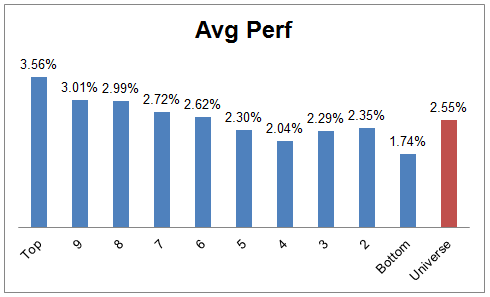
The table below shows the performance of a universe of mid and large cap U.S. equities, broken down by relative strength decile and then compared to the universe return. Those at the top of the ranks are those stocks which have the best intermediate-term relative strength. Relative strength strategies buy securities that have strong intermediate-term relative strength and hold them as long as they remain strong.

Last week’s performance (4/14/14 – 4/17/14) is as follows:

perf 04.21.14

Posted by:


Fund Flows

April 17, 2014

Mutual fund flow estimates are derived from data collected by The Investment Company Institute covering more than 95 percent of industry assets and are adjusted to represent industry totals.

ici 04.17.14

Posted by:


High RS Diffusion Index - In the “Green Zone”

April 16, 2014

Yes, it is true—momentum has had a bad month. While the S&P; 500 is only a couple percent off its all-time highs, momentum stocks have generally pulled back more. However, if you have been contemplating taking a position in a momentum strategy, this just may be the entry point you have been looking for.

The chart below measures the percentage of high relative strength stocks that are trading above their 50-day moving average (universe of U.S. mid and large cap stocks.) High relative strength stocks are defined as securities from the top quartile of our ranks. For the period Dec. 30, 1999 – Apr. 15, 2014:

(click to enlarge)

This high relative strength index has only spent 7% of its time below the 30 percent level, but on April 11, 2014 the index fell to 28%. Dips in this indicator have often provided good opportunities to add to relative strength strategies.

Furthermore, there has been no major trend deterioration in the PowerShares DWA Momentum ETF (PDP) as shown below.

(click to enlarge)

Source: Dorsey Wright & Associates

Find information about all 14 PowerShares DWA Momentum ETFs by clicking here.

A relative strength strategy is NOT a guarantee. There may be times where all investments and strategies are unfavorable and depreciate in value. Past performance is no guarantee of future returns. Potential for profits is accompanied by possibility of loss. Dorsey Wright & Associates is the index provider for the suite of Momentum ETFs with PowerShares. See www.powershares.com for more information.

Posted by:


Relative Strength Spread

April 15, 2014

The chart below is the spread between the relative strength leaders and relative strength laggards (universe of mid and large cap stocks). When the chart is rising, relative strength leaders are performing better than relative strength laggards. As of 4/14/2014:

Posted by:


Quote of the Week

April 11, 2014

Mark Abraham, of Abraham Trading:

While a fundamental analyst may be able to properly evaluate the economics underlying a stock, I do not believe they can predict how the masses will process this same information. Ultimately, it is the dollar-weighted collective opinion of all market participants that determines whether a stock goes up or down. This consensus is revealed by analyzing price.

HT: Michael Covel

Posted by:


Jamie Dimon on America

April 10, 2014

Jamie Dimon, CEO of JP Morgan Chase, in his annual shareholder letter expresses sentiments with which I wholeheartedly concur:

I have spoken about this in the past, and I don’t believe that it is blind optimism or patriotism. America today may be stronger than ever before. For example:

  • The United States has the world’s strongest military, and this will be the case for decades. We also are fortunate to be at peace with our neighbors and to have the protection of two great oceans.
  • The United States has among the world’s best universities and hospitals.
  • The United States has a reliable rule of law and low corruption.
  • The people of the United States have a great work ethic and “can do” attitude.
  • Americans are among the most entrepreneurial and innovative people in the world — from those who work on the factory floors to geniuses like Steve Jobs. Improving “things” and increasing productivity are American pastimes. And America still fosters an entrepreneurial culture where risk taking is allowed — accepting that it can result in success or failure.
  • The United States is home to many of the best businesses on the planet — from small and middle-sized companies to large, global multinationals.
  • The United States also has the widest, deepest, most transparent and best financial markets in the world. And I’m not talking just about Wall Street and banks — I include the whole mosaic: venture capital, private equity, asset managers, individual and corporate investors, and the public and private capital markets. Our financial markets have been an essential part of the great American business machine.

America’s future is not guaranteed, and,of course, America has its issues… But throughout history, we have shown great resiliency and a capacity to face our problems.

US flag

Posted by:


European Improvement

April 9, 2014

In light of European equities being among the best performing asset classes over the past year, consider what The Economist has to say about the economic improvement in that area:

A reassuring feature of the recovery is that it is spreading to the once-afflicted countries of southern Europe. Germany, which remains the main engine of growth in the euro zone, is likely to have expanded strongly in the first quarter of 2014, according to the Bundesbank. But the recovery is also being boosted by a return to growth, albeit sluggish, on the part of both Italy and Spain, the third- and fourth-biggest economies in the euro zone.

The peripheral economies are benefiting from falling long-term interest rates. Ten-year government-bond yields in Italy, Spain and Portugal are now lower than they were four years ago, shortly before the Greek crisis flared up and led to the first bail-out (see chart). Remarkably, yields in Ireland, which exited its rescue programme only last December, have fallen to their lowest since the euro started 15 years ago. Peripheral yields have been dragged down both by the fall in German yields and the narrowing of their spreads over German bonds since the height of the crisis. Although the spreads are still wider than before the crisis, their tightening reflects a broader reassessment of risk: investors no longer shun peripheral Europe on fears of a euro-zone break-up, whereas they fret about emerging markets.

asset class ranks 04.09.14

Source: Yahoo! Finance, Returns include dividends and interest payments, but do not include transaction costs

1PowerShares DB Gold, 2iShares MSCI Emerging Markets ETF, 3iShares DJ U.S. Real Estate Index, 4iShares S&P; Europe 350 Index, 5Green Haven Continuous Commodity Index, 6iBoxx High Yield Corporate Bond Fund, 7JP Morgan Emerging Markets Bond Fund, 8PowerShares DB US Dollar Index, 9iBoxx Investment Grade Corporate Bond Fund, 10PowerShares DB Oil, 11iShares Barclays 20+ Year Treasury Bond

Exposure to Europe in the PowerShares DWA Developed Markets Momentum ETF (PIZ) has increased over the last couple of years.

PIZ-exposure

Source: PowerShares

A relative strength strategy is NOT a guarantee. There may be times where all investments and strategies are unfavorable and depreciate in value. Past performance is no guarantee of future returns. Potential for profits is accompanied by possibility of loss. A list of all holdings for the trailing 12 months is available upon request. Dorsey Wright & Associates is the index provider for The PowerShares DWA Developed Markets Momentum ETF (PIZ). See www.powershares.com for more information.

Posted by:


The Wisdom of Crowds

April 9, 2014

NPR, reporting on “The Good Judgement Project” writes a fascinating story about the wisdom of crowds. Maybe there is something to this momentum factor after all!

For the past three years, Rich and 3,000 other average people have been quietly making probability estimates about everything from Venezuelan gas subsidies to North Korean politics as part of the Good Judgment Project, an experiment put together by three well-known psychologists and some people inside the intelligence community.

According to one report, the predictions made by the Good Judgment Project are often better even than intelligence analysts with access to classified information, and many of the people involved in the project have been astonished by its success at making accurate predictions…

…How can that be?

“Everyone has been surprised by these outcomes,” said Philip Tetlock, one of the three psychologists who came up with the idea for the Good Judgment Project. The other two are Barbara Mellers and Don Moore.

For most of his professional career, Tetlock studied the problems associated with expert decision making. His book Expert Political Judgment is considered a classic, and almost everyone in the business of thinking about judgment speaks of it with unqualified awe.

All of his studies brought Tetlock to at least two important conclusions.

First, if you want people to get better at making predictions, you need to keep score of how accurate their predictions turn out to be, so they have concrete feedback.

But also, if you take a large crowd of different people with access to different information and pool their predictions, you will be in much better shape than if you rely on a single very smart person, or even a small group of very smart people.

“The wisdom of crowds is a very important part of this project, and it’s an important driver of accuracy,” Tetlock said.

The wisdom of crowds is a concept first discovered by the British statistician Francis Galton in 1906.

Galton was at a fair where about 800 people had tried to guess the weight of a dead ox in a competition. After the prize was awarded, Galton collected all the guesses so he could figure out how far off the mark the average guess was.

It turned out that most of the guesses were really bad — way too high or way too low. But when Galton averaged them together, he was shocked:

The dead ox weighed 1,198 pounds. The crowd’s average: 1,197.

My emphasis added. As pointed out by Philip Tetlock, “everyone has been surprised by these outcomes.” Just like everyone (or many) are surprised by the results of momentum investing. Yet, momentum works for for the very same reasons that “The Good Judgement Project” is apparently succeeding—the wisdom of the crowds. It requires a certain amount of humility to turn investment decision-making over to the wisdom of the crowds and humility is not an attribute in great supply on Wall Street. The vast majority of investment managers in this industry spend large portions of their time convincing others (and themselves) that they are right and “the market” is wrong, but that the market will eventually come around to their way of thinking. Momentum takes a different approach. If a given security, or group of securities, are relatively stronger than their peers momentum investors follow those trends—often times without a clear understanding of the fundamental reasons for the superior momentum characteristics. If the market changes, momentum investors change and reorient their portfolios to adapt to the new leadership. Momentum investors focus on the process of keeping their portfolios in-tune with market trends rather than praying that the market will eventually prove that any one “expert” opinion will prove correct.

Posted by:


Power 4 Model Holdings

April 9, 2014

Current holdings of the DWA PowerShares Sector 4 Model are shown below:

power 4

Click here for model details.

The information contained herein has been prepared without regard to any particular investor’s investment objectives, financial situation, and needs. Accordingly, investors should not act on any recommendation (express or implied) or information in this material without obtaining specific advice from their financial advisors and should not rely on information herein as the primary basis for their investment decisions. Any statements nonfactual in nature constitute only current opinions, which are subject to change without notice. Neither the information nor any opinion expressed shall constitute an offer to sell or a solicitation or an offer to buy any securities, commodities or exchange traded products. This document does not purport to be complete description of the securities or commodities, markets or developments to which reference is made.

The PowerShares DWA Sector Portfolios are calculated by NYSE Euronext or its affiliates (NYSE Euronext). The PowerShares DWA Sector Momentum ETFs, which are based on Dorsey Wright indexes, are not issued, endorsed, sold, or promoted by NYSE Euronext, and NYSE Euronext makes no representation regarding the advisability of investing in such product.

NYSE EURONEXT MAKES NO EXPRESS OR IMPLIED WARRANTIES, AND HEREBY EXPRESSLY DISCLAIMS ALL WARRANTIES OF MERCHANTABILITY OR FITNESS FOR A PARTICULAR PURPOSE WITH RESPECT TO THE DORSEY WRIGHT INDEXES OR ANY DATA INCLUDED THEREIN. IN NO EVENT SHALL NYSE EURONEXT HAVE ANY LIABILITY FOR ANY SPECIAL, PUNITIVE, INDIRECT, OR CONSEQUENTIAL DAMAGES (INCLUDING LOST PROFITS), EVEN IF NOTIFIED OF THE POSSIBILITY OF SUCH DAMAGES.

Posted by:


High RS Diffusion Index

April 9, 2014

The chart below measures the percentage of high relative strength stocks that are trading above their 50-day moving average (universe of mid and large cap stocks.) As of 4/8/14.

diffusion 04.09.14

The 10-day moving average of this indicator is 66% and the one-day reading is 47%. Dips in this indicator have often provided good opportunities to add money to relative strength strategies.

Posted by:


March Arrow DWA Funds Review

April 8, 2014

3/31/14

The Arrow DWA Balanced Fund (DWAFX)

At the end of March, the fund had approximately 45% in U.S. Equities, 25% in Fixed Income, 18% in International Equities, and 12% in Alternatives.

We had a number of changes to this fund over the last month. In our Style sleeve, we replaced Mid-Cap Value and Small-Cap Value with Large-Cap Growth and Small-Cap Growth. In our Sector sleeve, we sold Financials and bought Technology. Finally, in our International sleeve, we sold Japan and bought Spain. From an overall asset allocation perspective, we slightly reduced our U.S. equity exposure and increased our International equity exposure. Much of the U.S. equity leadership in the first two months of the year pulled back in March. For example, positions like Healthcare and Small-Cap Growth which were among the leaders in January and February were among the laggards in March. However, International equity leadership was more stable in March.

DWAFX lost 1.01% in March, but is up 0.55% YTD through 3/31/14.

We believe that a real strength of this strategy is its balance between remaining diversified, while also adapting to market leadership. When an asset class is weak its exposure will tend to be towards the lower end of the exposure constraints, and when an asset class is strong its exposure in the fund will trend toward the upper end of its exposure constraints. Relative strength provides an effective means of determining the appropriate weights of the strategy.

dwafx 04.08.14

The Arrow DWA Tactical Fund (DWTFX)

At the end of March, the fund had approximately 90% in U.S. equities and 9% in International equities.

There were no changes in holdings to this fund in March. Leadership generally took a breather and underperformed in March, yet longer-term relative strength continues to favor U.S. equities. One area to keep an eye on is Commodities. This asset class has been a laggard for the last couple of years, but is showing some strong signs of life. A number of commodity ETFs are rising in our relative strength ranks, and if that continues, may find their way to into the fund.

DWTFX lost 0.57% in March, but is up 1.16% YTD through 3/31/14. This fund has outperformed 97% of its peers in the Morningstar Tactical Allocation category over the past year.

This strategy is a go-anywhere strategy with very few constraints in terms of exposure to different asset classes. The strategy can invest in domestic equities, international equities, inverse equities, currencies, commodities, real estate, and fixed income. Market history clearly shows that asset classes go through secular bull and bear markets and we believe this strategy is ideally designed to capitalize on those trends. Additionally, we believe that this strategy can provide important risk diversification for a client’s overall portfolio.

DWTFX 04.08.14

A list of all holdings for the trailing 12 months is available upon request. Past performance is no guarantee of future returns. See www.arrowfunds.com for a prospectus.

Posted by:


401k Spotlight: Q&A with Pat Church

April 8, 2014

Patrick Church, of Church Capital, was kind enough to share his insights into serving the 401k market with the following Q&A.;

Q (AH): Please give an overview of your background in the industry.

A (PC): I started out in the finance industry in 1983 right after college selling life insurance for Northwestern Mutual Life. Shortly after joining NML, they bought a regional broker dealer named Robert W. Baird and added the ability for insurance people to sell investments. Myself and another individual in the insurance agency gravitated toward the investment side of the business and I sold my first retirement plan around 1985. I continued with the big agency philosophy at that time of being the overall financial planner who could help with “all of your needs” from insurance to investments. I found this to not be very satisfying in not developing any area of expertise. In 1998 I decided to make the 100% focus to act only as an investment advisor and joined a mid- sized independent broker. The timing of that was a little rough with 2000-2001 just around the corner. That tough period made me realize I needed to develop an approach to the business I could rely on in good times and bad. I was at a conference where Tom Dorsey spoke. I took his book back to my hotel room and read it over the weekend and have been a proponent of DWA since. I focused with the DWA approach primarily with IRA rollers until 2008. It occurred to me around that time that people who roll money out of retirement plans receive pretty good advice but the solutions while in a retirement plan lack sophistication. I began looking at ways where I could bring in the DWA strategies to 401k plans in 2009. I happened to stumble upon a young ERISA attorney at the time, Jason Roberts, who has since become one of the industry’s more highly regarded ERISA consultants. He suggested to me that I act as an ERISA 3(38) fiduciary and create DWA investment models that 401k participants could choose as alternatives to mutual funds. I had some good success in bringing in plans utilizing the feature of adding “managed accounts”. As my managed accounts evolved over the past several years, I began to add ETF’s as the source for model management. Last year I decided, based on the growing interest of ETF managed accounts, to register my models as Collective Investment Trusts and make them available to any 401k platform. Dorsey Wright acts as the sub-advisor to the two Collective Investment Trusts. My role now is simple in that I am responsible for marketing the funds to plans, advisors and third party administrators.

Q (AH): How well do you think 401ks are doing in preparing people for retirement?

A (PC): I think the 401k providers are adding better features all the time to help people track where they are and what they need to do to accumulate the right amount but there is still a pretty good void in the area of providing specific advice to participants. For example, the advice tends to be very generic when explaining stock/bond allocations. Most participants have under emphasized small cap exposure over the past 15 years due to conventional wisdom 401k advisor direction advocating “safer” large cap equities. Since 2008, there has also been significant poor allocations with the international exposure to emerging markets while developed (European) stocks have been in a long, good performing cycle. We can do a better job with specific advice.

Q (AH): Describe the reasons that you chose to focus on serving the 401k market.

A (PC): I see an area of opportunity for myself and other advisors with 401k plans to begin implementing the same kind of evolved managed accounts that people are receiving on an individual basis. My discussions with plan sponsors and advisors to provide better asset allocation solutions than products like target date funds are an area of high interest. When I look at my 401k plan data base of 5500’s, there are plenty of quality funds on menus but the actual performance of participants is disconnected from fund performance. The reason is that people do not have the expertise to re-allocate in sync with market cycles. Something like 80% of participants never log on to their accounts.

Q (AH): Why did you choose to incorporate Dorsey Wright’s relative strength strategy in your Collective Investment Trusts for 401k plans?

A (PC): I believe the strategy is very much in sync with what 401k participants want, which is a long term reliable process of managing the investment markets.

Q (AH): What should other financial advisors know about how they can get involved in serving the 401k market?

A (PC): I think the first thing an advisor should know is that the industry is moving to a fee based structure. If you are not already converting your business to fee based, it would be prudent to do so. The key is to make everything transparent and simple for the plan sponsor. I think there is an interesting opportunity to talk to new plans about an area they have not likely been exposed to yet and that is ETF Managed Accounts. We have put together a careful well thought out asset allocation strategy with the Dorsey Wright ETF Global Growth and Dorsey Wright ETF Global Balanced funds. We are an option for investors looking to replace a series of target date funds. I think the last thing to mention is that there is a well established history of how an advisor serves a 401k plan to show value and one of the main functions has been to monitor the mutual funds. Statistics are starting to surface that show the funds that are replaced by advisors don’t necessarily provide value to participants. I think an advisor who approaches a plan sponsor today might use a different tactic of setting up the plan with low cost index funds with some managed account options and focus on getting specific advice to participants.

To learn more about Church Capital, please click here or call Pat at 253-797-0218.

Pat Church

Patrick Church

The opinions expressed herein are that of Patrick Church and Church Capital LLC and do not necessarily represent that of Dorsey, Wright & Associates, LLC.

Nothing contained herein should be construed as an offer to sell or the solicitation of an offer to buy any se­curity. This report does not attempt to examine all the facts and circumstances which may be relevant to any company, industry or security mentioned herein. We are not soliciting any action based on this document. This document does not constitute a personal recommendation or take into account the particular investment objectives, financial situations, or needs of individual clients. Before acting on any analysis, advice or recommendation in this document, clients should consider whether the security or strategy in question is suitable for their particular circumstances and, if neces­sary, seek professional advice. The relative strength strategy is NOT a guarantee. There may be times where all investments and strategies are unfavorable and depreciate in value. Relative Strength is a measure of price momentum based on historical price activity. Relative Strength is not predictive and there is no assurance that forecasts based on relative strength can be relied upon.

Posted by:


Relative Strength Spread

April 8, 2014

The chart below is the spread between the relative strength leaders and relative strength laggards (universe of mid and large cap stocks). When the chart is rising, relative strength leaders are performing better than relative strength laggards. As of 4/7/2014:

RS Spread 04.08.14

Posted by:


What to Make of Valuations

April 2, 2014

Jeffrey Kleintop of LPL Financial has an interesting rebuttal to the argument that the market is overvalued:

At any given time, there are always some bubbly valuations among industries and stocks that are hot. But overall, the S&P; 500 PE is currently a bit over 16 on current fiscal year estimates, slightly above the long-term average, but only half of what it was in late March 2000. Looking at valuations, compared to 14 years ago, the party in the stock market may not be just getting started — but it is not yet close to being over.

champagne-22

The whole article is worth the read.

Here is what John Lewis, our Senior Portfolio Manager, had to say about valuations in our quarterly letter to clients:

A lot of the volatility and rotation we have seen this year can be attributed to this current bull market turning 5 years old. The stock market has had tremendous gains since the bear market lows in 2009, and that has finally led to serious talk about stretched equity valuations. Some of the good momentum areas like solar stocks and biotechnology certainly fall into this theme, and were sold off during the last couple of weeks of the quarter as these concerns came to the forefront. These concerns surface as any bull market matures, and the truly strong stocks often perform very well long after the serious valuation discussions begin. As valuations become stretched, markets tend to focus more on growth opportunities. That is a positive for our strategies. Relative strength is very good at picking out high growth stocks. Yes, the overall market or certain pockets of the market may be pricey, but that doesn’t mean there aren’t well managed companies capitalizing on current trends that will continue to perform. That is often a great environment for our strategies.

The debate about valuation will rage on, but for momentum investors, having slightly stretched valuations may just be the environment where we can really shine.

Posted by:


Power 4 Holdings

April 2, 2014

Current holdings of the DWA PowerShares Sector 4 Model are shown below:

power4

(Click to enlarge)

Click here for model details.

The information contained herein has been prepared without regard to any particular investor’s investment objectives, financial situation, and needs. Accordingly, investors should not act on any recommendation (express or implied) or information in this material without obtaining specific advice from their financial advisors and should not rely on information herein as the primary basis for their investment decisions. Any statements nonfactual in nature constitute only current opinions, which are subject to change without notice. Neither the information nor any opinion expressed shall constitute an offer to sell or a solicitation or an offer to buy any securities, commodities or exchange traded products. This document does not purport to be complete description of the securities or commodities, markets or developments to which reference is made.

The PowerShares DWA Sector Portfolios are calculated by NYSE Euronext or its affiliates (NYSE Euronext). The PowerShares DWA Sector Momentum ETFs, which are based on Dorsey Wright indexes, are not issued, endorsed, sold, or promoted by NYSE Euronext, and NYSE Euronext makes no representation regarding the advisability of investing in such product.

NYSE EURONEXT MAKES NO EXPRESS OR IMPLIED WARRANTIES, AND HEREBY EXPRESSLY DISCLAIMS ALL WARRANTIES OF MERCHANTABILITY OR FITNESS FOR A PARTICULAR PURPOSE WITH RESPECT TO THE DORSEY WRIGHT INDEXES OR ANY DATA INCLUDED THEREIN. IN NO EVENT SHALL NYSE EURONEXT HAVE ANY LIABILITY FOR ANY SPECIAL, PUNITIVE, INDIRECT, OR CONSEQUENTIAL DAMAGES (INCLUDING LOST PROFITS), EVEN IF NOTIFIED OF THE POSSIBILITY OF SUCH DAMAGES.

Posted by:


More Noise, Less Signal

April 1, 2014

What are exactly the wrong things to do as an investor? Barry Ritholtz provides his top 10 ways to “get more noise, and less signal.” Enjoy!

1. Mainstream media is an excellent source of actionable trading & investing ideas. Especially financial television (FinTV). You should uncritically consume even more of it.

2. Data is overrated. Go with anecdotes from people you know personally and your gut instincts;

3. Pundits and TV guests are there to help you reach a comfortable retirement. They have no other agendas.

4. The most important information about the stock market — especially about when to buy or sell — is known only to handful of insiders. Envy them (and blame your losses on not being in that circle).

5. You need to exert lots of energy, spend lots of time, and create lots of stress about the following: The Federal Reserve, the Dollar, Congress, Inflation, Sovereign Bank Debt in Europe, Peak Oil, China, Deflation, Austerity in the UK, and the Hindenburg Omen.

6. Don’t worry if you are not good at math or science; Empiricism and probability analysis are vastly overrated (they are for geeks anyway); WTF is mean reversion?

7. Focus on the news sources that are in sync with your own political views and opinions and investment postures. Do not read anything that challenges your pre-existing beliefs. Besides, analysts and websites and fund managers that have been wrong for years are due for a winner!

8. Short term trading is where its at! Don’t worry about the long term — its way off in the future. Measure your success in minutes and hours, not years and decades.

9. There is no reason that you cannot also have a good time with your retirement account; That’s what its there for anyway.

10. Never listen to those who people with good long temr track records who have had a losing trade or a bad quarter. Its all about recent performance!

Posted by:


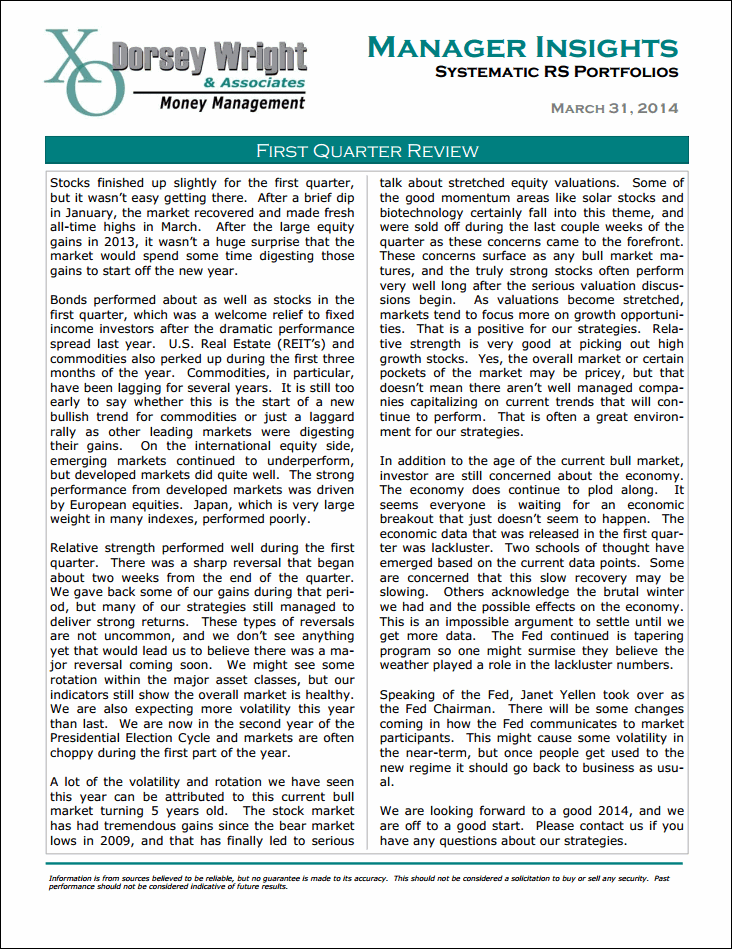
Q1 Manager Insights

April 1, 2014

Click here for our review of the first quarter and for our market outlook.

mgr insights

Relative strength strategy is NOT a guarantee. There may be times where all investments and strategies are unfavorable and depreciate in value. Relative Strength is a measure of price momentum based on historical price activity. Relative Strength is not predictive and there is no assurance that forecasts based on relative strength can be relied upon.

Posted by: