May Arrow DWA Funds Review

June 15, 2014

5/31/2014

The Arrow DWA Balanced Fund (DWAFX)

At the end of May, the fund had approximately 39% in U.S. equities, 26% in Fixed Income, 24% in International equities, and 11% in Alternatives.

We generally has positive returns in each of the different sleeves (U.S. equities, Fixed Income, International equities, and Alternatives) of the fund in May—something not always seen in a diversified balanced fund like DWAFX. We had a number of trades in May: sold Large-Cap Growth, Small-Cap Growth, and Consumer Cyclicals and bought Mid-Cap Value, Small-Cap Value, and Basic Materials. We also slightly reduced our U.S. Equity exposure and increased our Int’l Equity Exposure. While there were relatively few trades in the fund in 2013, this year has brought a number of changes.

DWAFX gained 1.23% in May, and is up 1.57% YTD through 5/31/14.

We believe that a real strength of this strategy is its balance between remaining diversified, while also adapting to market leadership. When an asset class is weak its exposure will tend to be towards the lower end of the exposure constraints, and when an asset class is strong its exposure in the fund will trend toward the upper end of its exposure constraints. Relative strength provides an effective means of determining the appropriate weights of the strategy.

dwafx

The Arrow DWA Tactical Fund (DWTFX)

At the end of May, the fund had approximately 70% in U.S. equities, 19% in International equities, and 10% in Commodities.

Our U.S. equity exposure was reduced from 90% to 70% in May and we added another position to European equities and a position to Commodities. U.S. equities continue to be the dominant asset class from a relative strength perspective, but we have seen better performance from other asset classes as well this year. Relative strength in general had a strong month in May after pulling back in March and part of April.

DWTFX gained 0.87% in May, and is up 1.07% YTD through 5/31/14.

This strategy is a go-anywhere strategy with very few constraints in terms of exposure to different asset classes. The strategy can invest in domestic equities, international equities, inverse equities, currencies, commodities, real estate, and fixed income. Market history clearly shows that asset classes go through secular bull and bear markets and we believe this strategy is ideally designed to capitalize on those trends. Additionally, we believe that this strategy can provide important risk diversification for a client’s overall portfolio.

dwtfx

A list of all holdings for the trailing 12 months is available upon request. Past performance is no guarantee of future returns. These relative strength strategies are NOT a guarantee. There may be times where all investments and strategies are unfavorable and depreciate in value. See www.arrowfunds.com for a prospectus.

Posted by:


Weekly RS Recap

June 15, 2014

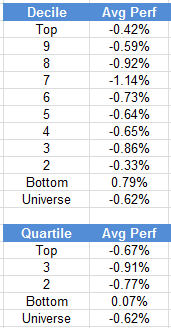
The table below shows the performance of a universe of mid and large cap U.S. equities, broken down by relative strength decile and quartile and then compared to the universe return. Those at the top of the ranks are those stocks which have the best intermediate-term relative strength. Relative strength strategies buy securities that have strong intermediate-term relative strength and hold them as long as they remain strong.

Last week’s performance (6/9/14 – 6/13/14) is as follows:

ranks 06.15.14

This example is presented for illustrative purposes only and does not represent a past recommendation. The performance above is based on pure price returns, not inclusive of dividends or all transaction costs. Past performance is not indicative of future results. Potential for profits is accompanied by possibility of loss.

Posted by:


PnF Relative Strength Signals White Paper

June 15, 2014

Earlier this week we released a whitepaper on Point and Figure Relative Strength signals. If you haven’t had a chance to read the paper you can access a copy of it here. The current paper covers the basics of how different Point and Figure Relative Strength patterns perform over time. In the coming months, we hope to release a few follow up papers that will look at some other aspects of a momentum strategy.

Relative Strength (also known as momentum) has been an incredibly robust factor for quite some time. Technicians have used momentum as a primary tool for over 100 years, but it has been in the last 20 years or so that research into the factor has really taken off. In 1993, “Returns to Buying Winners and Selling Losers” was published and the exploration of the momentum factor really began by the academics. There are hundreds of papers in the public domain that have found the momentum factor works across asset classes and within asset classes. As long as there is some volatility and some dispersion in the universe you can generally make a relative strength strategy work over time.

Most of the current research centers around time-based calculations of momentum. For example, you sort securities by their trailing 12 month price return and then put the top decile into the portfolio. Point and Figure, on the other hand, ignores time and really looks at volatility. The more volatile something is versus its benchmark the more columns you will have moving across the page. What all of these methods have in common is ranking on an intermediate term time horizon. If you use too short of a time window or too small of a point and figure box size you wind up trading on the noise rather than the trend. If you use too long of a window or too large of a box size you get into an area where mean reversion rather than trend continuation is the rule.

Every momentum study I have seen comes to the same conclusions. Buying the stuff with the best momentum works very well over time. You can short the stocks with weak momentum, but that presents two big problems. First, not everyone can sell positions short. And second, the laggard rallies off of bear market bottoms are a killer on the short side. You can see that in the performance table in the whitepaper in 2003 and 2009. The laggards tend to do very well off the bottom and the leaders tend to underperform. But otherwise, momentum is a very robust and consistent factor.

So why does momentum work, and why does it get such a bad rap in the press? I think the latter is easy to explain. Everyone understands the concept of getting something at a discount. If I want a roll of paper towels why would I buy one for $1.00 when I could get the same roll on sale for $0.50? Everyone can identify with that, and deals with those decisions on a daily basis. But not all stocks are the same! Buying IBM is not similar to buying AAPL. Each stock has its own identity. It is similar to betting on the NBA Finals right now. After the Spurs embarrassed the Heat the last two games who would you bet on to win the finals? Probably the Spurs because they have now demonstrated the ability to outperform the Heat. A good momentum stock does the same thing. It demonstrates the ability to outperform. Why not buy something that is doing well rather than betting on the Heat and hoping Mario Chalmers remembers how to shoot and Ray Lewis sends Dwayne Wade some deer antler spray for his creaky knee? Vegas figured this out a long time ago! If they didn’t set odds on the series everyone would bet on the Spurs right now because they have a high probability of winning. They aren’t a sure thing to win, but the odds are definitely in their favor. They have to entice people to bet on the Heat to try to even the money on both sides of the bet. The Heat can certainly still win, but it is going to take a major change in what we have seen so far in the series. When you are buying stocks there are no odds! The stocks on a buy signal and in a column of x’s have a high probability of outperforming over time. Why not just buy those rather than bottom fishing? You don’t get 2:1 odds if you buy the beaten down stock. You don’t get worse odds if you buy the winner. It’s all even odds. It is a great gift just sitting there waiting to be opened. Merry Christmas.

The conclusion we hope everyone eventually reaches is simple: disciplined implementation of the strategy is the ultimate key to success. Step back and think about what is the the BX group, for example. There are stocks with good fundamentals, bad fundamentals, some on pullbacks, and some on spikes. I’m sure that BX group contained tons of stocks that were bought right at the top and then sold very shortly after they were purchased. There were stocks that pulled back, fell out of the top group, and then turned around and shot to new highs. It is important to realize that all those potential problems didn’t matter in the long run. Somehow that best group kept right on chugging. The real issue is the opportunity cost of not constantly packing the portfolio in to the best momentum names. Hoping a stock turns around because you just bought it and your clients might be upset, not buying a strong relative strength name because it is on a spike, and not re-buying a strong stock after you had to sell it are not included in the BX group equity curve. The opportunity cost of leaving things that aren’t strong in the portfolio is what kills performance over time. Weak stocks are for value buyers. If you are going to buy high relative strength stocks you have to keep strong names in the portfolio.

Posted by:


Hoarding Cash

June 15, 2014

I would never argue against holding some cash (say 6-9 months worth of non-discretionary expenses), but holding this much??

According to new research on investors in 16 countries by State Street’s Center for Applied Research, retail investors globally were holding an average of 40 percent of their assets in cash, up from 31 percent two years ago. That’s a compounded annual growth rate of a whopping 13 percent.

The lowest levels of cash holdings were in India, at 26 percent, and China, at 30 percent; the highest was 57 percent in Japan. The United States was in the middle at 36 percent, but that was an increase of 10 percentage points in just two years. The survey, done by State Street, one of the world’s largest asset managers and custodians, was conducted in the first quarter of this year. It considered cash to be money held in savings and checking accounts as well as cash equivalents like money market funds.

Despite the run-up in equity markets, people have resisted rushing into stocks and have instead added to cash. They’ve done this regardless of their age or amount of wealth. The study found that millennials who are under 33 and have the longest time to invest their money were increasing their cash positions at the same rate as baby boomers, who will need to draw on their investments soon.

So, the amount of cash being held has gone up over the past two years even though there has been a rising market…doesn’t really support the position of some that we’re starting to see risk-taking come back in a major way. It also doesn’t strike me as the type of behavior you might see at a major market top.

Posted by: