Pre-commitment to a rational investment plan is important, because the intuitive impulse to act otherwise is strong. —Shlomo Benartzi
Understated quote by Shlomo Benartzi, but essential for investment success.
Pre-commitment to a rational investment plan is important, because the intuitive impulse to act otherwise is strong. —Shlomo Benartzi
Understated quote by Shlomo Benartzi, but essential for investment success.
 Leave a Comment » |
  Investor Behavior |
  Permalink

Posted by: Andy Hyer
A key excerpt from Andrew Ang’s book Asset Management: A Systematic Approach to Factor Investing:
Investors must use past data to estimate inputs for optimization problems. But many investors simply take historical averages on short, rolling samples. This is the worst thing you can do.
In drawing all of the mean-variance frontiers for the G5, or various subsets of countries, I used historical data. I plead guilty. I did, however, use a fairly long sample, from January 1970 to December 2011. Nevertheless, even this approximately forty-year sample is relatively short. You should view the figures in this chapter as what has transpired over the last forty years and not as pictures of what will happen in the future. As the investment companies like to say in small print, past performance is no guarantee of future returns. The inputs required for mean-variance investing—expected returns, volatilities, and correlations—are statements about what we think will happen in the future.
Using short data samples to produce estimates for mean-variance inputs is very dangerous. It leads to pro-cyclicality. When past returns have been high, current prices are high. But current prices are high because future returns tend to be low. Thus, using a past data sample to estimate a mean produces a high estimate right when future returns are likely to be low. These problems are compounded when more recent data are weighted more heavily, which occurs in techniques like exponential smoothing.
Mean-variance optimization (a darling of financial theory) works just fine when you can accurately predict returns, volatilities, and correlations. But, if you can’t (or should I say when you can’t), mean-variance optimization is useless. As Ang points out, simply taking historical averages “is the worst thing you can do.” Alas, coming up with the optimal asset allocation that will allow us to create wonderful returns with a small amount of volatility is comforting to wish for, but real life is much messier than the theory.
Trend following may, admittedly, be somewhat simple (although as John can attest, the computer programming required isn’t for simpletons). But, the only question that ultimately matters is does it work. Click here and here for some material to help answer that question.
Past performance is no guarantee of future returns. A relative strength strategy is NOT a guarantee. There may be times where all investments and strategies are unfavorable and depreciate in value.
4 Comments | Portfolio Theory | Permalink
Posted by: Andy Hyer
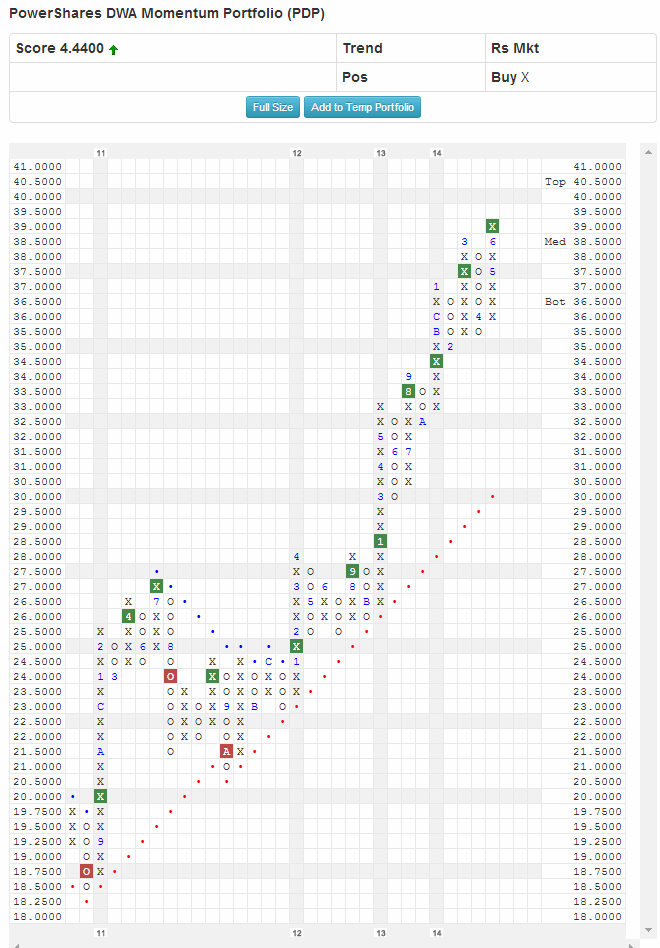
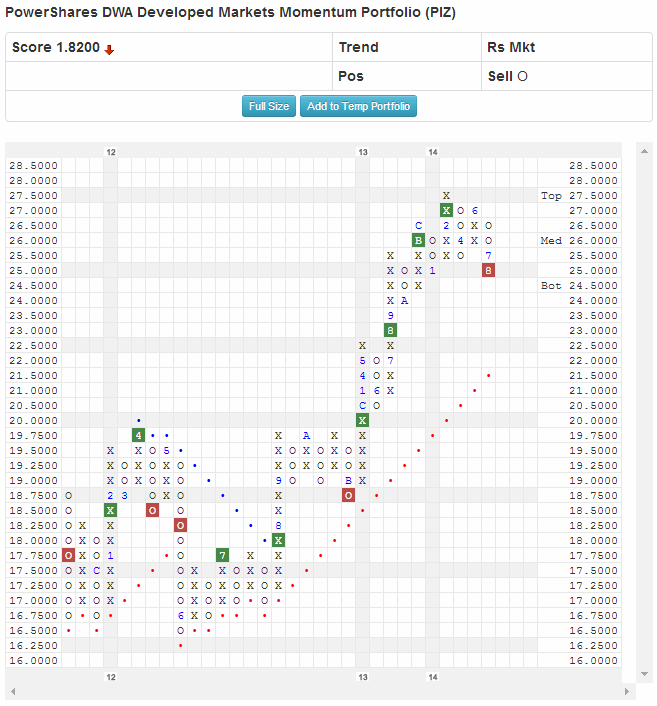
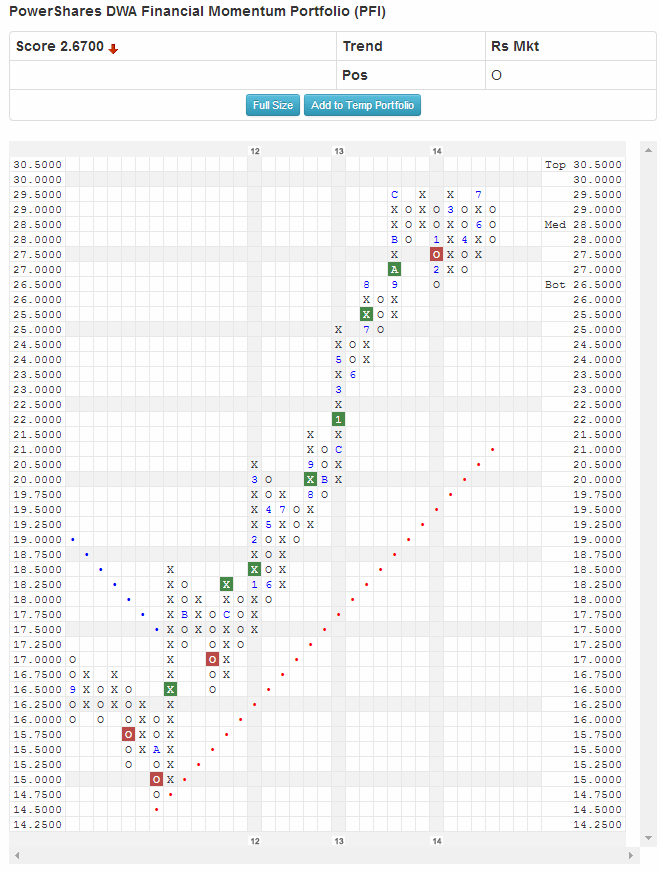
Shown below are Point & Figure charts of the 16 ETFs for which Dorsey Wright & Associates is the index provider (as of 8/13/14):






The information found on Dorsey, Wright & Associates’ Web Pages has been prepared without regard to any particular investor’s investment objectives, financial situation, and needs. Accordingly, investors should not act on any recommendation (express or implied) or information in this report without obtaining specific advice from their financial advisors and should not rely on information herein as the primary basis for their investment decisions. Information contained herein is based on data obtained from recognized statistical services, issuer reports or communications, or other sources, believed to be reliable. However, such information has not been verified by Dorsey, Wright and Associates, LLC (DWA) or the information provider and DWA and the information providers make no representations or warranties or take any responsibility as to the accuracy or completeness of any recommendation or information contained herein.
Neither the information nor any opinion expressed shall constitute an offer to sell or a solicitation or an offer to buy any securities or commodities mentioned herein. This report or chart does not purport to be a complete description of the securities or commodities, market or developments to which reference is made. There may be instances when fundamental, technical, and quantitative opinions may not be in concert.
Each investor should carefully consider the investment objectives, risks and expenses of any Exchange-Traded Fund (“ETF”) prior to investing. Before investing in an ETF investors should obtain and carefully read the relevant prospectus and documents the issuer has filed with the SEC. To obtain more complete information about the product the documents are publicly available for free via EDGAR on the SEC website (http://www.sec.gov).
PDP: Prior to the fund inception date (3/1/07), chart is created using extrapolated index data.
DWAS: Prior to the fund inception date (7/19/2012), the chart is created from extrapolated index data.
DWAQ: Prior to fund inception date (4/30/03), chart is created using extrapolated index data (DYO), and the fund tracked this index through 2/18/14. Effective 2/19/14, the fund changed the index that it tracks to DWA NASDAQ Technical Leaders Index (TLNASDAQ)
PIZ: Prior to the fund inception date (12/28/2007), chart is created using extrapolated index data.Prior to the fund inception date (12/28/2007), chart is created using extrapolated index data.
PEZ: Prior to fund inception date (10/12/06), chart is created using extrapolated index data (EZZK), and the fund tracked this index through 2/18/14. Effective 2/19/14, the fund changed the index that it tracks to DWA Consumer Cyclicals Technical Leaders Index (TLCONCYC)
PFI: Prior to fund inception date (10/12/06), chart is created using extrapolated index data (EZFK), and the fund tracked this index through 2/18/14. Effective 2/19/14, the fund changed the index that it tracks to DWA Financial Technical Leaders Index (TLFINANCE)
PRN: Prior to fund inception date (10/12/06), chart is created using extrapolated index data (EZLK), and the fund tracked this index through 2/18/14. Effective 2/19/14, the fund changed the index that it tracks to DWA Industrials Technical Leaders Index (TLINDUST)
PSL: Prior to fund inception date (10/12/06), chart is created using extrapolated index data (EZSK), and the fund tracked this index through 2/18/14. Effective 2/19/14, the fund changed the index that it tracks to DWA Consumer Staples Technical Leaders Index (TLCONSTA)
PTF: Prior to the fund inception date (10/12/2006), chart is created using extrapolated index data. and the fund tracked this index through 2/18/14. Effective 2/19/14, the fund changed the index that it tracks to DWA Technology Technical Leaders Index (TLTECH)
PTH: Prior to fund inception date (10/12/06), chart is created using extrapolated index data (EZXK), and the fund tracked this index through 2/18/14. Effective 2/19/14, the fund changed the index that it tracks to DWA Healthcare Technical Leaders Index (TLHEALTH)
PUI: Prior to fund inception date (10/25/05), chart is created using extrapolated index data (DWU), and the fund tracked this index through 2/18/14. Effective 2/19/14, the fund changed the index that it tracks to DWA Utilities Technical Leaders Index (TLUTIL)
PXI: Prior to fund inception date (10/12/06), chart is created using extrapolated index data (EZKK), and the fund tracked this index through 2/18/14. Effective 2/19/14, the fund changed the index that it tracks to DWA Energy Technical Leaders Index (TLENERGY)
PYZ: Prior to fund inception date (10/12/06), chart is created using extrapolated index data (EZBK), and the fund tracked this index through 2/18/14. Effective 2/19/14, the fund changed the index that it tracks to DWA Basic Materials Technical Leaders Index (TLBASMAT)
FV: Prior to the fund inception date (3/6/2014), chart is created using extrapolated index data (FTRUST5)
IFV: Prior to the fund inception date (7/23/2014), chart is created using extrapolated index data.
Leave a Comment » | Momentum | Permalink
Posted by: Andy Hyer
You are currently browsing the Systematic Relative Strength blog archives for the day Wednesday, August 13th, 2014.







