Piper Jaffray Sr. Technical Analyst, Craig Johnson, compares today’s markets to the 1950′s in their recent Informed Investor report:
History Does Not Always Repeat, but It Does Seem to Rhyme with the Early 1950′s
As market technicians we often use history as a guide to understanding current market environments. Two years-ago when we wrote our “SPX 2000 - The Next Great Equity Rally” report we drew comparisons with the latter stages of the 1970′s bear market and start of a new secular bull market (at that point unconfirmed as the SPX was still below its ’00 and ’07 highs). However, while the comparison with the late 1970′s was good, we now believe a better comparison is with the early 1950′s. First, in both periods, the U.S. economy was just starting to emerge from an extended period of weakness. As you can see in the chart below, the broader market has been in a secular consolidation range for more than 10 years. Second, similarly to the bear market in the 1940′s, the bear market that began in 2000 had two well-defined peaks before breaking out to new highs. Third, interest rates in the U.S. in the 1940-1950 period were near historic lows (similar to today). Thus, based on history, we believe the broader market has now entered the early stages of a secular bull market that we believe still has a lot of room to run. In prior secular bull markets, investors made five times their money from 1952 through the mid-1960′s and fifteen times their money from 1982 through 1999.
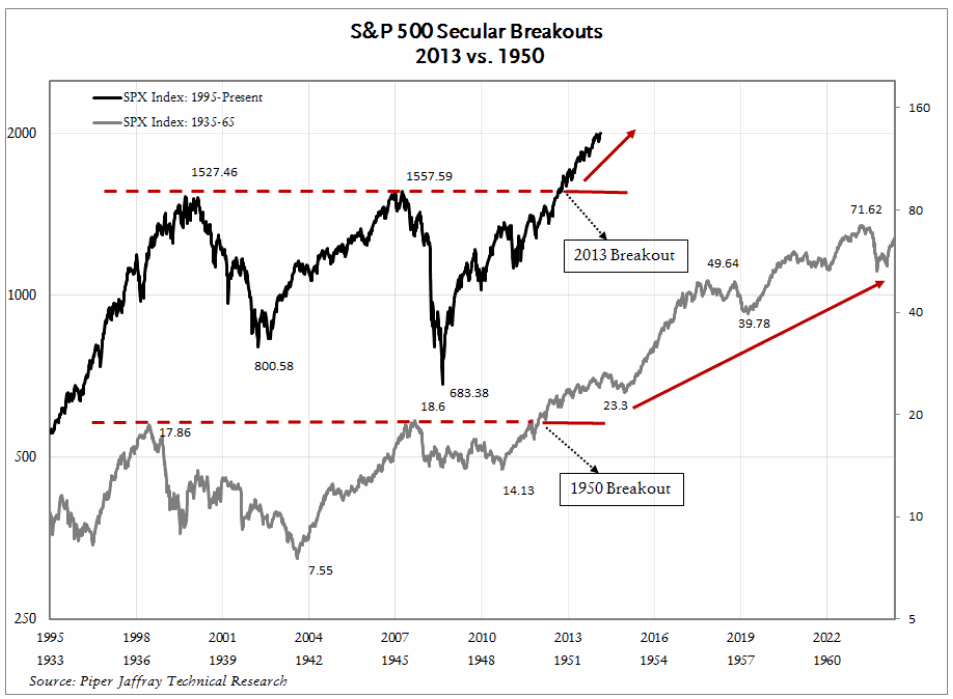
While there is no need to commit to a static allocation that counts on the parallel to the 1950′s continuing and resulting in another decade+ of strong equity returns, I do think the comparison is plausible. At a minimum, investors should invest in strategies that give them the opportunity to participate in secular bull markets. After all, part of risk management is managing (participating) on the upside. Frequent conversations with financial advisors confirm to me that there are many that remain focused on mitigating losses when “the other shoe drops.” The psychological damage inflicted on investors in the last two bear markets has left many seemingly unable to see anything but risk.
At Dorsey Wright, we are big proponents of employing strategies that can help mitigate the downside risk. However, there are ways to do that without locking the investor into consistently conservative strategies. Three ideas for strategies that seek to mitigate some of the downside risk (but also have the ability to “play offense”) are shown below:
- DWA PowerShares Sector 4 Model (has the ability to rotate into cash in poor equity markets)
- Global Macro SMA (available on the Masters and DMA platforms at Wells Fargo and several other platforms)
- Systematic RS Growth SMA (has the ability to raise up to 50 percent cash in bear markets)
As an example, although the Systematic RS Growth portfolio has the ability to get very defensive in bear markets, it can play strong offense and has actually outperformed the S&P 500 over the past 5 years.
For questions about any of these strategies, please contact Andy Hyer at 626-535-0630 or [email protected]
Nothing contained herein should be construed as an offer to sell or the solicitation of an offer to buy any security. This report does not attempt to examine all the facts and circumstances which may be relevant to any company, industry or security mentioned herein. We are not soliciting any action based on this document. It is for the general information of clients of Dorsey, Wright & Associates, LLC (“Dorsey, Wright & Associates”). This document does not constitute a personal recommendation or take into account the particular investment objectives, financial situations, or needs of individual clients. Before acting on any analysis, advice or recommendation in this document, clients should consider whether the security or strategy in question is suitable for their particular circumstances and, if necessary, seek professional advice.
The relative strength strategy is NOT a guarantee. There may be times where all investments and strategies are unfavorable and depreciate in value. Relative Strength is a measure of price momentum based on historical price activity. Relative Strength is not predictive and there is no assurance that forecasts based on relative strength can be relied upon.
Each investor should carefully consider the investment objectives, risks and expenses of any Exchange-Traded Fund (“ETF”) prior to investing. Before investing in an ETF investors should obtain and carefully read the relevant prospectus and documents the issuer has filed with the SEC. To obtain more complete information about the product the documents are publicly available for free via EDGAR on the SEC website (http://www.sec.gov).








