RS Chart of The Day

January 30, 2015

 photo SPYVSEEM_zpsbtaxigi1.jpg

Point and Figure RS Charts are calculated by dividing one security by another and plotting the ratio on a PnF chart. When the ratio is rising, it is plotted in a column of X’s and reflects the numerator outperforming the denominator. Likewise, when the relative strength ratio is declining, it is plotted in a column of O’s and reflects the outperformance of the denominator.

Past performance is not indicative of future results. Potential for profits is accompanied by possibility of loss. This example is presented for illustrative purposes only and does not represent a past recommendation. The relative strength strategy is NOT a guarantee. There may be times where all investments and strategies are unfavorable and depreciate in value. Nothing contained herein should be construed as an offer to sell or the solicitation of an offer to buy any security. This post does not attempt to examine all the facts and circumstances which may be relevant to any product or security mentioned herein. We are not soliciting any action based on this document. It is for the general information of clients of Dorsey, Wright & Associates, LLC (“Dorsey, Wright & Associates”). This document does not constitute a personal recommendation or take into account the particular investment objectives, financial situations, or needs of individual clients. Before acting on any analysis, advice or recommendation in this document, clients should consider whether the security or strategy in question is suitable for their particular circumstances and, if necessary, seek professional advice.

Posted by:


Sector Performance

January 30, 2015

The chart below shows performance of US sectors over the trailing 12, 6, and 1 month(s). Performance updated through 1/29/15.

sector 01.13.15

The performance above is based on pure price returns, not inclusive of dividends or all transaction costs. Past performance is not indicative of future results. Potential for profits is accompanied by possibility of loss. Source: iShares

Posted by:


RS Chart of The Day

January 29, 2015

 photo SPYVSGCC_zpswpxxzxqn.jpg

Point and Figure RS Charts are calculated by dividing one security by another and plotting the ratio on a PnF chart. When the ratio is rising, it is plotted in a column of X’s and reflects the numerator outperforming the denominator. Likewise, when the relative strength ratio is declining, it is plotted in a column of O’s and reflects the outperformance of the denominator.

Past performance is not indicative of future results. Potential for profits is accompanied by possibility of loss. This example is presented for illustrative purposes only and does not represent a past recommendation. The relative strength strategy is NOT a guarantee. There may be times where all investments and strategies are unfavorable and depreciate in value. Nothing contained herein should be construed as an offer to sell or the solicitation of an offer to buy any security. This post does not attempt to examine all the facts and circumstances which may be relevant to any product or security mentioned herein. We are not soliciting any action based on this document. It is for the general information of clients of Dorsey, Wright & Associates, LLC (“Dorsey, Wright & Associates”). This document does not constitute a personal recommendation or take into account the particular investment objectives, financial situations, or needs of individual clients. Before acting on any analysis, advice or recommendation in this document, clients should consider whether the security or strategy in question is suitable for their particular circumstances and, if necessary, seek professional advice.

Posted by:


High RS Diffusion Index

January 28, 2015

The chart below measures the percentage of high relative strength stocks that are trading above their 50-day moving average (universe of mid and large cap stocks.) As of 1/27/15.

diffusion 01.28.15

The 10-day moving average of this indicator is 74% and the one-day reading is 75%.

This example is presented for illustrative purposes only and does not represent a past recommendation. The performance above is based on pure price returns, not inclusive of dividends or all transaction costs. Investors cannot invest directly in an index. Indexes have no fees. Past performance is not indicative of future results. Potential for profits is accompanied by possibility of loss.

Posted by:


What’s Hot…And Not

January 27, 2015

How different investments have done over the past 12 months, 6 months, and month. As of 1/26/15:

asset class

Source: Yahoo! Finance. Performance listed is total returns.

1PowerShares DB Gold, 2MSCI Emerging Markets Index, 3DJ U.S. Real Estate Index,4S&P; Europe 350 Index,5Green Haven Continuous Commodity Index, 6iBoxx High Yield Corporate Bond Fund, 7JP Morgan Emerging Markets Bond Fund, 8PowerShares DB US Dollar Index, 9iBoxx Investment Grade Corporate Bond Fund,10PowerShares DB Oil, 11Barclays 20+ Year Treasury Bond,12 S&P; 500 Index,13 PowerShares QQQ,14 Dow Jones Industrial Average

This example is presented for illustrative purposes only and does not represent a past recommendation. Past performance is not indicative of future results.

Posted by:


Global Macro: Relative Strength-Driven Asset Allocation

January 27, 2015

In an ideal world, retirement planning could be simplified into the old saying “It’s not timing the market that makes all the difference, it’s time in the market.” That seems like such a prudent statement, doesn’t it? After all, timing the market conjures up images of undisciplined and emotion-driven allocation shifts in and out of the market, hopelessly trying to capture all of the up, but none of the down. Since nobody can time the market, why not just build a nicely diversified portfolio, rebalance once a year, and be done with it? Won’t that lead to fairly steady results and ultimately reaching your retirement goals? That is a nice theory, but I don’t believe that it holds up to reality. The problem with the static allocation approach, I believe, is as follow: It is not clear what the appropriate asset mix should be for a static allocation. One might look at 50 years worth of data and conclude that the static allocation should be 40% U.S. Equity, 20% International Equity, 30% Fixed Income, and 10% Commodity exposure. However, looking at 50 years worth of data is one thing. Having an appreciation for just how much variability there can be, decade to decade, in asset class returns, volatilities, and correlations can be an entirely different thing. If asset classes go through bull and bear markets, and they do, will investors have enough patience and tolerance for losses to stay the course? Some will, and over the course of 30 to 50 years, I suspect that some percentage of extremely patient clients will do just fine. However, most investors will make emotion-driven changes to their allocations. They will swear off Fixed Income in 1982. They will get bullish on Commodities in June 2008. They will give up on U.S. equities in March 2009. They will give up on European equities in 2011….and on and on. The Dalbar numbers are what they are for this very reason.

Less quantitatively, the problem with the static allocation approach can be seen in the following picture. One would like to believe that an investor could adhere to a static allocation / annual rebalance approach (“Your plan”) and steadily make progress towards your financial goals–kind of like a bank making monthly interest payments to your savings account. However, actual markets (“Reality”) are very different. Asset classes go out of favor for years, and even decades, at a time. There can be spectacular stretches of capital gains and there can be excruciatingly painful periods of market losses.

plan_thinkingip1

Source: @ThinkingIP

Thus, the need for a tactical approach to asset allocation. Let me be clear, I in no way advocate an undisciplined approach to asset allocation—what many think of when they think of market timing. Such an approach is very likely to perform substantially worse that the static approach to asset allocation over time. However, our research shows that relative strength can be an effective method of building an adaptive approach to asset allocation.

See: Tactical Asset Allocation Using Relative Strength, by John Lewis, CMT

A relative strength-driven approach to asset allocation basically allows the investor the possibility of investing in multiple asset classes, but allows for great flexibility. When asset classes are relatively strong, they will receive exposure in the strategy. When they are relatively weak, they will receive little or no exposure. The exposure ranges for our Global Macro portfolio, for example, are as follows.

exposure-ranges

Global Macro is one of our most widely used approaches to asset allocation and it is available as a separately managed account, as a mutual fund, and an ETF:

  • Separately Managed Account and UMA: Available on the Masters and DMA platforms at Wells Fargo Advisors and some 20 other firms. E-mail [email protected] for a fact sheet.
  • Mutual Fund: Arrow DWA Tactical Fund (DWTFX). See www.arrowfunds.com
  • ETF: Arrow DWA Tactical ETF (DWAT). See www. arrowshares.com

This strategy was first launched as a separately managed account on March 31, 2009. It was later adopted in the Arrow DWA Tactical Fund (DWTFX) in August 2009. Through 1/26/15, the Arrow DWA Tactical Fund (DWTFX) is stacking up quite well against its peers in the Morningstar Tactical Allocation category:

dwtfx

Source: Morningstar

Over the past 5 years, it has outperformed 92% of its peers; 97% of its peers over the past 3 years, 91% of its peers over the last year, and 74% of its peers so far in 2015.

Asset allocation can be flexible without being erratic and undisciplined and we believe that relative strength is the right tool for the task.

Past performance is not indicative of future results. Potential for profits is accompanied by possibility of loss. The relative strength strategy is NOT a guarantee. There may be times where all investments and strategies are unfavorable and depreciate in value. Dorsey Wright is the signal provider for the Arrow DWA Tactical Fund (DWTFX) and the Arrow DWA Tactical ETF (DWAT). See www.arrowfunds.com for a prospectus.

Posted by:


RS Chart of The Day

January 27, 2015

 photo SPYVSIYR_zpsdahsaf66.jpg

Point and Figure RS Charts are calculated by dividing one security by another and plotting the ratio on a PnF chart. When the ratio is rising, it is plotted in a column of X’s and reflects the numerator outperforming the denominator. Likewise, when the relative strength ratio is declining, it is plotted in a column of O’s and reflects the outperformance of the denominator.

Past performance is not indicative of future results. Potential for profits is accompanied by possibility of loss. This example is presented for illustrative purposes only and does not represent a past recommendation. The relative strength strategy is NOT a guarantee. There may be times where all investments and strategies are unfavorable and depreciate in value. Nothing contained herein should be construed as an offer to sell or the solicitation of an offer to buy any security. This post does not attempt to examine all the facts and circumstances which may be relevant to any product or security mentioned herein. We are not soliciting any action based on this document. It is for the general information of clients of Dorsey, Wright & Associates, LLC (“Dorsey, Wright & Associates”). This document does not constitute a personal recommendation or take into account the particular investment objectives, financial situations, or needs of individual clients. Before acting on any analysis, advice or recommendation in this document, clients should consider whether the security or strategy in question is suitable for their particular circumstances and, if necessary, seek professional advice.

Posted by:


DWTFX vs. Tactical Allocation Peers

January 27, 2015

Through 1/26/15, the Arrow DWA Tactical Fund (DWTFX) is stacking up quite well against its peers in the Morningstar Tactical Allocation category:

dwtfx

Source: Morningstar

Over the past 5 years, it has outperformed 92% of its peers; 97% of its peers over the past 3 years, 91% of its peers over the last year, and 74% of its peers so far in 2015.

Past performance is not indicative of future results. Potential for profits is accompanied by possibility of loss. The relative strength strategy is NOT a guarantee. There may be times where all investments and strategies are unfavorable and depreciate in value. Dorsey Wright is the signal provider for the Arrow DWA Tactical Fund (DWTFX) and the Arrow DWA Tactical ETF (DWAT). See www.arrowfunds.com for a prospectus.

Posted by:


Relative Strength Spread

January 27, 2015

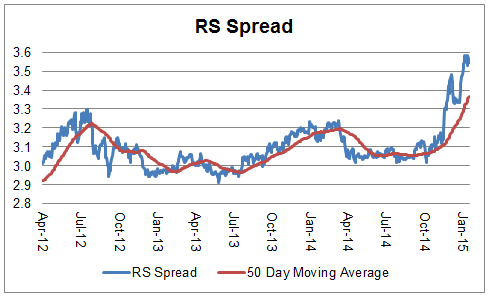
The chart below is the spread between the relative strength leaders and relative strength laggards (universe of mid and large cap stocks). When the chart is rising, relative strength leaders are performing better than relative strength laggards. As of 1/26/2014:

spread 01.27.15

This example is presented for illustrative purposes only and does not represent a past recommendation. The performance above is based on pure price returns, not inclusive of dividends or all transaction costs. Investors cannot invest directly in an index. Indexes have no fees. Past performance is not indicative of future results. Potential for profits is accompanied by possibility of loss.

Posted by:


DWA Momentum ETFs added to Schwab OneSource

January 26, 2015

ETF Trends reports that 4 of our ETFs (PDP, PIE, PIZ, and DWAS) will be added to the Schwab OneSource (commission-free) platform on February 1st:

Charles Schwab (NYSE: SCHW), the largest discount broker, said today it will expand its Schwab ETF OneSource lineup of commission-free exchange traded funds to nearly 200 offerings starting on Feb. 1.

On that date, Schwab clients will be able to access 198 ETFs across 64 Morningstar categories on a commission-free basis. Schwab does not have any enrollment requirements or charge early redemption fees for the ETFs in the program – two key differentiators for investors comparing similar commission-free ETF programs,according to a statement issued by California-based Schwab earlier Monday.

OneSource, the largest commission-free ETF platform on the market today, has been a significant driver of ETF asset growth for Schwab. Last year, ETF assets custodied at Schwab surged 18% to $231 billion, according to the firm’s fourth-quarter and 2014 snapshot released. [ETF Assets Continue Flowing to Schwab]

“Schwab ETF OneSource has $38 billion in assets under management as of December 31, 2014. Flows into ETFs in the program were over $10 billion in 2014, representing 43 percent of the total ETF flows at Schwab,” the company said in the statement.

In September, Schwab unveiled a massive expansion of its Schwab ETF OneSource commission-free ETF platform by adding 65 new ETFs and seven new issuers.

New providers joining OneSource are ALPS, Direxion Investments, Global X Funds, IndexIQ, PIMCO, ProShares and WisdomTree (NasdaqGS: WETF). Those firms join OneSource’s original members State Street (NYSE: STT), Guggenheim, Invesco’s (NYSE: IVZ) PowerShares, ETF Securities, U.S. Commodity Funds and Schwab’s own lineup of ETFs. [Schwab Bolsters Commission-Free ETF Lineup]

The new additions to OneSource come courtesy of five of the platforms current providers, Direxion, PowerShares, ProShares, State Street and WisdomTree.

OneSource’s newest ETFs include the Direxion iBillionaire Index ETF (NYSEArca:IBLN), PowerShares DWA Emerging Markets Momentum Portfolio (NYSEArca:PIE), PowerShares DWA SmallCap Momentum Portfolio (NYSEArca: DWAS),ProShares Morningstar Alternatives Solution ETF (NYSEArca: ALTS), SPDR MSCI ACWI Low Carbon Target ETF (NYSEArca: LOWC) and theWisdomTree Bloomberg U.S. Dollar Bullish Fund (NYSEArca: USDU).

one source

Table Courtesy: Charles Schwab

ETF Trends editorial team contributed to this post.

The opinions and forecasts expressed herein are solely those of Tom Lydon, and may not actually come to pass. Mr. Lydon serves as an independent trustee of certain mutual funds and ETFs that are managed by Guggenheim Investments; however, any opinions or forecasts expressed herein are solely those of Mr. Lydon and not those of Guggenheim Funds, Guggenheim Investments, Guggenheim Specialized Products, LLC or any of their affiliates. Information on this site should not be used or construed as an offer to sell, a solicitation of an offer to buy, or a recommendation for any product.

Dorsey Wright is the index provider for PDP, PIE, PIZ, DWAS and a suite of other momentum ETFs with PowerShares. See www.powershares.com for more information.

Posted by:


Dorsey Wright Separately Managed Accounts

January 26, 2015

Picture1

Our Systematic Relative Strength portfolios are available as separately managed accounts at a large and growing number of firms.

  • Wells Fargo Advisors (Global Macro available on the Masters/DMA Platforms)
  • Morgan Stanley (IMS Platform)
  • TD Ameritrade Institutional
  • UBS Financial Services (Aggressive and Core are available on the MAC Platform)
  • RBC Wealth Management (MAP Platform)
  • Raymond James (Outside Manager Platform)
  • Stifel Nicolaus
  • Kovack Securities (Growth and Global Macro approved)
  • Deutsche Bank
  • Charles Schwab Institutional (Marketplace Platform)
  • Sterne Agee
  • Scott & Stringfellow
  • Envestnet UMA (Growth, Aggressive, Core, Balanced, and Global Macro approved)
  • Placemark
  • Scottrade Institutional
  • Janney Montgomery Scott
  • Robert W. Baird
  • Prospera
  • Oppenheimer (Star Platform)
  • SunTrust

Different Portfolios for Different Objectives: Descriptions of our seven managed accounts strategies are shown below. All managed accounts use relative strength as the primary investment selection factor.

Aggressive: This Mid and Large Cap U.S. equity strategy seeks to achieve long-term capital appreciation. It invests in securities that demonstrate powerful relative strength characteristics and requires that the securities maintain strong relative strength in order to remain in the portfolio.

Core: This Mid and Large Cap U.S. equity strategy seeks to achieve long-term capital appreciation. This portfolio invests in securities that demonstrate powerful relative strength characteristics and requires that the securities maintain strong relative strength in order to remain in the portfolio. This strategy tends to have lower turnover and higher tax efficiency than our Aggressive strategy.

Growth: This Mid and Large Cap U.S. equity strategy seeks to achieve long-term capital appreciation with some degree of risk mitigation. This portfolio invests in securities that demonstrate powerful relative strength characteristics and requires that the securities maintain strong relative strength in order to remain in the portfolio. This portfolio also has an equity exposure overlay that, when activated, allows the account to hold up to 50% cash if necessary.

International: This All-Cap International equity strategy seeks to achieve long-term capital appreciation through a portfolio of international companies in both developed and emerging markets. This portfolio invests in those securities with powerful relative strength characteristics and requires that the securities maintain strong relative strength in order to remain in the portfolio. Exposure to international markets is achieved through American Depository Receipts (ADRs).

Global Macro: This global tactical asset allocation strategy seeks to achieve meaningful risk diversification and investment returns. The strategy invests across multiple asset classes: Domestic Equities (long & inverse), International Equities (long & inverse), Fixed Income, Real Estate, Currencies, and Commodities. Exposure to each of these areas is achieved through exchange-traded funds (ETFs).

Balanced: This strategy includes equities from our Core strategy (see above) and high-quality U.S. fixed income in approximately a 60% equity / 40% fixed income mix. This strategy seeks to provide long-term capital appreciation and income with moderate volatility.

Tactical Fixed Income: This strategy seeks to provide current income and strong risk-adjusted fixed income returns. The strategy invests across multiple sectors of the fixed income market: U.S. government bonds, investment grade corporate bonds, high yield bonds, Treasury inflation protected securities (TIPS), convertible bonds, and international bonds. Exposure to each of these areas is achieved through exchange-traded funds (ETFs).

Picture2

To receive fact sheets for any of the strategies above, please e-mail Andy Hyer at [email protected] or call 626-535-0630. Past performance is no guarantee of future returns. An investor should carefully review our brochure and consult with their financial advisor before making any investments.

Posted by:


RS Chart of The Day

January 26, 2015

 photo SPYVSAGG_zpsu7qygfde.jpg

Point and Figure RS Charts are calculated by dividing one security by another and plotting the ratio on a PnF chart. When the ratio is rising, it is plotted in a column of X’s and reflects the numerator outperforming the denominator. Likewise, when the relative strength ratio is declining, it is plotted in a column of O’s and reflects the outperformance of the denominator.

Past performance is not indicative of future results. Potential for profits is accompanied by possibility of loss. This example is presented for illustrative purposes only and does not represent a past recommendation. The relative strength strategy is NOT a guarantee. There may be times where all investments and strategies are unfavorable and depreciate in value. Nothing contained herein should be construed as an offer to sell or the solicitation of an offer to buy any security. This post does not attempt to examine all the facts and circumstances which may be relevant to any product or security mentioned herein. We are not soliciting any action based on this document. It is for the general information of clients of Dorsey, Wright & Associates, LLC (“Dorsey, Wright & Associates”). This document does not constitute a personal recommendation or take into account the particular investment objectives, financial situations, or needs of individual clients. Before acting on any analysis, advice or recommendation in this document, clients should consider whether the security or strategy in question is suitable for their particular circumstances and, if necessary, seek professional advice.

Posted by:


Weekly RS Recap

January 26, 2015

The table below shows the performance of a universe of mid and large cap U.S. equities, broken down by relative strength decile and quartile and then compared to the universe return. Those at the top of the ranks are those stocks which have the best intermediate-term relative strength. Relative strength strategies buy securities that have strong intermediate-term relative strength and hold them as long as they remain strong.

Last week’s performance (1/19/15 – 1/23/15) is as follows:

ranks 01.26.15

This example is presented for illustrative purposes only and does not represent a past recommendation. The performance above is based on pure price returns, not inclusive of dividends or all transaction costs. Past performance is not indicative of future results. Potential for profits is accompanied by possibility of loss.

Posted by:


First Trust DWA UITs

January 23, 2015

Among the ways to leverage the work of Dorsey Wright is through the Unit Investment Trusts that we construct for First Trust. We have been managing these UITs since early 2011 and have been happy with their results over time. For clients who are looking for a disciplined way to get exposure to a systematic relative strength strategy, we believe that these UITs may be a good solution. A brief introduction to both series of UITs is given below:

The Dorsey Wright Relative Strength Top 50 Series is a unit investment trust which invests in stocks selected by Dorsey Wright and is designed to be held over the fixed 15-month term of the trust.

Portfolio Selection Process

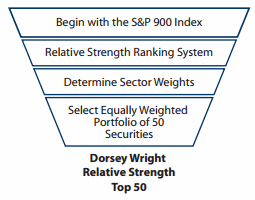
Through the selection process, we seeks to identify those companies that we believe are technical leaders within the marketplace. We begin with the companies listed in the S&P; 900 Index. All of the securities in the universe are scored on several measures of relative strength. The next step in the process is to determine the portfolio’s sector exposure. The sector weightings are determined by a combination of current market weights and the relative strength ranking of the securities within each sector. The goal is to acheive a portfolio of high relative strength securities with an overall sector weighting close to current market weights. The final step is to select the top 50 companies for the portfolio based on relative strength. The stocks are equally-weighted within the portfolio.


1

Portfolio holdings of the most recent trust are shown below:


Top 50

The Dorsey Wright Relative Strength Dividend Portfolio is a unit investment trust which invests in stocks selected by Dorsey Wright and is designed to be held over the fixed 15-month term of the trust.

Portfolio Selection Process

Through the selection process, we seeks to identify those companies that we believe will meet the dividend objective of the portfolio. We begin with the companies listed in the S&P; 900 Index. All of the securities in the universe are scored on several measures of relative strength. The next step in the process is to determine the portfolio’s sector exposure. The sector weightings are determined by a combination of current market weights, the relative strength ranking and those with the highest dividend yield of the securities within each sector. The goal is to acheive a portfolio of high relative strength securities with an overall sector weighting close to current market weights. The final step is to select the top 50 companies for the portfolio based on relative strength and dividend yield. The stocks are equally-weighted within the portfolio.


2

Portfolio holdings of the most recent trust are shown below:


Top 50 Dividend

To receive fact sheets, see www.ftportfolios.com.

An investment in this unmanaged unit investment trust should be made with an understanding of the risks involved with owning common stocks, such as an economic recession and the possible deterioration of either the financial condition of the issuers of the equity securities or the general condition of the stock market. Past performance is not indicative of future results. Potential for profits is accompanied by possibility of loss. A relative strength strategy is NOT a guaranteee. There may be times where all investments and strategies are unfavorable and depreciate in value. A list of all holdings over the past 12 months is available upon request.

Posted by:


Q1 2015 PowerShares DWA Momentum ETFs

January 1, 2015

The PowerShares DWA Momentum Indexes are reconstituted on a quarterly basis. These indexes are designed to evaluate their respective investment universes and build an index of stocks with superior relative strength characteristics. This quarter’s allocations are shown below.

PDP: PowerShares DWA Momentum ETF

pdp

DWAS: PowerShares DWA Small Cap Momentum ETF

dwas

DWAQ: PowerShares DWA NASDAQ Momentum ETF

dwaq

PIZ: PowerShares DWA Developed Markets Momentum ETF

piz

PIE: PowerShares DWA Emerging Markets Momentum ETF

pie

Source: Dorsey Wright, MSCI, Standard & Poor’s, and NASDAQ, Allocations subject to change

We also apply this momentum-indexing methodology on a sector level:

sector

See www.powershares.com for more information.

The Dorsey Wright SmallCap Momentum Index is calculated by Dow Jones, the marketing name and a licensed trademark of CME Group Index Services LLC (“CME Indexes”). “Dow Jones Indexes” is a service mark of Dow Jones Trademark Holdings LLC (“Dow Jones”). Products based on the Dorsey Wright SmallCap Momentum IndexSM, are not sponsored, endorsed, sold or promoted by CME Indexes, Dow Jones and their respective affiliates make no representation regarding the advisability of investing in such product(s). A list of all holding for the trailing 12 months is available upon request. This example is presented for illustrative purposes only and does not represent a past recommendation. Past performance is not indicative of future results. Potential for profits is accompanied by possibility of loss. Dorsey Wright is the index provider for the suite of momentum ETFs with PowerShares.

Posted by: