Weekly RS Recap

September 28, 2015

The table below shows the performance of a universe of mid and large cap U.S. equities, broken down by relative strength decile and quartile and then compared to the universe return. Those at the top of the ranks are those stocks which have the best intermediate-term relative strength. Relative strength strategies buy securities that have strong intermediate-term relative strength and hold them as long as they remain strong.

Last week’s performance (9/21/15 – 9/25/15) is as follows:

ranks

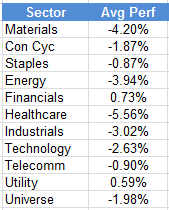
The sector performance from last week is shown below:

sector ranks

This example is presented for illustrative purposes only and does not represent a past recommendation. The performance above is based on pure price returns, not inclusive of dividends or all transaction costs. Past performance is not indicative of future results. Potential for profits is accompanied by possibility of loss.

Posted by:


If You’re Going to Be Active, Be Systematic

September 21, 2015

Michael Batnick of The Irrelevant Investor cites statistics from SPIVA showing that 79.59% of large-cap managers have failed to beat their benchmark over the last 10 years then makes these astute observations:

I believe the days of superstar stock pickers is a thing of the past. For many of these professionals, career risk is too large a hurdle to overcome. Straying too far from the index keeps their returns looking a lot like it and fees generally eat up any alpha they might earn. Aside from career risk, here are a few other risk factors to consider that can negatively affect a portfolio manager.

  1. Maybe they get divorced
  2. Maybe they lose a key analyst
  3. Maybe they go through a bad stretch and start second guessing themselves
  4. Maybe they leave for another company.
  5. Maybe they want to spend more time with their kids.

This is just too many maybes and why I believe that if you’re going to deviate from the index, it’s important to do so in a systematic way. With quantitative strategies, you understand there will be times when it falls out of favor, in fact you sign up for that ahead of time. However, if a stock picker hits a rough patch, you don’t know they will ever regain the ability it appeared they once had. Furthermore, it can be difficult to ascertain what caused them to outperform in the first place; that whole thing about distinguishing luck from skill.

When considering active strategies, it’s important for us that we’re not relying on anyone’s intuition, expertise, or mental or emotional well being. We don’t want our PMs speaking with management, doing channel checks or backing out the cash. We want them to follow their models with as little interference as humanly possible.

A focus on process over short-term results is a hallmark of DWA. We long ago recognized the need to systematize strategy decision rules in order to minimize the negative effect of human emotion on investment results. Part of the reason that we were comfortable with this is because of the mountain of research on momentum which suggests that momentum is a premier investment factor. With something that effective over time, why mess with it? Honing our craft is an ongoing process, but we take great pride in the level of consistency of our investment process over time.

Too often, our industry notes the percentage of active managers that fail to beat an index and comes to the wrong conclusion—essentially throwing the baby out with the bathwater. A much more telling statistic would be the percentage of systematic vs. non-systematic investment managers that beat an index over time. I suspect that the former number would be much higher than the latter.

The relative strength strategy is NOT a guarantee. There may be times where all investments and strategies are unfavorable and depreciate in value.

HT: Jim O’Shaughnessey

Posted by:


Quote of the Week

September 21, 2015

Aaron Brown, Red Blooded Risk (2011):

Taking less risk than is optimal is not safer; it just locks in a worse outcome.

Taking more risk than is optimal also results in a worse outcome, and often leads to complete disaster.

HT: Newfound Research

Posted by:


Weekly RS Recap

September 21, 2015

The table below shows the performance of a universe of mid and large cap U.S. equities, broken down by relative strength decile and quartile and then compared to the universe return. Those at the top of the ranks are those stocks which have the best intermediate-term relative strength. Relative strength strategies buy securities that have strong intermediate-term relative strength and hold them as long as they remain strong.

Last week’s performance (9/14/15 – 9/18/15) is as follows:

ranks

This example is presented for illustrative purposes only and does not represent a past recommendation. The performance above is based on pure price returns, not inclusive of dividends or all transaction costs. Past performance is not indicative of future results. Potential for profits is accompanied by possibility of loss.

Posted by:


RS Charts of The Week

September 18, 2015

 photo spyvsagg_zpspayjdtsm.png

 photo SPY vs IYR_zps0imqhgk7.png

 photo SPYVSGCC2_zpsibls6vys.png

 photo SPY VS EEM_zpsmdyssykb.png

 photo SPY VS EFA_zpscie5x9fh.png

Point and Figure RS Charts are calculated by dividing one security by another and plotting the ratio on a PnF chart. When the ratio is rising, it is plotted in a column of X’s and reflects the numerator outperforming the denominator. Likewise, when the relative strength ratio is declining, it is plotted in a column of O’s and reflects the outperformance of the denominator.

Past performance is not indicative of future results. Potential for profits is accompanied by possibility of loss. This example is presented for illustrative purposes only and does not represent a past recommendation. The relative strength strategy is NOT a guarantee. There may be times where all investments and strategies are unfavorable and depreciate in value. Nothing contained herein should be construed as an offer to sell or the solicitation of an offer to buy any security. This post does not attempt to examine all the facts and circumstances which may be relevant to any product or security mentioned herein. We are not soliciting any action based on this document. It is for the general information of clients of Dorsey, Wright & Associates, LLC (“Dorsey, Wright & Associates”). This document does not constitute a personal recommendation or take into account the particular investment objectives, financial situations, or needs of individual clients. Before acting on any analysis, advice or recommendation in this document, clients should consider whether the security or strategy in question is suitable for their particular circumstances and, if necessary, seek professional advice.

Posted by:


Strong Year for Sector Momentum

September 18, 2015

So far this year, all 9 of our PowerShares DWA Momentum Sectors are outperforming their cap-weighted peers. In some cases (Healthcare, Technology, and Consumer Staples) the outperformance of momentum is quite large.

momentum sector

Source: Dorsey Wright, Updated through 9/17/15, Performance is price only, not inclusive of dividends or all transaction costs

The PowerShares DWA Momentum Sector ETFs are constructed as follows:

  • Invest in 30-75 Small, Mid, and Large Cap Stocks
  • Stocks are selected for the index based on demonstrating favorable, in our view, momentum characteristics
  • Rebalanced on a quarterly basis

Dorsey Wright is the index provider for this suite of momentum ETFs at PowerShares. See www.powershares.com for more information. The relative strength strategy is NOT a guarantee. There may be times where all investments and strategies are unfavorable and depreciate in value.

Posted by:


Sector Performance

September 18, 2015

The table below shows performance of US sectors over the trailing 12, 6, and 1 month(s). Performance updated through 9/17/15.

sector

The performance above is based on pure price returns, not inclusive of dividends or all transaction costs. Past performance is not indicative of future results. Potential for profits is accompanied by possibility of loss. Source: iShares

Posted by:


Addressing the Recency Bias Monster

September 17, 2015

Ben Carlson provides a nice summary of how recency bias causes investors to leave a lot of money on the table:

This is why we had Depression babies who were risk averse for decades after the Great Depression. Investors who came up during the 1970s expected interest rates and inflation to stay high forever. Almost everyone who invested in the 80s or 90s became complacent and assumed mid-double digit stock market gains were their birthright. The latest generation of investors have decided that the world is going to end once a week because we’ve lived through two huge crashes in the past 15 years.

This is where I think it can be instructive to review the landscape of managers in the Tactical Allocation space. These are the managers who are seeking to adapt to different economic environments.

See the following definition of this category from Morningstar:

Tactical Allocation: Tactical Allocation portfolios seek to provide capital appreciation and income by actively shifting allocations between asset classes. These portfolios have material shifts across equity regions and bond sectors on a frequent basis. To qualify for the Tactical Allocation category, the fund must first meet the requirements to be considered in an allocation category. Next, the fund must historically demonstrate material shifts within the primary asset classes either through a gradual shift over three years or through a series of material shifts on a quarterly basis. The cumulative asset class exposure changes must exceed 10% over the measurement period.

How likely do you think it is that many Tactical Managers succumbed to recency bias and managed their portfolio over the past 5 years as if the “world is ending?” Judging by the numbers, I suspect that the answer is quite a few. However, note how our own Arrow DWA Tactical Fund (DWTFX) has outperformed 88 percent of our peers in the Tactical Allocation category over the past 5 years and has outperformed 92 percent of our peers over the past 3 years.

dwtfx

Source: Morningstar

Here are two key reasons why I believe this fund has stacked up well against its peer group over time:

  • Relative strength drives the allocations of the fund rather than human emotions.
  • We intentionally gave ourselves wide asset allocation flexibility. You will note that this type of flexibility allows us to perform well in a variety of market environments. See below for details:

Holdings of the fund as of 8/31/15 are shown below:

It is understandable that investors, most of whom have felt the pain of two major bear markets within the past 15 years, want a strategy that can play defense. However, that objective need not be sought at the expense of also having a strategy that can make money in good markets! Recency bias is a killer in the financial markets. I believe a relative strength-driven approach to asset allocation is a good solution to that challenge.

This portfolio is available in a number of different investment vehicles:

  • The Arrow DWA Tactical Fund (DWTFX). This fund adopted this strategy in 8/2009.
  • The Arrow DWA Tactical ETF (DWAT)
  • This strategy is also available as a separately managed account (called Global Macro). E-mail andy@dorseywright for a brochure on the SMA.

The relative strength strategy is NOT a guarantee. There may be times where all investments and strategies are unfavorable and depreciate in value. Dorsey Wright is the signal provider for the Arrow DWA Tactical Fund and Arrow DWA Tactical ETF. See arrowfunds.com for a prospectus.

Posted by:


High RS Diffusion Index

September 16, 2015

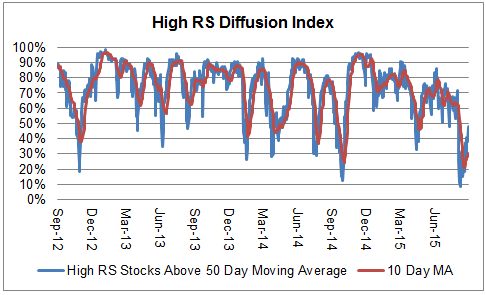
The chart below measures the percentage of high relative strength stocks that are trading above their 50-day moving average (universe of mid and large cap stocks.) As of 9/15/15.

diffusion

This index has rebounded after hitting a single-day low of 8% on 8/25/15. The 10-day moving average of this indicator is 30% and the one-day reading is 48%. Dips in this index have often provided good opportunities to add money to relative strength strategies.

This example is presented for illustrative purposes only and does not represent a past recommendation. The performance above is based on pure price returns, not inclusive of dividends or all transaction costs. Investors cannot invest directly in an index. Indexes have no fees. Past performance is not indicative of future results. Potential for profits is accompanied by possibility of loss.

Posted by:


Why We Invest

September 14, 2015

From Bob French of McLean:

Inflation is a fact of life. A dollar buys less today than when you were a kid, and it will buy even less in the future. There’s no way around it. To maintain your current standard of living in the future, you’ll need to spend more than you do today. We don’t know how much more because the inflation rate is always changing, but we can put it in perspective. Over the 30-year period from 1985 to the end of 2014, the annualized US CPI inflation rate was 2.71% year. That means that a dollar in 1985 is worth a little bit less than 44 cents today. You need to account for inflation when you think about your financial goals.

Posted by:


Weekly RS Recap

September 14, 2015

The table below shows the performance of a universe of mid and large cap U.S. equities, broken down by relative strength decile and then compared to the universe return. Those at the top of the ranks are those stocks which have the best intermediate-term relative strength. Relative strength strategies buy securities that have strong intermediate-term relative strength and hold them as long as they remain strong.

Last week’s performance (9/7/15 – 9/11/15) is as follows:

avg

This example is presented for illustrative purposes only and does not represent a past recommendation. The performance above is based on pure price returns, not inclusive of dividends or all transaction costs. Past performance is not indicative of future results. Potential for profits is accompanied by possibility of loss.

Posted by:


Sector Performance

September 11, 2015

The table below shows performance of US sectors over the trailing 12, 6, and 1 month(s). Performance updated through 9/10/15.

sector

The performance above is based on pure price returns, not inclusive of dividends or all transaction costs. Past performance is not indicative of future results. Potential for profits is accompanied by possibility of loss. Source: iShares

Posted by:


RS Charts of The Week

September 11, 2015

 photo SPYVSAGG75_zpsvddpewrd.png

 photo spyiyr75_zpshy42rlun.png

 photo SPYVSGCC_zpssgiynodl.png

 photo SPYVSEEM75_zpsscoe6ldq.png

 photo SPYEFA125_zpsq2zsd50k.png

Point and Figure RS Charts are calculated by dividing one security by another and plotting the ratio on a PnF chart. When the ratio is rising, it is plotted in a column of X’s and reflects the numerator outperforming the denominator. Likewise, when the relative strength ratio is declining, it is plotted in a column of O’s and reflects the outperformance of the denominator.

Past performance is not indicative of future results. Potential for profits is accompanied by possibility of loss. This example is presented for illustrative purposes only and does not represent a past recommendation. The relative strength strategy is NOT a guarantee. There may be times where all investments and strategies are unfavorable and depreciate in value. Nothing contained herein should be construed as an offer to sell or the solicitation of an offer to buy any security. This post does not attempt to examine all the facts and circumstances which may be relevant to any product or security mentioned herein. We are not soliciting any action based on this document. It is for the general information of clients of Dorsey, Wright & Associates, LLC (“Dorsey, Wright & Associates”). This document does not constitute a personal recommendation or take into account the particular investment objectives, financial situations, or needs of individual clients. Before acting on any analysis, advice or recommendation in this document, clients should consider whether the security or strategy in question is suitable for their particular circumstances and, if necessary, seek professional advice.

Posted by:


Most Stocks Do Poorly

September 10, 2015

Interesting stats from The Irrelevant Investor:

A study from J.P. Morgan examines all Russell 3000 stocks from 1980-2014. What they found was that 40% of all stocks suffered a catastrophic loss, which they define as “a decline of 70% or more in the price of a stock from its peak, after which there was little recovery such that the eventual loss from the peak is 60% or more.” J.P. Morgan also found that two-thirds of all stocks underperformed the Russell 3000, while 40% of stocks experienced negative absolute returns.

Active management, which seeks to add value over a cap-weighted index, has its work cut out for it. Some investors will simply look at the 7.57% annualized return of the Russell 3000 index from 1990-2014 (I didn’t have access to Russell 3,000 data going back to 1980) and conclude that they are just fine investing in a fund that seeks to track the returns of this capitalization-weighted index. I would argue that such an approach would be more prudent than simply buying 25 individual stocks in 1980 and holding them through 2014. At least with a fund that seeks to track the Russell 3,000 Index you get a more diversified approach that will give the most weight to the largest cap stocks. However, a cap-weighted index does suffer from the vulnerability of having significant exposure to large cap stocks that turn south and embark on extended periods of underperformance (think Japan in 1989, or tech-heavy Nasdaq in 2000).

Where a relative strength strategy excels is in focusing on those stocks within a broad investment universe that are demonstrating the best price momentum. The best price performance may or may not be coming from the stocks with the largest capitalization in the Russell 3,000. Furthermore, what you don’t own is every bit as important as what you do own. Presumably, many of those stocks from the J.P. Morgan study that experienced negative absolute returns or trailed the Russell 3,000 Index had weak price momentum for long enough periods not to spend too much time in a Momentum-driven portfolio strategy.

For those investors looking to dig deeper into the merits of a momentum approach to investing, I would recommend reading Relative Strength and Portfolio Management by John Lewis or some of the other research we have posted on our site.

Source of returns for the Russell 3000: FactSet. Total returns inclusive of dividends, but does not include transaction costs or management fees. The relative strength strategy is NOT a guarantee. There may be times where all investments and strategies are unfavorable and depreciate in value.

HT: Abnormal Returns

Posted by:


High RS Diffusion Index

September 10, 2015

The chart below measures the percentage of high relative strength stocks that are trading above their 50-day moving average (universe of mid and large cap stocks.) As of 9/9/15.

diffusion

The 10-day moving average of this indicator is 26% and the one-day reading is 29%. Dips in this indicator have often provided good opportunities to add money to relative strength strategies.

This example is presented for illustrative purposes only and does not represent a past recommendation. The performance above is based on pure price returns, not inclusive of dividends or all transaction costs. Investors cannot invest directly in an index. Indexes have no fees. Past performance is not indicative of future results. Potential for profits is accompanied by possibility of loss.

Posted by:


The Small-Cap Effect

September 9, 2015

Bridgeway recently provided a nice review of the historical small-cap effect:

The Center for Research in Security Prices (CRSP) divides all stocks traded on the New York Stock Exchange into 10 deciles based on company market capitalization. Decile 1 includes the largest of all companies, while decile 10 represents the smallest of small-cap stocks, known as ultra-small companies.

crsp

Some observations:

  • From 1926-June of 2015, small-cap stocks (CRSP 6-8) outperformed ultra-large stocks (CRSP 1) by 2.98% annually
  • Small-cap stocks (CRSP 6-8) outperformed ultra-large stocks (CRSP 1) in 6 out of the 10 periods shown in the above table
  • Markets go through extended periods of time favoring large-cap stocks vs. small-cap stock and vice versa

This data suggests that there can be meaningful benefits from including small-cap exposure as as part of an asset allocation. Of course, our personal preference for how to get that small-cap exposure is through a disciplined relative strength index.

A look at the chart of our own PowerShares DWA Small Cap Momentum ETF is shown below:

dwas

As of 9/8/15. This PnF chart is constructed using closing prices only. The performance above is based on pure price returns, not inclusive of dividends or all transaction costs.

A brief review of the index construction methodology for the PowerShares DWA Small Cap Technical Leaders Index:

The PowerShares DWA Small Cap Momentum Portfolio (Fund) is based on the Dorsey Wright® SmallCap Technical Leaders Index (DWA SmallCap Technical Leaders Index). The Fund will normally invest at least 90% of its total assets in equity securities of small capitalization companies that comprise the Index. The Index includes securities pursuant to a Dorsey, Wright & Associates, LLC proprietary selection methodology that is designed to identify companies that demonstrate powerful relative strength characteristics based on that company’s market performance. Approximately 200 companies are selected for inclusion in the Index from the NASDAQ US Benchmark Index. The Fund and the Index are rebalanced and reconstituted quarterly.

The stock market correction over the past month or so caused this chart to pull back to its bullish support line, but it has since reversed back into a column of X’s. In light of the fact that many of the short-term indicators that we follow at Dorsey Wright (NYSEHILO and TWNYSE) have reached oversold levels–even multi-year low levels, investors may wish to consider taking this opportunity put some money to work in this ETF.

Past performance is not indicative of future results. Potential for profits is accompanied by possibility of loss. Dorsey Wright is the index provider for DWAS and a suite of other Momentum ETFs with PowerShares.

Posted by:


Relative Strength Spread

September 9, 2015

The chart below is the spread between the relative strength leaders and relative strength laggards (universe of mid and large cap stocks). When the chart is rising, relative strength leaders are performing better than relative strength laggards. As of 9/8/15:

spread

This example is presented for illustrative purposes only and does not represent a past recommendation. The performance above is based on pure price returns, not inclusive of dividends or all transaction costs. Investors cannot invest directly in an index. Indexes have no fees. Past performance is not indicative of future results. Potential for profits is accompanied by possibility of loss.

Posted by:


Weekly RS Recap

September 8, 2015

The table below shows the performance of a universe of mid and large cap U.S. equities, broken down by relative strength decile and quartile and then compared to the universe return. Those at the top of the ranks are those stocks which have the best intermediate-term relative strength. Relative strength strategies buy securities that have strong intermediate-term relative strength and hold them as long as they remain strong.

Last week’s performance (8/31/15 – 9/4/15) is as follows:

ranks

This example is presented for illustrative purposes only and does not represent a past recommendation. The performance above is based on pure price returns, not inclusive of dividends or all transaction costs. Past performance is not indicative of future results. Potential for profits is accompanied by possibility of loss.

Posted by:


Impediments to Creating Wealth

September 2, 2015

Anthony Isola of The Christian Science Monitor identified two of the major impediments to creating wealth:

Too many choices and inexperience with complex issues are two of the biggest impediments to creating wealth. Limiting choices and automation, on the other hand, are great ways to improve your decision-making.

For the advisor who is providing relative strength-based solutions for their clients, these two impediments to creating wealth become perfectly surmountable. If I, as a financial advisor employing relative strength-based solutions to my clients, were articulating my value proposition to a prospect here are 3 key points I would make:

  • Relative strength provides a way to thoroughly and effectively analyze a broad universe of securities. Take the PowerShares DWA Momentum ETF (PDP) as an example. Every quarter, we take 1,000 securities and evaluate each of them based on their PnF relative strength attributes. The top 100 of our ranks make it into the index. This process is no more difficult with 1,000 securities in the investment universe than it would be if there were 500. Relative strength provides an elegant solution to the challenge of “too many choices.”
  • Relative strength provides a sell discipline that is as clearly defined as is the buy discipline. Most investors don’t have a problem coming up with ideas of securities to buy, but when it comes to knowing when to sell that is a different story. The end result is that losing positions can act as a drag on a portfolio for extended periods of time. What you don’t own is every bit as important as what you do own. Many of the guided ETF models on the Dorsey Wright research database are managed using a relative strength matrix. The sell discipline for many of these models is if the security falls out of the top half of the ranks. Just one of the ways that relative strength simplifies decisions that to many would seem complex.
  • Finally, I would make sure that a prospect understood that if they entrusted their financial wealth with you, that you would systematize the management of their wealth. Advisors have wholesalers in their office every day presenting a good idea. Most of these wholesalers make a compelling argument for the particular investment that they represent. If an advisor were to change their investment process every time they hear a good idea, their client’s portfolios would end up being a mish-mash of who knows what. Clients want to know that you are carefully monitoring their assets and relative strength provides a logical framework for this task.

Framing discussions with prospects around ways that your relative strength-based investment process can lead to them creating and preserving their wealth could very well be the key to winning new business and then keeping that business for decades to come.

The relative strength strategy is NOT a guarantee. There may be times where all investments and strategies are unfavorable and depreciate in value. Dorsey Wright is the index provider for PDP and a suite of other momentum-based ETFs.

Posted by: