Weekly RS Recap

November 30, 2015

The table below shows the performance of a universe of mid and large cap U.S. equities, broken down by relative strength decile and then compared to the universe return. Those at the top of the ranks are those stocks which have the best intermediate-term relative strength. Relative strength strategies buy securities that have strong intermediate-term relative strength and hold them as long as they remain strong.

Last week’s performance (11/23/15 – 11/27/15) is as follows:

ranks

This example is presented for illustrative purposes only and does not represent a past recommendation. The performance above is based on pure price returns, not inclusive of dividends or all transaction costs. Past performance is not indicative of future results. Potential for profits is accompanied by possibility of loss.

Posted by:


High RS Diffusion Index

November 25, 2015

The chart below measures the percentage of high relative strength stocks (top quartile of our ranks) that are trading above their 50-day moving average (universe of mid and large cap stocks.) As of 11/24/15.

diffusion

The 10-day moving average of this indicator is 78% and the one-day reading is 82%.

This example is presented for illustrative purposes only and does not represent a past recommendation. The performance above is based on pure price returns, not inclusive of dividends or all transaction costs. Investors cannot invest directly in an index. Indexes have no fees. Past performance is not indicative of future results. Potential for profits is accompanied by possibility of loss.

Posted by:


25 Years of the RS Spread

November 23, 2015

It is so easy to get caught up in the day to day outperformance or underperformance of our relative strength strategies. What do they currently own? Which positions are closest to being sold? What will replace them? All relevant questions for sure, but I find it helpful to take a couple steps back every now and again and look at a long-term look view of relative strength strategies. The RS Spread, shown below, offers a 25 year look at how the relative strength leaders have fared compared to the relative strength laggards.

The chart below is the spread between the relative strength leaders and relative strength laggards (top quartile of stocks in our ranks divided by the bottom quartile of stocks in our ranks; universe of U.S. mid and large cap stocks). When the chart is rising, relative strength leaders are performing better than relative strength laggards.

spread

Source: Dorsey Wright, 5/23/90 – 11/20/15. Price return only, not inclusive of dividends or transaction costs.

Some observations:

  • Over time, you’ve been much better off owning RS leaders as opposed the RS laggards
  • The RS Spread doesn’t always go up. In fact, there have been a number of periods (often after major recessions and during the first 12 months of new bull markets) where RS laggards have actually had better performance. Those are often the environments where momentum investors are glad they also own some value strategies in their allocation.
  • From late 2009 through the middle of 2014, the RS Spread chopped sideways. This was a period where most all stocks were going up, but the RS leaders weren’t necessarily doing any better than the RS laggards.
  • For the last year and a half or so, RS leaders have been dominating the RS laggards.

What does this suggest about the future? Could the meaningful outperformance of the RS leaders over the last year an a half or so constitute some type of breakout in light of the previous extended period of similar performance between the RS leaders and laggards? I am inclined to think so. Hopefully, this provides some food for thought for those advisors having discussions with clients about putting new money to work.

This example is presented for illustrative purposes only and does not represent a past recommendation. The performance above is based on pure price returns, not inclusive of dividends or all transaction costs. Investors cannot invest directly in an index. Indexes have no fees. Past performance is not indicative of future results. Potential for profits is accompanied by possibility of loss. This analysis speaks only in generalities and may or may not be directly applicable to any particular investment strategy.

Posted by:


Bunker Mentality Persists

November 23, 2015

Insightful commentary from Ben Carlson about the lingering effects of the financial crisis:

We’re well into the seventh year of an economic and stock market recovery. The economic expansion hasn’t been as robust as many would like and the recovery has been uneven, as some have fared better than others in the aftermath of the worst economic contraction since the Great Depression. But you can’t deny that things are much better than they were during that fateful 2007-2009 period.

Click here to continue reading.

Posted by:


Weekly RS Recap

November 23, 2015

The table below shows the performance of a universe of mid and large cap U.S. equities, broken down by relative strength decile and then compared to the universe return. Those at the top of the ranks are those stocks which have the best intermediate-term relative strength. Relative strength strategies buy securities that have strong intermediate-term relative strength and hold them as long as they remain strong.

Last week’s performance (11/16/15 – 11/20/15) is as follows:

ranks

Big week for most all RS decides. One real exception was the bottom decile of the RS ranks (largely Energy stocks).

This example is presented for illustrative purposes only and does not represent a past recommendation. The performance above is based on pure price returns, not inclusive of dividends or all transaction costs. Past performance is not indicative of future results. Potential for profits is accompanied by possibility of loss.

Posted by:


The Role of Cash in Systematic RS Growth

November 18, 2015

In a sense, asset allocation decisions are nothing more than a series of trade-offs. If an investor employs a fully-invested equity strategy, the investor may feel the full brunt of of market downturns, but they will also be ready to participate in the rebound. Alternatively, an investor may employ an equity strategy that seeks some measure of risk mitigation by at times raising cash in the portfolio. Such a move may help to limit some of of the downside risk, but has the additional risk of missing some of the rebound.

If only the “all of the up and none of the down” portfolio strategy would hurry up and get invented! Absent that illusive strategy, most investors seek diversification. Perhaps, an investor will diversify their investments among some of the following sleeves:

  • Fully-invested U.S. equity strategy
  • U.S. equity strategy that has the ability to raise cash
  • International equity
  • Tactical Allocation strategy that can rotate among different asset classes
  • Fixed Income

As we all know, there is no shortage of ways to put together an asset allocation. Everyone has their own twist on how they deal with this task. Each sleeve of the allocation serves a purpose. I have seen meaningful psychological and investment benefits come to clients who employ an equity strategy that has the ability to go to cash. It can help them ride out the inevitable rough patches in the markets knowing that some defensive action may be taken.

At Dorsey Wright, we manage both fully-invested equity strategies and equity strategies that have the ability to go to cash. See below for a profile of our Systematic RS Growth portfolio.

  • Invests in up to 25 U.S. mid and large cap stocks
  • Relative strength drives both the individual stock selection and the sector exposure
  • Can raise up to 50 percent cash if necessary

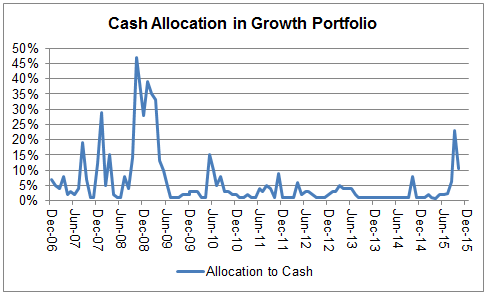
The chart below shows the amount of cash that has been raised in the Systematic RS Growth portfolio over time:
cash

Source: Dorsey Wright, cash allocation of a sample Growth portfolio from 12/31/06 – 10/31/15.

Performance of the strategy is shown below:

growth 11.18.15

rolling growth

Inception 12/31/06. Performance updated through 10/31/15

Over this period of time, the Systematic RS Growth portfolio has outperformed the S&P; 500 by 2.02% annually on a net basis with lower standard deviation than the S&P; 500. Those are the investment advantages. However, the emotional aspect of this type of portfolio shouldn’t be overlooked. My experience in consulting with investors in this strategy over the years is that they take great comfort in knowing that this portfolio has the ability to raise some cash at times. Keeping clients invested and committed to their investment plan is key to helping them ultimately achieve their financial goals.

Among the firms where this SMA is currently available:

  • TD Ameritrade
  • Charles Schwab
  • Envestnet UMA
  • Kovack Securities
  • RBC Wealth Management
  • Stifel Nicolaus
  • Raymond James

Please e-mail [email protected] for a fact sheet or call 626-535-0630.

Click here for important disclosures. The relative strength strategy is NOT a guarantee. There may be times where all investments and strategies are unfavorable and depreciate in value. The percentage allocation to cash shown in the chart above reflects a monthly snapshot of the holdings.
Posted by:


Weekly RS Recap

November 16, 2015

The table below shows the performance of a universe of mid and large cap U.S. equities, broken down by relative strength decile and quartile and then compared to the universe return. Those at the top of the ranks are those stocks which have the best intermediate-term relative strength. Relative strength strategies buy securities that have strong intermediate-term relative strength and hold them as long as they remain strong.

Last week’s performance (11/9/15 – 11/13/15) is as follows:

ranks

This example is presented for illustrative purposes only and does not represent a past recommendation. The performance above is based on pure price returns, not inclusive of dividends or all transaction costs. Past performance is not indicative of future results. Potential for profits is accompanied by possibility of loss.

Posted by:


Trend Following With ADRs

November 13, 2015

One of the realities of trend following is that you never know which trades are going to work out. In the case of our Systematic RS International portfolio, a stock has to meet certain relative strength-based criteria for us to add it to the portfolio. Specifically, we take a universe of ADR’s from both developed and emerging markets and rank them by their relative strength. Our purchases are made from the top quartile of our ranks and we sell the stocks once they fall out of the top half of our ranks. In other words, we buy stocks that have demonstrated favorable relative strength and then hold them for as long as they remain strong.

We have been employing this process in our Systematic RS International account since its inception on March 31, 2006. The result of 9 plus years worth of relative strength-driven trading is shown below:

srs intl trades

Performance is price return only, not inclusive of dividends or transaction costs. 3/31/06-11/12/15

There are a couple things that stand out to me from the scatter chart above which shows the number of days a trade was held and its accompanying return.

  • More than half of the trades (55%) were held for less than one year. These are the stocks that had strong momentum when we bought them, but they did not sustain it and were often sold at a loss.
  • As we have seen with many of our other relative strength strategies, it is a much smaller number of trades that were held for multiple years. Our longest holding was held for just over five years.
  • The trade where we made the most money was up over 600% and was held for over 2 years.

It is probably startling for some to see just how many trades don’t work out! Big multi-year winners are not a common phenomenon. This underscores just how important it is cut out the losers from the portfolio and move on. While looking at the profile of all the trading activity may not be a thing of beauty, the net results of this trend following approach has been something we are very proud of.

Results since inception are shown below:

intl v eafe

rolling intl perf

As of 10/31/15

Since inception, the Systematic RS International portfolio has outperformed the MSCI EAFE by 6.17% annually on a net basis.

Among the firms where this SMA portfolio is available:

  • Raymond James
  • Stifel Nicolaus
  • TD Ameritrade
  • Charles Schwab

Please contact andy@dorseywright or call 626-535-0630 to receive a fact sheet or to find out about availability at your firm.

Click here for important disclosures. The relative strength strategy is NOT a guarantee. There may be times where all investments and strategies are unfavorable and depreciate in value. Performance shown in the scatter chart are based on the day that the security was added and removed from our model. Actual trading of accounts may have happened a day after and may have resulted in a different gain/loss.

Posted by:


Relative Strength Spread

November 12, 2015

The chart below is the spread between the relative strength leaders and relative strength laggards (top quartile of stocks in our ranks divided by the bottom quartile of stocks in our ranks; universe of U.S. mid and large cap stocks). When the chart is rising, relative strength leaders are performing better than relative strength laggards. As of 11/11/15:

spread 11.12.15

This example is presented for illustrative purposes only and does not represent a past recommendation. The performance above is based on pure price returns, not inclusive of dividends or all transaction costs. Investors cannot invest directly in an index. Indexes have no fees. Past performance is not indicative of future results. Potential for profits is accompanied by possibility of loss.

Posted by:


Weekly RS Recap

November 9, 2015

The table below shows the performance of a universe of mid and large cap U.S. equities, broken down by relative strength decile and then compared to the universe return. Those at the top of the ranks are those stocks which have the best intermediate-term relative strength. Relative strength strategies buy securities that have strong intermediate-term relative strength and hold them as long as they remain strong.

Last week’s performance (11/2/15 – 11/6/15) is as follows:

ranks

This example is presented for illustrative purposes only and does not represent a past recommendation. The performance above is based on pure price returns, not inclusive of dividends or all transaction costs. Past performance is not indicative of future results. Potential for profits is accompanied by possibility of loss.

Posted by:


Stat of the Week

November 6, 2015

Via McLean:

In a recent study, BlackRock found that Americans hold about 65% of their net worth in cash. Some of this is likely because cash is the default investment option in many retirement plans (another issue in and of itself), but a lot of it is because people don’t feel comfortable investing.

Posted by:


Sector Performance

November 6, 2015

The table below shows performance of US sectors over the trailing 12, 6, and 1 month(s). Performance updated through 11/5/15.

sector

The performance above is based on pure price returns, not inclusive of dividends or all transaction costs. Past performance is not indicative of future results. Potential for profits is accompanied by possibility of loss. Source: iShares

Posted by:


Weekly RS Recap

November 2, 2015

The table below shows the performance of a universe of mid and large cap U.S. equities, broken down by relative strength decile and quartile and then compared to the universe return. Those at the top of the ranks are those stocks which have the best intermediate-term relative strength. Relative strength strategies buy securities that have strong intermediate-term relative strength and hold them as long as they remain strong.

Last week’s performance (10/26/15 – 10/30/15) is as follows:

ranks

This example is presented for illustrative purposes only and does not represent a past recommendation. The performance above is based on pure price returns, not inclusive of dividends or all transaction costs. Past performance is not indicative of future results. Potential for profits is accompanied by possibility of loss.

Posted by:






