In a sense, asset allocation decisions are nothing more than a series of trade-offs. If an investor employs a fully-invested equity strategy, the investor may feel the full brunt of of market downturns, but they will also be ready to participate in the rebound. Alternatively, an investor may employ an equity strategy that seeks some measure of risk mitigation by at times raising cash in the portfolio. Such a move may help to limit some of of the downside risk, but has the additional risk of missing some of the rebound.
If only the “all of the up and none of the down” portfolio strategy would hurry up and get invented! Absent that illusive strategy, most investors seek diversification. Perhaps, an investor will diversify their investments among some of the following sleeves:
- Fully-invested U.S. equity strategy
- U.S. equity strategy that has the ability to raise cash
- International equity
- Tactical Allocation strategy that can rotate among different asset classes
- Fixed Income
As we all know, there is no shortage of ways to put together an asset allocation. Everyone has their own twist on how they deal with this task. Each sleeve of the allocation serves a purpose. I have seen meaningful psychological and investment benefits come to clients who employ an equity strategy that has the ability to go to cash. It can help them ride out the inevitable rough patches in the markets knowing that some defensive action may be taken.
At Dorsey Wright, we manage both fully-invested equity strategies and equity strategies that have the ability to go to cash. See below for a profile of our Systematic RS Growth portfolio.
- Invests in up to 25 U.S. mid and large cap stocks
- Relative strength drives both the individual stock selection and the sector exposure
- Can raise up to 50 percent cash if necessary
The chart below shows the amount of cash that has been raised in the Systematic RS Growth portfolio over time:
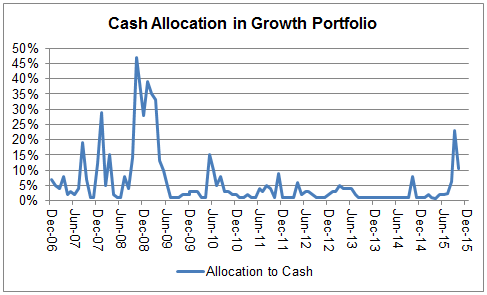
Source: Dorsey Wright, cash allocation of a sample Growth portfolio from 12/31/06 - 10/31/15.
Performance of the strategy is shown below:


Inception 12/31/06. Performance updated through 10/31/15
Over this period of time, the Systematic RS Growth portfolio has outperformed the S&P 500 by 2.02% annually on a net basis with lower standard deviation than the S&P 500. Those are the investment advantages. However, the emotional aspect of this type of portfolio shouldn’t be overlooked. My experience in consulting with investors in this strategy over the years is that they take great comfort in knowing that this portfolio has the ability to raise some cash at times. Keeping clients invested and committed to their investment plan is key to helping them ultimately achieve their financial goals.
Among the firms where this SMA is currently available:
- TD Ameritrade
- Charles Schwab
- Envestnet UMA
- Kovack Securities
- RBC Wealth Management
- Stifel Nicolaus
- Raymond James
Please e-mail [email protected] for a fact sheet or call 626-535-0630.
Click here for important disclosures. The relative strength strategy is NOT a guarantee. There may be times where all investments and strategies are unfavorable and depreciate in value. The percentage allocation to cash shown in the chart above reflects a monthly snapshot of the holdings.







