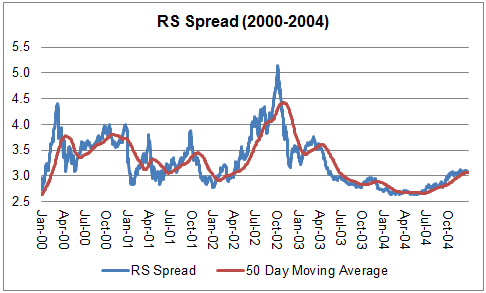
One of our favorite indicators for gauging the performance of relative strength strategies is the Relative Strength Spread. The way that we calculate the RS Spread is to divide the RS leaders by the RS laggards (top quartile of stocks in our ranks divided by the bottom quartile of stocks in our ranks; universe of U.S. mid and large cap stocks). When the chart is rising, relative strength leaders are performing better than relative strength laggards.
See below for both the long-term RS Spread as well as the RS Spread broken down into approximately 5-year chunks:




Some observations:
- The long-term chart of the RS Spread (1990-2016*) reflects the vastly superior performance of the RS leaders compared to the RS laggards over time. The ratio started at 1.00 on March 14, 1990 and had risen to 4.59 by January 21, 2016.
- Three of those approximately 5-year periods were very favorable to RS strategies: 1990-1994, 1995-1999, and 2010-2016*
- The RS Spread made no real net gains in two of the periods: 2000-2004 and 2005-2009
- The RS Spread tended to do the worst following major bear markets—periods of sharp laggard rallies
- The RS Spread tended to do the best during periods of stable leadership
- The RS Spread was flat from late 2009-late 2014, but has broken to the upside in a major way in recent years
There is always a desire on the part of investors to try to time exposure to different strategies like relative strength and value. Maybe some can pull the timing off well, but I think most investors would benefit most from relative strength strategies by simply doing sufficient homework to understand its long-term performance characteristics and then to allocate a portion of their money to disciplined RS strategies. Investors may then want to seek out uncorrelated strategies (like value) to round out their overall asset allocation. Sometimes relative strength investors have to be patient while RS comes back in favor, but I am not aware of any other strategy that compares as favorably over time.
*Data range: March 14, 1990 – January 21, 2016. This example is presented for illustrative purposes only and does not represent a past recommendation. The performance above is based on pure price returns, not inclusive of dividends or all transaction costs. Investors cannot invest directly in an index. Indexes have no fees. The relative strength strategy is NOT a guarantee. There may be times where all investments and strategies are unfavorable and depreciate in value.









