Avoid the Winners?

February 11, 2016

How hard is it to hold onto high relative strength stocks? Regarding high momentum stocks, The Motley Fool provocatively says, “Even with a time machine, a lot of people wouldn’t want to own the best-performing stocks.”

Monster Beverage (NASDAQ: MNST) was the best-performing stock from 1995 to 2015. It increased 105,000%, turning $10,000 into more than $10 million.

But this isn’t a retrospective about how you should wish you owned Monster stock. It’s almost the opposite.

The truth is that Monster has been a gut-wrenching nightmare to own over the last 20 years. It traded below its previous all-time high on 96% of days during that period. On average, its stock was 26% below its high of the previous two years. It suffered four separate drops of 50% or more. It lost more than two-thirds of its value twice, and more than three-quarters once.

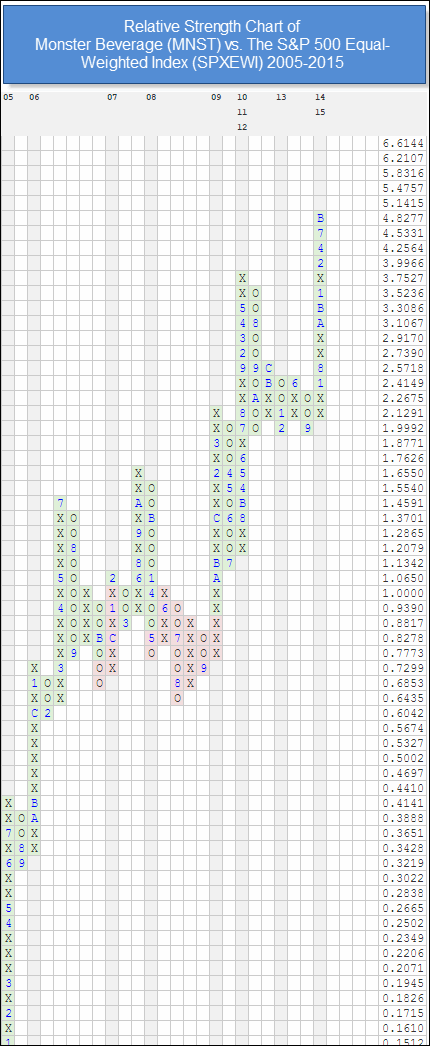
With that commentary in mind, consider a relative strength chart of MNST for the last 10 of those 20 years (2005-2015):
mnst

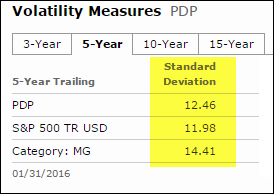
The green-shaded areas are when MNST was on a PnF buy signal and the red-shaded areas are when MNST was on a PnF sell signal. When buy and sell decisions are driven by longer-term relative strength signals as opposed to a trend chart of the stock, investing in high momentum stocks becomes easier. Relative strength signals filter out much of the day-to-day noise that can give a discretionary investor an ulcer. Furthermore, putting all your eggs in one basket with an investment in one momentum stock is one thing, but investing in a basket of momentum stocks is quite another. Will the basket of high momentum stocks have a standard deviation higher than that of the market—most likely yes. However, due to the fact that it is highly unlikely that a basket of high momentum stocks will all have a correlation of 1, the entire basket or portfolio of high momentum stocks may not have a standard deviation much higher than that of the broad equity market over time. For example, consider the 5-year standard deviation of the PowerShares DWA Momentum Portfolio (PDP) compared to that of the S&P; 500:
stdev

Source: Morningstar, a/o 1/31/16

PDP’s standard deviation is 12.46% compared to 11.98% for the S&P; 500. Not nearly as scary as the momentum naysayers would have you believe. Don’t get me wrong, I’m not saying that investing in high momentum stocks is a walk in the park. I’m just saying that I believe it is worth it.

This example is presented for illustrative purposes only and does not represent a past recommendation. Dorsey Wright currently owns MNST. A list of all holdings for the trailing 12 months is available upon request. Dorsey Wright is the index provider for PDP. See www.powershares.com for a prospectus. Standard deviation figures in are calculated using total returns, inclusive of dividends. The relative strength strategy is NOT a guarantee. There may be times where all investments and strategies are unfavorable and depreciate in value.

Posted by:


Weekly RS Recap

February 8, 2016

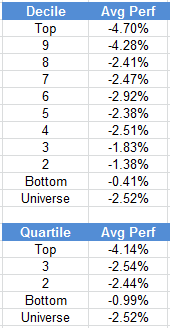
The table below shows the performance of a universe of mid and large cap U.S. equities, broken down by relative strength decile and quartile and then compared to the universe return. Those at the top of the ranks are those stocks which have the best intermediate-term relative strength. Relative strength strategies buy securities that have strong intermediate-term relative strength and hold them as long as they remain strong.

Last week’s performance (2/1/16 – 2/5/16) is as follows:

ranks

This example is presented for illustrative purposes only and does not represent a past recommendation. The performance above is based on pure price returns, not inclusive of dividends or all transaction costs. Past performance is not indicative of future results. Potential for profits is accompanied by possibility of loss.

Posted by:


Sector Performance

February 5, 2016

The table below shows performance of US sectors over the trailing 12, 6, and 1 month(s). Performance updated through 2/4/16.

sector

The performance above is based on pure price returns, not inclusive of dividends or all transaction costs. Past performance is not indicative of future results. Potential for profits is accompanied by possibility of loss. Source: iShares

Posted by:


Systematic RS Growth

February 5, 2016

“How do you manage risk?” Not surprisingly, the recent stock market correction has once again brought this question to the forefront of investor’s minds.

How we manage risk depends on the strategy. For some of our portfolios, rotating out of equities and into fixed income, currencies, or even inverse equities is an option. However, for our Systematic RS Growth portfolio, risk management is handled, in part, by employing an exposure overlay that, when activated, causes sales to go to cash and not be reinvested until indicated. This portfolio invests in up to 25 U.S. Mid and Large Cap equities demonstrating, what we believe to be, favorable relative strength characteristics. The strategy will hold up to 50% cash if necessary. Our exposure to cash in this portfolio is shown below:

growth_cash

Source: Dorsey Wright. As of 1/31/16. Estimate based on monthly cash values of a sample Growth portfolio.

Using cash as a way to seek to mitigate market losses has real appeal to investors who want to invest in equities, but also want to know that that there is a plan for risk management. Over time, the results have been very good as shown below. While the portfolio has still had periods where it has lost money, the cash overlay has indeed helped to buffer some of the downside risk.

growth 1

growth 2

growth 3

As of 1/31/16

Since 12/31/2006, this portfolio has been able to outperform the S&P; 500 by 2.03% annually on a net basis.

Contact Andy at 626-535-0630 or [email protected] to request a fact sheet. Click here for a list of platforms where our separately managed accounts are available.

Historical Performance Of the Dorsey, Wright Systematic Relative Strength Growth Strategy: The performance represented in this brochure is based on monthly performance of the Systematic Relative Strength Growth Model. Net performance shown is total return net of management fees for all Dorsey, Wright & Associates managed accounts, managed for each complete quarter for each objective, regardless of levels of fixed income and cash in each account. The advisory fees are described in Part II of the adviser’s Form ADV. The starting values on 12/31/2006 are assigned an arbitrary value of 100 and statement portfolios are revalued on a trade date basis on the last day of each quarter. All returns since inception of actual Accounts are compared against the S&P; 500 Index. The S&P; 500 is a stock market index based on the market capitalizations of 500 leading companies publicly traded in the U.S. stock market, as defined by Standard & Poor’s. A list of all holdings over the past 12 months is available upon request. The performance information is based on data supplied by the Manager or from statistical services, reports, or other sources which the Manager believes are reliable. Past performance does not guarantee future results. In all securities trading, there is a potential for loss as well as profit. It should not be assumed that recommendations made in the future will be profitable or will equal the performance as shown. Investors should have long-term financial objectives when working with Dorsey, Wright & Associates. The inception for this strategy was 12/31/1994. However, the strategy underwent a material change that was complete on 12/31/2006. The material changes included adding an exposure overlay and a systematic stock selection process.

Posted by:


Systematic RS International

February 5, 2016

There may be some truth to the idea that there are greater opportunities for outperformance in less efficient markets. That has certainly been the case in our line-up of separately managed accounts. The strategy where we have been able to generate the largest margin of outperformance over time has been our Systematic RS International portfolio.

As shown below, this portfolio has outperformed its benchmark by 6.56 percent annually (net) since its inception of 3/31/2006.

int'l 1

As of 1/31/16

Characteristics of our Systematic RS International portfolio:

  • Invests in 30-40 international stocks out of an investment universe of several hundred American Depository Receipts (ADR’s).
  • Invests in Small, Mid, and Large-Cap stocks
  • Relative Strength determines which securities are bought and when they are sold
  • Minimum investment is $100,000
  • Available as a separately managed account on many different platforms.

Top holdings as of 1/31/16 are shown below:

int'l 2

To learn more about this portfolio, please call 626-535-0630 or e-mail [email protected].

Historical Performance of the Dorsey, Wright Systematic Relative Strength International Strategy

The performance represented in this brochure is based on monthly performance of the Systematic Relative Strength International Model. Net performance shown is total return net of management fees for all Dorsey, Wright & Associates managed accounts, managed for each complete quarter for each objective, regardless of levels of fixed income and cash in each account. The advisory fees are described in Part II of the adviser’s Form ADV. The starting values on 3/31/2006 are assigned an arbitrary value of 100 and statement portfolios are revalued on a trade date basis on the last day of each quarter. All returns since inception of actual Accounts are compared against the MSCI EAFE Total Return Index. The MSCI EAFE Total Return Index is a stock market index that is designed to measure the equity market performance of developed markets outside of the United States and Canada and is maintained by MSCI Barra. A list of all holdings over the past 12 months is available upon request. The performance information is based on data supplied by the Manager or from statistical services, reports, or other sources which the Manager believes are reliable.

There are risks inherent in international investments, which may make such investments unsuitable for certain clients. These include, for example, economic, political, currency exchange, rate fluctuations, and limited availability of information on international securities.

Past performance does not guarantee future results. In all securities trading, there is a potential for loss as well as profit. It should not be assumed that recommendations made in the future will be profitable or will equal the performance as shown. Investors should have long-term financial objectives when working with Dorsey, Wright & Associates.

Posted by:


Instability At The Top

February 3, 2016

It requires a huge run of success to make it into the list of the top 5 stocks based on market capitalization, but how durable is the performance of those mega caps after they make it to the top? Justin Fox at Bloomberg took a look at this question. Consider the following two charts. The first chart shows today’s top 5 market-cap stocks (Alphabet/Google, Apple, Microsoft, Facebook, and Berkshire Hathaway) and the trajectory they took to get there.

today's top 5

The second chart looks at the top 5 market cap stocks from a decade ago (Exxon Mobil, General Electric, Microsoft, BP, and Citigroup), and how they have fared since.

top 5 from a decade ago

Only Microsoft remains in both lists. In fact, Microsoft was the only one of those stocks that beat the S&P; 500 over the past decade. Two of the stocks are still well underwater from where they were a decade ago.

return

Source: Yahoo! Finance. Returns are inclusive of dividends, but do not include any transaction costs. 2/2/06 – 2/2/16

Admittedly, this is not a comprehensive study. Rather, it simply illustrates the fact that success is not guaranteed. Just because a company has been successful in the past does not guarantee that it will be successful in the future. As we commonly point out, there is no shortage of data showing the rationale for buying high momentum stocks. Sometimes those high momentum stocks are also mega-cap stocks. However, having a good sell discipline is essential!

This example is presented for illustrative purposes only and does not represent a past recommendation. The relative strength strategy is NOT a guarantee. There may be times where all investments and strategies are unfavorable and depreciate in value.

Posted by:


High RS Diffusion Index

February 3, 2016

The chart below measures the percentage of high relative strength stocks (top quartile of our ranks) that are trading above their 50-day moving average (universe of mid and large cap stocks.) As of 2/2/16.

diffusion

The 10-day moving average of this indicator is 33% and the one-day reading is 44%. Dips in this index have often provided good opportunities to add money to relative strength strategies.

This example is presented for illustrative purposes only and does not represent a past recommendation. The performance above is based on pure price returns, not inclusive of dividends or all transaction costs. Investors cannot invest directly in an index. Indexes have no fees. Past performance is not indicative of future results. Potential for profits is accompanied by possibility of loss.

Posted by:


Relative Strength Spread

February 2, 2016

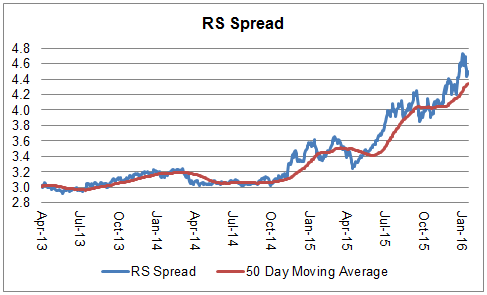
The chart below is the spread between the relative strength leaders and relative strength laggards (top quartile of stocks in our ranks divided by the bottom quartile of stocks in our ranks; universe of U.S. mid and large cap stocks). When the chart is rising, relative strength leaders are performing better than relative strength laggards. As of 2/1/16:

spread

This example is presented for illustrative purposes only and does not represent a past recommendation. The performance above is based on pure price returns, not inclusive of dividends or all transaction costs. Investors cannot invest directly in an index. Indexes have no fees. Past performance is not indicative of future results. Potential for profits is accompanied by possibility of loss.

Posted by:


Dorsey Wright Separately Managed Accounts

February 1, 2016

Picture1

Our Systematic Relative Strength portfolios are available as separately managed accounts at a large and growing number of firms.

  • Wells Fargo Advisors (Global Macro available on the Masters/DMA Platforms)
  • Morgan Stanley (IMS Platform)
  • TD Ameritrade Institutional
  • UBS Financial Services (Aggressive and Core are available on the MAC Platform)
  • RBC Wealth Management (MAP Platform)
  • Raymond James (Outside Manager Platform)
  • Stifel Nicolaus
  • Kovack Securities (Growth and Global Macro approved)
  • Charles Schwab Institutional (Marketplace Platform)
  • Envestnet UMA (Growth, Aggressive, Core, Balanced, and Global Macro approved)
  • Fidelity Institutional

Different Portfolios for Different Objectives: Descriptions of our seven managed accounts strategies are shown below. All managed accounts use relative strength as the primary investment selection factor.

Aggressive: This Mid and Large Cap U.S. equity strategy seeks to achieve long-term capital appreciation. It invests in securities that demonstrate powerful relative strength characteristics and requires that the securities maintain strong relative strength in order to remain in the portfolio.

Core: This Mid and Large Cap U.S. equity strategy seeks to achieve long-term capital appreciation. This portfolio invests in securities that demonstrate powerful relative strength characteristics and requires that the securities maintain strong relative strength in order to remain in the portfolio. This strategy tends to have lower turnover and higher tax efficiency than our Aggressive strategy.

Growth: This Mid and Large Cap U.S. equity strategy seeks to achieve long-term capital appreciation with some degree of risk mitigation. This portfolio invests in securities that demonstrate powerful relative strength characteristics and requires that the securities maintain strong relative strength in order to remain in the portfolio. This portfolio also has an equity exposure overlay that, when activated, allows the account to hold up to 50% cash if necessary.

International: This All-Cap International equity strategy seeks to achieve long-term capital appreciation through a portfolio of international companies in both developed and emerging markets. This portfolio invests in those securities with powerful relative strength characteristics and requires that the securities maintain strong relative strength in order to remain in the portfolio. Exposure to international markets is achieved through American Depository Receipts (ADRs).

Global Macro: This global tactical asset allocation strategy seeks to achieve meaningful risk diversification and investment returns. The strategy invests across multiple asset classes: Domestic Equities (long & inverse), International Equities (long & inverse), Fixed Income, Real Estate, Currencies, and Commodities. Exposure to each of these areas is achieved through exchange-traded funds (ETFs).

Balanced: This strategy includes equities from our Core strategy (see above) and high-quality U.S. fixed income in approximately a 60% equity / 40% fixed income mix. This strategy seeks to provide long-term capital appreciation and income with moderate volatility.

Tactical Fixed Income: This strategy seeks to provide current income and strong risk-adjusted fixed income returns. The strategy invests across multiple sectors of the fixed income market: U.S. government bonds, investment grade corporate bonds, high yield bonds, Treasury inflation protected securities (TIPS), convertible bonds, and international bonds. Exposure to each of these areas is achieved through exchange-traded funds (ETFs).

Picture2

To receive fact sheets for any of the strategies above, please e-mail Andy Hyer at [email protected] or call 626-535-0630. Past performance is no guarantee of future returns. An investor should carefully review our brochure and consult with their financial advisor before making any investments.

Posted by:


The Great Surge

February 1, 2016

Finished The Great Surge, The Ascent of the Developing World by Steven Radelet over the weekend. Here’s one excerpt that I found particularly insightful:

I believe that during the next twenty years, the great surge of development progress can continue. If it does, 700 million more people will be lifted out of extreme poverty, incomes in developing countries will more than double again, childhood death will continue to decline, hundreds of millions of children will get the educations they deserve, and basic rights and democratic freedoms will spread further around the world. China’s growth rate will slow gradually rather than abruptly, and it will move–with some disruptions–closer to a more open and democratic society rather than the other way around. India will continue its uneven ascendancy, and the majority of developing countries will continue to achieve moderate or rapid growth. New technologies will help fight diseases, increase agricultural production, and expand cleaner sources of energy. Global governance systems and international organizations will evolve to include developing countries and be more effective in meeting the world’s challenges. The world will be a safer, healthier, and more prosperous place…

…It’s easy to be pessimistic about the future. It’s also easy to forget that people have despaired about the future of the planet since the earliest civilizations. It may be true that some of the challenges the world faces today are greater than those of the past, but so are the world’s capacities to meet these challenges.

Posted by:


Weekly RS Recap

February 1, 2016

The table below shows the performance of a universe of mid and large cap U.S. equities, broken down by relative strength decile and then compared to the universe return. Those at the top of the ranks are those stocks which have the best intermediate-term relative strength. Relative strength strategies buy securities that have strong intermediate-term relative strength and hold them as long as they remain strong.

Last week’s performance (1/25/16 – 1/29/16) is as follows:

perf ranks

This example is presented for illustrative purposes only and does not represent a past recommendation. The performance above is based on pure price returns, not inclusive of dividends or all transaction costs. Past performance is not indicative of future results. Potential for profits is accompanied by possibility of loss.

Posted by: