How hard is it to hold onto high relative strength stocks? Regarding high momentum stocks, The Motley Fool provocatively says, “Even with a time machine, a lot of people wouldn’t want to own the best-performing stocks.”
Monster Beverage (NASDAQ: MNST) was the best-performing stock from 1995 to 2015. It increased 105,000%, turning $10,000 into more than $10 million.
But this isn’t a retrospective about how you should wish you owned Monster stock. It’s almost the opposite.
The truth is that Monster has been a gut-wrenching nightmare to own over the last 20 years. It traded below its previous all-time high on 96% of days during that period. On average, its stock was 26% below its high of the previous two years. It suffered four separate drops of 50% or more. It lost more than two-thirds of its value twice, and more than three-quarters once.
With that commentary in mind, consider a relative strength chart of MNST for the last 10 of those 20 years (2005-2015):
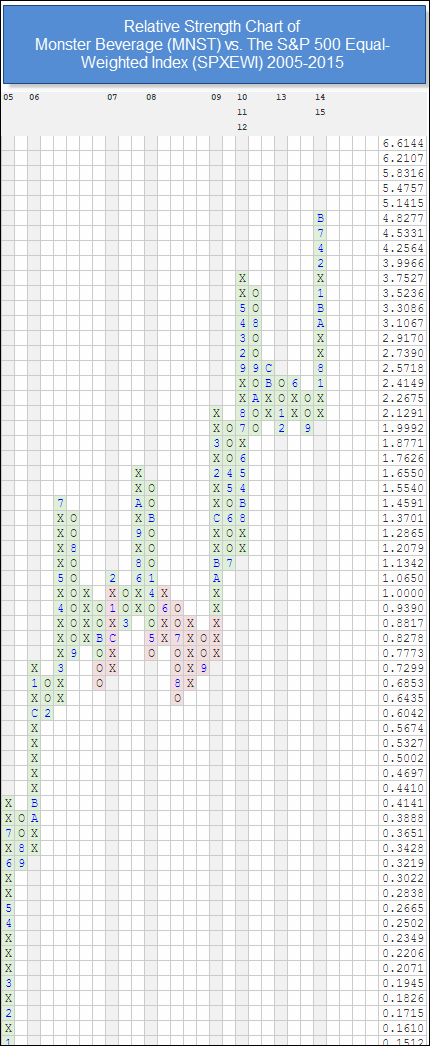
The green-shaded areas are when MNST was on a PnF buy signal and the red-shaded areas are when MNST was on a PnF sell signal. When buy and sell decisions are driven by longer-term relative strength signals as opposed to a trend chart of the stock, investing in high momentum stocks becomes easier. Relative strength signals filter out much of the day-to-day noise that can give a discretionary investor an ulcer. Furthermore, putting all your eggs in one basket with an investment in one momentum stock is one thing, but investing in a basket of momentum stocks is quite another. Will the basket of high momentum stocks have a standard deviation higher than that of the market—most likely yes. However, due to the fact that it is highly unlikely that a basket of high momentum stocks will all have a correlation of 1, the entire basket or portfolio of high momentum stocks may not have a standard deviation much higher than that of the broad equity market over time. For example, consider the 5-year standard deviation of the PowerShares DWA Momentum Portfolio (PDP) compared to that of the S&P; 500:
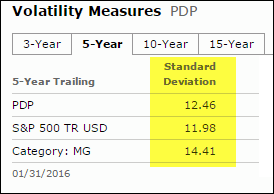
Source: Morningstar, a/o 1/31/16
PDP’s standard deviation is 12.46% compared to 11.98% for the S&P; 500. Not nearly as scary as the momentum naysayers would have you believe. Don’t get me wrong, I’m not saying that investing in high momentum stocks is a walk in the park. I’m just saying that I believe it is worth it.
This example is presented for illustrative purposes only and does not represent a past recommendation. Dorsey Wright currently owns MNST. A list of all holdings for the trailing 12 months is available upon request. Dorsey Wright is the index provider for PDP. See www.powershares.com for a prospectus. Standard deviation figures are calculated using total returns, inclusive of dividends. The relative strength strategy is NOT a guarantee. There may be times where all investments and strategies are unfavorable and depreciate in value.





MNST has been in PDP since inception?
One of the criteria for inclusion in PDP is that a stock be on a PnF buy signal against the market. So any time a stock doesn’t meet that criteria (and a few others) at the time we do our quarterly rebalance, that stock will not be in the index.