Systematic Relative Strength Portfolios (SMA/UMA Platforms)

September 28, 2016

Picture1

Our Systematic Relative Strength portfolios are available as separately managed accounts at a large and growing number of firms.

  • Wells Fargo Advisors (Global Macro available on the Masters/DMA Platforms)
  • Morgan Stanley (IMS Platform)
  • TD Ameritrade Institutional
  • UBS Financial Services (Aggressive and Core are available on the MAC Platform)
  • RBC Wealth Management (MAP Platform)
  • Raymond James (Outside Manager Platform)
  • Stifel (Opportunity Platform)
  • Kovack Securities (Growth and Global Macro approved on the UMA Platform)
  • Charles Schwab Institutional (Marketplace Platform)
  • Envestnet UMA
  • Fidelity Institutional
  • Adhesion Wealth

Different Portfolios for Different Objectives: Descriptions of our seven managed accounts strategies are shown below. All managed accounts use relative strength as the primary investment selection factor.

Aggressive: This Mid and Large Cap U.S. equity strategy seeks to achieve long-term capital appreciation. It invests in securities that demonstrate powerful relative strength characteristics and requires that the securities maintain strong relative strength in order to remain in the portfolio.

Core: This Mid and Large Cap U.S. equity strategy seeks to achieve long-term capital appreciation. This portfolio invests in securities that demonstrate powerful relative strength characteristics and requires that the securities maintain strong relative strength in order to remain in the portfolio. This strategy tends to have lower turnover and higher tax efficiency than our Aggressive strategy.

Growth: This Mid and Large Cap U.S. equity strategy seeks to achieve long-term capital appreciation with some degree of risk mitigation. This portfolio invests in securities that demonstrate powerful relative strength characteristics and requires that the securities maintain strong relative strength in order to remain in the portfolio. This portfolio also has an equity exposure overlay that, when activated, allows the account to hold up to 50% cash if necessary.

International: This All-Cap International equity strategy seeks to achieve long-term capital appreciation through a portfolio of international companies in both developed and emerging markets. This portfolio invests in those securities with powerful relative strength characteristics and requires that the securities maintain strong relative strength in order to remain in the portfolio. Exposure to international markets is achieved through American Depository Receipts (ADRs).

Global Macro: This global tactical asset allocation strategy seeks to achieve meaningful risk diversification and investment returns. The strategy invests across multiple asset classes: Domestic Equities (long & inverse), International Equities (long & inverse), Fixed Income, Real Estate, Currencies, and Commodities. Exposure to each of these areas is achieved through exchange-traded funds (ETFs).

Balanced: This strategy includes equities from our Core strategy (see above) and high-quality U.S. fixed income in approximately a 60% equity / 40% fixed income mix. This strategy seeks to provide long-term capital appreciation and income with moderate volatility.

Tactical Fixed Income: This strategy seeks to provide current income and strong risk-adjusted fixed income returns. The strategy invests across multiple sectors of the fixed income market: U.S. government bonds, investment grade corporate bonds, high yield bonds, Treasury inflation protected securities (TIPS), convertible bonds, and international bonds. Exposure to each of these areas is achieved through exchange-traded funds (ETFs).

Picture2

To receive fact sheets for any of the strategies above, please e-mail Andy Hyer at [email protected] or call 626-535-0630. Past performance is no guarantee of future returns. An investor should carefully review our brochure and consult with their financial advisor before making any investments.

Posted by:


Dialing Down the Noise

September 27, 2016

The Harvard Business Review’s October 2016 Issue includes a deep look at decision making by authors Kahneman, Rosenfield, Ghandhi, and Blaser. Their conclusion: “noise”, left unchecked, renders decision making highly inconsistent.

At a global financial services firm we worked with, a longtime customer accidentally submitted the same application file to two offices. Though the employees who reviewed the file were supposed to follow the same guidelines—and thus arrive at similar outcomes—the separate offices returned very different quotes. Taken aback, the customer gave the business to a competitor. From the point of view of the firm, employees in the same role should have been interchangeable, but in this case they were not. Unfortunately, this is a common problem.

Professionals in many organizations are assigned arbitrarily to cases: appraisers in credit-rating agencies, physicians in emergency rooms, underwriters of loans and insurance, and others. Organizations expect consistency from these professionals: Identical cases should be treated similarly, if not identically. The problem is that humans are unreliable decision makers; their judgments are strongly influenced by irrelevant factors, such as their current mood, the time since their last meal, and the weather. We call the chance variability of judgments noise. It is an invisible tax on the bottom line of many companies.

Some jobs are noise-free. Clerks at a bank or a post office perform complex tasks, but they must follow strict rules that limit subjective judgment and guarantee, by design, that identical cases will be treated identically. In contrast, medical professionals, loan officers, project managers, judges, and executives all make judgment calls, which are guided by informal experience and general principles rather than by rigid rules. And if they don’t reach precisely the same answer that every other person in their role would, that’s acceptable; this is what we mean when we say that a decision is “a matter of judgment.” A firm whose employees exercise judgment does not expect decisions to be entirely free of noise. But often noise is far above the level that executives would consider tolerable—and they are completely unaware of it.

The prevalence of noise has been demonstrated in several studies. Academic researchers have repeatedly confirmed that professionals often contradict their own prior judgments when given the same data on different occasions. For instance, when software developers were asked on two separate days to estimate the completion time for a given task, the hours they projected differed by 71%, on average. When pathologists made two assessments of the severity of biopsy results, the correlation between their ratings was only .61 (out of a perfect 1.0), indicating that they made inconsistent diagnoses quite frequently. Judgments made by different people are even more likely to diverge. Research has confirmed that in many tasks, experts’ decisions are highly variable: valuing stocks, appraising real estate, sentencing criminals, evaluating job performance, auditing financial statements, and more. The unavoidable conclusion is that professionals often make decisions that deviate significantly from those of their peers, from their own prior decisions, and from rules that they themselves claim to follow.

My emphasis added. Among the author’s proposed solutions to the “noise” problem was the was following:

The most radical solution to the noise problem is to replace human judgment with formal rules—known as algorithms—that use the data about a case to produce a prediction or a decision. People have competed against algorithms in several hundred contests of accuracy over the past 60 years, in tasks ranging from predicting the life expectancy of cancer patients to predicting the success of graduate students. Algorithms were more accurate than human professionals in about half the studies, and approximately tied with the humans in the others. The ties should also count as victories for the algorithms, which are more cost-effective.

This will sound very similar to advice that Dorsey Wright has been giving for many years: Embrace models! Try as we might to be consistent, without the framework of a systematic investment model, our own subjective decision making will be all over the place. Then, how can we tell if our investment success or failure is the result of skill or just good or bad luck? Of course, you can’t simply blindly adhere to just any systematic investment model. The decision rules upon which the model has been built must stack the odds in your favor. Extensive testing, as is detailed here, has give us the necessary input to build systematic relative strength strategies that “dial down the noise” and allow us to focus on execution of a well-designed investment process.

Focus on the process and the results will take care of themselves.

The relative strength strategy is NOT a guarantee. There may be times where all investments and strategies are unfavorable and depreciate in value.

Posted by:


Weekly RS Recap

September 26, 2016

The table below shows the performance of a universe of mid and large cap U.S. equities, broken down by relative strength decile and then compared to the universe return. Those at the top of the ranks are those stocks which have the best intermediate-term relative strength. Relative strength strategies buy securities that have strong intermediate-term relative strength and hold them as long as they remain strong.

Last week’s performance (9/19/16 – 9/23/16) is as follows:

ranks

This example is presented for illustrative purposes only and does not represent a past or present recommendation. The relative strength strategy is NOT a guarantee. There may be times where all investments and strategies are unfavorable and depreciate in value. The performance above is based on pure price returns, not inclusive of dividends, fees, or other expenses. Past performance is not indicative of future results. Potential for profits is accompanied by possibility of loss.

Posted by:


Relative Strength Spread

September 22, 2016

The chart below is the spread between the relative strength leaders and relative strength laggards (top quartile of stocks in our ranks divided by the bottom quartile of stocks in our ranks; universe of U.S. mid and large cap stocks). When the chart is rising, relative strength leaders are performing better than relative strength laggards. As of 9/21/16:

spread

The relative strength strategy is NOT a guarantee. There may be times where all investments and strategies are unfavorable and depreciate in value. Past performance is not indicative of future results. Potential for profits is accompanied by possibility of loss.

Posted by:


Momentum & Value vs. Growth & Value

September 20, 2016

At Dorsey Wright, we believe momentum can be used as a stand-alone investment strategy, however, combining it with other smart beta factors to which momentum is negatively correlated has its advantages. We have referenced this in previous blog posts, noting that it allows for a portfolio to capture alpha at different periods of the market cycle, which in turn can reduce both drawdowns and volatility. In this post we would like to discuss the potential benefits of combining momentum with value versus combining growth and value. Furthermore, we will take a look the correlation of excess returns for each portfolio, and wrap things up by comparing the returns of each.

To begin, let’s take a look at the side by side performance (annual figures) for the products we will be using in our study: PowerShares DWA Momentum Portfolio PDP, Russell 1000 Growth Index RLG, and the Guggenheim S&P; 500 Pure Value ETF RPV. We can reference this table in comparison to the results we get when combining the smart beta factors we mentioned earlier. In order to get proper historical data, we used the underlying index (total return) for both RLG and RPV. For PDP, total return figures were used starting on 3/1/2007. The table below confirms that when using each of these products as a stand-alone investment product. As we can see, momentum outperforms all other factors but also at a slightly elevated volatility. Perhaps the most surprising theme is the underperformance of the growth factor throughout this time frame.

all

PDP inception date: March 1, 2007, RLG inception date: May 22, 2000, RPV inception date: March 1, 2006 – data prior to inception is based on a back-test of the underlying indexes. Please see the disclosures for important information regarding back-testing. PDP returns do not include dividends prior to 3/1/2007. Returns do not include all potential transaction costs. Past performance is not indicative of future results. Potential for profits is accompanied by possibility of loss.

Next, let’s take a look at the correlation coefficients when comparing the returns of each portfolio. Below we’ve plotted the returns of each portfolio against each other on a year-to-year basis. The correlation of excess returns between PDP and RPV came out to be -.50 during this time period, just slightly better then RLG vs. RPV (which registered -.40). Again, both of these are impressive in terms of negative correlation which hopefully will give us the ability to capture alpha at different areas of the market cycle once we construct our portfolios. Typcially our goal in doing this is lowering portfolio volatility and reducing max drawdowns when compared to using them as stand alone investments.

pdp-vs-rpv

PDP inception date: March 1, 2007, RLG inception date: May 22, 2000, RPV inception date: March 1, 2006 – data prior to inception is based on a back-test of the underlying indexes. Please see the disclosures for important information regarding back-testing. PDP returns do not include dividend prior to 3/1/2007. Returns do not include all potential transaction costs. Past performance is not indicative of future results. Potential for profits is accompanied by possibility of loss.

rlg-vs-rpv

PDP inception date: March 1, 2007, RLG inception date: May 22, 2000, RPV inception date: March 1, 2006 – data prior to inception is based on a back-test of the underlying indexes. Please see the disclosures for important information regarding back-testing. PDP returns do not include dividend prior to 3/1/2007. Returns do not include all potential transaction costs. Past performance is not indicative of future results. Potential for profits is accompanied by possibility of loss.

In conclusion, the portfolios we will construct are going to be based on a static allocation of 70%/30%. To clarify, both the momentum and growth allocations will remain at 70%, while the value portion will be 30%. The portfolios are re-balanced annually (although as we mentioned the allocation will remain static). Looking at the table below, we can see that the momentum/value combination portfolio outperformed has over the growth/value combination. The returns are nearly double, while volatility remains the same at 22%. Market participants looking to combine a portion of their value portfolio with another allocation would certainly seem to benefit by using a momentum product vs. a growth product.

summary

PDP inception date: March 1, 2007, RLG inception date: May 22, 2000, RPV inception date: March 1, 2006 – data prior to inception is based on a back-test of the underlying indexes. Please see the disclosures for important information regarding back-testing. PDP returns do not include dividend prior to 3/1/2007. Returns do not include all potential transaction costs. Past performance is not indicative of future results. Potential for profits is accompanied by possibility of loss.

DWA provides the underlying index for PDP (discussed above) and receives licensing fees from Invesco PowerShares based on assets invested in the Fund.

Some information presented is the result of a strategy back-test. Back-tests are hypothetical (they do not reflect trading in actual accounts) and are provided for informational purposes to illustrate the effects of the strategy during a specific period. Back-tested results have certain limitations. Such results do not represent the impact of material economic and market factors might have on an investment advisor’s decision making process if the advisor were actually managing client money. Back-testing also differs from actual performance because it is achieved through retroactive application of a model investment methodology designed with the benefit of hindsight.

Neither the information within this email, nor any opinion expressed shall constitute an offer to sell or a solicitation or an offer to buy any securities, commodities or exchange traded products. This article does not purport to be complete description of the securities or commodities, markets or developments to which reference is made.

The relative strength strategy is NOT a guarantee. There may be times where all investments and strategies are unfavorable and depreciate in value. Relative Strength is a measure of price momentum based on historical price activity. Relative Strength is not predictive and there is no assurance that forecasts based on relative strength can be relied upon.

Posted by:


Small Caps On the Move

September 19, 2016

One of the simplest ways to determine the relative strength of small caps versus large caps is to use the SmartChart function to divide IWM (or another small cap ETF or index) by SPX. As shown below, large caps generally had the better relative strength in 2014 and 2015, as reflected by the declining RS chart, but it has been a different story in 2016. We have seen a series of higher highs and higher lows on the relative strength chart in 2016 as small cap indexes like the Russell 2000 have generally performed better than large caps.

iwm-vs-spx

Small cap momentum, however, had a slow start in the first half of the year, generally underperforming cap weighted small cap indexes like the Russell 2000. However, it looks like that may be changing. Our PowerShares DWA Small Cap Momentum ETF (DWAS) has pulled ahead of IWM so far in Q3 and both DWAS and IWM are well ahead of the S&P; 500 for the quarter as shown in the table below.

qtd_dwas_iwm_spx

Source: Dorsey Wright. *7/1/16 – 9/8/16. Price return only, not inclusive of dividends or transaction costs.

A quick review of the index construction process for The PowerShares DWA Small Cap Momentum ETF (DWAS):

  • Holds 200 stocks out of a universe of approximately 2,000 small cap stocks
  • Stocks are selected for this index based on PnF relative strength characteristics
  • The index is weighted by relative strength so that out of the 200 stocks that make it into the index, those with the better relative strength get the most weight
  • Rebalanced quarterly to remove any stocks that have lost sufficient relative strength and to replace them with stronger stocks

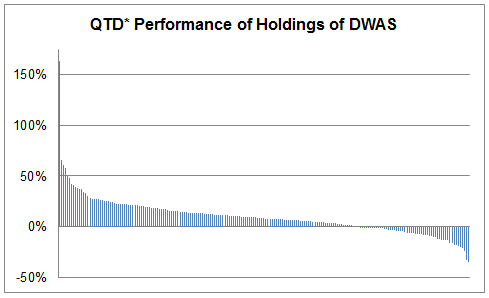
Among the things that we can control in this index construction process is to make sure that the process remains the same from one quarter to the next. All 200 stocks meet the necessary relative strength requirements to go into the index when it is rebalanced. Each quarter we see that some of those holdings continue to perform well and some of them don’t. Shown below is the quarter to date performance for the 200 holdings in DWAS so far in Q3.

dispersion_dwas

Source: Dorsey Wright. *7/1/16 – 9/8/16. Price return only, not inclusive of dividends or transaction costs.

The best performing holding is +162% and the worst performing holding is -34% so far this quarter. As is true each quarter, those stocks that maintain favorable relative strength will stay in the index and those that have sufficiently deteriorated will get replaced.

With U.S. equities ranked number 1 in DALI and with small caps showing improving relative strength, this may be an area that deserves some consideration.

Dorsey Wright is the index provider for a suite of momentum ETFs, including DWAS, at PowerShares. See www.powershares.com for more information. The relative strength strategy is NOT a guarantee. There may be times where all investments and strategies are unfavorable and depreciate in value.

Posted by:


Hedgeweek: Using Momentum to Invest in ADRs

September 13, 2016

Great new article by John Lewis in Hedgeweek:

American Depositary Receipts are an effective way for US investors to gain exposure to international stocks. Dorsey, Wright & Associates’ John Lewis explains how using a momentum strategy can prove effective in building the right exposure to this instrument class.

Read the full article here.

Posted by:


Weekly RS Recap

September 12, 2016

The table below shows the performance of a universe of mid and large cap U.S. equities, broken down by relative strength decile and quartile and then compared to the universe return. Those at the top of the ranks are those stocks which have the best intermediate-term relative strength. Relative strength strategies buy securities that have strong intermediate-term relative strength and hold them as long as they remain strong.

Last week’s performance (9/6/16 – 9/9/16) is as follows:

ranks

This example is presented for illustrative purposes only and does not represent a past or present recommendation. The relative strength strategy is NOT a guarantee. There may be times where all investments and strategies are unfavorable and depreciate in value. The performance above is based on pure price returns, not inclusive of dividends, fees, or other expenses. Past performance is not indicative of future results. Potential for profits is accompanied by possibility of loss.

Posted by:


It’s All At The Upper End

September 7, 2016

Almost all of the performance from a relative strength or momentum model comes from the upper end of the ranks. We run different models all the time to test different theories or to see how existing decision rules work on different groups of securities. Sometimes we are surprised by the results, sometimes we aren’t. But the more we run these tests, the more some clear patterns emerge.

One of these patterns we see constantly is all of the outperformance in a strategy coming from the very top of the ranks. People are often surprised at how quickly any performance advantage disappears as you move down the ranking scale. That is one of the things that makes implementing a relative strength strategy so difficult. You have to be absolutely relentless in pushing the portfolio toward the strength because there is often zero outperformance in aggregate from the stuff that isn’t at the top of the ranks. If you are the type of person that would rather “wait for a bounce” or “wait until I’m back to breakeven,” then you might as well just equal-weight the universe and call it a day.

Below is a chart from a sector rotation model I was looking at recently. This model uses the S&P; 500 GICS sub-sectors and the ranks were done using a point & figure matrix (ie, running each sub-sector against every other sub-sector) and the portfolio was rebalanced monthly. You can see the top quintile (ranks 80-100) performs quite well. After that, good luck. They are all clustered together well below the top quintile.

This is a constant theme we see. The very best sectors, stocks, markets, and so on drive almost all of the outperformance. If you miss a few of the best ones it is very difficult to outperform. If you are unwilling to constantly cut the losers and buy the winners because of some emotional hangup, it is extremely difficult to outperform. The basket of securities in a momentum strategy that delivers the outperformance is often smaller than you think, so it is crucial to keep the portfolio focused on the top-ranked securities.

The returns used within this article are the result of a back-test using indexes that are not available for direct investment. Returns do include dividends, but do not include transaction costs. Back-tested performance is hypothetical (it does not reflect trading in actual accounts) and is provided for informational purposes to illustrate the effects of the discussed strategy during a specific period. Back-tested performance results have certain limitations. Such results do not represent the impact of material economic and market factors might have on an investment advisor’s decision making process if the advisor were actually managing client money. Back-testing performance also differs from actual performance because it is achieved through retroactive application of a model investment methodology designed with the benefit of hindsight. Dorsey, Wright & Associates believes the data used in the testing to be from credible, reliable sources, however; Dorsey, Wright & Associates, LLC (collectively with its affiliates and parent company, “DWA”) makes no representation or warranties of any kind as to the accuracy of such data. Past performance is not indicative of future results. Potential for profits is accompanied by possibility of loss.

Posted by:


Weekly RS Recap

September 6, 2016

The table below shows the performance of a universe of mid and large cap U.S. equities, broken down by relative strength decile and quartile and then compared to the universe return. Those at the top of the ranks are those stocks which have the best intermediate-term relative strength. Relative strength strategies buy securities that have strong intermediate-term relative strength and hold them as long as they remain strong.

Last week’s performance (8/29/16 – 9/2/16) is as follows:

This example is presented for illustrative purposes only and does not represent a past or present recommendation. The relative strength strategy is NOT a guarantee. There may be times where all investments and strategies are unfavorable and depreciate in value. The performance above is based on pure price returns, not inclusive of dividends, fees, or other expenses. Past performance is not indicative of future results. Potential for profits is accompanied by possibility of loss.

Posted by:


AADR Investor Conference Call Recording

September 1, 2016

AADR Investor Conference Call Recording – Please click here to listen to John Lewis, Senior Vice President at Dorsey, Wright and Associates, who serves as AADR’s portfolio manager discuss the fund’s investment strategy in detail.

Click here for the press release detailing the announcement that Dorsey Wright was recently named the sub-advisor of this ETF.

See www.advisorshares.com for more information.

Posted by:


Dividend-Paying Stocks: Getting a Broader Picture

September 1, 2016

Among the biggest investor-driven trends in the market right now is the thirst for yield. The paltry yields available in most sectors of fixed income just are not providing the type of income that investors are looking for and so they are increasingly looking at earning that yield from dividend-paying stocks. However, an exclusive focus on yield provides an incomplete picture of the returns that an investor may achieve. There is also the performance of the stock itself that must be factored into the evaluation.

When we rank our universe of securities to construct the First Trust Dorsey Wright Dividend UITs, our relative strength ranks are determined by the total return of the stocks (price return + yield). For comparison’s sake, consider the construction methodology of the S&P; Dividend SPDR (SDY) which is based upon the S&P; High Yield Dividend Aristocrats Index. That index is designed to measure the performance of the highest dividend yielding S&P; Composite 1500 Index constituents that have followed a managed-dividends policy of consistently increasing dividends every year for at least 20 consecutive years.

In the table below, I show the top 10 holdings for both SDY and for the First Trust Dorsey Wright Relative Strength Dividend UIT, Series 22. While the top 10 holdings for SDY have a slightly higher yield, the top 10 holdings of the Dorsey Wright UIT have had better total returns over the past 12 months.

*DWA Top 10 is the top 10 holdings in the First Trust Dorsey Wright Relative Strength Dividend Top 50 UIT, Series 22. Performance 8/24/15 – 8/24/16. Source: Yahoo! Finance. Returns are inclusive of dividends, but do not include any transaction costs.

Evaluating dividend-paying stocks from a total return perspective seems to be fairly uncommon, yet it can make a significant difference in performance for the client while still allowing them to seek above-market yields.

Past performance is not indicative of future results. Potential for profits is accompanied by possibility of loss. See http://www.ftportfolios.com for more information.

Posted by: