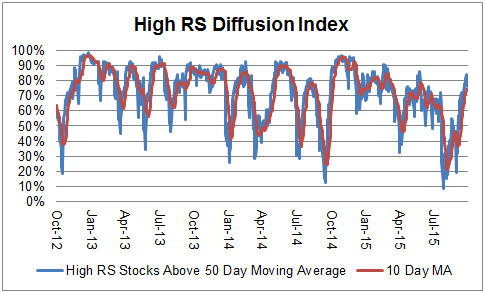
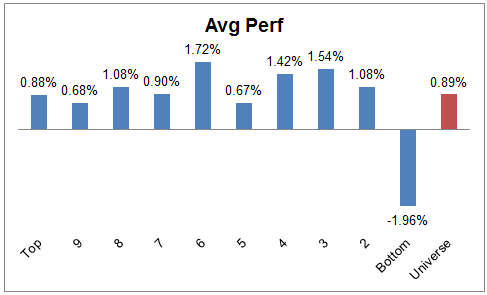
All 7 of our Systematic RS portfolios outperformed their benchmarks in November. In a year where the broad equity market has been relatively flat, our equity portfolios have excelled by finding pockets of strength. Detailed performance is shown below:

A brief overview of each of these separately managed account strategies is shown below:
Different Portfolios for Different Objectives
Aggressive: This Mid and Large Cap U.S. equity strategy seeks to achieve long-term capital appreciation. It invests in securities that demonstrate powerful relative strength characteristics and requires that the securities maintain strong relative strength in order to remain in the portfolio.
Core: This Mid and Large Cap U.S. equity strategy seeks to achieve long-term capital appreciation. This portfolio invests in securities that demonstrate powerful relative strength characteristics and requires that the securities maintain strong relative strength in order to remain in the portfolio. This strategy tends to have lower turnover and higher tax efficiency than our Aggressive strategy.
Growth: This Mid and Large Cap U.S. equity strategy seeks to achieve long-term capital appreciation with some degree of risk mitigation. This portfolio invests in securities that demonstrate powerful relative strength characteristics and requires that the securities maintain strong relative strength in order to remain in the portfolio. This portfolio also has an equity exposure overlay that, when activated, allows the account to hold up to 50% cash if necessary.
International: This All-Cap International equity strategy seeks to achieve long-term capital appreciation through a portfolio of international companies in both developed and emerging markets. This portfolio invests in those securities with powerful relative strength characteristics and requires that the securities maintain strong relative strength in order to remain in the portfolio. Exposure to international markets is achieved through American Depository Receipts (ADRs).
Global Macro: This global tactical asset allocation strategy seeks to achieve meaningful risk diversification and investment returns. The strategy invests across multiple asset classes: Domestic Equities (long & inverse), International Equities (long & inverse), Fixed Income, Real Estate, Currencies, and Commodities. Exposure to each of these areas is achieved through exchange-traded funds (ETFs).
Balanced: This strategy includes equities from our Core strategy (see above) and high-quality U.S. fixed income in approximately a 60% equity / 40% fixed income mix. This strategy seeks to provide long-term capital appreciation and income with moderate volatility.
Tactical Fixed Income: This strategy seeks to provide current income and strong risk-adjusted fixed income returns. The strategy invests across multiple sectors of the fixed income market: U.S. government bonds, investment grade corporate bonds, high yield bonds, Treasury inflation protected securities (TIPS), convertible bonds, and international bonds. Exposure to each of these areas is achieved through exchange-traded funds (ETFs).
To receive the brochure for these portfolios, please e-mail [email protected] or call 626-535-0630.
Total account performance shown is total return net of management fees for all Dorsey, Wright & Associates managed accounts, managed for each complete quarter for each objective, regardless of levels of fixed income and cash in each account. Information is from sources believed to be reliable, but no guarantee is made to its accuracy. This should not be considered a solicitation to buy or sell any security. Past performance should not be considered indicative of future results.
The S&P 500 is a stock market index based on the market capitalizations of 500 leading companies publicly traded in the U.S. stock market, as defined by Standard & Poor’s. The Barclays Aggregate Bond Index is a broad base index, maintained by Barclays Capital, and is used to represent investment grade bonds being traded in the United States. The 60/40 benchmark is 60% S&P 500 Total Return Index and 40% Barclays Aggregate Bond Index. The MSCI EAFE Total Return Index is a stock market index that is designed to measure the equity market performance of developed markets outside of the United States and Canada and is maintained by MSCI Barra. The Dow Jones Moderate Portfolio Index is a global asset allocation benchmark. 60% of the benchmark is represented equally with nine Dow Jones equity indexes. 40% of the benchmark is represented with five Barclays Capital fixed income indexes.
Each investor should carefully consider the investment objectives, risks and expenses of any Exchange-Traded Fund (“ETF”) prior to investing. Before investing in an ETF investors should obtain and carefully read the relevant prospectus and documents the issuer has filed with the SEC. ETFs may result in the layering of fees as ETFs impose their own advisory and other fees. To obtain more complete information about the product the documents are publicly available for free via EDGAR on the SEC website (http://www.sec.gov)
There are risks inherent in international investments, which may make such investments unsuitable for certain clients. These include, for example, economic, political, currency exchange, rate fluctuations, and limited availability of information on international securities.