More Money Has Been Lost Avoiding Risk Than at the Point of a Gun

June 14, 2011

That’s a paraphrase from Ray DeVoe’s old maxim about money being lost reaching for yield. For some reason—gee, I wonder if 2008 had anything to do with it?—investors are intensely allergic to equity risk right now. So, instead, they are buying safe things like structured notes. That hasn’t worked out too well. According to an article in Investment News:

Structured notes and other derivatives products have been marketed by Wall Street as safe and secure investments. Of course, there’s safe and then there’s safe. Retail investors of all stripes have lost at least $113 billion by purchasing these purportedly safe instruments, according to a new study conducted by the nonpartisan policy center Demos and The Nation Institute, a media think tank.

“In my three decades of Wall Street experience, I have not seen any other product as absurdly destructive as retail investments linked to structured products,” securities arbitration consultant Louis Straney wrote in the report.

We’ve written about this kind of karma boomerang before: the harder you try to avoid getting nailed, the more likely it is that you’ll get nailed by exactly what you are trying to avoid.

This happens because risk cannot be defined simply by volatility or capital loss. Risk is much more encompassing and there is no way to avoid it. Since you can’t avoid it, take your risk without significant leverage, in assets that have a chance to grow in value, in relatively liquid marketable instruments that you can understand—and do so in a systematic fashion.

homer points gun wallpaper   800x600 More Money Has Been Lost Avoiding Risk Than at the Point of a Gun

Do you feel lucky, punk? Do ya?

Source: www.simpsonwallpapers.net

Posted by:


Modern Portfolio Theory IS Harming Your Portfolio

June 7, 2011

This title is taken from a long blog post at Value Restoration Project—and no, I didn’t write it. The author, J.J. Abodeely, is a portfolio manager at Sitka Pacific Capital, and a CFA to boot. It’s nice to have some brothers-in-arms for a change! Mr. Abodeely bases a lot of his commentary on a recent article by Scott Vincent, available on the Social Science Research Network. Here’s the core of his argument:

In the paper Vincent argues that the flawed foundation of Modern Portfolio Theory (MPT) that risk=volatility has allowed MPT advocates to control the language of the debate and set the stage for the obvious conclusion that passive index-based investing is inherently superior. And don’t think for a second that this debate is simply theoretical, academic, or unimportant– the basic tenets of MPT shape the decisions of nearly every institutional money manager, wealth management firm, investment counselor/consultant, and financial planner in profound and often disturbing ways. YOUR money is almost certainly being managed with these ideas at the core. The traditional approach to asset allocation is built on false axioms.

While Vincent’s direct assault seems to be focused on highlighting the mistreatment of active, concentrated equity or fixed income asset managers vs. holding a passive equity or fixed income index, his arguments hold sway over the much larger and dangerous consequences of MPT on asset allocation. My assertion is that most damage to investors portfolios from the traditional approach to investing comes from the foundation of static, backward looking assumptions informing broad asset allocation decisions.

I put the good parts in bold—and I think you can make a good case for both of those statements. Instead of using static, backward-looking assumptions, I think it makes sense to examine tactical asset allocation, where asset weights can vary dynamically based on performance or valuation. To me, it makes no sense to assume, for example, that bonds are preferable as a client gets older, regardless of the interest rate environment or poor price performance. If an asset is performing poorly, why would any client be excited about holding it?

Strategic asset allocation is founded on the assumptions of Modern Portfolio Theory, and if the axioms are false, it is not surprising that it has not delivered in the way its apologists suggest it should. Most distressing to me is the fact that asset allocation models are most sensitive to the inputs for return, and return is the most variable input of the three (returns, correlations, and standard deviation). By definition, if your asset return assumptions are off, your asset allocation is wrong. And seriously, if you could actually forecast asset returns accurately, you wouldn’t need asset allocation—you’d just buy the best-performing asset. The greatest danger in strategic asset allocation, to me, is the assumption that past asset returns will be similar in the future.

I think that assumption is flat-out wrong, because it flies in the face of the observed life cycles of companies and economies. When companies are small, they are vulnerable. Many of them simply don’t make it and go out of business. Midsize companies that succeed often go through a very dynamic growth phase, where revenues and profits grow at a pace far beyond the growth rate of the underlying economy. Once companies become very large, it is almost impossible for them to grow at a rapid pace, simply because they are working off such a large base. It is pretty easy for a 20-store retailer to open ten new locations in a year and have 50% growth. To get 50% growth at Wal-Mart would require them to open 4,485 new locations in a year, more than 12 per day—and then 18 per day the following year to keep that growth rate up. That’s substantially more difficult.

Economies are no different. Developing economies can growth at a fast clip, but not forever. Once an economy is developed, the growth rate is going to slow down. Growth can be boosted by productivity enhancements and good incentives, but eventually broad market returns will be connected with revenues and profits in the underlying economy. In 1800, the US was an emerging market economy and the European economies were the developed markets. The US has gone through a long period of powerful growth and is now the largest economy in the world. As the Wal-Mart of world economies, we are not going to have the highest growth rate. That doesn’t mean we can’t have good stock market returns—and, clearly, plenty of dynamic individual companies will do fantastically well—but emerging markets are likely to have higher growth rates.

As a result, I think it is naive to assume that US returns will necessarily resemble what we’ve seen before. They will be lower than before if we pass the torch to more rapidly growing emerging economies, and they could be higher if emerging economies sabotage themselves with poor incentives or a lack of political stability. Money goes where it is treated best and that is always an open question in the future. Whatever the returns end up to be is a function of how we handle the future, not what has happened in the past. Asset allocation needs to be forward-looking to be relevant for investors’ performance in the future.

Posted by:


ETF Usage Continues to Grow

May 27, 2011

This Advisor Perspectives article is worth reading. Here is their summary:

More institutional investors are making ETFs part of their portfolio strategy, and that’s good news for retail investors. With many innovations, institutional investors are often the first in. Later the retail investors follow. ETFs, however, have shown a slightly different pattern. After 1993, when the first ETF was introduced in this country, ETFs were primarily of interest to institutional investors. At first, their main use was as a place to hold cash before investing in a new asset class, but institutions soon began using them for other purposes, such as tactical allocations and hedges.
We have seen tremendous interest and growth in our ETF-based separate account and mutual funds, particularly the go-anywhere Global Macro strategy. There is definitely strong interest among retail investors in a flexible product that uses tactical asset allocation. From a standing start in 2006 with Arrow Funds, we now manage about $800 million in ETFs!

See www.powershares.com for more information on our three DWA Technical Leaders Index ETFs (PDP, PIE, PIZ).

To obtain a fact sheet and prospectus for the Arrow DWA Tactical Fund (DWTFX) or the Arrow DWA Balanced Fund (DWAFX), click here.

Click here for disclosures. Past performance is no guarantee of future results.

Posted by:


Modern Portfolio Theory Is All Wrong

May 20, 2011

…according to a speaker at the recent IMCA conference. The speaker was Arun Muralidhar, an economist trained at the Sloan School of Management at the Massachusetts Institute of Technology. He is the former head of investment research for the World Bank, a former managing director at J.P. Morgan Investment Management and currently head of AlphaEngine Global Investment Solutions LLC.

What is his specific criticism? It has to do with the static nature of traditional portfolio theory. According to an article in Investment News:

The foundation of the CAPM investing model is to construct an optimal desired portfolio based on the investor’s objectives. As the market moves, the portfolio allocations are re-balanced to get it back to its optimal state. For example, if stock prices go up, a portfolio with 60% stocks and 40% bonds will become over-weighted in stocks. To prevent drift in the portfolio, the adviser re-balances by selling stocks and investing the proceeds in more bonds.

The benefit of this process is that it’s simple, transparent and easy to execute. However, a static re-balancing process does not work well in falling markets, Mr. Muralidhar said. The biggest risks faced by investors are large draw-downs in asset values, as it requires more substantial gains to recover the lost value. The re-balancing does nothing to prevent further losses when asset values plummet — as they did in the financial crisis.

“It’s like tieing the rudder on your ship in place and ignoring the winds and currents that you experience,” Mr. Muralidhar said.

How does he believe assets should be managed? Well, I’m feeling quite validated today. In fact, it sounds exactly like the systematic relative strength process we use.

The solution is for advisers to focus on using optimal investment strategies rather than maintaining optimal portfolios, he said. These strategies involve managing allocations more actively, based on market conditions. Mr. Muralidhar suggested advisers employ a “systematic management of assets using a rules-based technique” — “smart” investing.

Essentially, that involves an informed re-balancing of the portfolio toward the more-attractive assets and away from the less-attractive ones.

I added emphasis to the good parts. I think his focus on optimal investment strategies rather than optimal portfolios is quite insightful. We’ve long argued that the path to constructing better portfolios is to mix strategies, not just assets. As it turns out, relative strength and value are both excellent strategies—and they work extremely well in combination because the excess returns are uncorrelated. Unlike asset cross-correlations which can and do swing wildly up and down, strategy correlations are likely to be much more stable. The reason is simple: trend-following and trend reversion are opposites; stocks and bonds (or pick any asset pair) are not.

It’s nice to see an economist discussing the theoretical flaws in MPT that have been evident to thoughtful practitioners for years and years.

Posted by:


David Ricardo’s Golden Rules

April 20, 2011

Most people, if they have heard of David Ricardo at all, associate him with classical economics and the law of comparative advantage. What they don’t know is that David Ricardo was a trend follower—and made a fortune doing it.

David Ricardo was born in 1772, which ought to give you some idea just how robust trend following is and for how long it has worked. His father was a stockbroker, so he had some familiarity with financial markets. After an estrangement from his family from marrying outside his faith, he started his own brokerage business. He retired in 1814 (age 42) with a fortune of $65 million (in today’s dollars; 600,000 pounds sterling then) and bought Gatcombe Park, in Gloucestershire. (Today, Princess Anne lives at Gatcombe Park, a modest 730-acre estate, described as having five main bedrooms, four secondary bedrooms, four reception rooms, a library, a billiard room and a conservatory, as well as staff accommodations.)

 David Ricardos Golden Rules

David Ricardo: Millionaire Trend Follower

source: www.econc10.bu.edu

What was David Ricardo’s secret? According to an 1838 book, The Great Metropolis, Volume 2, by James Grant, it was what Ricardo referred to as his golden rules:

As I have mentioned the name of Mr. Ricardo, I may observe that he amassed his immense fortune by a scrupulous attention to what he called his own three golden rules, the observance of which he used to press on his private friends. These were, ” Never refuse an option* when you can get it,”—”Cut short your losses,”— ” Let your profits run on.” By cutting short one’s losses, Mr. Ricardo meant that when a member had made a purchase of stock, and prices were falling, he ought to resell immediately. And by letting one’s profits run on he meant, that when a member possessed stock, and prices were raising, he ought not to sell until prices had reached their highest, and were beginning again to fall. These are, indeed, golden rules, and may be applied with advantage to innumerable other transactions than those connected with the Stock Exchange.

The emphasis is mine, although I feel like the whole segment should be in bold!

Timeless investment wisdom: cut your losses and let your profits run! And further, even clarification of what Ricardo meant! If the price starts to fall, sell. If it is rising, stay with it until it begins to fall. Finally, the author points out that these golden rules may be applied to transactions other than those connected to the Stock Exchange. Indeed, it turns out that relative strength investing works in stocks and across sectors and asset classes, both domestically and internationally. And based on the story of David Ricardo, things haven’t changed much since 1800.

I think David Ricardo is now one of my favorite economists.

Hat tip to the World Beta blog and the Au.Tra.Sy blog for pointing me in the direction of this fantastic story.

Posted by:


Uncertainty and the Dart-Throwing Chimpanzee

April 11, 2011

I ran across a wonderful review of Dan Gardner’s new book, Future Babble. He discusses why pundits make predictions, why people listen to them, and why you would ultimately be better off with a dart-throwing chimpanzee. The fact is that experts are terrible at predictions:

In Future Babble, Gardner acknowledges his debt to political scientist Phililp Tetlock, who set up a 20-year experiment in which he enrolled nearly 300 experts in politics. Tetlock then solicited thousands of predictions about the fates of scores of countries and later checked how well they did. Not so well. Tetlock concluded that most of his experts would have been beaten by “a dart-throwing chimpanzee.” Tetlock found that the experts wearing rose-tinted glasses “assigned probabilities of 65 percent to rosy scenarios that materialized only 15 percent of the time.” Doomsters did even worse: “They assigned probabilities of 70 percent to bleak scenarios that materialized only 12 percent of the time.”

Why, then, do people even listen?

Besides making fun of the failures of the prognosticating class, Gardner also explains why so many of us keep falling for false prophesy: Humans beings hate uncertainty. Gardner offers myriad insights from research in cognitive psychology and behavioral economics that explains how and why we succumb to our desires for certainty. “Whether sunny or bleak, convictions about the future satisfy the hunger for certainty,” writes Gardner. “We want to believe. And so we do.”

It’s fine, I suppose, if you listen to forecasts for entertainment. But knowing the track record of forecasters, why in the heck would you ever base your investment policy on a forecast? I’m not talking about just extreme forecasts like the rosy scenario or gloom-and-doom. A pie chart that allocates assets based on a forecast of expected returns and expected correlations is no less a forecast—and no more likely to be accurate.

 Uncertainty and the Dart Throwing Chimpanzee

An Expert Pondering His Next Move in the Market

Source: www.blingcheese.com

Just because we hunger for certainty doesn’t mean it is available. The only thing I can forecast with any certainty is that things will continue to change in unpredictable ways. Price represents a market’s best guess about what might happen down the road, rightly or wrongly. Price is an informed guess; people are putting real money on the line. Research shows that prediction markets are often more accurate than experts. Relative strength is just a handy way to measure price and gauge what market participants are doing. There’s no guarantee that they will do the same thing tomorrow, but perceptions generally change gradually over time as new information comes to light, or new thinking about old information emerges. Staying with strong relative strength trends and departing when they weaken is the simplest way to stay in synch with the changing flow of information in the market.

Posted by:


Q1 Manager Insights

April 4, 2011

Click image below:

c1 Q1 Manager Insights

Posted by:


Too Much Information Makes Elvis Leave the Building

March 15, 2011

If your teenage sends you a text with “TMI” in it, you’ve overshared. Unfortunately for investors, the financial markets overshare all the time. The flow of information can be so intense that your brain literally becomes overloaded. Between earnings releases, corporate news, talking heads on CNBC with gongs, sirens, airhorns, or a dramatic opinion about everything, it’s no wonder you are overwhelmed. No one can effectively process so much information.

Source: www.audiobooksonline.com

A Newsweek article on the science of decision making explains:

As the information load increased, she [Angelika Dimoka, director of the Center for Neural Decision Making at Temple University] found, so did activity in the dorsolateral prefrontal cortex, a region behind the forehead that is responsible for decision making and control of emotions. But as the researchers gave the bidders more and more information, activity in the dorsolateral PFC suddenly fell off, as if a circuit breaker had popped. “The bidders reach cognitive and information overload,” says Dimoka. They start making stupid mistakes and bad choices because the brain region responsible for smart decision making has essentially left the premises. For the same reason, their frustration and anxiety soar: the brain’s emotion regions—previously held in check by the dorsolateral PFC—run as wild as toddlers on a sugar high. The two effects build on one another. “With too much information, ” says Dimoka, “people’s decisions make less and less sense.”

That’s kind of scary—when you get information overload, your brain leaves the building and your emotions take over. It’s a double whammy because the two effects reinforce one another. It doesn’t matter how smart you are—the information overload is a neural reaction, not a decision that you make.

Source: www.tshirts.name

It’s well documented that emotional financial decisions are bad financial decisions. While gut feelings are often useful in a social context, they are lethal in the market.

The implications are obvious. 1) Shut off the ridiculous information flow. More information does not result in better decisions. Focus on the information relevant to your return factor, like relative strength or valuation. 2) Stay calm. In fact, cutting down the information flow will help you stay calm. The less distractions you have, the more likely you are to have a Zen-like focus on what really matters. Finally, you need to 3) systematically execute your investment process. All of your testing is worthless if you cannot execute transactions with conviction at the point of decision.

The nice thing about a systematic process (like our Systematic Relative Strength accounts) is that the process can be designed and tested without any psychological pressure. We find there is great peace of mind designing a process that adapts—when the environment changes, we don’t worry about the model breaking. We know it will be out of synch for a while at the turns, but then it will adapt to the new trends. Knowing that it will adapt makes it substantially easier to execute, I think. The whole goal is not to get emotions involved when you are interacting with the markets.

Posted by:


PIMCO: Inflation Going Higher

February 25, 2011

PIMCO recently released a commentary on their inflation outlook and how to handle it in a portfolio. The comments of Mihir Worah, the head of PIMCO’s Real Return portfolio management team, were, I thought, exceptionally clear and direct. A glance at PIMCO’s resume as the largest global bond manager might also suggest you take their viewpoint seriously (or cause heart palpitations, depending on your portfolio allocation). Here’s their summary:

  • We expect popular measures of inflation to show modest increases in price levels this year from last year.
  • Masked behind these seemingly benign near-term increases in inflation are a number of longer-term factors that we believe could actually result in undesirably high rates of inflation in the not-too-distant future.
  • Higher rates of increases in food, energy and other commodity prices are leading to a divergence between the core rate of inflation that the Fed focuses on and the headline rate that includes food and energy prices and actually affects consumers.

That’s a pretty calm way of saying 1) inflation is going up, especially if you eat or drive, and 2) it could get out of control.

The article discusses some of the causes, which include increased demand for commodities in emerging markets, overseas wage increases that may increase import prices, and problematic domestic monetary and fiscal policy. Mr. Worah points out that large components in the CPI, like rents, appear to have stablized and will no longer be offsetting increases in some of the other areas. Commodity prices especially were emphasized as a problem:

We feel that although commodity prices may show tendencies to revert to a “mean,” the mean itself is not static, but rather a moving and, in our opinion, a rising target.

The most stark conclusion comes after the discussion of domestic fiscal policy:

Our budget deficit is around 10% of GDP and given the current trajectory and in the absence of a surprise economic expansion or political compromise, we estimate our debt-to-GDP ratio will reach around 100% in a few years. There are three ways to solve our debt problem: Growth, Inflation or Default. The choice is clear to us; which one seems most likely to you?

This is an excellent rhetorical question! Realistically, it seems that intentional inflation is a more palatable political option than default. Growth is really a non-option in my view, since the historical track record of governments is that they have always spent all receipts, plus a little more for good measure. Growth will help but seems unlikely to bail us out in the long run. Ken Rogoff points out that defaults often occur when debt is owned externally, but when much of the debt is owned domestically, inflation is a more typical outcome.

In archly understated fashion, PIMCO suggests:

All things considered, investors may wish to consider adding assets typically associated with inflation-hedging strategies to their portfolios.

While this may be bad news to the legions of retail investors snuggling up with their recently purchased bond portfolios, it may not be the end of the world for investors committed to global asset class rotation. (The types of asset classes than PIMCO suggests may be useful for inflation-hedging—commodities, real estate, equities, foreign bonds, and TIPs—are all, not coincidentally, included in the investment universe for our Global Macro strategy.) Tactical asset allocation makes a great deal of sense for inflation hedging, since many of the asset classes in question are quite volatile and may not be desirable to hold for the long term in the context of a strategic asset allocation.

Posted by:


Relative Strength Astounds the Skeptics Again

February 16, 2011

Morningstar ran a recent skeptical look at momentum as a return factor. The author, Shannon Zimmerman, was upfront about his bias as an analyst:

As an analyst, I’m a fundamentalist at heart, focusing primarily on fund managers whose success owes to bottom-up research and strict valuation work.

Still, he tried to give relative strength (known in academia as “momentum”) a fair look, especially since strict valuation work was notably unsuccessful. He notes:

It’s a fascinating topic, particularly for those who favor fundamental money managers, a group that, on average, has generally lost to the relevant bogies. Contrary to that track record, the data on price momentum seem to show remarkable long-haul success.

Then he brings up a couple of straw men to explain why relative strength may not really work. First, he suggests that the high returns from momentum may be concentrated in a few short periods of time—more on this later— (like the famous small-cap advantage over large caps) or that it may be a function of style.

In addition to time-series static, for example, how much of momentum’s long-haul outperformance may owe to style? Has the tactic’s showing been powered by pockets of success in, say, growth stocks or mid-cap names?

Fortunately for the home team, Ibbotson completed a recent research paper on that very topic. And what did they find?

…the conclusion is striking: Regardless of where in the style box they reside, portfolios comprising funds that provide the greatest level of exposure to high-momentum stocks significantly outperform those with the lowest levels.

While this may be surprising to a fundamentalist, this is no surprise at all to those of us that have been delving through relative strength research for many years. Relative strength seems to be a universal return factor, present in domestic and international securities—and even global asset classes. Clearly, Ibbotson showed that it was present in every style box.

As for the time concentration issue, not to worry. We tracked down total return data for the S&P 500 going back to 1930 and compared it to the momentum series on the website of Ken French at Dartmouth (top half in market cap, top 1/3 in momentum). Ironically, Ken French is one of the leading apologists for the efficient market theory. The chart below shows 10-year rolling returns, which is why it starts in 1940. The average ten-year returns? 405% for relative strength and 216% for the S&P 500, a near doubling! That’s without the momentum series getting any credit for dividends. Even more impressive, the ten-year rolling return of the relative strength series outperformed in 100% of the time periods. Clearly, unlike the small-cap versus large-cap issue, relative strength performance is not limited to certain narrow time periods.
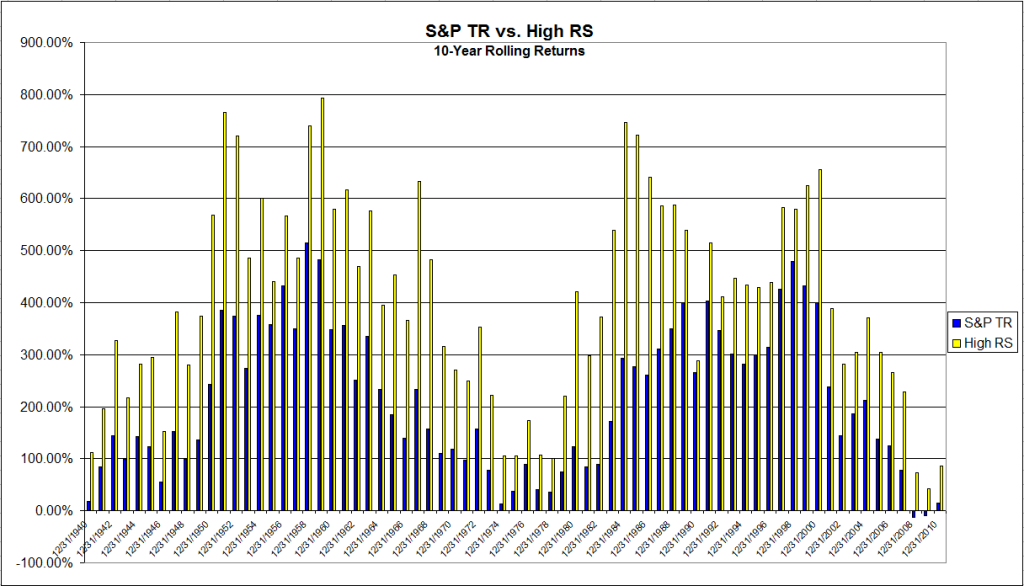
 Relative Strength Astounds the Skeptics Again

Click to enlarge

Source: J.P. Lee, Dorsey, Wright Money Management

Why are value investors always so shocked by the strong performance of relative strength methods? I think there are two major reasons: 1) the value cult has drowned out discussion of other successful return factors, and 2) the reason for strong momentum is poorly understood.

The value cult drowns out other schools of investing, but it developed its following largely by historical accident. Ben Graham and David Dodd’s classic Securities Analysis came out early on, in 1934, and found a vocal contemporary advocate in Warren Buffett. In other words, much of the historical prominence of value investing is due to its early start—and the fact that it developed and was propagated in academia, where it had a chance to be taught as the shining, virtuous path to wealth to generations of students. Its tenets were never really questioned bacause value investing is also logical, pretty transparent, and it works. However, it is a logical mistake to assume that since value investing works, it is the only thing that works.

Largely overlooked by the value cultists is the fact that Warren Buffett’s fortune has been made in growth stocks with high reinvestment rates and arbitrage, not cigar butts. From James Altucher’s book Trade Like Warren Buffett: “…Buffett achieved much of his early success from arbitrage techniques, short-term trading, liquidations, and so on rather than using the techniques he became famous for with stocks like Coca-Cola or Capital Cities. In the latter stages of his career he was able to successfully diversify his portfolio using fixed income arbitrage, currencies, commodities, and other techniques.” (Note: when Buffett purchased his stake in Coca-Cola, it carried a P/E of 13, while the overall market was selling for a P/E of 10! Not exactly a traditional value investment.) In recent years, Buffett has become famous for a giant derivatives trade where he essentially wrote a massive amount of naked put options on the U.S. market. In other words, the popular image of Warren Buffett as a buy-and-hold value investor is completely false. I’m not bashing here—Warren Buffett is clearly a great investor, and while he did take Ben Graham’s course at Columbia, much of his success is due to his investment flexibility, not some imaginary ability to identify value stocks and then hold them forever.

Likewise, Ben Graham made no secret of the fact that his personal fortune from the Graham-Newman Corporation was, in fact, due to the growth stocks purchased by his partner Jerry Newman. One magazine article I read quoted the anointed father of value investing, Benjamin Graham, as saying “Thank God for Jerry Newman! If it weren’t for him, we never would have made any money.” Based on the real lives of Buffett and Graham, profitable investing is a little more complex than reading The Intelligent Investor a few times, and clearly not limited to any strict definition of value investing.

Once value cultists concede that successful investing can be done in several ways, we’re left with trying to understand why relative strength works. Why do stocks that are strong tend to stay strong for a while? Simply put, strong stocks are typically in a sweet spot, either on a fundamental or macroeconomic basis. High RS stocks generally have tremendous current fundamentals.

Let’s look at a current example—the best performing stock in the S&P 500 last year, Netflix. In a moribund economy, the year-over-year change in revenues at Netflix accelerated from 19% growth in Q4 2008 to 34% growth by Q4 2010. While revenues were increasing 34%, earnings per share went up 55%, which indicates that margins were expanding. Investors, for some reason, were attracted to a stock with rapid and accelerating revenue growth and profit margins. Is that really so difficult to understand?

Can Netflix continue to accelerate revenues and margins? The laws of mathematics tell us that this feat cannot be pulled off forever—but it’s already gone on for a couple of years and that’s certainly long enough to make a lot of money. How much longer it will continue is anyone’s guess. (Certainly it has gone on longer than Whitney Tilson expected.) The high relative strength investor looks for stocks that are performing—but stays with them only as long as that performance continues. At some point, Netflix will hit a speed bump, and when it does, the high relative strength investor will happily part with the shares—hopefully at a tasty profit.

Lots of practitioner and academic studies show this exact pattern: if you hold strong assets and ruthlessly replace assets that become weak, the portfolios do very well. There’s really no mystery to it.

So, Mr. Zimmerman, if you’re reading this, don’t beat yourself up. I’m sure you’re a great guy. You’re not the first value investor that has had trouble understanding how relative strength operates as a return factor. And you should take heart in this: studies show that portfolios combining relative strength and value have uncorrelated excess returns, so it works great to have a mix of both styles. Value works, but relative strength rocks.

Posted by:


Is Your Index Fund Broken?

January 31, 2011

That’s the provocative title of a recent article in Smart Money. The article makes a controversial claim:

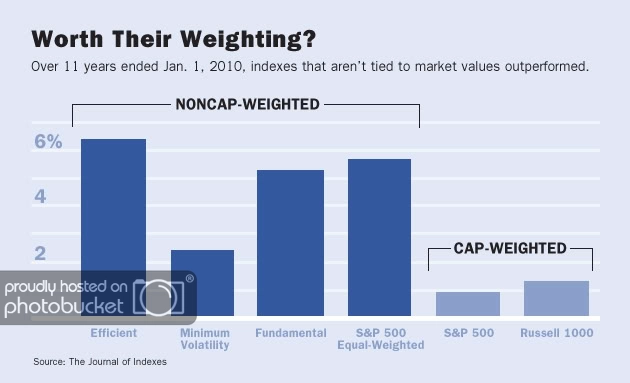
The Journal of Indexes gives academic treatment to bland investments, and so might not seem a likely source of hot controversy. The latest issue, however, is packed with it-and has greatly annoyed mutual fund titan Vanguard. A report therein gives new support for the claim that most index investors are unknowingly missing out on a large portion of the returns that their passive approach ought to provide.

Are investors really missing out on a large part of the passive return? The article implies that a variety of alternative weighting methods like efficiency weighting, volatility weighting, equal weighting, and fundamental weighting provide better returns than traditional capitalization weighting. ETFs are even available for some of these alternative methods, most notably equal weighting (RSP) and fundamental weighting (PRF). Over the eleven-year period cited in the article, all of them have better returns than capitalization weighting.

 Is Your Index Fund Broken?

Source: Smart Money/The Journal of Indexes

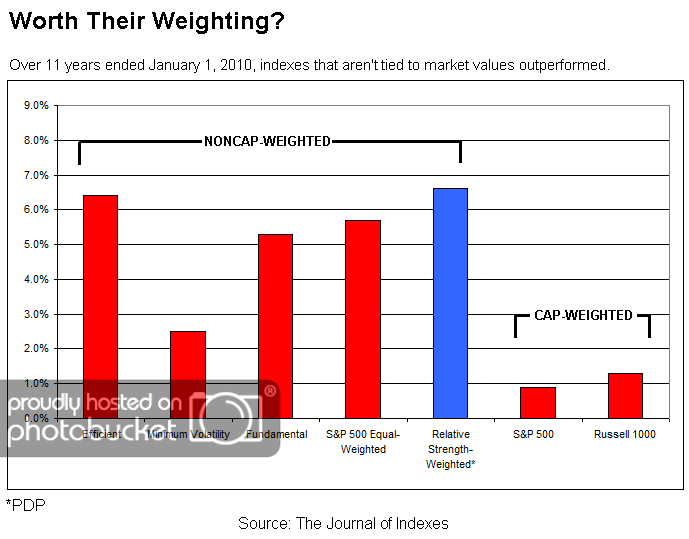
Here’s what drives me crazy: when alternative weighting methodologies are discussed, there is always one method omitted. That method is relative strength. Perhaps it is no surprise that over the eleven-year period cited in the article, relative strength weighting outperformed all of the other methods. (And I didn’t get to cherry pick the time period-the article made that choice. If the blowout year of 2010 was included in the results, relative strength would have an even larger advantage over its rivals.) It’s also nice to note that there is a relative strength weighted index available, the Technical Leaders Index (PDP). Here’s what the same chart looks like if relative strength weighting is included.

 Is Your Index Fund Broken?

Source: Journal of Indexes, Dorsey Wright

Why is relative strength weighting always left out? If I were cynical, I might say that relative strength is intentionally disregarded so that alternative methodologies do not have to show their comparative performance. But since I am in a charitable mood, I think the reason it is often ignored is because it is too simple. Yes, too simple.

It does not require manipulation of a massive fundamental database. It does not require equations and a mainframe computer to calculate a covariance matrix. It does not require a CFA, MBA, or PhD. (Think how much money you could save on grad school!) Instead, it requires a pocket calculator or spreadsheet and one of the many methods for measuring relative strength. We are partial to our proprietary measurements, but lots of methods work just fine. What does it say about your complicated alternative indexing method when it can be outperformed by something a middle-school student could learn to calculate?

There is one big advantage to capitalization weighting: it can be implemented in nearly infinite size. Along with theoretical reasons (“owning the market portfolio” in Modern Portfolio Theory), that may well be one reason why institutions, and Vanguard, believe it is the way to go. On the other hand, it is not really a stretch to believe that there are alternative indexing methodologies that could be designed for better performance. We think that relative strength has been demonstrated to be the simplest and most robust way to build the better mousetrap.

Posted by:


Jeremy Grantham of GMO on Momentum

January 27, 2011

Art Cashin, the market guru at UBS, quoted Jeremy Grantham of GMO in his newsletter this morning. Am I the only one that finds it ironic that Grantham was speaking at the annual Graham & Dodd breakfast? This is Grantham discussing the economist John Maynard Keynes:

Remember, when it comes to the workings of the market, Keynes really got it. Career risk drives the institutional world. Basically, everyone behaves as if their job description is “keep it.” Keynes explains perfectly how to keep your job: never, ever be wrong on your own. You can be wrong in company; that’s okay. For example, every single CEO of, say, the 30 largest financial companies failed to see the housing bust coming and the inevitable crisis that would follow it. Naturally enough, “Nobody saw it coming!” was their cry, although we knew 30 or so strategists, economists, letter writers, and so on who all saw it coming. But in general, those who danced off the cliff had enough company that, if they didn’t commit other large errors, they were safe; missing the pending crisis was far from a sufficient reason for getting fired, apparently. Keynes had it right: “A sound banker, alas, is not one who foresees danger and avoids it, but one who, when he is ruined, is ruined in a conventional and orthodox way along with his fellows, so that no one can really blame him.”

So, what you have to do is look around and see what the other guy is doing and, if you want to be successful, just beat him to the draw. Be quicker and slicker. And if everyone is looking at everybody else to see what’s going on to minimize their career risk, then we are going to have herding. We are all going to surge in one direction, and then we are all going to surge in the other direction. We are going to generate substantial momentum, which is measurable in every financial asset class, and has been so forever. Sometimes the periodicity of the momentum shifts, but it’s always there. It’s the single largest inefficiency in the market. There are plenty of inefficiencies, probably hundreds. But the overwhelmingly biggest one is momentum…

Brilliant. I put the really good parts in bold so you wouldn’t miss it. This is an interesting explanation for momentum and might partially explain why it is always present in markets: it’s part of human nature. We just try to measure it and use it.

HT to GA.

Posted by:


California Dreaming

January 20, 2011

Barron’s points out that CALPERS, the state pension system could have done better last year owning SPY. CALPERS made 12.5% last year. The state teacher retirement system, CALSTRS, did slightly better, earning 12.7%. But SPY returned more than 14.4%.

This neglects the fact that SPY is all equity and CALPERS is a balanced fund. The S&P balanced ETF that Barron’s mentioned, AOR, returned 11.1%.

I have a modest proposal. Maybe CALPERS should just put their $228 billion into the Arrow DWA Balanced Fund (DWAFX). It has bonds for stability, domestic and international equities for growth, and alternatives for diversification. And the return last year was 16.08%, beating CALPERS, CALSTRS, SPY, and AOR.

Is anyone is Sacramento listening? Heck, we could make do with even $5 billion. We can dream, can’t we?

Click to enlarge. Source: Yahoo! Finance

Click here to visit ArrowFunds.com for a prospectus & disclosures. Click here for disclosures from Dorsey Wright Money Management.

Posted by:


Dorsey Wright Fourth Quarter Review

January 4, 2011

(Click Image To Access Report)

ManagerInsightsQ42010 Dorsey Wright Fourth Quarter Review

Posted by:


MPT Headache

December 31, 2010

Modern Portfolio Theory has had a rough go lately, but its apologists are still trying to find a way to make it sound plausible. There’s a lot of emotional investment in MPT because so many firms have endorsed it and so many assets are invested according to its principles. Consider, for example, the following two statements taken from the same article written by a financial advisor:

Modern portfolio theory can be a useful guide for financial advisers, but it’s just a theory. It doesn’t take into account the current economic context.

And then, a couple of paragraphs later:

MPT is only successful if it takes current economic conditions into consideration.

So, it doesn’t take current conditions into account, but it can only be successful if it takes current conditions into account? What?

That’s why I get a headache when I read this stuff.

I think I understand what he is getting at in his article-that asset allocation can’t be done mechanically through portfolio optimization. Yet, isn’t that the exact premise of Modern Portfolio Theory? Once you start actively tweaking the asset allocation based on your judgement, that’s tactical asset allocation-not a bad thing, but not MPT. When MPT advocates write articles, it seems that more often than not they backpedal into an endorsement of what everyone else calls tactical asset allocation!

Here’s one section of his article that I agree with:

…MPT assumes certain asset classes have reverse correlations — that they’re “natural hedges” for each other. But in 2008 many of those natural hedges crashed at the same time, and many investors who had put all their eggs in the MPT basket faced economic ruin.

Somehow, to me, “economic ruin” sounds slightly worse than the not-really-comforting explanation that MPT is “not that good at dealing with statistical anomalies.” Tactical asset allocation using relative strength does not make any assumptions about the correlations between asset classes and focuses entirely on current conditions, which might be a little safer bet.

Posted by:


Early New Year’s Resolutions for 2011

December 23, 2010

Money is not the most important thing in life, but it’s right up there with oxygen.—-Dennis Miller

For those of you who like to get an early start on your resolutions, I have a list of things that might positively impact your financial well-being. Admittedly, this is the season when most Americans are preoccupied with spending money, but maybe it’s not a bad idea to also think about preserving and growing it.

1. Hire a good financial advisor. You might know a little more about what is going on, and you could end up with a lot more money. At least that was the conclusion from a recent study of 14,000 adults by ING Retirement Research.

According to the data, those who spent some time with an advisor reported saving, on average, more than twice as much for retirement as those who spent no time at all with an advisor. The number jumped even higher – over three times as much – for those who spent a lot of time with an advisor.

And yet the usage rate of advisors for this sample was a significant minority, only 31%.

2. Save more. You’re going to need it, because you are probably going to live a lot longer than you think. You’ve seen all of the statistics about how little Americans have saved or stashed into their 401ks. Do something about it. Bump your 401k savings rate up a couple of percentage points for next year. If you’re already maxing it out, start an automatic investment plan with a good mutual fund. (I am biased toward the Arrow DWA Balanced Fund!) Yes, you! Do it now before you forget about it.

3. Identify a good return factor and exploit it. Mercilessly. Relative strength and value are the most prominent return factors that have proven themselves over time. Better yet, create a portfolio that uses them both, because they mesh together very nicely.

4. Persist. Markets are going to be uncomfortable at times. You’ve got to stick with a strategy through thick and thin to reap the best returns. It’s most important not to abandon a sound strategy when it is really uncomfortable-that’s what causes investors to perform poorly.

5. If you must listen to the financial media at all, consider going opposite the accepted wisdom. A market is only news when it’s at an extreme-and that’s usually the time to consider going against the grain.

If you decide to get into shape and lose a few pounds also, great. Here’s a link to a Wall Street Journal article about how to stick to your resolutions. It’s all worthwhile.

Posted by:


What is a Balanced Fund, and Why Should You Care?

November 15, 2010

A balanced fund is a fund that is designed to balance income, growth, and capital preservation. Balanced funds have some special attributes, a couple of which are summarized in this article in the Baltimore Sun.

1) The SEC requires that any fund purporting to be balanced maintain at least 25 percent of its assets in fixed-income senior securities — that is, debt securities, such as bonds and notes, and preferred stocks.

2) A balanced fund is designed to be a complete investment program. As the prospectus for American Balanced Fund puts it, “The fund approaches the management of its investments as if they constituted the complete investment program of the prudent investor.” The prospectus for Dodge & Cox Balanced Fund refers to investors finding it “suitable for their entire long-term investment program.”

3) The Department of Labor has established “safe harbor” regulations for pension plans. The regulations set out certain investment alternatives that pension sponsors under ERISA are allowed to use for default options for employee pensions. The approved default categories in the DoL proposal - now known as qualified default investment alternatives (QDIAs) - include:

  • lifecycle or targeted-retirement date funds,
  • balanced funds, and
  • managed accounts.

“The new default options will help workers accumulate larger nest eggs for retirement,” said [Assistant Secretary of Labor, Ann] Combs. “Workers who don’t feel equipped to make investment decisions will be automatically invested in a mix of stocks and bonds appropriate for long term savings.”

The basic idea is that balanced funds conform to the prudent investor rule and that employers, assuming they continue to monitor the investment managers, cannot be sued (hence “safe harbor”) for lack of suitability.

Clearly, if you own just one fund, a balanced fund is probably the best choice. A balanced fund would be the logical choice for the smaller accounts in your book, or as the first fund for a beginning investor. A balanced fund is also an excellent choice for a systematic investment plan, where the investor places a fixed dollar amount in a fund each month. (I think advisors who are not urging their clients to use a systematic investment plan alongside their other investments are missing the boat.) It would make sense to have a balanced fund in a 401k plan. Finally, a balanced fund can help protect you from legal liability.

Traditional balanced funds often stayed close to the 60% equity/40% bond mix. Modern balanced funds now often include international stocks as part of the equity mix and have some latitude to change the mix slightly over time.

Fun fact: the first balanced fund was started by a Philadelphia accountant named Walter Morgan. He was the founder of Wellington Management. Vanguard’s Wellington Fund is still one of the largest balanced funds today.

Most of the giant balanced funds in the investment industry are large because they have had long track records of superior performance. Some of the largest funds currently are Capital Income Builder ($58 billion), Income Fund of America ($51 billion), Franklin Income Fund ($33 billion), American Balanced Fund ($30 billion), Vanguard Wellington Fund ($28 billion), Fidelity Balanced Fund ($17 billion), and Dodge & Cox Balanced Fund ($14 billion). [These asset numbers came from Lipper.] Chances are that you have holdings of one or more of these funds in your book.

Each fund approaches the balanced mandate slightly differently. Franklin Income Fund tilts toward a large chunk of fixed income (55% of the portfolio), including a slug of high yield bonds. Capital Income Builder has the largest part of its equity investments overseas (39% of the portfolio), while Dodge & Cox Balanced Fund stays close to home (61% of the portfolio). [This asset allocation information came from Morningstar.]

The Arrow DWA Balanced Fund (DWAFX) has a similar mandate. Like all balanced funds, we have a minimum of 25% bond exposure at all times. However, there are a couple of things we do rather differently than many balanced funds.

1) Different from most balanced funds, DWAFX has a sleeve dedicated to alternative assets. This is because the fund is run along the lines of the Yale Endowment model, with a very broad mix of investable asset classes. Right now those alternative assets (19%) are gold and real estate, which have been quite additive to returns.

2) Different from most balanced funds, DWAFX allocates assets dynamically based on relative strength. The four sleeves within the portfolio-domestic equities, international equities, fixed income, and alternative assets-can have their weights vary dynamically within broad bands depending on the strength of the asset class. For example, right now the bond allocation is 27%, but it has been as high as 52% during periods of market stress. Similarly, the international equity allocation is currently 21%, but it has been as high as 38% during periods of U.S. dollar weakness.

Here’s a snapshot of DWAFX’s allocation as of 9/30/10:

Source: ArrowFunds.com

We think systematic application of relative strength across a broad range of asset classes-otherwise known as global tactical asset allocation-within a balanced fund can be a superior strategy for an investor that is looking for a complete investment solution. Although the Arrow DWA Balanced Fund does not yet have the long tenure of many of the other excellent balanced funds, performance has been strong since inception. (For an interactive price chart of performance of DWAFX versus the other industry heavyweights, click here. Select “max” under the chart to see full performance since inception.) We hope that at some point in the future we will be mentioned in the same breath as the other top balanced funds.

For information about the Arrow DWA Balanced Fund (DWAFX), click here. Click here for disclosures. Past performance is no guarantee of future returns.

Posted by:


DWA Poll

October 25, 2010

We recently polled users of the Dorsey Wright research database to find out how many users of the research are also using Dorsey Wright managed products. The question was:

Do you use Dorsey Wright managed products in your business? This would include any of the following: Arrow DWA Balanced Fund (DWAFX), Arrow DWA Tactical Fund (DWTFX), PowerShares Technical Leaders ETFs (PDP, PIE, PIZ), Rydex Variable Insurance Trusts (Sector Rotation or Flexible Allocation), or Dorsey Wright separately managed accounts.

There were 256 responses to this poll.

For more information:

Arrow Funds: www.arrowfunds.com

PowerShares: www.powershares.com

Rydex SGI: www.rydex-sgi.com

Separately Managed Accounts: www.dorseywrightmm.com

Posted by:


What if the U.S. Really Is Like Japan?

October 19, 2010

There are lots of reasons to assume that the U.S. will not turn out like Japan after their market peak in 1989. There are vast cultural differences and many significant differences in the economic systems. Most often, when the Japan-U.S. analogy is brought up by bearish commentators, it is quickly dismissed by those who are more bullish. However, one important way in which the U.S. might not be very different from Japan, or anywhere else, is human psychology. Even across cultures, people tend to have similar cognitive biases. What if it turns out that the U.S. really is on the cusp of a Japan-like experience? What might that be like for investors?

The view on the market side is not encouraging. As a recent article in the New York Times points out:

The decline has been painful for the Japanese, with companies and individuals like Masato having lost the equivalent of trillions of dollars in the stock market, which is now just a quarter of its value in 1989, and in real estate, where the average price of a home is the same as it was in 1983. And the future looks even bleaker, as Japan faces the world’s largest government debt — around 200 percent of gross domestic product — a shrinking population and rising rates of poverty and suicide.

Perhaps even more surprising-and concerning-has been the impact of the slow-motion financial crisis on the psychology of the public:

But perhaps the most noticeable impact here has been Japan’s crisis of confidence. Just two decades ago, this was a vibrant nation filled with energy and ambition, proud to the point of arrogance and eager to create a new economic order in Asia based on the yen. Today, those high-flying ambitions have been shelved, replaced by weariness and fear of the future, and an almost stifling air of resignation. Japan seems to have pulled into a shell, content to accept its slow fade from the global stage.

Animal spirits are important. The willingness to take a risk for the prospect of future gain is a requirement for the proper functioning of an entrepreneurial capitalist economy or a strong financial market. Struggling through a difficult economy is one thing, but losing all hope is another thing entirely. When hope disappears, so does the willingness to take risk.

When asked in dozens of interviews about their nation’s decline, Japanese, from policy makers and corporate chieftains to shoppers on the street, repeatedly mention this startling loss of vitality. While Japan suffers from many problems, most prominently the rapid graying of its society, it is this decline of a once wealthy and dynamic nation into a deep social and cultural rut that is perhaps Japan’s most ominous lesson for the world today.

The classic explanation of the evils of deflation is that it makes individuals and businesses less willing to use money, because the rational way to act when prices are falling is to hold onto cash, which gains in value. But in Japan, nearly a generation of deflation has had a much deeper effect, subconsciously coloring how the Japanese view the world. It has bred a deep pessimism about the future and a fear of taking risks that make people instinctively reluctant to spend or invest, driving down demand — and prices — even further.

I think this article is an important read, not so much for the debate about whether the U.S. is economically like Japan or not, but more for the sentiment aspect. Pessimism has economic and financial market consequences. Although I’m concerned about our current national mood, I don’t think Americans have succumbed to permanent pessimism at this point. Given the current low spirits, however, what makes sense from an investment point of view? I think there might be a few right answers.

1) Companies that innovate and grow. Although the broad indexes in Japan are down over the trailing 12 months, a cursory search on the Dorsey, Wright research website reveals many companies with 25%+ returns for that same time frame. Just because the market is dead doesn’t mean every company has thrown in the towel. In many cases, companies in good industries or with new, exciting products will continue to perform well. (In the U.S., Apple would be an apt current example.) Relative strength, incidentally, is a good way to identify strong companies.

2) Global tactical asset allocation. There is usually a bull market somewhere. Lots of countries and asset classes have had phenomenal growth over the last 20 years while Japan has been stagnating. A global approach allows an investor to commit to areas where animal spirits are still powerful, wherever they may be. Maybe Japan has suffered a loss of confidence, but perhaps Brazil is just starting on the way up. There could also be opportunities in alternative asset classes like commodities and currencies. Having a wide-angle view of global business and politics might be very helpful. Here, too, relative strength can be an excellent guide.

If the “PIMCO New Normal” turns out to be the case, then perhaps sovereigns of lightly-indebted nations and canned goods will be the way to go. In a New Normal scenario, a traditional value buyer may end up with a higher-than-normal percentage of value traps-assets that are persistently cheap for a good reason, one that becomes apparent only after you’ve saddled the dog. There’s no telling how events will unfold, but keeping a global perspective and an eye on the mood of the citizenry may prove important.

Posted by:


Third Quarter Review

October 12, 2010

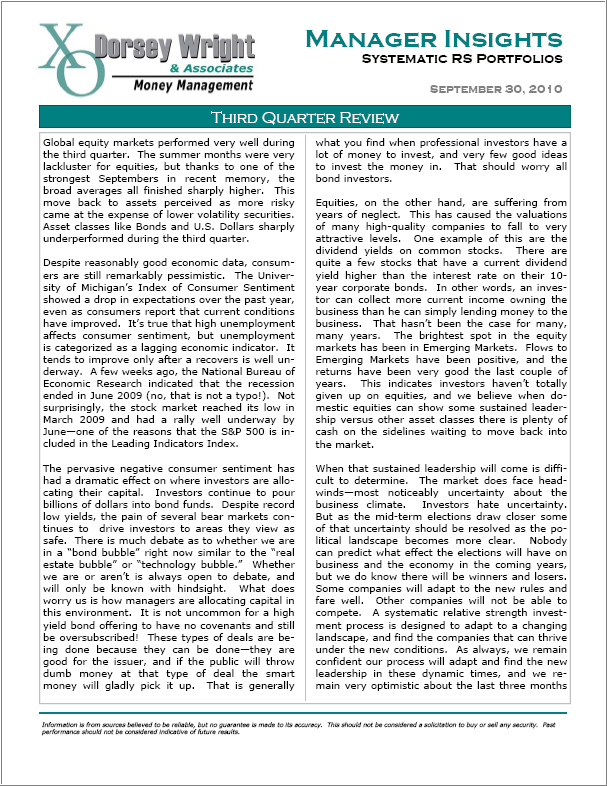
Click the image below to read the third quarter review of our Systematic RS portfolios.

ManagerInsights Third Quarter Review

To receive the brochure for our Separately Managed Acccounts, click here. Click here and here for disclosures. Past performance is no guarantee of future returns.

Posted by:


Why Investors Fail

October 5, 2010

My earlier post about passive investing does bring up an interesting point. Even though investors are, by and large, buying decent funds, they’re not making much money. As a class, DALBAR’s QAIB has shown pretty conclusively that retail mutual fund investors underperform-and the onus should really be where it belongs-on investor behavior. It’s not active management that is the problem. As Morningstar shows, investors are making good fund choices, but their emotional asset allocation decisions are killing them. Owning an index fund, unfortunately, does not make you emotionally numb. Index fund investors may be just as likely to fall prey to behavioral issues as active fund investors. Finding winning strategies is clearly possible, but that’s not the whole story. Good investor behavior is probably the best ticket to better returns.

We see the same thing here as every other money management shop with a good long-term strategy: a decent percentage of clients bail out after a period of short-term underperformance. What really makes for good returns is good clients. Seth Klarman, the legendary hedge fund manager, said exactly that in a recent interview with Jason Zweig:

…ideal clients have two characteristics. One is that when we think we’ve had a good year, they will agree. It would be a terrible mismatch for us to think we had done well and for them to think we had done poorly. The other is that when we call to say there is an unprecedented opportunity set, we would like to know that they will at least consider adding capital rather than redeeming.

You can’t say it more clearly than that. Imagine how much money clients would make if 1) they understood a strategy well enough to know when it had performed well, when it had performed poorly, and why, and 2) they added money during periods when the strategy was temporarily out of favor.

Relative strength trend following is an excellent strategy that has historically afforded investors large excess returns, along with periodic episodes of underperformance (i.e., good entry points). The inherent volatility keeps most investors away so that returns do not appear to have been arbitraged away over time. Unless human nature changes, the relative strength return factor is likely to continue to work extremely well over time. Have we mentioned this before? Yes-but the reason we are mentioning it again is because relative strength has had a significant period of underperformance which may be in the process of ending. (Check out the short-term and long-term views here.)

Posted by:


One Argument for Passive Investing Bites the Dust

October 1, 2010

Advocates of passive investing have lots of talking points, quite a few of which I think are horse-pucky. It appears that Morningstar may agree with me, although they phrased it in a much more conciliatory way. They looked at how investors actually selected mutual funds and had some interesting findings.

One of the common things spouted is that “80% of mutual fund managers underperform.” This is cited as evidence that you should just give up and buy an index fund, but the argument is bogus for at least two reasons. Here’s why:

1) It assumes that investors select funds by throwing darts. And that’s not what happens.

2) The logical syllogism is faulty. 80% of Americans can’t dunk either, but if I am in charge of the draft for an NBA team, does that mean I should give up on finding someone who can dunk? Of course not! By restricting my draft selections to, say, Division I college basketball players that are 6’8″ or greater, I significantly improve my chances of finding a whole lot of people who can dunk a basketball.

Morningstar weighs in on 1) as well:

And I think Morningstar user mrpcid hit the nail on the head posting one of the earliest comments on the Ferri video, saying that the flaw with some academic studies is that they act as if investors pick their actively managed funds at random from the entire pool of funds. But in reality, they use research from firms such as Morningstar to narrow the field, avoiding obviously horrible funds while focusing their efforts on what the military calls a target-rich environment. In this case, it is the small group of funds with numerous favorable characteristics that are not too hard to identify and which tend to endure, such as proven managers with a repeatable process, good stewardship, reasonable costs, and a manageable asset base.

If you assume investors could be picking from a target-rich environment, it turns out to be a game-changer. When Morningstar analyzed which funds investors owned the most of, a trend emerged:

That sounds great on paper, but what have investors done? Turns out, they know quality when they see it. About 80% of the total assets in active equity funds are held in funds that have beaten the market over the past 15 years. For sure, there’s been performance-chasing, but the flow data indicates that investors have done a decent job of avoiding the losers and buying the winners, perhaps switching from one winner to another.

[My emphasis.] Further, Morningstar points out that the active funds that have outperformed have done so by larger margins than the funds that have lagged. That means that if you put together a portfolio of several funds, even if one or two of them lagged a little bit, you might well make up the performance lag from the funds that outperformed.

There might be reasons to own index funds, but the “80% of active managers underperform” argument isn’t one of them.

Posted by:


Will Inflation Wipe You Out?

September 28, 2010

Although a number of economists are still concerned about deflation, there is a growing concern on the part of other economists about inflation. Irwin Kellner, the economist at MarketWatch, had an article with his take on the topic recently. One thing that is clear is that inflation is partly a child of globalization. A recent Yahoo! Finance article on Starbuck’s planned price increase makes that clear:

The upcoming agony of Starbucks devotees offers three fundamental truths that should be apparent to all who pay attention to economic news:

(1) global growth is strong;

(2) U.S. growth is weak compared to global growth;

(3) the world’s national economies and markets have never been more connected or interconnected.

The global economy continues to recover from the plague year of 2009 — the first since 1944 in which the world’s economic output shrunk. The International Monetary Fund pegs growth at 4.5 percent for 2010.

In nearly every corner of the world, more people are building and eating more stuff. That has pushed up prices for a range of commodities — steel, copper, cotton, soybeans, wheat, and cotton. Many commodities (notably oil and gold) are priced in dollars. Slow U.S. growth, which weakens the dollar, can also have the effect of making commodities more expensive.

But it’s the third factor — the rising tide of globalization — that is making venti-size waves at Starbucks and elsewhere. In an era where production of key staples and finished goods can happen anywhere, so too can problems. Coffee is expensive in part because of poor harvests in Vietnam and Colombia. Bloomberg reported on Monday, that “raw sugar rose to a seven-month high in New York on concern that suppliers will struggle to meet demand.” A big part of the problem: “Drought in Brazil, the world’s biggest producer of coffee and oranges as well as sugar, is harming crops and drying the Amazon River to its lowest in 47 years.” For farmers in Brazil, Antonio Carlos Jobim’s Waters of March can’t come soon enough.

In other areas, the problem is too much water. Bloomberg notes that “sugar-cane yields in Uttar Pradesh, India’s biggest cane producer” could be harmed by recent flooding. The price of a pound of sugar for delivery in October has soared 67 percent in the past few months (For current prices on agricultural commodities, check out the CME Group’s website.)

Since inflation is a global phenomenon, it’s not going to be possible to counteract it with a new government policy. Inflation is bigger than any one government, so we’re just going to have to deal with it. Here’s the big problem: most investors do not have the resources to deal with inflation.

Rob Arnott has an outstanding article on the inflation problem for 401k investors. (You really need to read this article all the way through. Important stuff.) The problem with most 401k plans is that investors do not have sufficient flexibility to deal with inflation if it crops up:

The evidence supports this: investors hold between 55–75% in stocks and 25–45% in short-term fixed-income and bonds. Most 401(k) plans have a money market or stable value option, and one or two bond funds providing fixed-income exposure. But, on average, only 5 of the typical 18 investment choices are non-stock funds! With stock funds comprising 70% of our available choices, it’s no coincidence that the average 401(k) investor has roughly 70% of their 401(k) in stocks.

I’d generalize things even further: even outside a 401k plan, most investors do not have the expertise to use an alternative toolset to deal with investment problems that they have not been seen in their investing career. Inflation requires that alternative toolset. Mr. Arnott thinks there are four critical components:

An effective real return strategy should have four key components:

1. Inflation-fighting assets such as TIPS, REITs, and commodities should be blended into the portfolio in a meaningful way.

2. Non-dollar assets should be used on a scale large enough to protect against any government choices that may debase the dollar. Of course, Japan and Europe face the same “3-D Hurricane” that we face here, only more so. So, these non-dollar investments should be in the emerging markets, in the local currencies. It bears mention that the emerging markets largely shrugged off the “global financial crisis” and the “great recession.” Why? Most did not have massive debt. Most did not respond to the crisis with massive deficit spending and new debt. And most chose to let failing enterprises fail instead of propping them up.

3. There should be investments in inflation “stealth fighters” such as high-yield bonds, bank loans, convertibles, and local currency emerging markets debt. Inflation stealth fighters work in a subtle way. Inflation reduces the real value of the debts, improving debt coverage ratios. As the coverage ratios improve, the credit spread can narrow creating capital gains on top of the original rich yields. This leads to startlingly high correlations between their returns and the rate of inflation.

4. Tactical allocations among the asset class choices. Higher inflation breeds volatility which, in turn, breeds opportunities to be tactical in response to price dislocations. This includes the ability to invest in absolute return, low beta, alpha-oriented strategies for times when both traditional and real return funds offer meager risk-adjusted returns.

That is a handful. Excuse me for believing that Mom and Pop are not prepared to deal in TIPs, REITs, commodities, high-yield bonds, bank loans, convertibles, and emerging markets debt and equity, let alone make knowledgeable tactical asset allocations among them! Most investors have enough trouble making money in boring stocks and bonds.

Our Global Macro portfolio (and the Arrow DWA Tactical Fund, DWTFX) is designed to deal with this very problem. It allows an investor to rotate toward strong asset classes, whether in domestic equities, international equities, emerging market debt and equity, REITs, commodities, inverse funds, currencies, inflation-protected securities, and more traditional fixed income. Both exposure and timing are addressed so that Mom and Pop-who have no expertise-don’t have to try to figure out what to buy and when. Best of all, the portfolio adapts as strength in various asset classes waxes and wanes. Market regimes change, and while Mr. Arnott is concerned about inflation now, it is possible that an entirely different concern will be on the horizon a few years from now. Global Macro is designed to roll with the changes.

To receive the brochure for our Global Macro strategy, click here. For information about the Arrow DWA Tactical Fund (DWTFX), click here.

Click here and here for disclosures. Past performance is no guarantee of future returns.

Posted by:


What’s Your Retirement Number?

September 17, 2010

Once in a while, I think it is important to revisit our touchstone in the financial advisory business-what is the point of investment management in the first place? I’ve always looked at it as a way to make our clients’ dreams come true, not necessarily in the fantasy sense, but in terms of being financially comfortable and having the freedom not to worry about money constantly. Surveys indicate that the main reason investors save is to meet their retirement goals. Of course, there are often other goals along the way, like buying a house or getting the kids through college, but retirement is the Big Kahuna.

How paradoxical is it, then, that Americans do such a lousy job saving for retirement? According to a recent article on MarketWatch, the current gap between what Americans will need to retire and what they have actually saved is a staggering $6.6 trillion dollars. Yes, trillion with a T. Suddenly saving and getting good investment advice seems a lot more important!

Part of the reason the gap is so big is that most investors never bother to calculate how much money they might actually need to retire! According to Retirement Investigator:

…if you are like 58% of active workers, you haven’t. That’s right, 58% of workers have NEVER tried to calculate what they need to save for a comfortable retirement…

And “only 42% of active workers have ever tried to calculate how much they need… and 8% of those admitted they arrived at their answer by guessing,” reported National Underwriter on April 24, 2006.

For whatever reason, trying to figure out a retirement number must be either baffling or terrifying to investors. (Or maybe they just find it amusing. ING has developed an entire advertising campaign around “the number,” with individuals walking around with bright orange numerical plaques.)

Source: Adrant

I will de-mystify the process and show a couple of simple calculations to arrive at your retirement number, depending on whether you want to be conservative or minimalist in your estimate. First, let’s define our terms. When I am talking about a conservative approach to a retirement number, I am talking about the pool of capital that would be required to support your required spending on a sustainable basis, while attempting to leave the original capital intact. A minimalist approach simply assumes, as the study in the MarketWatch article did, that you convert all of your savings to an immediate annuity.

Sustainable spending is a tricky concept. Dozens of studies have been performed on historical data that suggest that the proper spending rate is 3 to 5%. A lot of endowments use 4%, for example. In reality, I think the sustainable spending level depends quite heavily on financial conditions at the time. A stock market with a 6% dividend yield is going to support more spending than a market yielding 3%. In other words, I tilt toward a relative calculation first developed by James Garland. He shows that you can generally spend more than just your dividend and interest income, but far less than your total earnings yield. His rule of thumb is that sustainable spending is about 130% of the yield on the major stock indexes. (You can use this link to find the current dividend yield on the major stock indexes.) The current yield on the S&P 500, for example, is now 2.02%, so 130% of that number would be 2.626% (2.02 x 1.3 = 2.626). Garland’s sustainable spending rule will form the basis for our conservative estimate.

The basis of every retirement number is income. The easiest way to calculate a retirement number is to determine what income you need in retirement and work backward from there. Let’s say that you would like to have an income of $50,000 in retirement, in today’s dollars. The calculation of the conservative retirement number is straightforward. First, find your multiplier by dividing your sustainable spending level into 100. At the current time, that would be about 38 (100 / 2.626 = 38.080731). Your retirement number is simply your desired income times the multiplier, which in the example would amount to $1.9 million ($50,000 x 38). This calculation gives you the amount in today’s dollars. You can either adjust it upward for inflation to get a future dollar number, or you can use real returns (nominal returns minus inflation) to determine if you are on track on not. Morningstar’s savings calculator is easy to use. There are literally hundreds of others on the web.

The minimalist approach is a little different. It assumes that you will take all of your savings and convert it to an immediate annuity. In this approach, you aren’t worried about dipping into principal-in fact, you’re liquidating it. On the plus side, it allows you generate more income with the same amount of capital. Again, the easiest way to do this is to back into the number. I used one of the popular annuity websites to do this calculation, assuming a 62-year-old couple in Richmond, Virginia. The desired monthly income would be $4,167 , which is equivalent to our earlier annual income of $50,000. The day I ran it, annuity rates were such that I got a quote for a single-life annuity with no payments to beneficiaries for $707,351 at the low end, all the way up to a joint life annuity with a minimum 20-year payment period for $888,741 at the top end. (Every annuity company will have different rates and some have different income options, including income that grows with inflation.)

What did we learn from this little exercise?

1) Retirement requires a lot of money! We determined that supporting $50,000 of spending requires a capital pool of $700,000 to $1.9 million. If you fiddle around with one of the many retirement calculators for a while, you will quickly realize that…

2) You need a high savings rate to get to your retirement number. Putting a 3% contribution into your 401k isn’t going to do it. Think about 15% as a starting number. Without savings to work with, no amount of investment management can help you.

3) Compounding makes a big difference too. The earlier you start, the more years you have to compound. And your assets will compound much faster when your investment return is high. As you play around with a retirement calculator, it becomes clear that you have to…

4) Invest for growth. Here, we finally get back around to why investment management is important. Low rates of return that barely offset inflation, sustained over long periods of time, will not allow you to reach your retirement number. Nope-you’re going to have to figure out how to intelligently expose your portfolio to return factors (and risk) that will allow you to compound at rates far above inflation, at least for an accumulation portfolio. (Perhaps your risk exposure will need to be reduced when you transition to a distribution portfolio, but that’s another discussion.)

Any proven return factor, rigorously executed, will give you a decent chance of reaching your goals, but we tilt toward a relative strength approach. It has been shown to work within markets-and also across markets and asset classes. That flexibility may prove to be critical in a world where many of the best investment opportunities may not be in the U.S., or maybe not even in equities at all. Relative strength is possibly the most adaptable tool in the investment toolkit.

Posted by:


Shift Your Paradigm!

August 27, 2010

Sometimes in order to see something differently, you just have to look at it from a different vantage point. Jonathan Hoenig, writing in Smart Money, makes a very valid point about how investors tend to look at the market.

First, we’re conditioned to want a bargain. If we’re bullish on NTT DoCoMo (DCM: 17.04*, +0.34, +2.03%) trading at $16.75, for some reason we refuse to pay anything more than $16.40, and when it rallies further, we stubbornly sit on our hands and promise to add shares only if the price corrects back to where we originally spotted it. We’re a nation of hagglers: Nobody wants to pay full price.

In other words, investors tend to look at things in terms of high or low. The desire for a bargain has led to various flawed analogies that investors should be delighted to buy stocks “on sale,” as if they were buying toilet paper or vegetables. That may not be the correct frame to use. Toilet paper and vegetables are consumables that fulfill a specific need. Vegetables and toilet paper are not performance-based. A financial asset cannot be consumed to fulfill a specific need-its only value lies in its eventual performance. Hoenig goes on to say:

Regular readers know we never characterize markets as “high” or “low,” but as “strong” or “weak.” And in trending markets, strong securities like the yen or bonds tend to stay strong, or at least stronger than alternatives. On a price basis alone, an all-time-high is a reason to follow a market, not flee it.

Although this is a simple statement, the implications are profound. As soon as markets are framed as strong or weak (rather than high or low), your perspective changes. It is a crucial paradigm shift. As Hoenig points out (and lots of research has confirmed), strong markets tend to stay strong. I think strong and weak is the correct mindset when dealing with financial markets from a performance perspective. Relative strength approaches financial markets from this perspective-measuring strength or weakness objectively and always pushing the portfolio toward strength.

In every other endeavor where performance is important, we gravitate to strength. When a baseball manager fills in a lineup card, he tries to put the best players on the field to win the game. When a corporation needs to win over a big account, they send their best salesperson, not their worst. When we send a relay team to the Olympics, we send the four fastest runners-not slow runners that we hope will improve. As Damon Runyan wrote, “The race is not always to the swift, but if you have to bet, that’s the way to play it.”

Markets are no different. The paradigm shift in thinking about strong and weak assets seems simple but may be a tipping point in terms of finding profitable investment strategies.

Posted by: