Anne Hathaway

March 21, 2011

…is not the wife of Berkshire Hathaway. But news about her may be affecting the price of Berkshire Hathaway stock! The Atlantic explains how:

A couple weeks ago, Huffington Post blogger Dan Mirvish noted a funny trend: when Anne Hathaway was in the news, Warren Buffett’s Berkshire Hathaway’s shares went up. He pointed to six dates going back to 2008 to show the correlation. Mirvish then suggested a mechanism to explain the trend: “automated, robotic trading programming are picking up the same chatter on the Internet about ‘Hathaway’ as the IMDb’s StarMeter, and they’re applying it to the stock market.”

The idea seems ridiculous. But the more I thought about the strange behavior of algorithmic trading systems and the news that Twitter sentiment analysis could be used by stock market analysts and the fact that many computer programs are simply looking for tradeable correlations, I really started to wonder if Mirvish’s theory was plausible.

I called up John Bates, a former Cambridge computer scientist whose company Progress Software works with hedge funds and others to help them find new algorithmic strategies. I asked, “Is this at all possible?” And I was surprised that he answered, roughly, “Maybe?”

One more thing for Warren Buffett to worry about!

Source: The Atlantic

Posted by:


Supply and Demand on the High Seas

March 15, 2011

In every corner of the world, supply and demand is the essential law of economics that never gets repealed. For proof, consider this quote from a Reuters story:

Somali pirates said on Sunday they would lower some of their ransom demands to get a faster turnover of ships they hijack in the Indian Ocean.

Armed pirate gangs, who have made millions of dollars capturing ships as far south as the Seychelles and eastwards towards India, said they were holding too many vessels and needed a quicker handover to generate more income.

In essence, supply is piling up and the pirates are cutting prices! This demonstrates pretty clearly why price is so important—it is the clearing level for supply and demand.

Source: www.timtim.com

Posted by:


Prediction is Dumb: Idiot-Maker Rally Edition

March 9, 2011

Clusterstock has a whole list of gurus who were wrong about the 2-year rally from the lows in the S&P 500, which they refer to as the “idiot-maker rally.” Kind of funny.

On the other hand, they could have been right at any time. Does that mean you should listen to them? No!

Some predictions are bound to be right, but it’s basically a coin flip. No one knows what will happen in the future. Stick with an adaptive, systematic method.

Posted by:


Quote of the Month Candidate

March 8, 2011

From a story in The Economist, discussing the many problems with the efficient markets hypothesis:

But the efficient-market hypothesis, like a Hollywood monster, has proved very hard to kill off.

The whole article is worth a read, especially the brief discussion of relative strength (known in academic circles as momentum).

Posted by:


Bernanke: Inflation is not a Problem

March 2, 2011

From Barron’s today:

Morgan Stanley analysts checked out some mid-tier department stores and found that the prices of cotton goods like towels, denim, dress shirts and and sheets were up 20% on average.

Who is paying for Mr. Bernanke’s dress shirts when he testifies on Capital Hill? 20% is not a moderate price increase—it’s a big one. If inflation ramps up, investors may find they need a flexible strategy that may preserve purchasing power even in a difficult environment. How many investors even think explicitly about purchasing power?

Posted by:


Investment Strategies for Mideast Dictators

March 1, 2011

Josh Brown strikes again. This is so politically incorrect!

Posted by:


Podcast# 12 Stock Market Adages: Truth or Myth?

February 24, 2011

Podcast# 12 Stock Market Adages: Truth or Myth?

Mike Moody, Harold Parker, Andy Hyer

Posted by:


Peter Lynch’s Cocktail Party Indicator

February 18, 2011

An absolute classic, by way of Barry Ritholtz at The Big Picture. I know, not quite as exciting as the Sports Illustrated Swimsuit Indicator. Hard to say what stage we are at, but it’s clearly not stage four!

Posted by:


Sports Illustrated Swimsuit Indicator #2

February 17, 2011

This one might even be statistically significant. Apparently the market prefers blondes. CNBC.com reports:

The models’ hair color was gauged from the Sports Illustrated website, dating back to 1964.

  • 24 Blonde covers — average annual return of Dow 10.0%, S&P 10.9%

  • 20 Brunette covers — average annual return of Dow 2.2%, S&P 2.3%

  • The fact that there is such a large return difference between covers featuring blondes and brunettes is obviously coincidental. However, it points to the danger of data-mining and optimization. If you search through enough data to find relationships, you will succeed in your quest—and lots of the relationships will be coincidental. When you do research, you must first start from a logical premise that suggests that two data series are related in a specific way. Otherwise you will find lots of stuff with high statistical significance that will fall apart in real life.

    Posted by:


    Sports Illustrated Swimsuit Indicator

    February 15, 2011

    You can read all about it here at Bespoke. Our congratulations for doing such thorough, um, investment research. How come I never think of this stuff?

    Posted by:


    Fighting the Trend with Ralph Lauren

    February 10, 2011

    Bespoke carries a nice post on what can happen when you fight a trend. An unnamed analyst, presumably looking at fundamental data, has apparently been negative on a stock throughout its 175% rise over the last two years. I say “presumably looking at fundamental data” because he surely wasn’t looking at price action!

    Source: Bespoke Investment Group

    One of the advantages of using relative strength is that price is both unambiguous and objective.

    Posted by:


    How Not to Invest

    February 10, 2011

    From Carl Richards’ Behaviorgap.com:

    Source: Behaviorgap.com

    You’ve got to love the napkin. Yet-and this is the sad part-even though they will usually not admit it to themselves, this is how most people actually invest. Don’t be one of them.

    Posted by:


    Dilbert on Taxation

    January 31, 2011

    A humor piece from Dilbert’s creator Scott Adams that appeared in the Wall Street Journal this weekend. Sounds crazy, might work?

    Posted by:


    Netflix Target Price TBD

    January 27, 2011

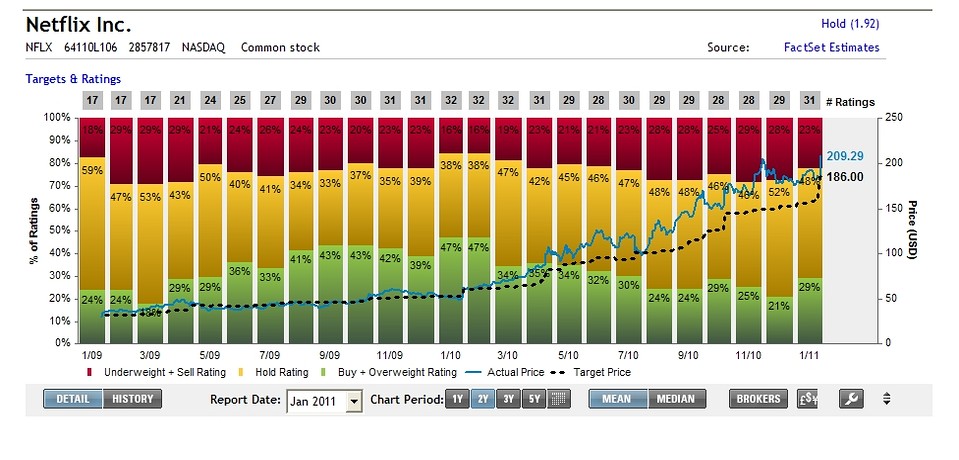
    Here is a cool chart from MarketBeat. It’s from an article on Netflix in which they discussed how analysts are still playing catch-up on the stock price target. Currently, the analysts’ consensus price target is $186, but the stock is currently trading at about $210.

     Netflix Target Price TBD

    Click to enlarge. Source: MarketBeat, FactSet

    It’s a tough business, estimating a target price, especially when the darn stock won’t cooperate. It looks like the stock price and the consensus target were pretty aligned in 2009. In 2010, the stock charged higher and the analysts are still trying to make sense of the move. (On the other hand, the 18% of analysts that carried NFLX as a buy in March 2009 are looking pretty good.)

    No doubt Netflix will top out at some point in the future-but that price is still to be determined.

    Disclosure: Dorsey, Wright Money Management owns NFLX in some account styles.

    Posted by:


    Winning the Super Bowl

    January 25, 2011

    Every NFL team competes every week with one goal in mind: to get to the Super Bowl. No team wins every year, but every team tries to win every year. Like NFL teams, investment managers are a competitive bunch. Each year, about this time, firms wrap up their year-end performance data. We always look to see how we stack up against our direct competitors-some years great, other years not so well.

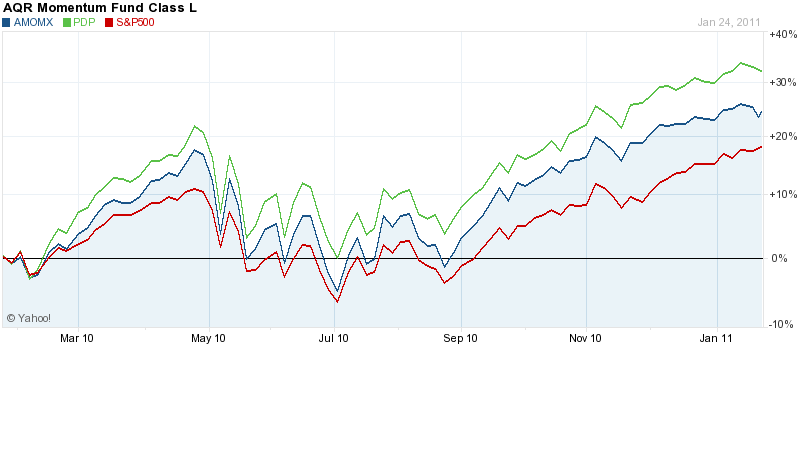
    Last year, 2010, turned out to be a very good year for relative strength generally, and especially our relative strength process. The grand-daddy of relative strength indexes, the Technical Leaders Index, performed admirably against both the market and other momentum indexes. While that is unlikely to be the case every year, perhaps we should take the opportunity to do a touchdown dance now!

    2010 S&P 500 total return +15.06%

    AQR Momentum Index +18.60%

    Technical Leaders Index +26.59%

    There are some differences between the indexes, of course. The S&P 500 is the de-facto market, containing 500 companies weighted by capitalization. The AQR Momentum Index (AMOMX) contains the top third (about 300 companies) of the largest 1000 by market value. It is ranked by 12-month return and is capitalization weighted. The Technical Leaders Index (PDP) contains 100 companies from the Russell 1000, ranked by Dorsey Wright’s proprietary relative strength measure. The 100 stocks are weighted by relative strength also.

     Winning the Super Bowl

    Click to enlarge. Source: Yahoo! Finance

    Posted by:


    Sorry, Jets Fans

    January 21, 2011

    According to the Super Bowl Stock Market Predictor, we need the Jets to lose this weekend!

    Posted by:


    Forecasting = Guessing

    January 12, 2011

     Forecasting = Guessing

    Source: Carl Richards, New York Times

    I think Carl Richards hits the nail on the head here. Investing for your future is too important to be left to guessing. We think it is far more sensible to harness a proven return factor (like relative strength) in a systematic process. There is enough randomness in the market and in life as it is!

    Posted by:


    Quote of the Week: Volatility Bites

    January 10, 2011

    Andrew Barber, quoted in Forbes, had this to say about volatility products:

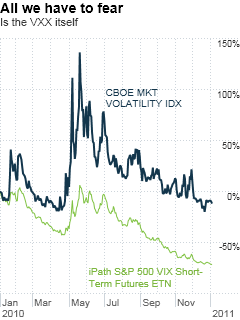
    “I would advise anyone considering buying one of the volatility futures products to dig a small hole in the backyard and set their money on fire instead,” said Andrew Barber, a strategist at investment adviser Waverly Advisors in Corning, N.Y. “The net result is the same.”

     Quote of the Week: Volatility Bites

    Source: Forbes.com

    Hilarious. Mr. Barber has a way with words. It’s sexy to talk about hedging your portfolio with VXX or some similar product, but when in contango, the negative roll yield causes terrible performance. And they’ve been in steep contango for a while. Since VIX typically has a strong inverse correlation with the S&P, another option would be just to use an inverse ETF-unleveraged.

    On the other hand, there’s a simple way to handle volatility: if you want exposure to the market, suck it up and learn to deal with it.

    Posted by:


    Sausage Factory

    January 6, 2011

    Dynamic Hedge has a funny article about how messy the investment process is. That’s especially true for investors in separately-managed accounts (SMA). While the SMA has tax advantages over a mutual fund, and sometimes expense and return advantages, the SMA is also inherently messier because clients can see the trades. Often clients interpret a few losses as evidence that a manager is ineptly thrashing around in the market. In fact, as Dynamic Hedge points out, the whole investing process is like a sausage factory. You might like the end result-RS strategies had really, really nice numbers last year-but you might not like to watch the sausage being made. We think that the SMA vehicle is very worthwhile, but you might need to avert your eyes now and then. Give the portfolio manager a break, eh?

     Sausage Factory

    Source: Dynamic Hedge

    Posted by:


    Official 2011 Forecast

    January 4, 2011

    In January, many firms seem compelled to offer a forecast for the coming year. Not us. (By now you should know what I think about predictions!) We just go with the flow and try to turn every year into a good year.

    Since I recognize this is not very satisfying, here is my favorite prediction so far, courtesy of Laszlo Birinyi, by way of Investment News. I’m not saying it’s more accurate, just that I like it better!

    Posted by:


    Haters Gonna Hate

    December 29, 2010

    Earlier this year I highlighted an article by Mr. Brett Arends of the WSJ who thrashed Apple, calling for investors to take profits, or at the minimum, buy some puts to cover the risk. Apple stock is up around 100% since Arends was calling to short Apple back in 2009.

    Earlier this week, I read another article by Mr. Arends on the WSJ website, Is This The Peak for Netflix? You can guess what he thinks about a stock that’s up over 250% in 2010 alone…that’s right, you should take profits!

    But the game is different, and getting harder.

    To me, it looks like Mr. Arends is playing the same game as always. He recommends shorting stocks that are up double digits…and continuing to short them if they become triple digit gainers. I cannot make this stuff up. If Brett Arends tells you to GET OUT or BUY PUTS, you might consider doing the opposite! Look-sooner or later, he will be right-he might even be right about Netflix. I have no better likelihood of guessing correctly than he does. It’s his job to make predictions, I suppose, but we all know predictions are unreliable.

    You know what really grinds my gears about Mr. Arends? His articles are consistently at the top of the most-read and most-emailed links on the entire WSJ website! He is obviously getting paid good money to have his apocalyptic work published. Clearly, people love to hate on a winner.

    Today, Mr. Arends came out with a new article, this one called, Why I Don’t Believe In This Santa Rally. With the stock market up around 10% this quarter, here’s what Mr. Arends has to say:

    Two words: Bah, humbug.

    The market doesn’t care what any commentator thinks should happen. Neither should you! If you’re going to read predictions, do it strictly for entertainment purposes.

    Disclosure: Dorsey Wright Money Management owns Apple and Netflix in some of our portfolios.

    haters gonna hate Haters Gonna Hate

    .GIF credit to thisisallido.com

    Posted by:


    Early New Year’s Resolutions for 2011

    December 23, 2010

    Money is not the most important thing in life, but it’s right up there with oxygen.—-Dennis Miller

    For those of you who like to get an early start on your resolutions, I have a list of things that might positively impact your financial well-being. Admittedly, this is the season when most Americans are preoccupied with spending money, but maybe it’s not a bad idea to also think about preserving and growing it.

    1. Hire a good financial advisor. You might know a little more about what is going on, and you could end up with a lot more money. At least that was the conclusion from a recent study of 14,000 adults by ING Retirement Research.

    According to the data, those who spent some time with an advisor reported saving, on average, more than twice as much for retirement as those who spent no time at all with an advisor. The number jumped even higher – over three times as much – for those who spent a lot of time with an advisor.

    And yet the usage rate of advisors for this sample was a significant minority, only 31%.

    2. Save more. You’re going to need it, because you are probably going to live a lot longer than you think. You’ve seen all of the statistics about how little Americans have saved or stashed into their 401ks. Do something about it. Bump your 401k savings rate up a couple of percentage points for next year. If you’re already maxing it out, start an automatic investment plan with a good mutual fund. (I am biased toward the Arrow DWA Balanced Fund!) Yes, you! Do it now before you forget about it.

    3. Identify a good return factor and exploit it. Mercilessly. Relative strength and value are the most prominent return factors that have proven themselves over time. Better yet, create a portfolio that uses them both, because they mesh together very nicely.

    4. Persist. Markets are going to be uncomfortable at times. You’ve got to stick with a strategy through thick and thin to reap the best returns. It’s most important not to abandon a sound strategy when it is really uncomfortable-that’s what causes investors to perform poorly.

    5. If you must listen to the financial media at all, consider going opposite the accepted wisdom. A market is only news when it’s at an extreme-and that’s usually the time to consider going against the grain.

    If you decide to get into shape and lose a few pounds also, great. Here’s a link to a Wall Street Journal article about how to stick to your resolutions. It’s all worthwhile.

    Posted by:


    Thanks a Trillion!

    December 21, 2010

    There have been a few articles over the last few days about the ETF marketplace gathering its first $1 trillion in assets, like this one from Index Universe. A trillion dollars is a lot even for a Congressman, and really speaks to the product acceptance in the marketplace. And while we are at it, Thank You! We would like to thank all of the Dorsey, Wright clients that have made our Technical Leaders Indexes so successful-more than $800 million in assets at the end of last week. We think it is a great way to get exposure to the high RS equity universe, but we couldn’t do it without you. You’ve made Wall Street take notice-now several other firms are coming out with products that target high relative strength stocks as well.

    Best of all for investors is that relative strength has been a good return factor over the last year. Below are charts comparing PDP with the S&P 500, PIZ with EAFE, and PIE with MSCI Emerging Markets—don’t I wish every single year would be like 2010!

    PDP vs SP 500

    PIZ vs EFA

    PIE vs EEM

    Source: Yahoo! Finance

    Posted by:


    How Not to Balance the Budget

    December 15, 2010

    I’m not claiming that I have any fool-proof solution to balance the budget, but I was intrigued to read this article in the Wall Street Journal detailing the historical experience of tax increases and spending. In a conclusion that will surprise no one:

    In the late 1980s, one of us, Richard Vedder, and Lowell Gallaway of Ohio University co-authored a often-cited research paper for the congressional Joint Economic Committee (known as the $1.58 study) that found that every new dollar of new taxes led to more than one dollar of new spending by Congress. Subsequent revisions of the study over the next decade found similar results.

    We’ve updated the research. Using standard statistical analyses that introduce variables to control for business-cycle fluctuations, wars and inflation, we found that over the entire post World War II era through 2009 each dollar of new tax revenue was associated with $1.17 of new spending. Politicians spend the money as fast as it comes in—and a little bit more.

    I put the good part in bold. Clearly, we need some way to encourage savings and investment-consumption doesn’t seem to be a problem!

    Posted by:


    Hello, Goodbye

    December 9, 2010

    I say high, you say low
    You say why, and I say I don’t know
    Oh, no
    You say goodbye and I say hello
    Hello, hello
    I don’t know why you say goodbye
    I say hello
    Hello, hello
    I don’t know why you say goodbye
    I say hello
    —-John Lennon/Paul McCartney

    This is a good reminder not to get locked into a position-when one door closes, another door opens. I have long suspected these lyrics referred to sector rotation in the stock market, but I guess you can never be sure, since John Lennon is no longer around to ask. He was killed thirty years ago yesterday, news that was broken to the American public by Howard Cosell during a Monday Night Football game. Moment of silence, please.

    Posted by: