The Big Surprise Coming for Most Bond Investors

December 8, 2010

If interest rates rise, what will typically happen to bond prices?

18% - They will rise
28% - They will fall
5% -They will stay the same
10% - There is no relationship between bond prices and the interest rate
37% - Don’t know
2% - Prefer not to say

The heinous data above comes from Finra’s newly released Financial Capability Survey: only 28% of the national sample of more than 28,000 adults had a clue that bond prices would fall if interest rates went up. This strikes me as a pretty good argument to get a competent financial advisor.

In unrelated news, 67% of respondents rated their overall financial knowledge as “high,” and 75% endorsed the statement, “I am pretty good at math.”

The financial market is a really expensive place to get an education.

Posted by:


Advice on Maintaining Optimism

December 8, 2010

In a nutshell, ascribe success to your incredible abilities and failure due to temporary factors out of your control.

The most critical aspect of optimists’ explanatory style is that they reflexively attribute negative events to external, transient causes (“the poor economy preordained failure before I opened for business”), while attributing favorable outcomes to permanent, personal factors (“my exhaustive knowledge of the stock market is why I made so much money”).

Frankly, optimism is incredibly adaptive in life-it’s what allows you to take risks, persist despite obstacles, or stay invested in a winning strategy during a downturn. As Bob Dunwoody might say, “Sounds crazy, might work.” You can thank me later.

Source: Forbes, How to Stay Optimistic

Posted by:


The Oldest Chart in the World

November 12, 2010

I belong to a number of professional associations. One of my colleagues was doing serious historical research and asked if anyone knew what the oldest chart in the world was. This was my less-than-serious nomination for that distinction. I’m pretty sure that even Neanderthal man bought at the highs and sold at the lows. In fact, most of them died broke, as there are no surviving Neanderthal mansions.

Source: NY Times

Posted by:


Heads or Tails?

November 8, 2010

By definition, financial markets and their sewing circles are rife with predictions.

The bond bubble is about to burst

China will become the next superpower

Equities will NEVER regain their footing

Unfortunately, these predictions are mostly useless. Quite simply, we have no idea what’s going to happen in the future. It’s impossible to predict the future accurately over a large sample-set. It’s impossible. That goes for stock market prices, macroeconomic trends, socioeconomic trends, the weather, and how long it’s going to take you to get home from work today. There are just too many variables to accurately predict the future with any sort of reliability.

In the spirit of bashing any and all de-facto predictions, then, we turn to a Newsweek article written in 1995 by a pseudo-famous PhD astronomer-techie-pundit, Clifford Stoll. The article, entitled The Internet? Bah!, was written at just around the time when PC computing on the internet was just beginning to hit the mainstream US consumer market.

After two decades online, I’m perplexed. It’s not that I haven’t had a gas of a good time on the Internet… But today, I’m uneasy about this most trendy and oversold community. Visionaries see a future of telecommuting workers, interactive libraries and multimedia classrooms. They speak of electronic town meetings and virtual communities. Commerce and business will shift from offices and malls to networks and modems…

Baloney.

The future of the internet summed up in a word – BALONEY! This is coming from a professional on the cutting edge of internet usage (two decades of use in 1995). He’s not some media hack just firing from the hip – with a PhD in astronomy, Mr. Stoll was quite literally a part of the birth of the internet (in a broader sense of the word, a la academia).

It’s important that we give Mr. Stoll a sense of professional expertise, because it’s that very professional expertise that leads to a false sense of confidence in knowing the future (from us, for believing him, and from him, for predicting in the first place). The guy’s a computer engineer astronomer academic. If there was somebody in the room who everyone could agree could shed some light on the future of internet computing…it would be him.

You have to read the whole article to get the full flavor of his prediction. Why would ANYONE buy ANYTHING on the internet? There are no salespeople on the internet! There’s no order on the internet! (Google was founded in 1998, just 3 years down the road).

My point is this – no matter who you are, no matter how smart you are, no matter how exalted you are within your chosen field – it’s impossible to predict the future. On the other side, the same is true for the people he is arguing against, who predicted the internet would become the nexus of information and commerce that it’s grown to be. Both sides’ predictions are equal as probable outcomes. It’s quite literally a coin-flip, just with more variables. We can sit here Monday Morning Quarterbacking, and laugh at Mr. Stoll and how wrong his predictions were, etc. That’s not the point. The point is to beat into your brain that predicting the future is an impossible task.

The future is unknowable. We solve this philosophical quandary by systematically following an adaptive rule set that has been rigorously tested and can be shown to have outperformed over a long period of time. We buy what is strong and continue to hold it until it becomes weak. It really is that simple.

Posted by:


According To A Recent Government Publication

November 8, 2010
  • A billion seconds ago Harry Truman was president.
  • A billion minutes ago was just after the time of Christ.
  • A billion hours ago man had not yet walked on the earth.
  • A billion dollars ago was late yesterday at the U.S. Treasury.

HT: The Leuthold Group

Posted by:


Gold vs. Silver — Place Your Bets!

November 4, 2010

Everyone is talking about the gold trade these days. Gold Gold Gold. All over the news, all day everyday, 24/7, all anyone wants to talk about is gold.

What about silver? What’s silver been up to? Silver has to be rising too, right? Here’s a screen-grab I took of the GoogleTrends comparison of the phrases “gold prices” versus “silver prices.” You can consider it a rough estimation of media coverage via Google searches, keyword hits and overall internet chatter.

source: Google

You can see gold crushes silver in terms of media mentions and overall visibility, by a factor of around 2 to 1.

Now let’s go to the charts!! If you had to pick which ETF has done better in the last year, would you pick GLD (gold) or SLV (silver)?

Click here to see results. Click to find out!!

Disclosure: Dorsey Wright Money Management owns GLD & SLV in some of our portfolios & managed products.

Posted by:


A Nearly Foolproof Recipe for Market Gains

September 27, 2010

Tell Congress to go home and stay there. According to a recent article in the New York Times:

…stocks fare better when Congress is out of session, much as [Will] Rogers suggested. Along with Michael F. Ferguson of the University of Cincinnati, Professor Witte corroborated this finding in a 2006 paper. The researchers found that more than 90 percent of the price gains over the 108-year life of the Dow Jones industrial average through 2006 came on days when Congress was out of session.

Amazing, is it not? Several theories were offered as to why this effect occurs, but I prefer the theories of American humorists Will Rogers and Mark Twain. Twain’s take on the situation:

Suppose you were an idiot. And suppose you were a member of Congress. But I repeat myself.

Will Rogers went for immaturity rather than stupidity. He wrote:

This country has come to feel the same when Congress is in session as we do when the baby gets hold of a hammer. It’s just a question of how much damage he can do with it before you can take it away from him.

Will Rogers wrote in 1930. Twain’s commentary came in his autobiography, which was dictated to a stenographer between 1906 and his death in 1910. Current sentiments toward Congress are obviously nothing new! For those who are seriously concerned, here is a link to a Congressional calendar. The target date for the next adjournment is October 8.

Posted by:


Bond Market: The Movie

September 23, 2010

Courtesy of MTV Films and Paramount Productions

Starring Johnny Knoxville as the Retail Investor and the bison as the Bond Market. Not sure when it will be released, but I’m pretty sure it’s in production. Oh, wait-never mind-wrong movie. My bad.

Posted by:


Roubini Sentiment Index — An Instant Classic!

August 31, 2010

Check out Make Money with Roubini Sentiment Indicator for a hilarious take on one media staple’s correlation with stock market performance. Nouriel Roubini has become famous in the last three years for his correct prediction of a dramatic worldwide recession and stock market decline. Roubini-mania has subsided a bit since the height of the financial crisis, but it doesn’t take many clicks on a finance website to find a mention of Dr. Doom, as he’s affectionately known.

Dr. Dogan at Insider Monkey takes a look at the raw data, using GoogleTrends to form an underlying Roubini Index which gauges Roubini’s media exposure. He then takes a look at market performance, and more specifically, the VIX.

Long story short, it turns out the Roubini Index actually leads VIX performance by about two weeks, allowing for some actionable VIX trades which have made money over the last three years.

Here is our simple trading strategy: Go long the VIX when Roubini Sentiment Index goes %25 above its four-week moving average. Following this strategy over the 2007-2010 period will earn us a weekly average return of an amazing 2.4% (If we had simply gone long VIX at all times, the average weekly return would have been 1.6%). If we hold on to our long VIX position for three weeks, the average return over this time period is 8.25%

I’d be interested to find out what the longer-term trading results are for this new indicator. What’s problematic is that Roubini was completely off the radar until 2006. Here’s a screen grab of his GoogleTrends chart – his name doesn’t start to jump until mid-2007, which would only give us 2 years of worthwhile data (we can only test forward to August, 2009 on a yearly basis).

Click to Enlarge. source: Google

Theoretically we could just use the VIX as a proxy and test the results…check back for more!

HT: Clusterstock

Posted by:


Maybe This is Why Warren Buffett is Always So Jovial

July 7, 2010

It turns out that money can buy happiness. Well, maybe not directly-but researchers were surprised when they examined data from a Gallup survey. According to a Wall Street Journal synopsis of the results:

A new analysis of Gallup World Poll data, surveying 136,000 people across 132 nations from 2005 to 2006, suggests that income is much more highly correlated to happiness (or at least a form of it) than previously thought.

Even some experts in behavioral finance were surprised:

What was interesting about the study was how universal the desire for financial success was across the world. “People in Togo and Denmark have the same idea of what a good life is, and a lot of that has to do with money and material prosperity,” Daniel Kahneman, professor emeritus of psychology and public affairs at Princeton University, told the Washington Post. “That was unexpected.”

To me, it’s not so surprising. If you work in the financial services field, you see firsthand how hard people strive to achieve financial success for themselves and their families. When they fail, they are miserable.

Warren Buffett, on the other hand, has a lot to be happy about. He has lifelong buddies (Charlie Munger), new friends (Bill Gates), influence, and financial security. Although he might be less happy if his friends and influence went away, he probably wouldn’t be miserable because he would still have financial security, Cherry Coke, and the t-bones at Gorat’s.

 Maybe This is Why Warren Buffett is Always So Jovial

Source: Yahoo! News

Financial security is a much more important financial good than people give it credit for. Like most quantities, it seems to be relative. A retired executive might feel pinched or deprived at a different level of retirement income than a retired janitor, for example. This psychological insight led some clever financial service professional in the hazy past to popularize the “70% of income in retirement” rule of thumb, which is completely relative. There’s probably a paper waiting to be written on the S-curve of satisfaction with relative retirement income levels-above (and below) certain thresholds, satisfaction is probably reliably high (or low). In between, there may be a steep incline, where rising assets equate with rising happiness. At this point in the curve-where most of us are-the impact of good or bad financial advice can be huge.

Perhaps financial advisors can’t do much about the current worldwide financial malaise, but they certainly have the ability to influence and improve their clients’ finances through the encouragement of savings and the pursuit of sensible investment policies.

Posted by:


Your Money or Your Life

June 23, 2010

This used to be just a cliche that muggers would use when relieving you of your wallet. Apparently Americans headed toward retirement feel like they are being mugged as well. According to an Allianz Life Insurance study cited in Financial Planning magazine,

…more respondents between the ages of 44 and 49 say they fear outliving their assets more than they fear death (77% versus 23%).

In other words, an overwhelming majority consider running out of money a fate worse than death. Saving and investing must be far worse than death because Americans really don’t want to do that.

Posted by:


Advice From a Hedge Fund Manager

June 12, 2010

A faux radio call-in show where a few listeners ask financial questions to an out-of-touch hedge fund manager. You can read the transcript, but the audio is much funnier. Sort of.

Posted by:


Coffee Spill at BP Headquarters

June 11, 2010

A comedy video imagines what happens when BP executives spill their coffee at a meeting, found on CNBC.com. Black humor, to be sure.

Posted by:


Hobo Investing

May 26, 2010

Investing, at its core, is a simple process. You need to determine if the train is going north or south, or just sitting on a track siding doing nothing. Once you’ve found a train going north, you need only to hop aboard. If the train starts to go south, you need to jump off.

The concept is simple, but sometimes investors make the execution more complicated. For us, relative strength and trend following provide the tools and methodology to find the northbound trains. The same tools and methodology can be used to tell you when the switch engine has come along and started to move the train south.

The problems happen when investors deviate from the simple goal-directed hobo mentality and get too clever for their own good. Can you imagine how irrational some investor behavior must look to a hobo? Here are the top six dysfunctional hobo sayings:

1. I wanted to go north, so I hopped on an out-of-favor southbound train, hoping it would go north eventually. (value hobo)

2. I got on a northbound train, but it only went north a few miles. A switch engine came along and started to take my boxcar south. How embarrassing! This train owes me. I’m not getting off. (ego-attached hobo)

3. There are so many trains going north. I want to hop on one eventually, but I’m afraid it will go south right after I get on it. (failure to launch hobo)

4. This northbound train is picking up speed. I’d better get off. (premature ejection hobo)

5. I want to go north, but my train pulled on to a siding and stopped. Maybe I’ll just sit here and see what happens. (buy-and-hold hobo)

6. There are so many trains going north without me. Eventually they will all have to go south, and then I’ll have my revenge! (bitter hobo with economics background)

If you want to go north, get on a northbound train. KISS really applies here. On our good days, we all know this, but it’s so easy to forget.

Posted by:


Net Worth is a Worthwhile Obsession

May 19, 2010

Ron Lieber wrote an interesting article in the New York Times about a number of websites that allow you to anonymously track and post your net worth and compare it with others in similar circumstances. Mr. Lieber didn’t say explicitly what he thought about this new trend in social networking, but the title to the article, “Net Worth Obsession,” gives a clue. A number of pundits were quoted decrying the trend:

But does our almost irresistible urge to rank ourselves against others based on any available data serve as a source of inspiration? Or does it lead to endless striving in search of some ever-elusive achievement? “I think this is a profound problem, this aspect of humans in the West,” said Andrew Oswald, a professor of behavioral science at the Warwick Business School in England. “We’re now extraordinarily rich by almost any standard of human history. But because we are creatures of comparison, it’s harder to get happier and happier.”

It’s certainly possible to pay too much attention to your net worth and ignore your happiness, but most of the actual site participants had very positive things to say. Perhaps there is something redeeming in tracking assets minus debts! One user says:

Initially, the idea of laying herself bare on a blog and on NetworthIQ caused a lot of anxiety. “You’re saying I have a secret and here it is for everyone to see,” she says. “But once it’s out there, and especially now that it’s not just a flat line saying ‘negative $23,000,’ and it is moving up a little bit, there’s a sense of pride and accomplishment that goes along with that. I know people are visiting, and it makes me want to pay something else off so I can post another entry that’s something good.” She’s currently putting a third of her monthly take-home pay from her job as a benefits analyst toward debt payments.

All of this has led to some odd reversals in her life. She looks forward to getting her bills in the mail, for instance, because it means it’s time to update her total debt. “Which might be a little bit sick,” she said. “But I know it’s lower than the last month. I know it for a fact.”

Grant often wonders about the people who are far ahead of her in the NetworthIQ standings. Did they get lucky? Are they lottery winners? Or did they get smart about money before she did? She tries not to beat herself up over it. “For people with the same income as me but higher net worth, it tells me that I can get there, too. It just takes discipline,” she says. “I know it has only been a couple of months now, but I kind of feel like I’ve made a life change.”

In other words, most of the participants found tracking their net worth to be motivational. This is something that I have noticed repeatedly with real clients over the past 25 years. The clients who track their net worth always do way, way better than clients who have only a vague idea of their finances. The difference is so dramatic that I routinely suggest the practice to clients. Before there were social networking websites for net worth, there were spreadsheets. As far as I know, none of my clients have ever shared their information with anyone but their financial advisor, but like most things, just the fact that it is being tracked makes them pay attention to it. Most clients do not see updating their spreadsheet each month or each quarter as a joyless activity-they are instead motivated to keep that number moving north.

If competing with your net worth on a social networking website helps push you to save and invest, well, more power to you. One person interviewed in the New York Times article makes this same point:

She admits that some of her pleasure is fueled as much by competition as self-satisfaction. “I’m not that far off from the person right above me” on the NetworthIQ list, she says. “I can probably catch them this month. And maybe next month I can get to the next one.”

It’s not as if people don’t notice their socioeconomic status anyway. Even Mr. Osvald, who was quoted earlier in the article lamenting the “profound problem” with humans admits that comparison is actually just human nature:

Oswald, the professor of behavioral science, says the craving for comparison may be rooted in our biology. “It’s easier said than done to break through two million years of evolution,” he says. “A million years ago, you could watch what others were doing and mimic that to get food and resources. Or if you were high up the monkey pack, you could get the best mates.”

Let’s face it: everyone wants to be high up in the monkey pack. Perhaps we’re not all members of the same monkey pack, but humans always and everywhere are in competition for resources. Consequently, social and economic signifiers are embedded in everything from the car you drive, the sneakers you wear, the sports you enjoy (polo anyone?), the bling and tats you do (or do not) have. We have elaborate social ways of interpreting these signifiers: the same Bentley might be seen as appropriate if the owner comes from ”old money,” but tacky if the owner is “nouveaux riche.” Most product marketing is based more on the branding-the social signifier-than on the actual product features.

“Keeping up with the Joneses” will always be with us. Ultimately, I think tracking net worth is a much healthier way of keeping up with the Joneses than accumulating possessions and racking up consumer debt. After all, most of our personal and national fiscal problems are caused from too much spending and not enough savings and investment. Tracking your net worth, I suspect, is actually aspirational and motivational rather than pathological. Instead of sucking the fun out of life, clients end up bonding with their grandkids for the summer at the beach condo they wouldn’t otherwise have had. Pundits may worry about it, but the public seems to find it practical and valuable.

Posted by:


Imaginary Memo: Yesterday’s Selloff

May 7, 2010
MEMO
To: Financial Crisis Inquiry Commission
Lay off, guys. We can do this anytime we want to.
Regards,
Goldman Sachs
Just kidding, of course. It’s actually somewhat ridiculous the way Congress is trying to demonize the industry to push through legislation. Courtesy of JC.

Posted by:


Good News if You Like the Smell of Grease

May 6, 2010

Amazingly, this product is apparently sold out! My hat is off to the incredible ingenuity of American consumer marketing professionals everywhere.

Posted by:


Icelandic Volcano Humor

April 22, 2010

On Wall Street, even natural disasters are turned into fodder for jokes. CNBC.com has a cute article on a few of the quips.

Posted by:


Why No One Pays Attention to Economists

April 16, 2010

This article from Time Magazine is priceless. Two econ professors are suggesting that young people use 2-1 leverage to buy stocks for their long time horizon retirement portfolios. Apparently their Monte Carlo simulation didn’t include all of the margin calls you would get during every drawdown. Long on IQ perhaps, but short on common sense.

Posted by:


The Clown Says It’s Undervalued

March 26, 2010

The Economist has once again published its “Big Mac Index“. As some long-time readers may recall, this index is based on the theory of purchasing-power parity, in which exchange rates should equalize the price of a basket of goods across countries.

The index shows that the Big Mac that costs $3.58 in the U. S. would cost $6.16 in Switzerland and $6.87 in Norway. This suggests that their currencies are overvalued relative to the U. S. dollar. On the other end of the valuation spectrum, a Big Mac in China costs $1.83, suggesting that the yuan is 49% below its fair-value benchmark with the dollar.

source: The Economist. Click to enlarge.

Posted by:


Even Your Happiness is Relative

March 25, 2010

Relative strength really is everywhere! If you don’t believe us, take a look at the Wealth Report at the Wall Street Journal. They discuss research from professors who were puzzling over the fact that people tended not to be any happier even though they were making more money, although generally money tends to enhance happiness. Why did that happen?

…the researchers decided to dig deeper into what is called the “reference-income hypothesis,” a fancy way of saying that wealth is relative. If an entire country gets richer at the same time, individuals wouldn’t necessarily feel wealthier, since their relative positions in society hadn’t changed.

It turns out that your happiness hinges much more on your relative position than on your absolute position on the income scale. This explains how you can be miserable even on a high income if your idiot brother-in-law makes more money than you. The people in your comparison set are what counts.

…[researchers] found that the person’s rank within the comparison set was a stronger predictor of happiness than absolute wealth. “If absolute income matters, as we increased our income, everybody should get happier at a national level, but we don’t seem to,” Mr. Boyce said. “So what we are showing is that in terms of life satisfaction, rank is a better predictor than absolute wealth.”

Source: www.despair.com

Posted by:


Economics in One Picture

March 9, 2010

From Greg Mankiw’s blog, economics in one picture. This nicely captures the principle of supply and demand!

Posted by:


John Bogle is Missing!

March 2, 2010

There is an absolutely hilarious round of letters and investment challenges going around, started by a challege from Roger Schreiner of Schreiner Capital Management to John Bogle. It’s been 193 days and John Bogle has yet to accept.

David Loeper from Wealthcare Capital Management responded in a Letter to the Editor and the accusations are flying. (There’s a link to the original challenge and Loeper’s response in the article.)

Everyone has an ax to grind and the challenges are somewhat tilted, but it’s been a great excuse for Mr. Schreiner to skewer passive investing.

Our investment strategy is to own stocks when the market is strong and sell them when the market is weak. By comparison, the investment process (if you can call it that) of the passive investor is embarrassingly simple: hope.

I’m sure this will not end the active versus passive debate, but it has been good for some entertainment.

Posted by:


Reverse Psychology

February 26, 2010

This just in: People do the opposite of what you tell them.

Researchers at the University of Indiana released the results of a study yesterday, which examined the effects of shame and guilt-inducing public service announcements. Specifically, the researchers studied ads which promoted responsible alcoholic consumption by way of illustrating the harmful consequences of over-drinking. By highlighting side effects like blackouts and car accidents, viewers of the ads were made to feel ashamed and guilty for indulging in those behaviors.

What’s the problem with that? Unwittingly, the ads caused people who are already dealing with those problems to drink even more.

Findings show such messages are too difficult to process among viewers already experiencing these emotions – for example, those who already have alcohol-related transgressions.

So not only do the ads not really work, they also exacerbate the situation for people who already have a problem.

Why do we care? Because this same kind of shame-inducing message could be leading retail investors to continue to do exactly what is hurting them in the first place. The human brain, when confronted with the horrors of reality, sets up a foiling mechanism to cope with the bright light of truth.

Advisor: You know, the research proves without a doubt that retail investors cannot time the market. You would be well-served by adopting a proven strategy and sitting tight for the long-term.

Client: Well that sure doesn’t sound like me! Hey this fund is down on the year, let’s find a new one. Next!

So not only does the client have a major problem to begin with, when you show them the error of their ways, it forces the client down a rabbit-hole of denial. It’s a vicious cycle.

We’ve talked about this type of behavior before.

Maybe we should try reverse psychology and suggest that clients churn their portfolio at every whim?

[Editor's note: J.P. does not have teenagers, or he would already know people do the opposite of what you tell them!]

Posted by:


Zut Alors!

February 19, 2010

If you need another reason to hate the French, besides envy of their excellent cuisine, it turns out that a bevy of winemakers were fined and given suspended sentences for foisting cheap, lousy wine on American consumers and charging them premium prices for it.

On the other hand, it shows that cognitive biases are everywhere. Neither the American company the wine was shipped to nor consumers drinking it ever complained! Because the wine was labeled as premium pinot noir, wine enthusiasts apparently thought it tasted great. In fact, it turns out that wine drinkers think expensive wine tastes better, even when you trick them and give them two glasses of wine from the same bottle.

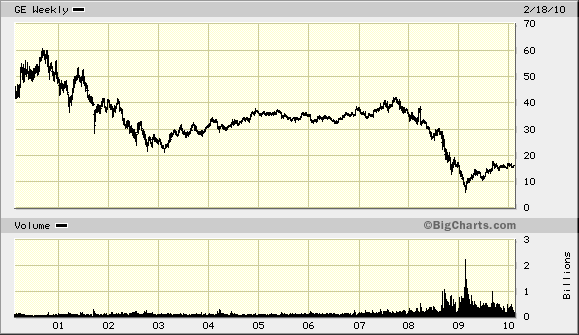
This behavior is not unknown in the stock market, where cognitive biases run unbridled down Wall Street. Ten years ago, everyone was in love with General Electic. It, too, was high-priced and tasted great. Ten years later, GE is considered cheap swill that leaves a bitter taste in the mouths of investors.

 Zut Alors!

The moral of the story is that you can’t fall in love with your stocks or your wine. You have to like it on its own merits. In the case of our Systematic RS accounts, we like a stock only as long as it has high relative strength. When it becomes weaker and drops in its ranking-indicating that other, stronger stocks are available-we sell it and move on to a better class of grape. (We’ve been known to break a bottle here and there, but the idea is to adapt as tastes change.) In this way, we strive to keep our wine cellar stocked with the best vintages all the time.

 Zut Alors!

Posted by: