Fund Flows

May 3, 2012

The Investment Company Institute is the national association of U.S. investment companies, including mutual funds, closed-end funds, exchange-traded funds (ETFs), and unit investment trusts (UITs).  Members of ICI manage total assets of $11.82 trillion and serve nearly 90 million shareholders.  Flow estimates are derived from data collected covering more than 95 percent of industry assets and are adjusted to represent industry totals.


High RS Diffusion Index

May 2, 2012

The chart below measures the percentage of high relative strength stocks that are trading above their 50-day moving average (universe of mid and large cap stocks.)  As of 5/1/12.

The 10-day moving average of this indicator is 69% and the one-day reading is 79%.


The Approaching Reallocation Rally

May 1, 2012

From a large commentary from Doug Kass, found at TheStreet.com:

It remains my contention that it will take relatively large losses in bond funds to bring back the individual investor into equities. But this is likely coming — it almost always occurs coincident with higher stock prices — and when it does, one of the greatest reallocations out of bonds and into equities will commence.

Mr. Kass discusses also the flow of funds and many factors that he believes are impacting prices.  It’s a nice piece because it hits most of the talking points that clients ask about.


What’s Hot…and Not

May 1, 2012

How different investments have done over the past 12 months, 6 months, and month.

 1PowerShares DB Gold, 2iShares MSCI Emerging Markets ETF, 3iShares DJ U.S. Real Estate Index, 4iShares S&P Europe 350 Index, 5Green Haven Continuous Commodity Index, 6iBoxx High Yield Corporate Bond Fund, 7JP Morgan Emerging Markets Bond Fund, 8PowerShares DB US Dollar Index, 9iBoxx Investment Grade Corporate Bond Fund, 10PowerShares DB Oil, 11iShares Barclays 20+ Year Treasury Bond


High Correlations: We’ve Been Here Before

April 30, 2012

There has been a lot of talk in recent years about the rising correlation among US stocks.  High correlations potentially make it harder for stock-pickers to really stand out and a commonly expressed fear is that this condition is the “new normal.”   With that backdrop, consider the chart below that shows the correlations of large-cap US stocks going back to the late 1920s.

Source: iShares

Yes, correlations are higher today than they have been for decades, but the market has experienced periods of high correlations before–notably in the aftermath of the Great Depression.  I think the explanation is pretty straightforward–when investor trading is primarily driven by “macro” concerns, the correlations tends to be high and as those fears subside, correlations tend to drop.

In a glass-is-half-full mindset, I find it encouraging that our Technical Leaders Index (PDP) has outperformed the S&P 500 over the last 5+ years notwithstanding the rising correlations (from 3/1/2007 – 4/27/2012, PDP is +17.08% while the S&P 500 is +0.01%).  It may be possible for that margin of outperformance to expand once the correlations again begin to subside.

See www.powershares.com for more information about PDP.


Weekly RS Recap

April 30, 2012

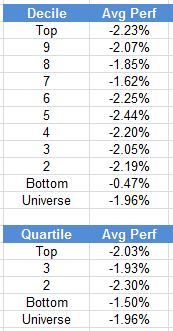
The table below shows the performance of a universe of mid and large cap U.S. equities, broken down by relative strength decile and quartile and then compared to the universe return.  Those at the top of the ranks are those stocks which have the best intermediate-term relative strength.  Relative strength strategies buy securities that have strong intermediate-term relative strength and hold them as long as they remain strong.

Last week’s performance (4/23/12 – 4/27/12) is as follows:

High relative strength stocks posted strong gains for the week and finished ahead of the universe.


Job Growth Surges

April 30, 2012

According to the Wall Street Journal, job growth at US multinationals has been surging for the last two years…overseas.

Thirty-five big U.S.-based multinational companies added jobs much faster than other U.S. employers in the past two years, but nearly three-fourths of those jobs were overseas, according to a Wall Street Journal analysis.

Those companies, which include Wal-Mart Stores Inc., WMT +0.12%  International Paper Co., Honeywell International Inc. and United Parcel Service Inc., boosted their employment at home by 3.1%, or 113,000 jobs, between 2009 and 2011, the same rate of increase as the nation’s other employers. But they also added more than 333,000 jobs in their far-flung—and faster-growing— foreign operations.

Economists who study global labor patterns say companies are creating jobs outside the U.S. mostly to pursue sales there, and not to cut costs by shifting work previously performed in the U.S., as has sometimes been the case.

The reason is simple—there is more growth overseas than in the US.  Companies naturally desire to be close to their customers, so they put operations nearby to serve them.  If you decide to distribute Pepsi in Mongolia, that has to be done by Mongolians.  It’s not a matter of evil corporations exporting jobs overseas—there’s just no way for that job to be done in the US.

When I read articles like this, it makes the argument that some type of global macro strategy needs to be part of a core portfolio.  We no longer have the investment luxury of staying completely within our borders, figuring that the best returns available can be captured here.  The world is changing and global is the new core.


Dorsey, Wright Client Sentiment Survey – 4/27/12

April 27, 2012

Here we have the next round of the Dorsey, Wright Sentiment Survey, the first third-party sentiment poll.  Participate to learn more about our Dorsey, Wright Polo Shirt raffle! Just follow the instructions after taking the poll, and we’ll enter you in the contest.  Thanks to all our participants from last round.

As you know, when individuals self-report, they are always taller and more beautiful than when outside observers report their perceptions!  Instead of asking individual investors to self-report whether they are bullish or bearish, we’d like financial advisors to weigh in and report on the actual behavior of clients.  It’s two simple questions and will take no more than 20 seconds of your time. We’ll construct indicators from the data and report the results regularly on our blog–but we need your help to get a large statistical sample!

Click here to take Dorsey, Wright’s Client Sentiment Survey.

Contribute to the greater good!  It’s painless, we promise.


Wrong Way Corrigans

April 27, 2012

Professionals are no good at forecasting the market, something that numerous studies have made clear.  CXO Advisory shows that bloggers are no better.  This isn’t really a surprise, but I like their graphic that shows when bloggers are most bullish, the market performs most poorly—and vice versa.  (Unlike Douglas Corrigan, bloggers probably aren’t going the wrong way on purpose.)

Source: CXO Advisory    (click on image to enlarge)

This is a good bit of what makes financial markets so frustrating for the retail investor.  Just when they are feeling most bullish…wham!  Then, they watch helplessly as the market rises, paralyzed by fear and unable to bring themselves to participate.  (This has been going on for three years now, if you’re paying attention to the Funds Flow report.)

Advisors often complain about the amount of hand-holding they need to do during adverse market conditions, but this may be their most critical function.  If investors want a chance at the returns, they have no alternative but to get in the game.  For may investors, guidance from a trusted advisor  could be the difference between success and failure.


Why Countries Succeed and Fail

April 27, 2012

Ray Dalio of Bridgewater is an interesting character and an independent thinker.  He’s also been immensely successful as an investor.  If you are interested in economic history and think it might have some relevance to the way things might evolve in the future, you’ll want to read his paper on why countries succeed and fail.

This is also a wake-up call that you need to consider a flexible, global investment policy.  You need to go where the returns are, and that can change from cycle to cycle.


Sector and Capitalization Performance

April 27, 2012

The chart below shows performance of US sectors and capitalizations over the trailing 12, 6, and 1 month(s).  Performance updated through 4/26/2012.


Fund Flows

April 26, 2012

The Investment Company Institute is the national association of U.S. investment companies, including mutual funds, closed-end funds, exchange-traded funds (ETFs), and unit investment trusts (UITs).  Members of ICI manage total assets of $11.82 trillion and serve nearly 90 million shareholders.  Flow estimates are derived from data collected covering more than 95 percent of industry assets and are adjusted to represent industry totals.


The Patience Problem

April 25, 2012

Jeremy Grantham of GMO posits a tension between doing the right thing for the client and getting terminated as a manager.  Much of this, he believes, is a function of the client’s patience.  He writes in Advisor Perspectives:

Ridiculous as our market volatility might seem to an intelligent Martian, it is our reality and everyone loves to trot out the “quote” attributed to Keynes (but never documented): “The market can stay irrational longer than the investor can stay solvent.” For us agents, he might better have said “The market can stay irrational longer than the client can stay patient.” Over the years, our estimate of “standard client patience time,” to coin a phrase, has been 3.0 years in normal conditions. Patience can be up to a year shorter than that in extreme cases where relationships and the timing of their start-ups have proven to be unfortunate. For example, 2.5 years of bad performance after 5 good ones is usually tolerable, but 2.5 bad years from start-up, even though your previous 5 good years are well known but helped someone else, is absolutely not the same thing! With good luck on starting time, good personal relationships, and decent relative performance, a client’s patience can be a year longer than 3.0 years, or even 2 years longer in exceptional cases. I like to say that good client management is about earning your firm an incremental year of patience.

On the one hand, this is kind of funny from a manager’s point of view because it is something we can all relate to.  DALBAR has documented that a client’s average holding period is about three years, and that is exactly the conclusion that Mr. Grantham comes to also.  (The bold is mine; I think Mr. Grantham’s twist on Keynes may become a classic.)

On another level, this is very sad.  It’s sad that good client management is required to earn an extra year of patience.  As an industry, we apparently do a poor job of educating our clients about realistic expectations.  If we start a relationship promising sunshine and rainbows, of course the client will be disappointed when the first dark clouds appear.  On the other hand, if we warn clients about the inevitability of rain, and the possibility or likelihood of hail, tornadoes, and earthquakes, they are likely to sign up with our sunshine-and-rainbows competitor.

And, honestly, part of the blame may lie with the clients.  Many clients want to hear about sunshine and rainbows, not rain and hail.  If both are mentioned, they tend to remember the sunshine and rainbows and have only a hazy recollection of anything else.

Here’s the problem: return factors, even historically reliable ones like relative strength or value, tend to play out over periods longer than three years.  This is why there is such a disconnect between manager returns (NAV returns) and client returns (dollar-weighted returns).  I guess if return factors were so uber-reliable that they worked every year, there would be no patience problem.  Clients would be happy to sit on their hands and collect the premium.

Unfortunately, collecting on return premiums is a lumpy business.  In extreme cases, you can have situations where there are a number of years that go nowhere, followed by all of the excess return in a six-month period.  Clients ideally would like to be invested just for those six months, but no one ever knows at what point in the cycle the excess return will occur.  This makes it really tough for clients, as they essentially have to make a leap of faith.

The ideal client is one whose “standard client patience time” is infinite.  We have a few very long-term clients here that have been with us since 1994, almost twenty years.  They’ve moved from capital accumulation mode when they first joined us to distribution mode some years ago.  In a couple of cases, they’ve already withdrawn more money than they started with—and still have balances in excess of their original deposit.  Every money manager would clone clients like these if they could.

Here’s an interesting thing that Mr. Grantham doesn’t mention: if you talk to any number of advisors, you will find that, inevitably, the clients with infinite patience tend to be the clients with the best performance!  I don’t know what twist of karma makes it so, but advisors all know this phenomenon.  Clients who can make that courageous leap of faith tend to be rewarded.  It’s our job as advisors to allow the clients to feel comfortable doing something that is inherently uncomfortable for them.


High RS Diffusion Index

April 25, 2012

The chart below measures the percentage of high relative strength stocks that are trading above their 50-day moving average (universe of mid and large cap stocks.)  As of 4/24/12.

The 10-day moving average of this indicator is 62% and the one-day reading is 56%.


More on 294 Chances to Screw Up

April 24, 2012

From MarketSci, a article with a graphic representation of all of the corrections!


Dorsey, Wright Client Sentiment Survey Results – 3/14/12

April 23, 2012

Our latest sentiment survey was open from 4/13/12 to 4/20/12.  The Dorsey, Wright Polo Shirt Raffle continues to drive advisor participation, and we greatly appreciate your support!  This round, we had 40 advisors participate in the survey. If you believe, as we do, that markets are driven by supply and demand, client behavior is important.  We’re not asking what you think of the market—since most of our blog readers are financial advisors, we’re asking instead about the behavior of your clients.  Then we’re aggregating responses exclusively for our readership. Your privacy will not be compromised in any way.

After the first 30 or so responses, the established pattern was simply magnified, so we are comfortable about the statistical validity of our sample. Most of the responses were from the U.S., but we also had multiple advisors respond from at least three other countries.  Let’s get down to an analysis of the data! Note: You can click on any of the charts to enlarge them.

Question 1. Based on their behavior, are your clients currently more afraid of: a) getting caught in a stock market downdraft, or b) missing a stock market upturn?

Chart 1: Greatest Fear.  From survey to survey the S&P 500 fell -2.7%, and the greatest fear levels snapped higher.  The fear of a downdraft group rose from 74% to 90%, the highest levels we’ve seen all year.  The missed opportunity group fell from 26% to 10%.  Client sentiment is back in the doghouse.

Chart 2. Greatest Fear Spread.  Another way to look at this data is to examine the spread between the two groups.  The spread shot higher this round from 47% to 80%.  We’re a long way from par again!

Question 2. Based on their behavior, how would you rate your clients’ current appetite for risk?

Chart 3: Average Risk Appetite.  The overall risk appetite number has fallen for two straight surveys in a row.  This round the overall average fell from 2.85 to 2.7, dropping with the market.

Chart 4: Risk Appetite Bell Curve. This chart uses a bell curve to break out the percentage of respondents at each risk appetite level.  This round, over half of all respodents wanted a risk appetite of 3.  However, there has been a noticeable shift towards less risk, with both 1 and 2 gaining ground.

Chart 5: Risk Appetite Bell Curve by Group. The next three charts use cross-sectional data. This chart plots the reported client risk appetite separately for the fear of downdraft and for the fear of missing upturn groups.  This chart sorts out mostly as expected, with the upturn group wanting more risk than the downturn group.  However, there were so few respondents in the opporunity camp, that the distribution is slightly skewed from normal.

Chart 6: Average Risk Appetite by Group.  This round, the downturn group’s appetite rose slightly, and the upturn group’s appetite fell by a large degree.  Keep in mind the overall average fell with the market.

Chart 7: Risk Appetite Spread.  This is a spread chart constructed from the data in Chart 6, where the average risk appetite of the downdraft group is subtracted from the average risk appetite of the missing upturn group.  The swung lower this round.

From survey to survey, the market took a sizeable hit, and our client sentiment indicators responded like they should.  The greatest fear numbers rose to its highest level we’ve seen so far this year.  The overall risk appetite fell for the second straight survey round in a row.  When taking into account our client survey and the continued outflows from equities, it’s obvious that clients are not ready to jump back into the stock market.  Keep in mind the market is still up more than 20% from its Fall 2011 lows.

No one can predict the future, as we all know, so instead of prognosticating, we will sit back and enjoy the ride. A rigorously tested, systematic investment process provides a great deal of comfort for clients during these types of fearful, highly uncertain market environments. Until next time, good trading and thank you for participating.


The Fund Flows Paradox

April 23, 2012

Great read by Wade Slome of Investing Caffeine about how the stock market has gone up so much over the past couple of years while fund flows for domestic equity funds have been massively negative.


Weekly RS Recap

April 23, 2012

The table below shows the performance of a universe of mid and large cap U.S. equities, broken down by relative strength decile and quartile and then compared to the universe return.  Those at the top of the ranks are those stocks which have the best intermediate-term relative strength.  Relative strength strategies buy securities that have strong intermediate-term relative strength and hold them as long as they remain strong.

Last week’s performance (4/16/12 – 4/20/12) is as follows:

High RS Stocks performed nearly in line with the universe last week.


Reexamining the Meaning of “Safe”

April 20, 2012

John Maxfield says “Goodbye to Safe Assets”:

For much of the past decade, it was presumed that the debt of developed economies was risk-free. This is why a full $38 trillion, or more than 51%, of the world’s total outstanding marketable safe assets is investment-grade sovereign securities — that is, government bonds.

However, the financial crisis has shown the folly of this presumption. While 68% of advanced economies carried a AAA rating five years ago, the proportion had dropped to 52% by the end of last year, as countries like the United States, France, and Spain all lost their coveted AAA status. And the same trend can be seen in the movement of sovereign bond yields in advanced economies. Prior to 2008, the yields moved in harmony. After 2008, individual countries started peeling away. Greece was the first to depart, followed by Portugal, and then Spain, Italy, and Belgium. All told, $15 trillion in investment-grade sovereign debt has been downgraded.

Why is this happening? Quite simply, countries are far too leveraged. The debt-to-GDP ratio of the euro area went from 66% in 2008 to 85% last year. The United States’ went from 64% to 93%. And Japan went from an already-high 188% to an even higher 220%. While the total general government gross debt of advanced economies amounts to more than $47 trillion today — this includes both investment-grade and non-investment-grade sovereign bonds — the IMF projects this figure will rise to $58 trillion by 2016, an increase of 38%.

In an era of rising debt-to-GDP ratios of developed governments, labels such as “safe” and “risky” are likely to be fluid.  It’s entirely possible that asset classes previously considered risky will be the ones that ultimately prove to be the safest from the perspective of preserving purchasing power.  Asset allocations that remain flexible enough to respond to unfolding developments are the ones most likely to succeed going forward.  


Investor Self-Defense

April 20, 2012

Index Universe ran an article about the five worst ETF investments.  All of these ETFs have declined more than 90% in price, and some of them have had gross inflows of more than $4 billion over their lifespan.  (See below for a typical example)  That is a lot of money going up in smoke!

Source: Yahoo! Finance    (click on image to enlarge)

Here’s something to think about: a simple relative strength chart would have kept you away from all of these things when they were nosediving.  We use relative strength because it’s been shown to be highly profitable to own the strongest securities or asset classes, but it’s equally useful for avoiding the dogs and cats.

Relative strength should be your first line of self-defense from bombs like these.


The Largest Market Inefficiency

April 20, 2012

Jeremy Grantham on “the largest market inefficiency”:

The central truth of the investment business is that investment behavior is driven by career risk.  In the professional investment business we are all agents, managing other peoples’ money.  The prime directive, as Keynes knew so well, is first and last to keep your job.  To do this, he explained that you must never, ever be wrong on your own.  To prevent this calamity, professional investors pay ruthless attention to what other investors in general are doing.  The great majority “go with the flow,” either completely or partially.  This creates herding, or momentum, which drives prices far above or far below fair price.  There are many other inefficiencies in market pricing, but this is by far the largest.

Going with the flow in an unsystematic way is likely to lead to poor results, but capitalizing on this market inefficiency in a systematic manner has demonstrated the ability to provide superior performance over time.


Sector and Capitalization Performance

April 20, 2012

The chart below shows performance of US sectors and capitalizations over the trailing 12, 6, and 1 month(s).  Performance updated through 4/19/2012.


Fund Flows

April 19, 2012

The Investment Company Institute is the national association of U.S. investment companies, including mutual funds, closed-end funds, exchange-traded funds (ETFs), and unit investment trusts (UITs).  Members of ICI manage total assets of $11.82 trillion and serve nearly 90 million shareholders.  Flow estimates are derived from data collected covering more than 95 percent of industry assets and are adjusted to represent industry totals.


294 Chances to Screw Up

April 18, 2012

Being an investor is tough.  Nothing moves in a straight line, except maybe a fake Bernie Madoff-type account.  Everything proceeds in sawtooth fashion, and each up and down seems cleverly calculated to play on your emotions just enough to tempt you to take action at the wrong time.  In fact, we could be headed into a correction right now.  Carl Richards of Behavior Gap has an awesome illustration of the basic problem:

Source: Carl Richards/Behavior Gap  (click to enlarge)

According to DALBAR data, the dips are pretty good at causing investors to bail out.  DALBAR’s most recent study released in March 2012 showed that the average stock fund investor made annual returns of only 3.49% over the last 20 years versus an annual return of 7.81% for the S&P 500.  The average investor “generally abandons investments at inopportune times,” according to their research.  That’s a polite way of saying that investors panic when the market goes down and they sell out, often near the lows.

And there is plenty of temptation.  According to uber-reliable Ned Davis Research, as summarized in this Wells Fargo market update, there have been 294 dips of 5% or more since 1928.  In other words, you usually have three or four chances a year to screw up.  Considering that most investors have a 20-30 year life cycle, that’s a lot of dips to deal with.

Source: Ned Davis Research/Wells Fargo  (click on image to enlarge)

The abundance of opportunities to mess up probably accounts for the short average holding periods for both stock and bond funds—a little over three years.  Maybe that really isn’t too surprising, given that there is a greater than 20% correction every three years or so.  Perhaps investors white-knuckle it through all of the small dips and finally throw in the towel when they get whacked upside the head.  Whatever is happening, it is costing retail investors a lot of money.

There’s a better way to handle this—buy on the dips instead.  If you’ve got a reasonable investment strategy, buying on dips will help your returns.  Even if you are investing in an index fund, buying on dips will reduce your average cost.

For example, you could look at the table above and decide to add new money each time there is a 10% correction.  On average, you’d be adding new money about once a year.  You would probably never hit the exact bottom, but you would be consistently adding at prices below the highs.  Or you could use a different threshold, 5% or 12% or 15%, or whatever.  The idea is just to force money in not at the highs.

Another option is to use a market indicator and add new money when the indicator is oversold.  There’s an example using an ETF over the last five years here, including a calculation of how much it helped investor returns over that time.

Think about the math for the whole market: the average mutual fund investor is earning 3.49%, while the market is earning 7.81%.  By definition, all investors in aggregate have to be earning 7.81%, since all investors are the market.  (John Bogle makes this point all the time.)  The corollary is that some investors have to be earning significantly more than 7.81%.  In other words, if many investors have below-average results, someone has to have above-average results in order to have things average out.

That someone could be you.  Instead of using a market pullback as just another opportunity to panic, why not add new money and give yourself the chance to be that someone with above-average results?


High RS Diffusion Index

April 18, 2012

The chart below measures the percentage of high relative strength stocks that are trading above their 50-day moving average (universe of mid and large cap stocks.)  As of 4/17/12.

The 10-day moving average of this indicator is 66% and the one-day reading is 58%.