High RS Diffusion Index

June 4, 2014

The chart below measures the percentage of high relative strength stocks that are trading above their 50-day moving average (universe of mid and large cap stocks.) As of 6/3/2014.

diffusion 06.04.14 High RS Diffusion Index

High RS stocks have rebounded sharply since mid-April. The 10-day moving average of this indicator is 72% and the one-day reading is 85%.

This example is presented for illustrative purposes only and does not represent a past recommendation. The performance above is based on pure price returns, not inclusive of dividends or all transaction costs. Investors cannot invest directly in an index. Indexes have no fees. Past performance is not indicative of future results. Potential for profits is accompanied by possibility of loss.

Posted by:


Relative Strength Spread

June 3, 2014

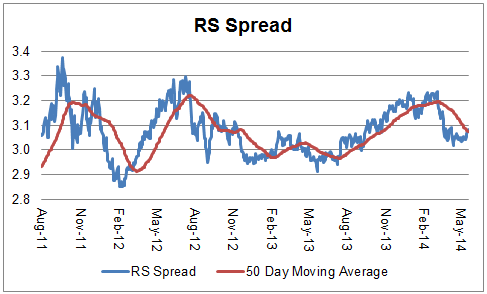
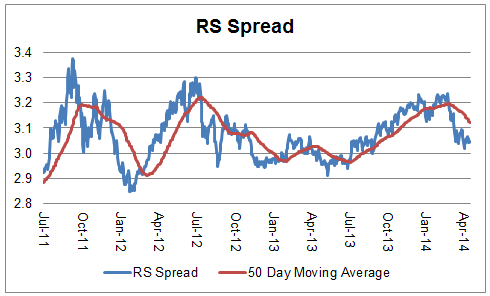
The chart below is the spread between the relative strength leaders and relative strength laggards (universe of mid and large cap stocks). When the chart is rising, relative strength leaders are performing better than relative strength laggards. As of 6/2/14:

spread 06.03.14 Relative Strength Spread

The RS Spread has moved above its 50 day moving average after spending a couple months below.

This example is presented for illustrative purposes only and does not represent a past recommendation. The performance above is based on pure price returns, not inclusive of dividends or all transaction costs. Investors cannot invest directly in an index. Indexes have no fees. Past performance is not indicative of future results. Potential for profits is accompanied by possibility of loss.

Posted by:


Power 4 Model Holdings

June 2, 2014

Current holdings of the DWA PowerShares Sector 4 Model are shown below:

power 42 Power 4 Model Holdings

Click here for model details.

The information contained herein has been prepared without regard to any particular investor’s investment objectives, financial situation, and needs. Accordingly, investors should not act on any recommendation (express or implied) or information in this material without obtaining specific advice from their financial advisors and should not rely on information herein as the primary basis for their investment decisions. Any statements nonfactual in nature constitute only current opinions, which are subject to change without notice. Neither the information nor any opinion expressed shall constitute an offer to sell or a solicitation or an offer to buy any securities, commodities or exchange traded products. This document does not purport to be complete description of the securities or commodities, markets or developments to which reference is made.

The PowerShares DWA Sector Portfolios are calculated by NYSE Euronext or its affiliates (NYSE Euronext). The PowerShares DWA Sector Momentum ETFs, which are based on Dorsey Wright indexes, are not issued, endorsed, sold, or promoted by NYSE Euronext, and NYSE Euronext makes no representation regarding the advisability of investing in such product.

NYSE EURONEXT MAKES NO EXPRESS OR IMPLIED WARRANTIES, AND HEREBY EXPRESSLY DISCLAIMS ALL WARRANTIES OF MERCHANTABILITY OR FITNESS FOR A PARTICULAR PURPOSE WITH RESPECT TO THE DORSEY WRIGHT INDEXES OR ANY DATA INCLUDED THEREIN. IN NO EVENT SHALL NYSE EURONEXT HAVE ANY LIABILITY FOR ANY SPECIAL, PUNITIVE, INDIRECT, OR CONSEQUENTIAL DAMAGES (INCLUDING LOST PROFITS), EVEN IF NOTIFIED OF THE POSSIBILITY OF SUCH DAMAGES.

Posted by:


Weekly RS Recap

May 31, 2014

The table below shows the performance of a universe of mid and large cap U.S. equities, broken down by relative strength decile and then compared to the universe return. Those at the top of the ranks are those stocks which have the best intermediate-term relative strength. Relative strength strategies buy securities that have strong intermediate-term relative strength and hold them as long as they remain strong.

Last week’s performance (5/27/14 - 5/30/14) is as follows:

perf 05.31.14 Weekly RS Recap

This example is presented for illustrative purposes only and does not represent a past recommendation. The performance above is based on pure price returns, not inclusive of dividends or all transaction costs. Past performance is not indicative of future results. Potential for profits is accompanied by possibility of loss.

Posted by:


Relative Strength Spread

May 30, 2014

The chart below is the spread between the relative strength leaders and relative strength laggards (universe of mid and large cap stocks). When the chart is rising, relative strength leaders are performing better than relative strength laggards. As of 5/29/14:

spread 05.30.14 Relative Strength Spread

This example is presented for illustrative purposes only and does not represent a past recommendation. The performance above is based on pure price returns, not inclusive of dividends or all transaction costs. Investors cannot invest directly in an index. Indexes have no fees. Past performance is not indicative of future results. Potential for profits is accompanied by possibility of loss.

Posted by:


Systematic RS International Portfolio

May 22, 2014

International equities continue to rank just behind U.S. equities in Dorsey Wright’s Dynamic Asset Level Investing (DALI) tool, reflecting this asset class’s favorable relative strength. DALI, one of the most widely used tools on Dorsey Wright’s research database, provides a clear way for investors to identify leadership from an asset class perspective. While most investors are likely to have some portion of their overall asset allocation always exposed to International equities, those advisors who look to provide a tactical overlay may seek to overweight those asset classes with the best longer-term relative strength and to underweight those with the weakest relative strength.

dali 05.22.14 Systematic RS International Portfolio

Source: Dorsey Wright. This example is presented for illustrative purposes only and does not represent a past recommendation.

One way that advisors may consider gaining exposure to International equities is through our Systematic RS International portfolio (available as a separately managed account). We have been managing this strategy since March 31, 2006 and it is an area where we have been able to generate some meaningful outperformance over time.

Intl perf Systematic RS International Portfolio

Source: Dorsey Wright, March 31, 2006 - April 30, 2014. The performance above is based on total returns, inclusive of dividends and transaction costs. Investors cannot invest directly in an index. Indexes have no fees.

As shown above, this strategy has outperformed its benchmark by 4.19% annually on a net basis since its inception, over eight years ago. A description of the strategy is found below:

The Dorsey Wright Systematic RS International strategy seeks to provide long-term capital appreciation through exposure to international equities, primarily using American Depository Receipts (ADRs).

The strategy holds approximately 30-40 equities that demonstrate, in our opinion, favorable relative strength characteristics. The strategy is constructed pursuant to Dorsey Wright’s proprietary macroeconomic sector ranking and individual stock rotation methodology.

This strategy is uniquely positioned from an investment opportunity perspective because it is not limited by style (value or growth), investment capitalization (small, mid or large), or even classification of international market (emerging or developed). Rather, the Systematic Relative Strength International strategy is allowed the flexibility to seek out strong trends wherever they may be found within our universe of International equities.

The allocation of this portfolio is currently tilted towards developed international markets, as shown below:

Intl alloc 05.22.141 Systematic RS International Portfolio

Source: Dorsey Wright

Relative strength works all over the world! We certainly aren’t experts in analyzing the financials of foreign companies, but price is universal. With a relative strength strategy, you can succeed in many different markets and asset classes without specialized knowledge of the fundamentals of each country. Click here to see where this separately managed account is currently available. E-mail [email protected] or call 626-535-0630 to receive the brochure for this portfolio.

The performance represented in this brochure is based on monthly performance of the Systematic Relative Strength International Model. Net performance shown is total return net of management fees for all Dorsey, Wright & Associates managed accounts, managed for each complete quarter for each objective, regardless of levels of fixed income and cash in each account. The advisory fees are described in Part II of the adviser’s Form ADV. The starting values on 3/31/2006 are assigned an arbitrary value of 100 and statement portfolios are revalued on a trade date basis on the last day of each quarter. All returns since inception of actual Accounts are compared against the MSCI EAFE Total Return Index. The MSCI EAFE Total Return Index is a stock market index that is designed to measure the equity market performance of developed markets outside of the United States and Canada and is maintained by MSCI Barra. A list of all holdings over the past 12 months is available upon request. The performance information is based on data supplied by the Manager or from statistical services, reports, or other sources which the Manager believes are reliable.

There are risks inherent in international investments, which may make such investments unsuitable for certain clients. These include, for example, economic, political, currency exchange, rate fluctuations, and limited availability of information on international securities.

Past performance does not guarantee future results. In all securities trading, there is a potential for loss as well as profit. It should not be assumed that recommendations made in the future will be profitable or will equal the performance as shown. Investors should have long-term financial objectives when working with Dorsey, Wright & Associates.

Posted by:


Power 4 Model Holdings

May 19, 2014

Current holdings of the DWA PowerShares Sector 4 Model are shown below:

power 42 Power 4 Model Holdings

Click here for model details.

The information contained herein has been prepared without regard to any particular investor’s investment objectives, financial situation, and needs. Accordingly, investors should not act on any recommendation (express or implied) or information in this material without obtaining specific advice from their financial advisors and should not rely on information herein as the primary basis for their investment decisions. Any statements nonfactual in nature constitute only current opinions, which are subject to change without notice. Neither the information nor any opinion expressed shall constitute an offer to sell or a solicitation or an offer to buy any securities, commodities or exchange traded products. This document does not purport to be complete description of the securities or commodities, markets or developments to which reference is made.

The PowerShares DWA Sector Portfolios are calculated by NYSE Euronext or its affiliates (NYSE Euronext). The PowerShares DWA Sector Momentum ETFs, which are based on Dorsey Wright indexes, are not issued, endorsed, sold, or promoted by NYSE Euronext, and NYSE Euronext makes no representation regarding the advisability of investing in such product.

NYSE EURONEXT MAKES NO EXPRESS OR IMPLIED WARRANTIES, AND HEREBY EXPRESSLY DISCLAIMS ALL WARRANTIES OF MERCHANTABILITY OR FITNESS FOR A PARTICULAR PURPOSE WITH RESPECT TO THE DORSEY WRIGHT INDEXES OR ANY DATA INCLUDED THEREIN. IN NO EVENT SHALL NYSE EURONEXT HAVE ANY LIABILITY FOR ANY SPECIAL, PUNITIVE, INDIRECT, OR CONSEQUENTIAL DAMAGES (INCLUDING LOST PROFITS), EVEN IF NOTIFIED OF THE POSSIBILITY OF SUCH DAMAGES.

Posted by:


The Economist: “The Mo the Merrier”

May 14, 2014

If you don’t want to take the time to read the recently released white paper Fact, Fiction and Momentum Investing by Israel, Frazzini, Moskowitz, and Asness, you might want to read the summary published by The Economist:

IF THERE is a greater mystery in financial markets than momentum, it is hard to think of one. Why should stocks that have been rising keep going up? Surely this is widely avaialble information that will be quicky exploited by investors, if the market is remotely efficient? And yet the momentum effect has been remarkably persistent.

In a new paper, renowned quant Cliff Asness, some colleagues from AQR and Tobias Moskowitz of the University of Chicago examine what they call “Fact, Fiction and Momentum Investing”. The most important point is the size and volatility of the return; some dismiss momentum as too small and sporadic a factor to exploit.

Here are the numbers. The table needs a bit of explanation. SMB refers to the well-known smallcap effect; this portfolio goes long smallcap stocks and short largecap. HML refers to the value effect, specificially the tendency of companies that are cheap, relative to their book value, to outperform. So this portfolio goes long stocks with a high book value, relative to their market cap, and short companies with a low book value. And UMD is the momentum measure; a portfolio that goes long stocks that have performed strongest over the last 12 months and short the stocks that have been weakest. The returns are annual.

SMB HML UMD

1927-2013 2.9% 4.7% 8.3%

1963-2013 3.1% 4.5% 8.4%

1991-2013 3.3% 3.6% 6.3%

As you can see, momentum is the biggest of the three effects. Lots of people practice value investing and smallcap investing, even though the returns have been lower than for momentum.

The full Economist article can be found here.

Posted by:


Relative Strength Spread

May 13, 2014

The chart below is the spread between the relative strength leaders and relative strength laggards (universe of mid and large cap stocks). When the chart is rising, relative strength leaders are performing better than relative strength laggards. As of 5/12/14:

spread 05.13.14 Relative Strength Spread

Posted by:


New White Paper: Fact, Fiction and Momentum Investing

May 10, 2014

Israel, Frazzini, Moskowitz, and Asness address (aggressively!) the critics of momentum investing in what is one of the best white papers I have read on the topic. Absolute must-read.

Abstract:

It’s been over 20 years since the academic discovery of momentum investing (Jegadeesh and Titman (1993), Asness (1994)), yet much confusion and debate remains regarding its efficacy and its use as a practical investment tool. In some cases “confusion and debate” is us attempting to be polite, as it is near impossible for informed practitioners and academics to still believe some of the myths uttered about momentum — but that impossibility is often belied by real world statements. In this article, we aim to clear up much of the confusion by documenting what we know about momentum and disproving many of the often-repeated myths. We highlight ten myths about momentum and refute them, using results from widely circulated academic papers and analysis from the simplest and best publicly available data.

Click here to download.

Posted by:


Power 4 Model Holdings

May 9, 2014

Current holdings of the DWA PowerShares Sector 4 Model are shown below:

power 42 Power 4 Model Holdings

Click here for model details.

The information contained herein has been prepared without regard to any particular investor’s investment objectives, financial situation, and needs. Accordingly, investors should not act on any recommendation (express or implied) or information in this material without obtaining specific advice from their financial advisors and should not rely on information herein as the primary basis for their investment decisions. Any statements nonfactual in nature constitute only current opinions, which are subject to change without notice. Neither the information nor any opinion expressed shall constitute an offer to sell or a solicitation or an offer to buy any securities, commodities or exchange traded products. This document does not purport to be complete description of the securities or commodities, markets or developments to which reference is made.

The PowerShares DWA Sector Portfolios are calculated by NYSE Euronext or its affiliates (NYSE Euronext). The PowerShares DWA Sector Momentum ETFs, which are based on Dorsey Wright indexes, are not issued, endorsed, sold, or promoted by NYSE Euronext, and NYSE Euronext makes no representation regarding the advisability of investing in such product.

NYSE EURONEXT MAKES NO EXPRESS OR IMPLIED WARRANTIES, AND HEREBY EXPRESSLY DISCLAIMS ALL WARRANTIES OF MERCHANTABILITY OR FITNESS FOR A PARTICULAR PURPOSE WITH RESPECT TO THE DORSEY WRIGHT INDEXES OR ANY DATA INCLUDED THEREIN. IN NO EVENT SHALL NYSE EURONEXT HAVE ANY LIABILITY FOR ANY SPECIAL, PUNITIVE, INDIRECT, OR CONSEQUENTIAL DAMAGES (INCLUDING LOST PROFITS), EVEN IF NOTIFIED OF THE POSSIBILITY OF SUCH DAMAGES.

Posted by:


Less Theory, More Reality

May 9, 2014

I’ve always said that relative strength investing appeals to pragmatists. This article by Morningstar only strongly confirms that position.

Yesterday’s The Wall Street Journal featured an unusual teaser: “Thumbs Up For Technical Analysis.” In the article, Wasatch Funds president Sam Stewart described his company’s increasing use of price-based signals with stock selection. “We used to be 100% fundamental analysis,” Stewart told the Journal. Now the firm reviews “several technical indicators.”

It’s been a while since I’ve seen a portfolio manager confess to using technical analysis. Well, not using that word.

Picking stocks because of their price movements fell into academic disfavor in the 1960s, when mainframe computers gave professors the ability to collect and crunch large data sets. The University of Chicago’s Gene Fama showed that past stock prices had little if any relationship to future prices. Since then, academics have conducted many follow-up studies, nearly all reaching the same conclusion. Among the ivory towers, “chartist” is not a compliment.

The reality is that many academics have long researched and published studies on price momentum and practitioners have long been applying relative strength analysis to portfolio management. Click here for a list of some of the best known white papers on the subject. Also, click here for a white paper written by our own John Lewis on relative strength investing. Selecting an effective investment methodology should be less about trying to employ an “ivory tower-approved” approach and more about what works. Less theory, more reality.

A relative strength strategy is NOT a guarantee. There may be times where all investments and strategies are unfavorable and depreciate in value. Past performance is no guarantee of future returns. Potential for profits is accompanied by possibility of loss.

Posted by:


Market Narratives-Oops

May 5, 2014

A Wealth of Common Sense makes a good point as it relates to sector leadership over the past couple of years:

The best performer over this period was the consumer discretionary sector. One of the narratives following the financial crisis was that the consumer was tapped out from the debt overhang. From 2009-13, consumer discretionary stocks were up nearly 240% versus the S&P’s gain of roughly 130% (Although that trend has finally reversed this year).

sector leadership Market Narratives  Oops

So much for that market narrative! It sounded good at the time, but the Consumer Discretionary sector has been a strong outperformer over the last couple of years.

Allocations to the PowerShares DWA Momentum ETF (PDP), of course, pay no attention to market narratives. Rather, allocations to this index are based solely on relative strength.

pdp Market Narratives  Oops

Source: Dorsey Wright

As shown above, the Consumer Discretionary sector has shown some signs of deterioration this year, so it is possible that when PDP goes through its next quarterly rebalance at the end of the quarter that the exposure to Consumer Discretionary stocks will drop (it is also possible that they will rebound from here and regain a leadership position).

However, the broader point is a good one—beware of market narratives.

A relative strength strategy is NOT a guarantee. There may be times where all investments and strategies are unfavorable and depreciate in value. Past performance is no guarantee of future returns. Potential for profits is accompanied by possibility of loss. Dorsey Wright & Associates is the index provider for the suite of Momentum ETFs with PowerShares. See www.powershares.com for more information. A list of all holdings for the trailing 12 months is available upon request.

HT: Abnormal Returns

Posted by:


Combining Yield with Relative Strength

May 2, 2014

Barron’s points out that investors who focus solely on yield may be more susceptible to value traps:

Owning an investment for its dividend doesn’t relieve you of the other, hidden exposures of the asset. Value, growth, quality, junk, etc.: You’ve made a choice whether you realize it or not.

Pankaj Patel, quantitative strategist at ISI Group, highlighted one risk for clients this week:”Dividend yield as a factor is susceptible to value traps. To use dividend yield as a factor for stock selection it needs to be combined with other factors.”

We have found that combining yield with relative strength has been effective at leading us to those stocks that not only have high dividend yields, but are also technically strong. Click here to read more about why we use rankings based on total return (price + yield) to identify holdings for the First Trust DWA Relative Strength Dividend UITs.

Past performance is not indicative of future results. Potential for profits is accompanied by possibility of loss. See http://www.ftportfolios.com for more information.

Posted by:


Dorsey Wright Managed Accounts

May 2, 2014

Picture1 Dorsey Wright Managed Accounts

Our Systematic Relative Strength portfolios are available as managed accounts at a large and growing number of firms.

  • Wells Fargo Advisors (Global Macro available on the Masters/DMA Platforms)
  • Morgan Stanley (IMS Platform)
  • TD Ameritrade Institutional
  • UBS Financial Services (Aggressive and Core are available on the MAC Platform)
  • RBC Wealth Management (MAP Platform)
  • Raymond James (Outside Manager Platform)
  • Stifel Nicolaus (Opportunity Platform)
  • Kovack Securities
  • Deutsche Bank
  • Charles Schwab Institutional (Marketplace Platform)
  • Sterne Agee
  • Scott & Stringfellow
  • Envestnet UMA
  • Placemark
  • Scottrade Institutional
  • Janney Montgomery Scott
  • Robert W. Baird
  • Prospera
  • Oppenheimer (Star Platform)
  • SunTrust
  • Lockwood

Different Portfolios for Different Objectives: Descriptions of our seven managed accounts strategies are shown below. All managed accounts use relative strength as the primary investment selection factor.

Aggressive: This Mid and Large Cap U.S. equity strategy seeks to achieve long-term capital appreciation. It invests in securities that demonstrate powerful relative strength characteristics and requires that the securities maintain strong relative strength in order to remain in the portfolio.

Core: This Mid and Large Cap U.S. equity strategy seeks to achieve long-term capital appreciation. This portfolio invests in securities that demonstrate powerful relative strength characteristics and requires that the securities maintain strong relative strength in order to remain in the portfolio. This strategy tends to have lower turnover and higher tax efficiency than our Aggressive strategy.

Growth: This Mid and Large Cap U.S. equity strategy seeks to achieve long-term capital appreciation with some degree of risk mitigation. This portfolio invests in securities that demonstrate powerful relative strength characteristics and requires that the securities maintain strong relative strength in order to remain in the portfolio. This portfolio also has an equity exposure overlay that, when activated, allows the account to hold up to 50% cash if necessary.

International: This All-Cap International equity strategy seeks to achieve long-term capital appreciation through a portfolio of international companies in both developed and emerging markets. This portfolio invests in those securities with powerful relative strength characteristics and requires that the securities maintain strong relative strength in order to remain in the portfolio. Exposure to international markets is achieved through American Depository Receipts (ADRs).

Global Macro: This global tactical asset allocation strategy seeks to achieve meaningful risk diversification and investment returns. The strategy invests across multiple asset classes: Domestic Equities (long & inverse), International Equities (long & inverse), Fixed Income, Real Estate, Currencies, and Commodities. Exposure to each of these areas is achieved through exchange-traded funds (ETFs).

Balanced: This strategy includes equities from our Core strategy (see above) and high-quality U.S. fixed income in approximately a 60% equity / 40% fixed income mix. This strategy seeks to provide long-term capital appreciation and income with moderate volatility.

Tactical Fixed Income: This strategy seeks to provide current income and strong risk-adjusted fixed income returns. The strategy invests across multiple sectors of the fixed income market: U.S. government bonds, investment grade corporate bonds, high yield bonds, Treasury inflation protected securities (TIPS), convertible bonds, and international bonds. Exposure to each of these areas is achieved through exchange-traded funds (ETFs).

Picture2 Dorsey Wright Managed Accounts

To receive fact sheets for any of the strategies above, please e-mail Andy Hyer at [email protected] or call 626-535-0630. Past performance is no guarantee of future returns. An investor should carefully review our brochure and consult with their financial advisor before making any investments.

Posted by:


Thriving Amid Complexity

April 29, 2014

Brian Portnoy of Forbes identifies one of the longstanding challenges of the financial markets: Choice.

In the modern world of investing, complexity dominates. Thousands of difficult-to-assess choices present themselves, often with the perverse result of confounding us further rather than solving a problem. In response, the principle of “simplicity” is ascendant among advisors, fund managers, brokers, and authors.

But what counts as simple? Unfortunately (and ironically), the answer is elusive.

This is where clients of Dorsey Wright & Associates have a clear advantage over the competition. It is a common occurrence for me to hear from a subscriber of our research or user of one of our managed products that finally they have a game plan. The concept of relative strength is not complex. In fact it is really quite simple—a security can gain relative strength by going up more than the market in an uptrend or by going down less than the market in a downtrend. Relative strength measurements and rankings are what determine what our models own and when they will make any necessary changes to adapt to new leadership. With some reasonable amount of due diligence and investment in becoming fluent with our process a financial advisor can look at the financial markets with an entirely different perspective. No longer is there a need to feel completely overwhelmed by the ever-expanding universe of securities and without plan for risk management.

I have been on the road much of the past couple of weeks making presentations on our line-up of PowerShares DWA Momentum ETFs and in introducing the DWA PowerShares Power 4 Model. This particular model is resonating with financial advisors in a way that has made me realize just how hungry people are for this type of logical, rules-based process that is based on the powerful concept of relative strength and that also provides clear guidance on how to incorporate cash as a risk management tool. Click here for details of this model.

This topic always brings be back to “The Hedgehog and the Fox.”

In his famous essay “The Hedgehog and the Fox,” Isaiah Berlin divided the world into hedgehogs and foxes, based upon an ancient Greek parable: “The fox knows many things, but the hedgehog knows one big thing.”

The fox is a cunning creature, able to devise a myriad of complex strategies for sneak attacks upon the hedgehog. Day in and day out, the fox circles around the hedgehog’s den, waiting for the perfect moment to pounce. Fast, sleek, beautiful, fleet of foot, and crafty—the fox looks like the sure winner. The hedgehog, on the other hand, is a dowdier creature, looking like a genetic mix-up between a porcupine and a small armadillo. He waddles along, going about his simple day, searching for lunch and taking care of his home.

The fox waits in cunning silence at the juncture in the trail. The hedgehog, minding his own business, wanders right into the path of the fox. “Aha, I’ve got you now!” thinks the fox. He leaps out, bounding across the ground, lightning fast. The little hedgehog, sensing danger, looks up and thinks, “Here we go again. Will he ever learn?” Rolling up into a perfect little ball, the hedgehog becomes a sphere of sharp spikes, pointing outward in all directions. The fox, bounding toward his prey, sees the hedgehog defense and calls off the attack. Retreating back to the forest, the fox begins to calculate a new line of attack. Each day, some version of this battle between the hedgehog and the fox takes place, and despite the greater cunning of the fox, the hedgehog always wins.

Berlin extrapolated from this little parable to divide people into two basic groups: foxes and hedgehogs. Foxes pursue many ends at the same time and see the world in all its complexity. They are “scattered or diffused, moving on many levels,” says Berlin, never integrating their thinking into one overall concept or unifying vision. Hedgehogs, on the other hand, simplify a complex world into a single organizing idea, a basic principle or concept that unifies and guides everything. It doesn’t matter how complex the world, a hedgehog reduces all challenges and dilemmas to simple—indeed almost simplistic—hedgehog ideas. For a hedgehog, anything that does not somehow relate to the hedgehog idea holds no relevance.

To be clear, hedgehogs are not stupid. Quite the contrary. They understand that the essence of profound insight is simplicity. No, the hedgehogs aren’t simpletons; they have a piercing insight that allows them to see through complexity and discern underlying patterns. Hedgehogs see what is essential, and ignore the rest.

The future is very bright for those financial advisors who can clearly articulate a logical investment process to their clients and have the tools and skills to execute. Dorsey Wright can help put advisors in that position of strength.

A relative strength strategy is NOT a guarantee. There may be times where all investments and strategies are unfavorable and depreciate in value. Past performance is no guarantee of future returns. Potential for profits is accompanied by possibility of loss.

Posted by:


Power 4 Model Holdings

April 24, 2014

Current holdings of the DWA PowerShares Sector 4 Model are shown below:

power 42 Power 4 Model Holdings

Click here for model details.

The information contained herein has been prepared without regard to any particular investor’s investment objectives, financial situation, and needs. Accordingly, investors should not act on any recommendation (express or implied) or information in this material without obtaining specific advice from their financial advisors and should not rely on information herein as the primary basis for their investment decisions. Any statements nonfactual in nature constitute only current opinions, which are subject to change without notice. Neither the information nor any opinion expressed shall constitute an offer to sell or a solicitation or an offer to buy any securities, commodities or exchange traded products. This document does not purport to be complete description of the securities or commodities, markets or developments to which reference is made.

The PowerShares DWA Sector Portfolios are calculated by NYSE Euronext or its affiliates (NYSE Euronext). The PowerShares DWA Sector Momentum ETFs, which are based on Dorsey Wright indexes, are not issued, endorsed, sold, or promoted by NYSE Euronext, and NYSE Euronext makes no representation regarding the advisability of investing in such product.

NYSE EURONEXT MAKES NO EXPRESS OR IMPLIED WARRANTIES, AND HEREBY EXPRESSLY DISCLAIMS ALL WARRANTIES OF MERCHANTABILITY OR FITNESS FOR A PARTICULAR PURPOSE WITH RESPECT TO THE DORSEY WRIGHT INDEXES OR ANY DATA INCLUDED THEREIN. IN NO EVENT SHALL NYSE EURONEXT HAVE ANY LIABILITY FOR ANY SPECIAL, PUNITIVE, INDIRECT, OR CONSEQUENTIAL DAMAGES (INCLUDING LOST PROFITS), EVEN IF NOTIFIED OF THE POSSIBILITY OF SUCH DAMAGES.

Posted by:


The Japan Example

April 21, 2014

Burton Malkiel suggests that “Smart Beta” may be just a fad and that capitalization-weighted indexes “will give the investor the most prudent trade-off between risk and return available.” I wonder how he would respond to the “Japan example.” Japan, at its 1989 peak, made up 60% of the MSCI EAFE index, as shown in the chart below.

Japan MSCI EAFE The Japan Example

Source: ETF.com

The chart above is only updated through 1998. However, the weighting of Japan in the MSCI EAFE is still around 20 percent. Japan’s stock market performance since 1989 has been ugly:

Nikkei Index The Japan Example

Source: Yahoo! Finance. Returns include dividends, but do not include any transaction costs. Investors cannot invest directly in an index. Jan. 1984 - Mar 2014.

Japan is still 62% below its 1989 peak! Some might take issue with the argument that investing in a capitalization-weighted index like the MSCI EAFE has given you the “most prudent trade-off between risk and return available.” Weighting an index by capitalization has its strengths and its weaknesses. ”Smart Beta” indexes that build an index around different investment factors also have their strengths and their weaknesses. Our area of expertise-building momentum indexes-is supported by a large body of work and we believe will offer superior returns to capitalization-weighted indexes over time. Ultimately, I don’t think it is helpful to investors to try to position anything other than a capitalization-weighted index in a negative light. Investors have benefited greatly from innovation over time, and “Smart Beta” is just another step in giving investors what we believe to be better tools to help them achieve their financial goals.

Dorsey Wright provides an alternative way to get exposure to developed international markets with the PowerShares DWA Developed Markets ETF (PIZ).

A relative strength strategy is NOT a guarantee. There may be times where all investments and strategies are unfavorable and depreciate in value. Past performance is no guarantee of future returns. Potential for profits is accompanied by possibility of loss. Dorsey Wright & Associates is the index provider for the suite of Momentum ETFs with PowerShares. See www.powershares.com for more information.

Posted by:


High RS Diffusion Index - In the “Green Zone”

April 16, 2014

Yes, it is true—momentum has had a bad month. While the S&P 500 is only a couple percent off its all-time highs, momentum stocks have generally pulled back more. However, if you have been contemplating taking a position in a momentum strategy, this just may be the entry point you have been looking for.

The chart below measures the percentage of high relative strength stocks that are trading above their 50-day moving average (universe of U.S. mid and large cap stocks.) High relative strength stocks are defined as securities from the top quartile of our ranks. For the period Dec. 30, 1999 - Apr. 15, 2014:

(click to enlarge)

This high relative strength index has only spent 7% of its time below the 30 percent level, but on April 11, 2014 the index fell to 28%. Dips in this indicator have often provided good opportunities to add to relative strength strategies.

Furthermore, there has been no major trend deterioration in the PowerShares DWA Momentum ETF (PDP) as shown below.

(click to enlarge)

Source: Dorsey Wright & Associates

Find information about all 14 PowerShares DWA Momentum ETFs by clicking here.

A relative strength strategy is NOT a guarantee. There may be times where all investments and strategies are unfavorable and depreciate in value. Past performance is no guarantee of future returns. Potential for profits is accompanied by possibility of loss. Dorsey Wright & Associates is the index provider for the suite of Momentum ETFs with PowerShares. See www.powershares.com for more information.

Posted by:


European Improvement

April 9, 2014

In light of European equities being among the best performing asset classes over the past year, consider what The Economist has to say about the economic improvement in that area:

A reassuring feature of the recovery is that it is spreading to the once-afflicted countries of southern Europe. Germany, which remains the main engine of growth in the euro zone, is likely to have expanded strongly in the first quarter of 2014, according to the Bundesbank. But the recovery is also being boosted by a return to growth, albeit sluggish, on the part of both Italy and Spain, the third- and fourth-biggest economies in the euro zone.

The peripheral economies are benefiting from falling long-term interest rates. Ten-year government-bond yields in Italy, Spain and Portugal are now lower than they were four years ago, shortly before the Greek crisis flared up and led to the first bail-out (see chart). Remarkably, yields in Ireland, which exited its rescue programme only last December, have fallen to their lowest since the euro started 15 years ago. Peripheral yields have been dragged down both by the fall in German yields and the narrowing of their spreads over German bonds since the height of the crisis. Although the spreads are still wider than before the crisis, their tightening reflects a broader reassessment of risk: investors no longer shun peripheral Europe on fears of a euro-zone break-up, whereas they fret about emerging markets.

asset class ranks 04.09.14 European Improvement

Source: Yahoo! Finance, Returns include dividends and interest payments, but do not include transaction costs

1PowerShares DB Gold, 2iShares MSCI Emerging Markets ETF, 3iShares DJ U.S. Real Estate Index, 4iShares S&P Europe 350 Index, 5Green Haven Continuous Commodity Index, 6iBoxx High Yield Corporate Bond Fund, 7JP Morgan Emerging Markets Bond Fund, 8PowerShares DB US Dollar Index, 9iBoxx Investment Grade Corporate Bond Fund, 10PowerShares DB Oil, 11iShares Barclays 20+ Year Treasury Bond

Exposure to Europe in the PowerShares DWA Developed Markets Momentum ETF (PIZ) has increased over the last couple of years.

PIZ exposure European Improvement

Source: PowerShares

A relative strength strategy is NOT a guarantee. There may be times where all investments and strategies are unfavorable and depreciate in value. Past performance is no guarantee of future returns. Potential for profits is accompanied by possibility of loss. A list of all holdings for the trailing 12 months is available upon request. Dorsey Wright & Associates is the index provider for The PowerShares DWA Developed Markets Momentum ETF (PIZ). See www.powershares.com for more information.

Posted by:


The Wisdom of Crowds

April 9, 2014

NPR, reporting on “The Good Judgement Project” writes a fascinating story about the wisdom of crowds. Maybe there is something to this momentum factor after all!

For the past three years, Rich and 3,000 other average people have been quietly making probability estimates about everything from Venezuelan gas subsidies to North Korean politics as part of the Good Judgment Project, an experiment put together by three well-known psychologists and some people inside the intelligence community.

According to one report, the predictions made by the Good Judgment Project are often better even than intelligence analysts with access to classified information, and many of the people involved in the project have been astonished by its success at making accurate predictions…

…How can that be?

“Everyone has been surprised by these outcomes,” said Philip Tetlock, one of the three psychologists who came up with the idea for the Good Judgment Project. The other two are Barbara Mellers and Don Moore.

For most of his professional career, Tetlock studied the problems associated with expert decision making. His book Expert Political Judgment is considered a classic, and almost everyone in the business of thinking about judgment speaks of it with unqualified awe.

All of his studies brought Tetlock to at least two important conclusions.

First, if you want people to get better at making predictions, you need to keep score of how accurate their predictions turn out to be, so they have concrete feedback.

But also, if you take a large crowd of different people with access to different information and pool their predictions, you will be in much better shape than if you rely on a single very smart person, or even a small group of very smart people.

“The wisdom of crowds is a very important part of this project, and it’s an important driver of accuracy,” Tetlock said.

The wisdom of crowds is a concept first discovered by the British statistician Francis Galton in 1906.

Galton was at a fair where about 800 people had tried to guess the weight of a dead ox in a competition. After the prize was awarded, Galton collected all the guesses so he could figure out how far off the mark the average guess was.

It turned out that most of the guesses were really bad — way too high or way too low. But when Galton averaged them together, he was shocked:

The dead ox weighed 1,198 pounds. The crowd’s average: 1,197.

My emphasis added. As pointed out by Philip Tetlock, “everyone has been surprised by these outcomes.” Just like everyone (or many) are surprised by the results of momentum investing. Yet, momentum works for for the very same reasons that “The Good Judgement Project” is apparently succeeding—the wisdom of the crowds. It requires a certain amount of humility to turn investment decision-making over to the wisdom of the crowds and humility is not an attribute in great supply on Wall Street. The vast majority of investment managers in this industry spend large portions of their time convincing others (and themselves) that they are right and “the market” is wrong, but that the market will eventually come around to their way of thinking. Momentum takes a different approach. If a given security, or group of securities, are relatively stronger than their peers momentum investors follow those trends—often times without a clear understanding of the fundamental reasons for the superior momentum characteristics. If the market changes, momentum investors change and reorient their portfolios to adapt to the new leadership. Momentum investors focus on the process of keeping their portfolios in-tune with market trends rather than praying that the market will eventually prove that any one “expert” opinion will prove correct.

Posted by:


Power 4 Model Holdings

April 9, 2014

Current holdings of the DWA PowerShares Sector 4 Model are shown below:

power 42 Power 4 Model Holdings

Click here for model details.

The information contained herein has been prepared without regard to any particular investor’s investment objectives, financial situation, and needs. Accordingly, investors should not act on any recommendation (express or implied) or information in this material without obtaining specific advice from their financial advisors and should not rely on information herein as the primary basis for their investment decisions. Any statements nonfactual in nature constitute only current opinions, which are subject to change without notice. Neither the information nor any opinion expressed shall constitute an offer to sell or a solicitation or an offer to buy any securities, commodities or exchange traded products. This document does not purport to be complete description of the securities or commodities, markets or developments to which reference is made.

The PowerShares DWA Sector Portfolios are calculated by NYSE Euronext or its affiliates (NYSE Euronext). The PowerShares DWA Sector Momentum ETFs, which are based on Dorsey Wright indexes, are not issued, endorsed, sold, or promoted by NYSE Euronext, and NYSE Euronext makes no representation regarding the advisability of investing in such product.

NYSE EURONEXT MAKES NO EXPRESS OR IMPLIED WARRANTIES, AND HEREBY EXPRESSLY DISCLAIMS ALL WARRANTIES OF MERCHANTABILITY OR FITNESS FOR A PARTICULAR PURPOSE WITH RESPECT TO THE DORSEY WRIGHT INDEXES OR ANY DATA INCLUDED THEREIN. IN NO EVENT SHALL NYSE EURONEXT HAVE ANY LIABILITY FOR ANY SPECIAL, PUNITIVE, INDIRECT, OR CONSEQUENTIAL DAMAGES (INCLUDING LOST PROFITS), EVEN IF NOTIFIED OF THE POSSIBILITY OF SUCH DAMAGES.

Posted by:


What to Make of Valuations

April 2, 2014

Jeffrey Kleintop of LPL Financial has an interesting rebuttal to the argument that the market is overvalued:

At any given time, there are always some bubbly valuations among industries and stocks that are hot. But overall, the S&P 500 PE is currently a bit over 16 on current fiscal year estimates, slightly above the long-term average, but only half of what it was in late March 2000. Looking at valuations, compared to 14 years ago, the party in the stock market may not be just getting started — but it is not yet close to being over.

champagne 22 What to Make of Valuations

The whole article is worth the read.

Here is what John Lewis, our Senior Portfolio Manager, had to say about valuations in our quarterly letter to clients:

A lot of the volatility and rotation we have seen this year can be attributed to this current bull market turning 5 years old. The stock market has had tremendous gains since the bear market lows in 2009, and that has finally led to serious talk about stretched equity valuations. Some of the good momentum areas like solar stocks and biotechnology certainly fall into this theme, and were sold off during the last couple of weeks of the quarter as these concerns came to the forefront. These concerns surface as any bull market matures, and the truly strong stocks often perform very well long after the serious valuation discussions begin. As valuations become stretched, markets tend to focus more on growth opportunities. That is a positive for our strategies. Relative strength is very good at picking out high growth stocks. Yes, the overall market or certain pockets of the market may be pricey, but that doesn’t mean there aren’t well managed companies capitalizing on current trends that will continue to perform. That is often a great environment for our strategies.

The debate about valuation will rage on, but for momentum investors, having slightly stretched valuations may just be the environment where we can really shine.

Posted by:


Power 4 Holdings

April 2, 2014

Current holdings of the DWA PowerShares Sector 4 Model are shown below:

power4 Power 4 Holdings

(Click to enlarge)

Click here for model details.

The information contained herein has been prepared without regard to any particular investor’s investment objectives, financial situation, and needs. Accordingly, investors should not act on any recommendation (express or implied) or information in this material without obtaining specific advice from their financial advisors and should not rely on information herein as the primary basis for their investment decisions. Any statements nonfactual in nature constitute only current opinions, which are subject to change without notice. Neither the information nor any opinion expressed shall constitute an offer to sell or a solicitation or an offer to buy any securities, commodities or exchange traded products. This document does not purport to be complete description of the securities or commodities, markets or developments to which reference is made.

The PowerShares DWA Sector Portfolios are calculated by NYSE Euronext or its affiliates (NYSE Euronext). The PowerShares DWA Sector Momentum ETFs, which are based on Dorsey Wright indexes, are not issued, endorsed, sold, or promoted by NYSE Euronext, and NYSE Euronext makes no representation regarding the advisability of investing in such product.

NYSE EURONEXT MAKES NO EXPRESS OR IMPLIED WARRANTIES, AND HEREBY EXPRESSLY DISCLAIMS ALL WARRANTIES OF MERCHANTABILITY OR FITNESS FOR A PARTICULAR PURPOSE WITH RESPECT TO THE DORSEY WRIGHT INDEXES OR ANY DATA INCLUDED THEREIN. IN NO EVENT SHALL NYSE EURONEXT HAVE ANY LIABILITY FOR ANY SPECIAL, PUNITIVE, INDIRECT, OR CONSEQUENTIAL DAMAGES (INCLUDING LOST PROFITS), EVEN IF NOTIFIED OF THE POSSIBILITY OF SUCH DAMAGES.

Posted by:


Q2 2014 PowerShares DWA Momentum ETFs

April 1, 2014

The PowerShares DWA Momentum Indexes are reconstituted on a quarterly basis. These indexes are designed to evaluate their respective investment universes and build an index of stocks with superior relative strength characteristics. This quarter’s allocations are shown below.

PDP: PowerShares DWA Momentum ETF

pdp Q2 2014 PowerShares DWA Momentum ETFs

DWAS: PowerShares DWA Small Cap Momentum ETF

dwas Q2 2014 PowerShares DWA Momentum ETFs

DWAQ: PowerShares DWA NASDAQ Momentum ETF

dwaq Q2 2014 PowerShares DWA Momentum ETFs

PIZ: PowerShares DWA Developed Markets Momentum ETF

piz Q2 2014 PowerShares DWA Momentum ETFs

PIE: PowerShares DWA Emerging Markets Momentum ETF

pie Q2 2014 PowerShares DWA Momentum ETFs

Source: Dorsey Wright, MSCI, Standard & Poor’s, and NASDAQ, Allocations subject to change

We also apply this momentum-indexing methodology on a sector level:

sector1 Q2 2014 PowerShares DWA Momentum ETFs

See www.powershares.com for more information.

The Dorsey Wright SmallCap Momentum Index is calculated by Dow Jones, the marketing name and a licensed trademark of CME Group Index Services LLC (“CME Indexes”). “Dow Jones Indexes” is a service mark of Dow Jones Trademark Holdings LLC (“Dow Jones”). Products based on the Dorsey Wright SmallCap Momentum IndexSM, are not sponsored, endorsed, sold or promoted by CME Indexes, Dow Jones and their respective affiliates make no representation regarding the advisability of investing in such product(s). A list of all holding for the trailing 12 months is available upon request.

Posted by: