High RS Diffusion Index

September 29, 2010

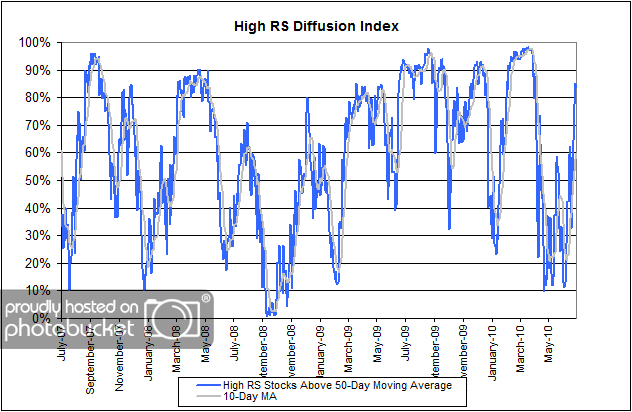
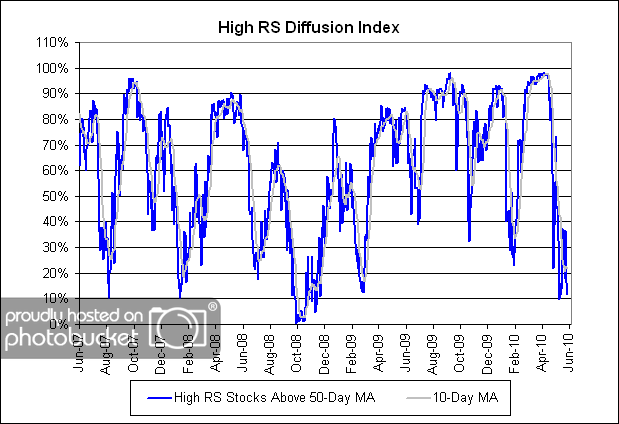
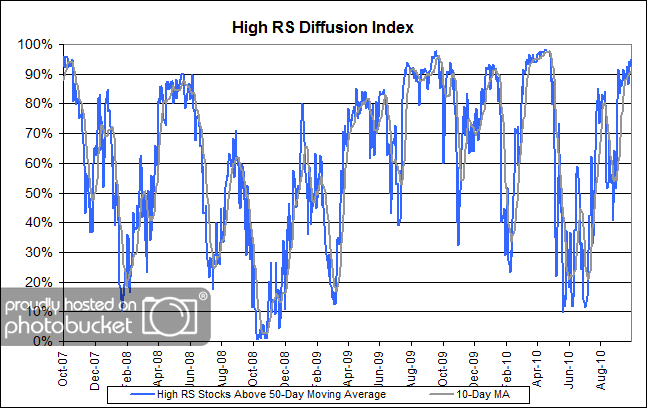
The chart below measures the percentage of high relative strength stocks that are trading above their 50-day moving average (universe of mid and large cap stocks.) As of 9/28/10.

 High RS Diffusion Index

The 10-day moving average of this indicator is 91% and the one-day reading is 95%. After pulling back to the middle of the distribution in August, this index has risen sharply in recent weeks and continues to inch higher.

Posted by:


Sector and Capitalization Performance

September 17, 2010

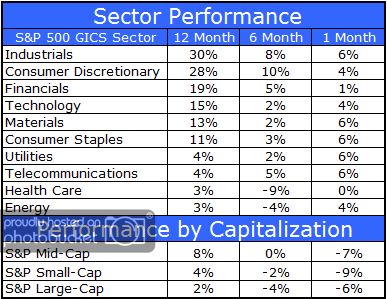
The chart below shows performance of US sectors and capitalizations over the trailing 12, 6, and 1 month(s). Relative strength strategies buy securities that have strong intermediate-term relative strength and hold them as long as they remain strong. Performance updated through 9/16/2010.

 Sector and Capitalization Performance

Posted by:


Sector and Capitalization Performance

August 27, 2010

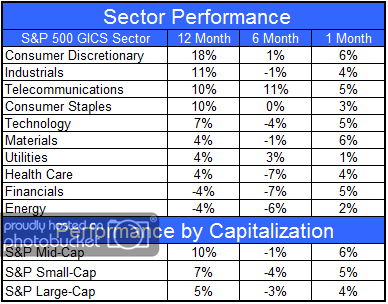
The chart below shows performance of US sectors and capitalizations over the trailing 12, 6, and 1 month(s). Relative strength strategies buy securities that have strong intermediate-term relative strength and hold them as long as they remain strong. Performance updated through 8/26/2010.

 Sector and Capitalization Performance

Posted by:


Moving Average Ratio and Momentum

August 26, 2010

A few months ago I had a post about the Momentum Echo (click here to read the post). I ran across another relative strength (or momentum if you prefer) paper that tests yet another factor. In Seung-Chan Park’s paper, “The Moving Average Ratio and Momentum,” he looks at the ratio between a short-term and long-term moving average of price in order to rank securities by strength. This is different from most of the other academic literature. Most of the other studies use simple point-to-point price returns to rank the securities.

Technicians have used moving averages for years to smooth out price movement. Most of the time we see people using the crossing of a moving average as a signal for trading. Park uses a different method for his signals. Instead of looking at simple crosses, he compares the ratio of one moving average to another. A stock with the 50-day moving average significantly above (below) the 200-day moving average will have a high (low) ranking. Securities with the 50-day moving average very close to the 200-day moving average will wind up in the middle of the pack.

In the paper Park is partial to the 200-day moving average as the longer-term moving average, and he tests a variety of short-term averages ranging from 1 to 50 days. It should come as no surprise that they all work! In fact, they tend to work better than simple price-return based factors. That didn’t come as a huge surprise to us, but only because we have been tracking a similar factor for several years that uses two moving averages. What has always surprised me is how well that factor does when compared to other calculation methods over time.

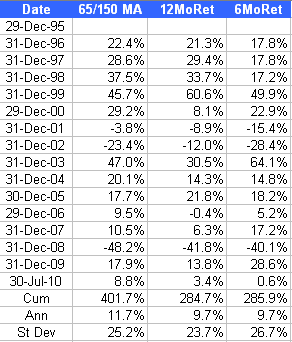
The factor we have been tracking is the moving average ratio of a 65-day moving average to the 150-day moving average. Not exactly the same as what Park tested, but similar enough. I pulled the data we have on this factor to see how it compares to the standard 6- and 12-month price return factors. For this test, the top decile of the ranks is used. Portfolios are formed monthly and rebalanced/reconstituted each month. Everything is run on our database, which is a universe very similar to the S&P 500 + S&P 400.

 Moving Average Ratio and Momentum

(click to enlarge)

Our data shows the same thing as Park’s tests. Using a ratio of moving averages is significantly better than just using simple price-return factors. Our tests show the moving average ratio adding about 200 bps per year, which is no small feat! It is also interesting to note we came to the exact same conclusion using different parameters for the moving average, and an entirely different data set. It just goes to show how robust the concept of relative strength is.

For those readers who have read our white papers (available here and here) you may be wondering how this factor performs using our Monte Carlo testing process. I’m not going to publish those results in this post, but I can tell you this moving average factor is consistently near the top of the factors we track and has very reasonable turnover for the returns it generates.

Using a moving average ratio is a very good way to rank securities for a relative strength strategy. Historical data shows it works better than simple price return factors over time. It is also a very robust factor because multiple formulations work, and it works on multiple datasets.

Posted by:


Momentum Investing: “Nearly Unmatched In Its Predictive Strength and Robustness”

August 16, 2010

Tobias J. Moskowitz, PhD has a nice article on momentum investing in the July/August issue of IMCA’s journal, Investments & Wealth Monitor (linked here with permission from IMCA). As pointed out in the article, Dorsey Wright is among those providing momentum (aka relative strength) products to investors:

Known to financial academics for many years, momentum investing is a powerful tool for building portfolio efficiency, diversification, and above-average returns. Until recently, momentum investing has been difficult to access for most investors, but that is changing.

A couple firms recently launched products that give more investors access to momentum. Some are technical, such as Dorsey-Wright’s ETF: others, such as MSCI, are based on proprietary models.

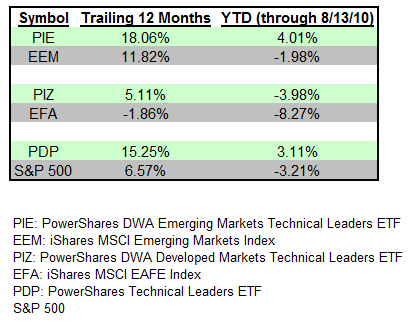
My emphasis added. In fact, Dorsey Wright provides three technical leaders indexes that are used to manage PDP, PIE, and PIZ. Trailing twelve-month performance and year-to-date performance is shown for each relative to their benchmark. As shown in the table, each have performed better than their benchmark over the past 12 months and YTD.

TL081610 Momentum Investing: Nearly Unmatched In Its Predictive Strength and Robustness

After detailing much of the academic testing of momentum investing on U.S. equities, Moskowitz then turns to the rest of the world and other asset classes. His conclusion: it was found to work pretty much everywhere!

The original momentum studies focused on U.S. equities during the period 1963-1990. Subsequent studies found momentum as far back as the Victorian age (Chabot et al. 2009) and in the out-of-sample period after the original research was published (Carhart 1997, Jegadeesh and Titman 2001, Grundy and Martin 2001, Asness et al. 2009). Momentum has been found in markets in Europe (Rouwenhorst 1998), in emerging markets (Rouwenhorst 1999), in Asia (Chui e al. 2000), and in 40 different markets globally (Griffin et al. 2005). Momentum also has been documented among other asset classes than individual stocks, e.g., bonds, commodities, and currencies (Asness et al. 2009); industries (Moskowitz and Grinblatt 1999, 2004; Asness et al. 2000), and country indexes (Asness et al. 1997).

Among the possible explanations for momentum, Moskowitz says:

Several possible behavioral explanations have been put forth, many based on the Nobel memorial prize-winning work of Daniel Kahneman and Amos Tversky. One explanation posits that investors may be slow to react to new information: different investors (e.g., a trader vs. a casual investor) receive news from different sources and react to news over different time horizons and in different ways. This “anchoring and adjustment” is a behavioral phenomenon in which individuals update their views only partially when faced with new information, slowly accepting its full impact. Ample evidence supoports slow-reaction-to-information theories ranging from market response to earnings and dividend announcements to analysts’ reluctance to update their forecasts.

Overall, Moskowitz’s article is a great overview of momentum investing and makes a compelling case for employing momentum strategies as part of an asset allocation. However, we couldn’t help smile when noting the irony that the author, Tobias J. Moskowitz, PhD, is currently the Fama Family Professor of Finance at The University of Chicago Booth School of Business, given that Eugene Fama (along with Ken French) have arguably done more to advance the theory of the Efficient Markets Hypothesis than any other academics. Regular readers of our blog may remember one of our earlier rants on the topic. But, I digress. A vast amount of research supports Moskowtiz’s conclusion that “Momentum is a powerful investment style, nearly unmatched in its predictive strength and robustness.”

Disclosures for PDP, PIE, and PIZ can be found at www.powershares.com.

Posted by:


Relative Strength Across the Globe

August 13, 2010

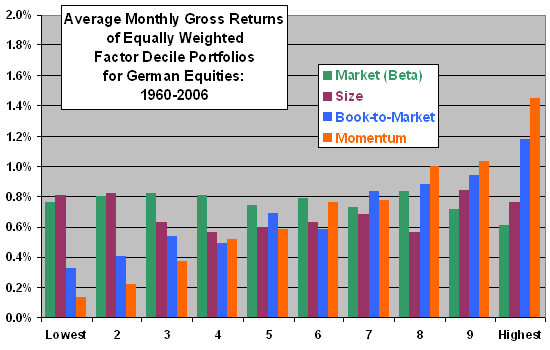
CXO Advisory has a nice review of a study of the German stock market, which looked for universal factors that served as a source of return. Here is their summary:

“The Cross-Section of German Stock Returns: New Data and New Evidence” informs beliefs as follows:

  • There is no basis for belief that stock beta or firm size predict future returns.
  • There is some basis for belief that book-to-market ratio predicts future returns.
  • There is strong basis for belief that momentum predicts future returns.

Not surprisingly, relative strength (known to academics as momentum) was the strongest return factor, outperforming value. (Book-to-market ratio is a value factor and that seemed to have some predictive ability as well. The best mix was stocks with good momentum that were also inexpensive.) Below you can see the returns of each factor by decile.

 Relative Strength Across the Globe

Source: CXO Advisory (click to enlarge)

The picture shows very graphically what we find over and over-most of the excess returns in every factor come from the top couple of deciles. In other words, most of the returns come at the extremes. If you try to buy middle-of-the-road value stocks, it is likely not going to work. The same thing is true of relative strength. It’s important to hold assets with powerful relative strength characteristics. The biggest benefit of a systematic approach is that it forces our portfolios to hold these outliers, however uncomfortable it may feel.

One of the reasons that it is difficult for investors to outperform indexes is the psychological discomfort entailed by holding stocks at the extremes. No one wants to own stocks that have already gone up a lot (high relative strength) or stocks that are financially impaired or teetering on the edge of bankruptcy (deep value stocks). Instead, they prefer to own something that seems safer. Hence, the premium returns of stocks in the top couple of deciles persist. Dozens of studies show exactly where the excess returns are-investors are just unwilling, for the most part, to do what is necessary to take advantage of them.

Posted by:


RS Spread

August 10, 2010

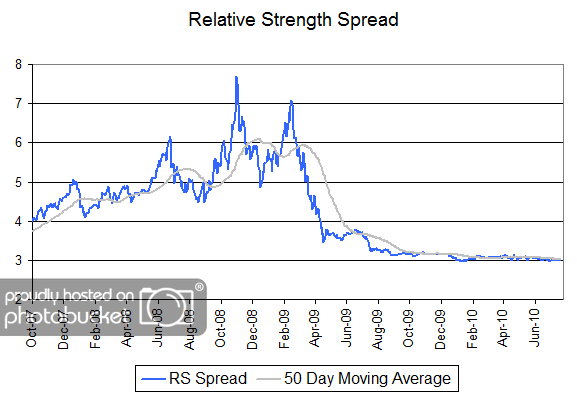
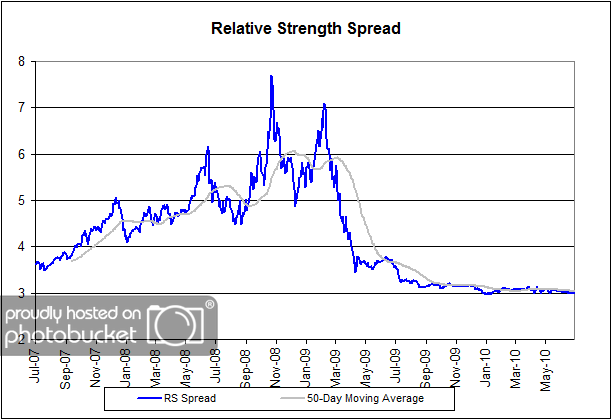
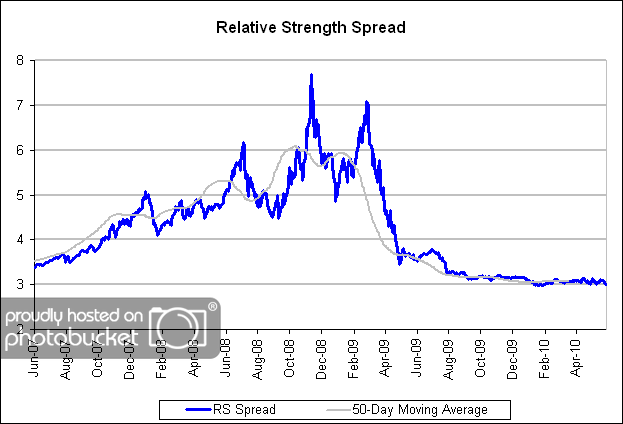
The chart below is the spread between the relative strength leaders and relative strength laggards (universe of mid and large cap stocks). When the chart is rising, relative strength leaders are performing better than relative strength laggards. As of 8/9/2010:

RSSpread081010 RS Spread

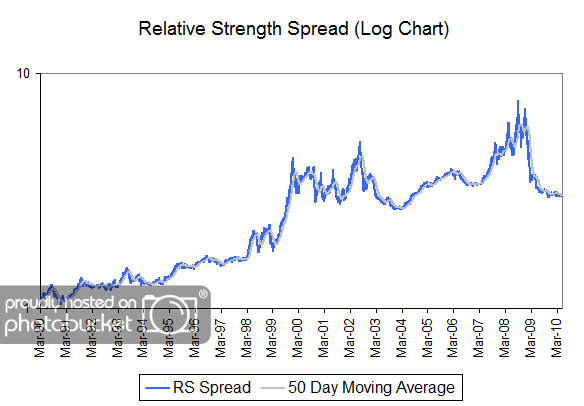
A longer term RS Spread is shown below.

RSSpreadPartII081010 RS Spread

The RS Spread has risen (in fits and starts) over time as the high relative strength stocks have handily outperformed the relative strength laggards. The RS Spread has been relatively flat for the last year or so, after declining sharply in the first half of 2009. Can you identify other periods where the RS Spread had similar action to what we have seen over the last couple of years? What followed those periods? Perhaps, that will help provide insight into our optimism for relative strength strategies in the coming years.

Posted by:


SRS Aggressive: Five Years On

August 2, 2010

One of the benefits managing money in a systematic (i.e. rules-based) fashion is that we are able to apply a given set of investment rules to a historical data set in order to see how those rules worked over longer periods of time. In fact, a major reason that we introduced our rules-based relative strength portfolios to the market is because of the compelling results of such tests by us and by many others. Our family of Systematic Relative Strength separately managed accounts consists of a number of different strategies which focus on different asset classes. The first member of this family of Systematic Relative Strength portfolios was our Aggressive strategy which invests in 20-25 U.S. mid- and large-cap stocks with powerful relative strength characteristics.

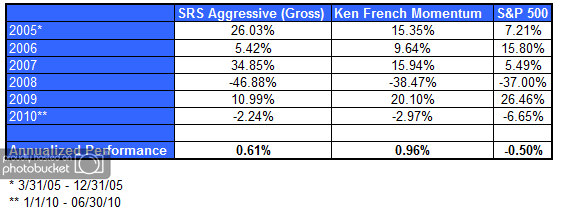
Now that we have over five years worth of real returns, it is instructive to compare the actual gross returns of our Aggressive strategy to one of the more prominent publicly available relative strength models to see how it has stacked up.

One of the more prominent publicly-known relative strength models is maintained by Dr. Ken French at his online data library. French’s data library is valuable source of information for those who want to see the validity of rules-based models. French maintains models on a number of different investment factors, including a number of value and price momentum factors.

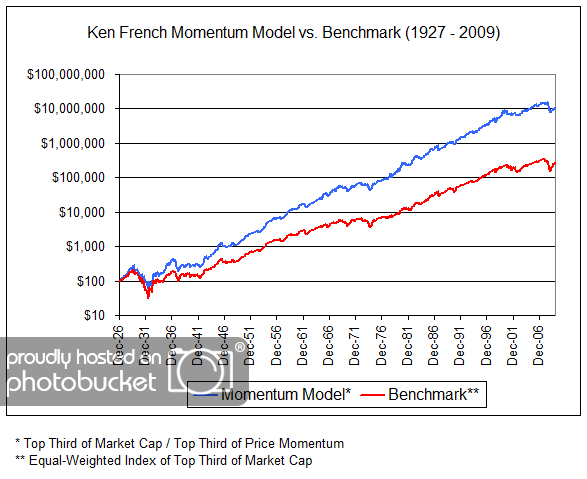
The table below shows the results of Dr. French’s Momentum Model which is constructed by taking stocks with the top third of market capitalization in his universe of stocks that trade on the NYSE, AMEX, and NASDAQ and the top third of price momentum (defined by trailing 12-month returns) out of the same universe. As shown in the table below, the public momentum model outperformed the benchmark by over 5% per year over the last 83 years. (The benchmark is an equally-weighted index of the stocks with the top third of market capitalization in the same investment universe.)

KF3080210 SRS Aggressive: Five Years On

(Click to Enlarge)

Although our own relative strength models are based on a proprietary relative strength factor, it is similar to Dr. French’s model in that it is designed to keep the portfolio fresh with stocks that have strong intermediate-term relative strength. If our model is working as anticipated, one would expect the returns to be similar to Dr. French’s momentum portfolio. And, in fact, that is exactly the case. There was only a difference in annualized performance of 35 basis points between the French Momentum Model and our own Aggressive portfolio over the last 5.25 years. In other words, the live returns of our Aggressive model are about in line with what we would expect after comparing it to a publicly-known method of constructing a relative strength model.

Our longer-term testing suggests that there may be performance advantages of our proprietary method over publicly-known methods for calculating relative strength. Nevertheless, the real key to outperformance over time is found in the consistent execution of relative strength models.

KF080210 SRS Aggressive: Five Years On

(Click to Enlarge)

The amount of outperformance of relative strength strategies over the past 5.25 years has been modest compared to the longer-term average. However, a more detailed look at the historical returns of the Ken French Momentum Model reveal that relative strength tends to move in and out of favor as an investment factor. Relative strength strategies have plenty of short-term time periods where the returns are fairly average or even sub-par. However, over longer periods of time, relative strength has proven capable of delivering spectacular outperformance. Here’s a view of the longer-term performance of Dr. French’s momentum model.

Growthof100080210 SRS Aggressive: Five Years On

(Click to Enlarge)

At first glance, it looks nice, but not earthshaking. However, it is a logarithmic chart scale, designed to equate percentage changes. For a mind-blowing perspective, look carefully at the terminal values of the line on the right hand side of the chart: less than $300,000 for the benchmark, but around $11 million dollars for the high relative strength portfolio. Now that’s a testament to the power of compounding!

In summary, after 5.25 years of managing live money in the Systematic Relative Strength Aggressive strategy we are right where we need to be and we look forward to capitalizing on what we expect to be the very fruitful rewards that have been earned by those who stick to the discipline for extended periods of time.

Click here to receive the brochure on our Systematic Relative strength portfolios. Click here for disclosures.

Posted by:


High RS Diffusion Index

July 28, 2010

The chart below measures the percentage of high relative strength stocks that are trading above their 50-day moving average (universe of mid and large cap stocks.) As of 7/27/10.

 High RS Diffusion Index

The 10-day moving average of this indicator is 60% and the one-day reading is 84%. The diffusion index continues to shoot higher as HighRS stocks and sectors cling to gains earned in the July rally. Dips in the High RS Diffusion Index have often provided good opportunities to add to relative strength strategies.

Posted by:


Relative Strength Spread

July 27, 2010

The chart below is the spread between the relative strength leaders and relative strength laggards (universe of mid and large cap stocks). When the chart is rising, relative strength leaders are performing better than relative strength laggards. As of 7/26/2010:

 Relative Strength Spread

No change this week–or for much of the past year for this indicator. The relative strength spread continues to reflect the fact that neither the relative strength leaders nor the relative strength laggards have been able to pull away. For now, both groups continue to generate similar performance.

Posted by:


Weekly RS Recap

July 26, 2010

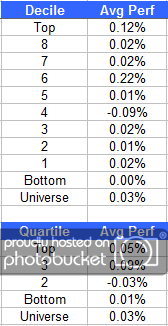
The table below shows the performance of a universe of mid and large cap U.S. equities, broken down by relative strength decile and quartile and then compared to the universe return. Those at the top of the ranks are those stocks which have the best intermediate-term relative strength. Relative strength strategies buy securities that have strong intermediate-term relative strength and hold them as long as they remain strong.

Last week’s performance (7/19/10 – 7/23/10) is as follows:

 Weekly RS Recap

It was a flat week for stocks in all relative strength deciles. We have no out- or under-performance to speak of.

Posted by:


Good vs. Best

July 22, 2010

Relative Strength is just that-a method of measuring strength not in absolute terms, but in relative terms. It is one thing to attempt to assign an intrinsic value to a given security in isolation and another thing entirely to assign a relative value, or relative rank, within the context of a universe of securities.

I am reminded of a line from the film Crocodile Dundee, when a street hoodlum pulls a switchblade against our hero, Paul Hogan. “You call that a knife?” says Hogan incredulously, withdrawing a bowie blade from the back of his boot. “Now this,” he says with a sly grin, “is a knife.”

One of the biggest challenges for an investor is to be able to make the best use of limited resources. After all, the value of every investment portfolio is finite. How can you be sure that you are allocating your finite resources to those securities that represent the “best” investment opportunities and not just “good” or “acceptable” investment opportunities?

The elegance of systematic relative strength models is that all securities in the investment universe are evaluated relative to every other security in the investment universe. With this knowledge you can be sure that each of the final holdings has superior relative strength characteristics and, therefore, gives you the best probabilities of successful investment results.

HT: Dan Ariely, Predictably Irrational

Posted by:


So What Happens Now?

July 16, 2010

The current cover of Time magazine does a nice job of capturing the level of uncertainty that currently exists about the direction of the economy. The same cover would be just as timely if the word “economy” were replaced with “stock market.” So what happens now?

time071610 So What Happens Now?

Every time that there seems to be an unusually large degree of uncertainty about the direction of the economy or stock market, the natural reaction for many is to seek “expert” opinion. Richard Ferri’s recent article in Forbes should make you think twice before getting too excited about what the “experts” think is in store for the economy or stock market in the months and years to come.

Truth be told, market predictions aren’t about the markets; they’re about marketing. By predicting markets, the gurus provide the illusion of skill and knowledge, and that brings attention to whatever service they’re selling. This is especially true if a guru makes an outrageous market prediction that actually comes true. People tend to remember the one big call and overlook a guru’s dismal long-term track record. Is there hope of finding a guru that actually has market timing skill? Sure there is. Anything’s possible. It’s possible that some guru someplace has forecasting powers, just like it’s possible that space aliens will send giant cockroaches to eat the Earth. It’s just not probable.

A behavioral economist could very easily explain why my plea to pay no attention to investment gurus will fall on deaf ears (it’s emotionally satisfying for an investor to rely on expert opinion so that it is no longer their fault if things don’t work out). Another explanation, could simply be that many are unaware of the poor track record of forecasters.

For those of us who employ trend-following strategies, the name of the game is to always maintain the flexibility to adapt to new trends. Furthermore, the question isn’t whether “it” is going to go up or down because there are generally some asset classes going up, some stagnating, and some going down. Trend followers focus not on forecasting, but on execution. A behavioral economist would probably also point out that one reason someone like us may prefer to rely on systematic trend-following models is because that it is also emotionally satisfying (I can attest to the fact that it is much less stressful to manage money by strict adherence to models than by my current judgement/emotions). If reliance on guru opinion and reliance on systematic trend-following models are BOTH emotionally satisfying ways of dealing with uncertainty, doesn’t it make sense to choose the one that gives you the best probability of investment success? To help you evaluate the probabilities and performance associated with trend-following models, click here to read the white paper Relative Strength and Asset Class Rotation, written by one of our portfolio managers, John Lewis.

Posted by:


Another Nail in the Coffin

July 6, 2010

…of the Efficient Markets Hypothesis. Rather than random walking, sector funds seem to outperform the market when rotated according to a relative strength (momentum) criterion.

After performing a simple study, CXO Advisory concludes:

In summary, simple sector ETF momentum strategies have generally outperformed the broad stock market over the past decade for reasonably low trading frictions.

But wait, there’s more:

Including ETFs representing other asset classes (such as bonds, commodities, equity styles and international stocks) may enhance results.

That is essentially the recipe for our Global Macro separate account and the two Arrow Funds we sub-advise. Our own white paper on asset class rotation found the same thing. Relative strength just tries to go where the returns are. The evidence shows that often those returns persist.

Posted by:


“One of the Most Fascinating Phenomena in Finance”

June 22, 2010

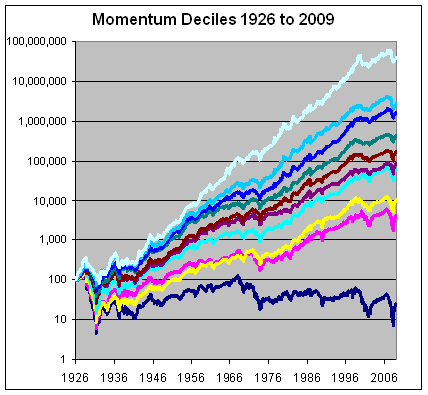
Using data from Dr. Ken French’s website, Eddy Elfenbein has posted updated performance of momentum models that cover the 1926-2009 period. Elfenbein states, “This is one of the most fascinating phenomena in finance. Stocks that have done well, on average, continue to do well.”

The chart shows the historical performance of stocks ranked by momentum decile (meaning 10% slices).

image951 One of the Most Fascinating Phenomena in Finance

The deciles are perfectly rank ordered. The stocks that had been doing the best, do the best. The stocks that had been doing the worst, fare the worst.

The data comes from Dr. Ken French’s website. Just to be clear, momentum is defined by performance over the 11-month period starting 12 months ago and ending one month ago. The one-month directly prior to each period is excluded. At the end of the month, the whole thing is repeated. The data series goes back over 80 years.

Here’s how each decile has performed:

Decile 1: 16.79%
Decile 2: 13.11%
Decile 3: 12.42%
Decile 4: 10.63%
Decile 5: 9.42%
Decile 6: 8.47%
Decile 7: 8.05%
Decile 8: 5.73%
Decile 9: 4.54%
Decile 10: -1.73%

Such superior results achieved by momentum, aka relative strength, is exactly why we have based our entire management process on its application.

Past performance is no guarantee of future results.

Posted by:


High RS Diffusion Index

June 9, 2010

The chart below measures the percentage of high relative strength stocks that are trading above their 50-day moving average (universe of mid and large cap stocks.) As of 6/8/10.

 High RS Diffusion Index

(Click to Enlarge)

The 10-day moving average of this indicator is 22% and the one-day reading is 12%. The correction in the market over the last month has brought this indicator into oversold territory. Dips in this indicator have often provided good opportunities to add to relative strength strategies.

Posted by:


Relative Strength Spread

June 8, 2010

The chart below is the spread between the relative strength leaders and relative strength laggards (universe of mid and large cap stocks). When the chart is rising, relative strength leaders are performing better than relative strength laggards. As of 6/7/2010:

 Relative Strength Spread

The sharp decline in the RS Spread during much of the first half of 2009 has transitioned into a flat spread, which may be setting the stage for a more favorable environment for relative strength investing.

Posted by:


The Real Efficient Frontier

June 3, 2010

Emotions are the well-documented cause of most problems in investing. For some reason, it is very difficult for most people to be rational during uptrends, downtrends, or during periods of high volatility-in other words, 90% of the time.

The recent “flash crash,” besides spawning humorous t-shirts, got investors riled up again.

 The Real Efficient Frontier

The clever t-shirt took me back to 1987 when it was de rigeur for advisors to own at least one piece of ”I Survived the Crash” apparel. I thought about a great, great Joe Nocera column in the New York Times as the 20th anniversary of the 1987 stock market crash was looming. He was interviewing Jason Zweig, who had a priceless anecdote about the father of modern portfolio theory, Harry Markowitz.

“There is a story in the book about Harry Markowitz,” Mr. Zweig said the other day. He was referring to Harry M. Markowitz, the renowned economist who shared a Nobel for helping found modern portfolio theory — and proving the importance of diversification. It’s a story that says everything about how most of us act when it comes to investing. Mr. Markowitz was then working at the RAND Corporation and trying to figure out how to allocate his retirement account. He knew what he should do: “I should have computed the historical co-variances of the asset classes and drawn an efficient frontier.” (That’s efficient-market talk for draining as much risk as possible out of his portfolio.)

But, he said, “I visualized my grief if the stock market went way up and I wasn’t in it — or if it went way down and I was completely in it. So I split my contributions 50/50 between stocks and bonds.” As Mr. Zweig notes dryly, Mr. Markowitz had proved “incapable of applying” his breakthrough theory to his own money. Economists in his day believed powerfully in the concept of “economic man”— the theory that people always acted in their own best self-interest. Yet Mr. Markowitz, famous economist though he was, was clearly not an example of economic man.

This story basically says it all. Even the theory’s originator was incapable of applying it, due to his emotional hang-ups!

We think this is the very best argument for our systematic relative strength approach. Relative strength has been shown to work over time and our process is systematic. There will be no emotional backsliding on the part of the computer when it comes to calculating our relative strength ranks. I cannot stress enough how much more important the systematic execution of the process is, as opposed to the individual items that might be held in a portfolio. A recent white paper by one of our portfolio managers, John Lewis, makes this point powerfully by picking portfolios of high relative strength stocks at random.

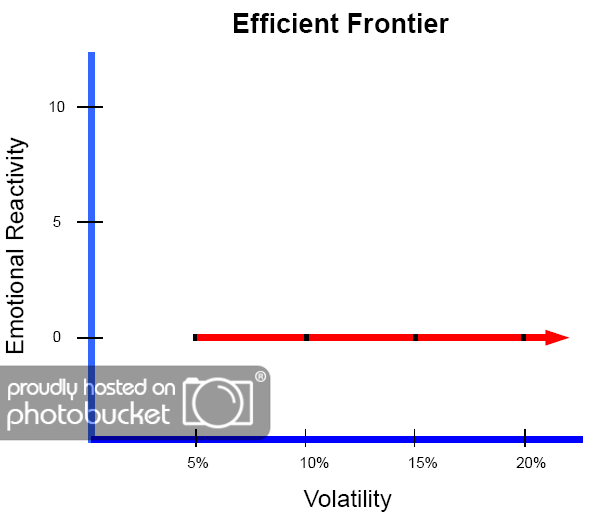
The point is that our Systematic Relative Strength portfolios keep investors continuously exposed to the relative strength return factor, come hell or high water. (There’s plenty of both in financial markets.) Over time, that’s very likely to be a winning strategy. The coordinates for the real efficient frontier are emotional reactivity and volatility, not risk and return. If you can suppress your emotions and stay rational, you have a chance.

 The Real Efficient Frontier

Jason Zweig, in Joe Nocera’s article, had a nice quip for that too:

As our interview was winding down, Mr. Zweig told me a story — “I think it might even be true” — about Charles T. Munger, the Los Angeles lawyer best known as Mr. Buffett’s sidekick at Berkshire Hathaway. “A woman was sitting next to him at a dinner party in L.A.,” Mr. Zweig said. “She turned to him and said, `You’re Warren Buffett’s partner, and a great investor. Tell me, what is your secret?’”

Mr. Munger looked up at her. “I’m rational,” he said. Then he went back to his dinner.

Posted by:


CSI Pasadena: Relative Strength Identity Theft

May 7, 2010

Most readers of Systematic Relative Strength are aware of our high esteem for relative strength. But they may not be aware of the nearly criminal neglect of relative strength in finance-for reasons shrouded in history. Perhaps over time that mystery will be solved, but this is one view of it.

Relative strength has deep historical roots in financial market analysis. Prominent technical analysts like Richard Wyckoff and H.M. Gartley wrote books in the 1930s that discussed relative strength (among other things) and made it clear that the practice of examining relative performance was not new even then. Richard Wyckoff used it to make a fortune in the stock market, retiring to an estate in the Hamptons next to Alfred E. Sloan, the legendary chairman of General Motors. George Chestnutt, the iconic manager of the American Investors Trust, compiled the best mutual fund track record of the 1960s using relative strength-and did not flame out in the 1970s like many other managers from the go-go years. Technical analysis failed to profit much from its association with relative strength, however. Over the years, warm-hearted technical analysts welcomed market strays promoting all sorts of esoteric waves, angles, retracements, ambiguous patterns, and even astrology into their tent. Even though there were still plenty of excellent practitioners, the further technical analysis strayed from actual market-generated data and testable hypotheses, the more its credibility as a profession slipped. To understand how relative strength had its identity stolen, it makes sense to revisit the scene of the crime.

A uniquely American school of thought from the 1930s was fundamental security analysis, best exemplified by Benjamin Graham at Columbia University. His idea was that an intrinsic value could be placed on a company, so that it could be readily determined if a security was undervalued or overpriced. This was much more scientific than speculative buying on margin based on rumor or inside information. Security analysis quickly gained adherents in the investment community, even as valuation metrics proliferated, some having little to do with value in a way Benjamin Graham would recognize.

Another milestone in finance came in 1952 when Harry Markowitz pioneered Modern Portfolio Theory. In a paper published in the Journal of Finance, he discussed the mathematics behind the effects of asset risk, return, and correlation in the construction of an optimal portfolio. Academia swooned and the rout for relative strength was on.

Fundamental analysts quickly allied themselves with the academic community, although the marriage was always a little problematic. After all, how do you reconcile the notion that the market is efficient with the idea that you can identify undervalued securities?

In time, anomalies popped up in efficient-market land. For example, Eugene Fama and Ken French discovered that there were performance differences between large-cap and small-cap stocks. Even Fama and French, however, didn’t know what to do with relative strength. According to James Picerno in his wonderful article “Bodies in Motion:”

Professors Eugene Fama and Ken French cited the momentum factor as an “embarrassment” for their own popular three-factor asset pricing model, which identifies small and value stocks, along with the overall market, as the primary risk factors driving equity returns. Fama and French couldn’t explain the success of momentum investing, even if they did acknowledge its existence.

Unfortunately for relative strength, some of the research was sloppy. For example, numerous studies were published purporting to show performance differences between growth stocks and value stocks. Value stocks always won, evidence that, taken on its face, seemed to validate the value-oriented security analysis crowd. Since relative strength had always been viewed more as a growth factor, this outcome was particularly damaging to the reputation of relative strength.

Closer examination of the studies revealed a serious flaw in their construction. The stock universe used was typically segmented by some valuation ratio, with the good value stocks classified as “value” and the bad value stocks getting thrown into the “growth” category. It took John Brush to point out that growth was not the same thing as bad value. His re-examination of the data showed that growth factors actually outperformed value factors over time.

In 1967, an American University graduate student named Robert Levy did the first computerized testing of relative strength as a return factor. His article, “Relative Strength as a Criterion for Investment Selection,” in the Journal of Finance, soon followed by a book, was earthshaking. Academia, still in the thrall of efficient markets, shouted him down. How dare he show that a simple momentum factor could consistently outperform the market? Levy left the investment field-but his relative strength return factor continued to work, as was shown in subsequent papers, like our own 2005 article published in Technical Analysis of Stocks & Commodities magazine.

Unfortunately for Modern Portfolio Theory, anomalies continued to proliferate to the point that they were perhaps more frequent than the things that worked according to theory. Academics were emboldened to explore new avenues, one of which was really an old friend, relative strength. Given the reception that Levy had received, modern academics thought it perhaps wiser to rechristen the return factor as “momentum.”

The first academic papers on momentum began appearing in the early 1990s, alongside more popular treatments of relative strength like James O’Shaughnessy’s What Works on Wall Street. Even so, discussions of relative strength still took a backseat to value-oriented anomalies. When I went to the first conference on behavioral finance held at Harvard University in 1997, the crowd was captivated by Josef Lakonishok and his presentation of investor over-reaction and under-reaction, I suspect because it fit in very nicely with the contrarian/value bias of most of the conference attendees. In contrast, when Lakonishok later presented his paper on momentum at the same conference, the crowd was sparse and uninterested.

Very recently, relative strength has garnered new attention. In an outstanding article in Financial Advisor, James Picerno traces some of the history of momentum as a return factor:

Since it was formally revived in the academic literature for the first time in the early 1990s, there’s been a wide-ranging debate about why momentum investing exists and what it means for modern portfolio theory. Yet now there’s a growing acceptance of it as a separate and distinct driver of return premiums.

As a gauge of institutional acceptance, Morningstar recently announced plans to include momentum as a return factor and will begin to rate funds by the average level of momentum in the holdings as well. (It should be noted that quantitative analysts did not ignore Levy’s groundbreaking work. Quants long ago confirmed relative strength as a return factor, which is why it is now ensconced in nearly every multifactor model.)

This re-acceptance of relative strength, as Picerno points out, is well-grounded:

The concept of momentum investing is compelling not just because investors are hungry for diversification and new strategies but also for it’s durability in the real world. Relatively few other strategies survive the transition from paper to real-world portfolios the way momentum investing does.

In the textbooks, minting profits looks easy because the standard asset pricing theory suffers from so-called return anomalies—sources of excess returns above and beyond what’s implied by the academic models. But exploiting these anomalies in actual portfolios is hard. Trading costs, taxes and other frictions take a toll. And many profitable return patterns that look solid in the financial laboratory have an annoying habit of disappearing when the crowd comes rushing in.

Is momentum investing different? It appears to be. Academics and money managers tend to agree that it is a resilient source of return that stands up to the usual lines of attack, such as criticism that it’s simply a byproduct of data mining or that it’s vulnerable to arbitrage. It doesn’t hurt that the basic idea is as old as investing itself and so it’s stood the test of time.

Relative strength also turned out to be a universal factor. It worked not just for U.S. stocks, but for asset classes, and for all manner of foreign markets. Picerno writes:

“Momentum is ubiquitous across all major asset classes,” says professor Craig Pirrong at the University of Houston, summarizing the conclusion in one of his own research efforts.

A similar finding echoes throughout the analysis of Mebane Faber, a portfolio manager at Cambria Investment Management. His work demonstrates that momentum investing’s close cousin—trend following—has proved its worth as a risk management tool in connection with tactical asset allocation.

What’s the point in our forensic analysis of the scene of the crime? What can we take away from this tale of intellectual kidnapping, of eclipse and re-emergence? There are several useful lessons, I think.

First, respect history. Don’t be too quick to dismiss the “primitive” ideas of your predecessors. They may not have had the same technological tools as we do now, but that doesn’t mean their IQ was lower. Relative strength was based on close observation of markets and actual human behavior, and ironically, it has turned out to be much more sturdy than the equations and the rational man of Modern Portfolio Theory. The only thing new under the sun is the history you haven’t read yet.

Second, evidence trumps assertion. Don’t believe everything you read. Test it yourself. Levy’s formulation still works more than 40 years later, even though his critics claimed it did not. Everyone has an ax to grind and you need to figure out what it is. Many times it is the search for truth, but sometimes it is just the preservation of the status quo.

Finally, seek the universal. The biggest breakthrough in biology occurred when Watson and Crick were able to show that DNA replication was at the heart of all living things. Now that we can sequence the genome, scientists realize that humans share most of their DNA not just with other primates, but with insects and virtually every other species. That is amazing! DNA is universal and so malleable that it can adapt to create a human eye or the compound eye of a fly.

Relative strength is part of the DNA of markets. Markets and asset classes everywhere exhibit momentum. Relative strength is universal and so malleable that it can be used to power stock selection or global tactical asset allocation. Relative strength makes no assumptions about the future-it simply adapts to what is. Darwin wrote, “It is not the strongest of the species that survives, nor the most intelligent, but rather the one most adaptable to change.” Relative strength is adaptive and adaptation is what ensures survival.

Relative strength has come full circle. After years of academic neglect and derision by fundamental analysts-and a blatant case of identity theft in renaming it “momentum”- relative strength as a return factor may be regaining its place at the table.
Posted by:


The Momentum Echo

May 7, 2010

CXO Advisory had an interesting post (click here for the post) on momentum earlier this week. In the post, CXO goes over Robert Novy-Marx’s November 2009 paper, “Is Momentum Really Momentum?” I read this paper when it came out, but it was one of those things that got put on the shelf for future research (and ultimately forgotten about!). When I saw the post on CXO it piqued my interest again, and I think it was very timely given the current state of the market.

The premise of Novy-Marx’s paper is that maybe the momentum effect isn’t really momentum, but more of an echo. It is common for researchers to use a trailing 12-month price return when constructing momentum models. The paper broke the 12-month ranking period into two subperiods: months 12-6 and months 6-0. (The actual paper skips the most recent month as does most momentum literature. I am not doing that. I am simply running everything as of the current month end. ) So what’s more important? Is it the current momentum, or the momentum from 6 months ago?

Novy-Marx’s data indicates the current momentum (most recent 6 months) is not as important as the previous momentum (the earliest 6 months). You can view his paper or the CXO blog entry for the data. I found that conclusion very thought-provoking considering the current state of the market. It seems everyone we speak with expects relative strength models to be undergoing major changes because of the market changes this week. I think the overall perception is that the faster you get on a trend, the better your performance will be. Or maybe you just feel better because at least you are doing something! The data in the paper indicates the most recent momentum data isn’t as important as the long-term data. I think that’s exactly the opposite of what most people think.

I ran Novy-Marx’s factor on our database to see how it looked on our data. There are a couple of differences. Our universes are different. I am using a universe similar to the S&P 500 + S&P 400. Novy-Marx used the top 20% of market cap out of the CRSP database. I used the top decile instead of the top 20% of ranks. This doesn’t make as big of a difference as you would think. When I ran the data using the top 20%, the cumulative numbers were very similar. And finally, I am not skipping a month between the ranking date and portfolio formation. I don’t believe any of these will have a material impact on results. I also think it is good to have a slightly different rule set and universe- it just helps reduce the data snooping bias that can crop up in these types of studies.

12MonthEcho The Momentum Echo

(click to enlarge)

The table above shows the results we generated using Novy-Marx’s factor. I have also included returns from a 12-month, 6-month, and 3-month price return factor. These returns were generated by taking the top decile of ranks each month end, holding the portfolio for 1 month, then reconstituting and rebalancing the whole portfolio at the next month end.

The 12-Month Echo factor does significantly better than either the 12-month or 6-month factor. And it blows a 3-month return factor out of the water. The table indicates the data at the back-end of an intermediate momentum factor is more important to returns than the near-term data. So as this market continues to gyrate wildly, keep in mind where the best long-term returns come from. It’s not the most recent data that everyone can’t stop overreacting to!

Posted by:


Recognition is a Long Time Coming

May 3, 2010

Relative strength is no longer the Rodney Dangerfield of investing.

In a watershed event for relative strength investing, Morningstar will begin to consider “momentum” as a return factor. This nugget was disclosed in a Portfolio Strategy article that appeared in today’s Wall Street Journal.

For many years, academic researchers believed a stock’s performance could be explained by three primary factors: the market where the stock traded, the size of the company, and the stock’s style, along a continuum from shares of fast-expanding “growth” companies to seemingly cheap value stocks.

But now, the academic community has “coalesced” around recognition of momentum as the “fourth factor,” says Mr. Rekenthaler, a sentiment echoed in recent research.

Momentum, as you may recall, is the name academics use for relative strength. Academic research began appearing on momentum in the 1990s, although market technicians have been writing about-and using-relative strength at least since the 1930s. (My theory is that academics and value investors can’t stand to admit that technical analysis has tremendous value.)

Morningstar didn’t stop with just the recognition of relative strength as a return factor. They’re going to measure it:

In a sign of just how popular this idea is becoming, Morningstar Inc. this summer will roll out a new gauge: The research firm will assign U.S. and international stocks a score between 1 and 100 for momentum and take the mean momentum score of a mutual fund’s holdings to give the fund an overall momentum ranking. If funds that consistently score highly on momentum perform similarly, Morningstar might eventually create a new category of momentum-oriented funds, says John Rekenthaler, vice president of research at the firm.

The other salient point that the Wall Street Journal article makes is something that we have emphasized often on this blog. Relative strength strategies and deep value strategies are often complementary. The article references the work of Clifford Asness at AQR:

Mr. Asness co-authored a 2009 study entitled “Value and Momentum Everywhere,” which suggested that investors can hedge themselves and boost returns with a simple combination of momentum and value strategies—in stocks and all other asset classes.

In the past, many investors looked to hold a mix of value-oriented and growth-oriented stocks or funds, since the two were thought to take turns in favor. Now AQR suggests that momentum, rather than growth, is the right foil for value strategies.

There’s one area where I take issue with the article. It suggests that relative strength has no fundamental underpinning; that it is purely a psychological phenomenon, or somehow related to group-think:
These momentum trends in markets have more to do with the faddishness of human behavior than the fundamentals of economics and balance sheets. In essence, investors often flock to the stocks that have been going up, which tends to propel them further.

That is a very incomplete description of how relative strength works. A number of academic studies have shown that part of the push behind relative strength is that new information sifts into the market gradually and that the time-release effect is one of the drivers of relative performance. Fundamental analysts often comment that a positive earnings revision is frequently followed by another-the so-called “cockroach effect.” Analysts tend to adjust their earnings estimates more slowly than they should and relative strength is often just recognition of improved prospects in the market running ahead of the analysts’ conservative thinking.

Indeed, relative strength is typically driven by fundamentals. For example, the largest weight in the PowerShares DWA Technical Leaders Index (PDP) is Apple Computer (AAPL). If you look at a chart, you can see that it has vastly outperformed the S&P 500 index over the past few years.

 Recognition is a Long Time Coming

click to enlarge

Is that because investors are blindly flocking to it because it has been going up, or is it in recognition of the earnings per share going from $2.27 (9/2006) to $6.29 (9/2009), with a consensus estimate of $13.08 for this fiscal year? In our view, it’s simple math. Earnings going from $2 to $13 merits an increase in the stock price. Value investors can debate if Apple is cheap or expensive, but the market has already voted. In other words, if a stock is outperforming the market and its peer group, it’s typically because the fundamentals are superior.

That caveat aside, I would like to tip my cap to Morningstar and the Wall Street Journal. It’s about time that relative strength gets the respect it deserves.

Posted by:


CXO on Asset Class Rotation

April 27, 2010

We’ve written about this paper by Mebane Faber already, but here is a link to a review of his work from CXO Advisory. Mr. Faber’s paper is about industry and asset class rotation, and CXO’s conclusion is:

In summary, evidence from simple tests indicates that the momentum anomaly is substantial and persistent over long periods for industries/asset classes on a gross return basis.

We are big fans of the words “substantial” and “persistent.”

Posted by:


Mebane Faber’s New White Paper

April 20, 2010

Mebane Faber recently released a nice white paper, Relative Strength Strategies for Investing, in which he tested relative strength models consisting of US equity sectors from 1926-2009. He also tested relative strength models consisting of global assets like foreign stocks, domestic stocks, bonds, real estate, and commodities from 1973-2009. The relative strength measures that he used for the studies are publicly-known methods based on trailing returns. Some noteworthy conclusions from the paper:

  • Relative strength models outperformed buy-and-hold in roughly 70% of all years
  • Approximately 300-600 basis points of outperformance per year was achieved
  • His relative strength models outperformed in each of the 8 decades studied

I always enjoy reading white papers on relative strength. It is important to mention that the methods of calculating relative strength that were used in Faber’s white paper are publicly-known and have been pointed to for decades by various academics and practitioners. Yet, they continue to work! Those that argue that relative strength strategies will eventually become so popular that they will cease to work have some explaining to do.

Posted by:


Momentum and Value in Inflationary Times

April 9, 2010

Mark Hooker, Ph.D, of Advanced Research Center recently released a study in which he looked at the returns from value and momentum during low/medium/high inflationary episodes in the US back to the 1920s.

After many years of being a minor concern for US investors, inflation worries have again assumed a more prominent position in the investment landscape. While core inflation has remained muted, headline figures have been whipsawed by dramatic movements in energy prices, and the outlook has been clouded by countervailing pressures from the deep recession on the one hand and the government’s massive stimulus measures and the resulting extraordinarily high deficits on the other hand. These forces threaten to trigger a shift from the benign inflation regime enjoyed over the past roughly 25 years in the U.S. to something more like the volatile earlier experience shown in Chart 1.

inflation 1 Momentum and Value in Inflationary Times

(Click to Enlarge)

Dr. Hooker used the data library compiled and made available by Professor Ken French. It contains returns on US stocks grouped into deciles by several factors that are relevant for bottom-up quantitative stock selection models back to the 1920s. He used book-to-price ratio as his value metric, and he used trailing 12-month total return for his momentum metric.

In our analysis, we evaluate the performance of a value-only, a momentum-only, and a 50/50 value/momentum model, in each case as represented by returns on the top-ranked decile (10%) of stocks relative to the bottom decile.

The results of the study are found in the tables below:

inflaiton2 Momentum and Value in Inflationary Times

(Click to Enlarge)

inflation3 Momentum and Value in Inflationary Times

(Click to Enlarge)

The study concludes that value does better during low or falling inflation while momentum does much better during rising and high inflation. Again, we see the merit of combining value and momentum strategies. Furthermore, in light of the surge in money supply (15% year-over-year growth in the M1 money supply) that we have seen in recent years, and economic recovery that is well on its way, I think it is reasonable to expect that inflation will be on the rise in coming years. Momentum (relative strength) strategies may well be increasingly valuable in the years ahead.

HT: World Beta

Posted by:


Updated White Paper Data

April 8, 2010

Back in January, we published a white paper that discussed using relative strength and portfolio management. If you haven’t read the paper (or would like to read it again) it can be found here. (Note: Please see the original paper for all of the necessary disclosures.) The original paper also outlines the unique process we use to test various relative strength factors. All of the data in that paper was updated through 2009. Since we have just finished updating all of our data through the end of Q1, we can update the data in the paper.

The first quarter was very good for relative strength. The data in the original paper showed that the best returns come from an intermediate term time horizon (about 3-12 months). Last year that was very different. We found very good returns for 2009 at very short-term time horizons. A 1-Month RS factor was actually one of the better performers in 2009. Over longer periods, a 1-Month RS factor has been a very poor performer so we definitely saw some anomalies during the huge laggard rally last year. The first quarter of 2010 was much more normal for relative strength strategies. The table below shows the performance for the first three months of 2010 for all of the models we tested in the original paper.

 Updated White Paper Data(Click To Enlarge)

The best returns came in the 6-12 month time horizon, which is what we would expect. (For those of you who are confused about the “Factor,” it is not a holding period. It is the lookback period for calculating relative strength. So the 6-Mo Price Return, for example simply takes the 6-month return for all stocks in the universe and ranks them from best to worst.)

The next table shows the cumulative annualized returns for all of the models updated through 3/31/10.

 Updated White Paper Data

(Click To Enlarge)

The various models keep chugging along! The intermediate term factors work very well. Even when we are throwing darts at a basket of high relative strength stocks we find 100 out of 100 trials outperforming the benchmark over time. As the original paper showed, relative strength models aren’t going to outperform each quarter or each year, but over time they do exceptionally well.

Posted by: