Retirees “Consumed by Fear”

June 14, 2010

So says a recent Bloomberg story about the retirement finances of Americans, and, indeed, there is ample reason to worry. According to the article, nearly half of those nearing retirement are predicted to run out of money.

Source: airanwright.com

Although we all worry about the government having a fiscal crisis, perhaps we should pay more attention to our onrushing collective personal fiscal crisis. How did everything become so dire? Part of it may have to do with the fact that traditional pension plans have been supplanted in the main by 401k plans:

In 1983, 62 percent of workers had only company-funded pensions, while 12 percent had 401(k)s, the center said. In 2007, those numbers were 17 percent and 63 percent, respectively.

Part of it may have to do with the relatively low level of Social Security benefits available to the average worker:

The average monthly Social Security benefit as of April was $1,067.

On the other hand, the biggest part of it may have to do with pre-retirees not saving enough:

The average 401(k) account balance as of March 31 was $66,900, according to Boston-based Fidelity Investments, which has 11 million participants.

A couple of solutions were mentioned in the article. One possibility is to include an annuity option to generate the highest possible income payout in retirement. However, with the savings levels cited, that’s probably not going to get it done. Another promising possibility is to indicate on the employee statements exactly how much monthly income can be expected from the portfolio. Although it might be a shock for employees on the cusp of retirement, that option might also serve as a wakeup call for workers who are not saving enough and still have enough time to do something about it.

Now that retirement is largely left up to the individual, investing decisions and disciplined saving are more important than ever. If you are not already taking a systematic approach to saving and investing, now would be a good time to start.

Posted by:


$140 Billion Tax Increase is a Done Deal

May 26, 2010

Opportunity cost is just as real as capital loss-it’s just sneakier and harder to see. Laura Rowley’s column on Yahoo! Finance had this gem in an article discussing the low rates available for savers:

“The Fed is determined to keep rates very low, and while it’s painted as fiscal stimulus I think it’s really a stealth bailout of the banks,” says Richard Barrington, a certified financial analyst and expert with the bank comparison site Money-Rates.com. U.S. savers have lost $140 billion in purchasing power to inflation over the 12 months ending in March, according to a Money-Rates study released last month.

“If you tried to raise $140 billion in taxes there would be massive outrage and protests but they’ve taken the equivalent of that out of the pockets of depositors by keeping rates below inflation,” Barrington says. “Depositors are really getting the shaft in this environment and it’s something that’s not really talked about. There’s sympathy for borrowers who are overextended, but they contributed to the financial problem. The sympathy should be with people who did the right thing and saved their money, and are getting teeny tiny interest rates.”

I’ve added the underlining to make the point about opportunity costs; Mr. Barrington is on to something. Savers have had $140 billion in purchasing power evaporate, but because there has been no visible capital loss, it doesn’t necessarily occur to them what has happened. In effect, savers have been taxed $140 billion as their purchasing power has been transferred to someone else.

What can you do about opportunity cost? It helps if you think of things in terms of beanbag economics: if you mush a beanbag down in one spot, it just poofs out somewhere else. What incentive is created by pushing savings rates effectively to zero? It simply causes investors to move their cash elsewhere in the quest for yield or capital gains. The risk level may be different, but money will start to flow nonetheless.

This is the primary attraction of using relative strength for tactical asset allocation. It is able to identify shifts in supply and demand by measuring what assets are strong and what assets are weak. Opportunity cost may be hidden from view, but its effects on the capital markets are laid bare.

Posted by:


Two Approaches to Retirement Income

May 25, 2010

Research Magazine has a nice piece on building retirement income portfolios. If you have clients that are aging baby boomers-and most of you do-or you are, like me, an aging baby boomer yourself, you’ll recognize that lots of people are suddenly thinking about this topic.

The two approaches to retirement income that are discussed are the total return approach and the investment pool approach, sometimes called the bucket approach.

Courtesy: Research Magazine

The graphic highlights the differences between the two approaches, although the article points out that advisors are trying to achieve the same end result:

While advisors may differ in the philosophy they follow for retirement clients, there are consistent elements among best-practice advisors that cut across both approaches. These common elements include:

- Generating an annual income or cash flow target of between 3 percent and 6 percent;

- Managing portfolios to support spending on essential needs such as housing, healthcare and other daily living expenses while also looking to maintain long-term purchasing power in light of potential inflationary pressures;

- Seeking to produce competitive returns for the client within agreed-upon risk parameters, but not striving for consistent above-average returns or outperforming market benchmarks;

- Focusing on broad diversification in asset classes, relying on vehicles they are highly familiar with, such as mutual funds, ETFs, individual securities, separately managed accounts and annuities;

- Emphasizing the process of constructing portfolios rather than the products or solutions available.

So which approach is best? The article doesn’t take a position on that question, but I think two things should be kept in mind when trying to decide.

1. There is no necessary functional difference at all between the two approaches. In other words, an investment pool approach with six equal 5-year buckets allocated progressively to Treasury bills, short-term bonds, intermediate-term bonds, large-cap value stocks, large-cap growth stocks, and emerging market equities is absolutely the same thing as a 50/50 balanced portfolio that uses the same asset classes.

2. As a result, the only thing that matters is which approach works best psychologically for the client. If the portfolios are functionally the same, ideally we should gravitate to whatever will help the client achieve their income and investment growth goals. Twenty years ago, the total return approach was dominant-and it still makes perfect sense from a financial point of view. However, over the last decade or so, the rise of behavioral finance has generated research that focuses on ways to nudge clients into more productive investment behaviors. There seems to be an innate tendency of humans to compartmentalize their finances; whether it is rational or not is beside the point. Even though we can all agree that the two leading retirement income approaches are functionally the same, if the client is more comfortable breaking an account into buckets-and will therefore have less emotional anxiety when the growth buckets bounce around in choppy markets-that’s the way it should be handled. Lousy emotional asset allocation is the root of most portfolio problems and anything that can improve results by alleviating emotional strain on clients should be encouraged.

Posted by:


Net Worth is a Worthwhile Obsession

May 19, 2010

Ron Lieber wrote an interesting article in the New York Times about a number of websites that allow you to anonymously track and post your net worth and compare it with others in similar circumstances. Mr. Lieber didn’t say explicitly what he thought about this new trend in social networking, but the title to the article, “Net Worth Obsession,” gives a clue. A number of pundits were quoted decrying the trend:

But does our almost irresistible urge to rank ourselves against others based on any available data serve as a source of inspiration? Or does it lead to endless striving in search of some ever-elusive achievement? “I think this is a profound problem, this aspect of humans in the West,” said Andrew Oswald, a professor of behavioral science at the Warwick Business School in England. “We’re now extraordinarily rich by almost any standard of human history. But because we are creatures of comparison, it’s harder to get happier and happier.”

It’s certainly possible to pay too much attention to your net worth and ignore your happiness, but most of the actual site participants had very positive things to say. Perhaps there is something redeeming in tracking assets minus debts! One user says:

Initially, the idea of laying herself bare on a blog and on NetworthIQ caused a lot of anxiety. “You’re saying I have a secret and here it is for everyone to see,” she says. “But once it’s out there, and especially now that it’s not just a flat line saying ‘negative $23,000,’ and it is moving up a little bit, there’s a sense of pride and accomplishment that goes along with that. I know people are visiting, and it makes me want to pay something else off so I can post another entry that’s something good.” She’s currently putting a third of her monthly take-home pay from her job as a benefits analyst toward debt payments.

All of this has led to some odd reversals in her life. She looks forward to getting her bills in the mail, for instance, because it means it’s time to update her total debt. “Which might be a little bit sick,” she said. “But I know it’s lower than the last month. I know it for a fact.”

Grant often wonders about the people who are far ahead of her in the NetworthIQ standings. Did they get lucky? Are they lottery winners? Or did they get smart about money before she did? She tries not to beat herself up over it. “For people with the same income as me but higher net worth, it tells me that I can get there, too. It just takes discipline,” she says. “I know it has only been a couple of months now, but I kind of feel like I’ve made a life change.”

In other words, most of the participants found tracking their net worth to be motivational. This is something that I have noticed repeatedly with real clients over the past 25 years. The clients who track their net worth always do way, way better than clients who have only a vague idea of their finances. The difference is so dramatic that I routinely suggest the practice to clients. Before there were social networking websites for net worth, there were spreadsheets. As far as I know, none of my clients have ever shared their information with anyone but their financial advisor, but like most things, just the fact that it is being tracked makes them pay attention to it. Most clients do not see updating their spreadsheet each month or each quarter as a joyless activity-they are instead motivated to keep that number moving north.

If competing with your net worth on a social networking website helps push you to save and invest, well, more power to you. One person interviewed in the New York Times article makes this same point:

She admits that some of her pleasure is fueled as much by competition as self-satisfaction. “I’m not that far off from the person right above me” on the NetworthIQ list, she says. “I can probably catch them this month. And maybe next month I can get to the next one.”

It’s not as if people don’t notice their socioeconomic status anyway. Even Mr. Osvald, who was quoted earlier in the article lamenting the “profound problem” with humans admits that comparison is actually just human nature:

Oswald, the professor of behavioral science, says the craving for comparison may be rooted in our biology. “It’s easier said than done to break through two million years of evolution,” he says. “A million years ago, you could watch what others were doing and mimic that to get food and resources. Or if you were high up the monkey pack, you could get the best mates.”

Let’s face it: everyone wants to be high up in the monkey pack. Perhaps we’re not all members of the same monkey pack, but humans always and everywhere are in competition for resources. Consequently, social and economic signifiers are embedded in everything from the car you drive, the sneakers you wear, the sports you enjoy (polo anyone?), the bling and tats you do (or do not) have. We have elaborate social ways of interpreting these signifiers: the same Bentley might be seen as appropriate if the owner comes from ”old money,” but tacky if the owner is “nouveaux riche.” Most product marketing is based more on the branding-the social signifier-than on the actual product features.

“Keeping up with the Joneses” will always be with us. Ultimately, I think tracking net worth is a much healthier way of keeping up with the Joneses than accumulating possessions and racking up consumer debt. After all, most of our personal and national fiscal problems are caused from too much spending and not enough savings and investment. Tracking your net worth, I suspect, is actually aspirational and motivational rather than pathological. Instead of sucking the fun out of life, clients end up bonding with their grandkids for the summer at the beach condo they wouldn’t otherwise have had. Pundits may worry about it, but the public seems to find it practical and valuable.

Posted by:


Don’t Wait!

May 3, 2010

Time ran a series of pithy articles with retirement advice. Although I don’t agree with every single bit of advice, most of it is quite sound. One important piece of advice:

You’re pretty much on your own when it comes to earning, saving and investing. So make a plan early and check in often. Those who have a realistic plan are far more likely to achieve their financial goals.

According to AARP, more than 50% of people closing in on retirement do not have any kind of plan! Get started. In my experience, clients who commit to even the simple act of setting up a spreadsheet to tally their net worth each quarter take a huge step toward getting on the right track.

Posted by:


Morningstar: What NOT to Do When Investing for Income

April 23, 2010

Maybe Christine Benz, the personal finance specialist at Morningstar, is a regular reader of our blog. Or maybe she just gets it. She wrote a great piece on what income investors should avoid. Here’s a section of it:

Is it even healthy to focus on generating income, particularly if doing so comes at the expense of total return? Is generating a livable yield from a portfolio a vestige of a bygone era? No and yes, I’d say.

It’s easy to see the intuitive appeal of being able to live on the income you earn from clipping bond coupons, yet being too income-focused carries its own set of pitfalls. A key one in today’s low-yield environment is that you have to venture into very risky stuff to generate a livable yield, and that could erode your principal in the process. And by focusing unduly on investments that kick off income, you also risk starving your portfolio of the capital-appreciation potential that comes with stocks. True, stock returns have been no great shakes over the past decade, but bonds may well fight their own uphill battle over the next one.

The bottom line is that most people will have to tap their principal to fund living expenses in retirement, so the key aim for most retirees and pre-retirees should be to grow those retirement kitties as large as they can. If they have to tap their principal, they’ll be tapping a larger base than if they had focused on income without regard to total return. Investments that generate current income aren’t bad, but total return is your real bottom line.

[The emphasis is mine.] This is exactly what we wrote about on 4/16 in a post on investing for income. We made the added point that capital gains can be spent just as easily as income, so there is no reason not to focus on total return. We also had a suggestion for how an income-oriented investor might be persuaded to incorporate growth into the portfolio. I don’t always agree with Morningstar’s orientation on investing-they tend to think that value is the only way to go-but I think their take on investing for income and the dangers of only paying attention to the current yield are right on the money.

Posted by:


Theory versus Practice

April 22, 2010

William Sharpe, a Nobel Prize winner in Economics, wrote a recent paper about how the 4% retirement spending rule is inefficient. MarketWatch had a recent feature discussing his paper-and more than anything about the spending rule itself, the piece made me think about how large the gulf in finance is between theory and reality. As Yogi Berra is reported to have quipped, “In theory, there’s no difference between theory and practice. But in practice, there is.” (There’s a link to Mr. Sharpe’s paper in the MarketWatch article.)

The 4% retirement spending rule is clearly a rule of thumb, and I am sure that most practitioners modify it depending on the client’s circumstances. (We prefer a 3% spending rule, and I’ve seen other rules based on the yields available. For example, one paper I read advocated a spending rule of 125% of the yield on the S&P 500, arguing that you can spend more when yields are high than when they are low.) Mr. Sharpe says the 4% spending rule is too simplistic. He’s right-rules of thumb are supposed to be simplistic. But no one using it is really going to mistake it for the be-all-and-end-all.

An extraordinarily complex retirement spending rule that takes many complicated factors into account is just as likely-or maybe even more likely-to fail. The real world is a much messier place than an ivory tower. Things that seem like good ideas in theory, even to Nobel Prize winners (I’m thinking Long-Term Capital Management here), often fail miserably in practice.

The reason that complicated things never work in real life is that there are too many unknowns in the equation. In modern portfolio theory, market returns and correlations between assets are not stable, so the whole thing is essentially unworkable. A perfect retirement spending rule could be made for each client if the practitioner only knew exactly what their investments would earn each year and how long the client would live. That’s not going to happen, so we are left with rules of thumb.

The most important thing about any modeling approach is how robust it is. If you jiggle around the inputs, does it fail miserably or does it continue to work? Is it based on historical inputs which are guaranteed to change, or does it just adapt without making assumptions? We have strong feelings about this. The fewer factors a modeling approach uses, the less likely it is to be knocked down by some unanticipated factor interaction. We use a single-factor model and test rigorously for robustness (you can read our white paper on Bringing Real-World Testing to Relative Strength here). Academic finance would be much more useful to real investors if they kept in mind another saying: it is better to be approximately right than precisely wrong.

Posted by:


Investing for Income

April 16, 2010

As the front end of the baby boomers hit retirement age, investing for income has become their mantra. Retirees are often sold terrible investments because of their known propensity to lunge at income the way a starving fish attacks a baited hook. But is investing for income desirable, or even possible? Let’s take a look at the income possibilities from bonds, stocks, and alternatives.

Bonds are boring and safe, and are usually the first place investors go for income-except that with current interest rates, there isn’t much income available. Most retirees can’t live on 2-year Treasury yields of 1.04%, and moving out to the 30-year Treasury at 4.72% brings with it a significant chance of getting hurt by inflation. Yields on junk bonds (euphemistically known as high-yield bonds) are higher, but that crosses over from investing for income to its less glamorous cousin, “reaching for yield.” Junk bonds might work for a while, as long as the economy is in recovery mode, but are probably not a long-term solution for a retiree. As the saying goes, “More money has been lost reaching for yield than at the point of a gun.”

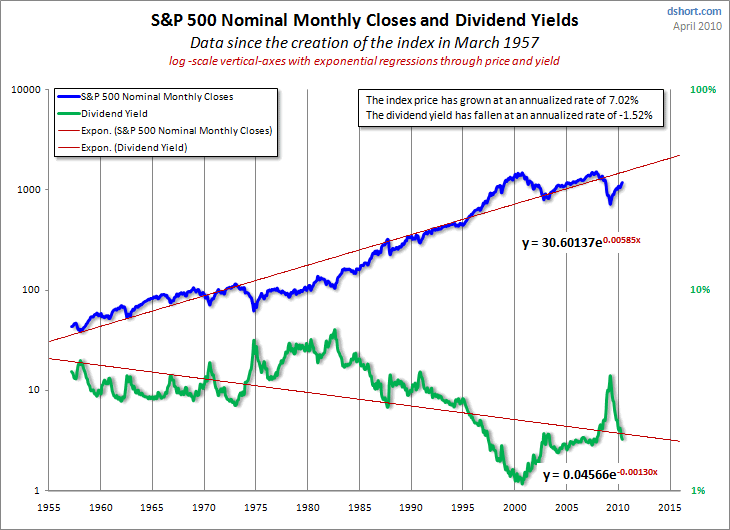
Many investors have looked to the stock market for dividend yield. Doug Short has a nice piece on the disappearing yields in stocks on his excellent site. The chart below is taken from his article. Stock prices have been rising, but dividend yields have been going the other direction.
 Investing for Income

Click to enlarge. Source: dshort.com

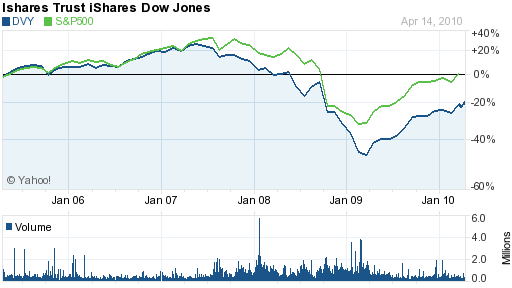
The traditional high-dividend sectors for investors were always banks, oil stocks, utilities, and REITs. When stock prices plunged in 2008, many banks eliminated or severely slashed their dividends. Some REITs had the same problem. Oil stocks and utilities don’t have nearly the dividend yields they used to. All of the dividend cuts and reductions caused the high-yielding equities to do worse than the general market. (See the chart below for a comparison of the S&P 500 to the Dow Jones Select Dividend Index ETF.)
 Investing for Income

Source: Yahoo! Finance

Alternatives range from MLPs (typically finite lives and unstable income streams) to all sorts of structured products. This morning someone sent me an offering flyer for a 12-year 8% CD, where the quarterly rate is based on the slope of the yield curve. 8% was the cap rate, but it could drop to 0% if the yield curve flattened out. I’m not sure Mrs. Jones is ready to speculate with derivatives.

All in all, it appears that the income investor has hit a rough patch and there seems to be no easy way out. I’m going to let you in on a secret that very few investors know: capital gains can be spent just as easily as dividends. Ok, that’s not really a secret at all, but many investors act like it is. They chase yield so they can spend the income, but really, total return is all that matters.

Segmentation, like the distinction investors often impose between income and principal, is a natural function of the mind. Many retirement planners have been using this human tendency to segment things by presenting a retirement income solution that consists of a number of buckets, a solution that is generally well-received by clients.

The first bucket is the liquidity bucket, where spending will be drawn from. The second bucket is the income bucket, which is typically put into some kind of fixed-income investment. The third bucket is the growth bucket. By segmenting the growth portion, the investor might be more willing to leave it alone as it gyrates with the market.

When there is a particularly good quarter or good year, the growth bucket can be trimmed back and the proceeds “deposited” into the liquidity bucket. Obviously, you could use any number of buckets depending on how finely you choose to segment the investment universe. The relative size and specific composition of each bucket would be determined by the client’s situation. Most often, all of this can be done within one account. The buckets are mental, but they help separate the investments and their specific purpose in the client’s mind.

When viewed in the context of buckets within a single account, it becomes quite apparent that total return is what counts. Investing for income may be a misnomer; investing for total return is the real deal.

Posted by:


Delayed Gratification

April 5, 2010

Stanford University psychology researcher Walter Mischel famously demonstrated the importance of self-discipline (the ability to delay immediate gratifiction in exchange for long-term goal achievement) in achieving lifelong success in his well-known “Marshmallow Study.” In the study which began in the 1960s, he offered hungry 4-year-olds a marshmallow, but told them that if they could wait for the experimenter to return after running an errand, they could have two marshmallows. Those who could wait the fifteen or twenty minutes for the experimenter to return would be demonstrating the ability to delay gratification and control impulse.

About one-third of of the children grabbed the single marshmallow right away while some waited a little longer, and about one-third were able to wait 15 or 20 minutes for the researcher to return.

Years later when the children graduated from high school, the differences between the two groups were dramatic: the resisters were more positive, self-motivating, persistent in the face of difficulties, and able to delay gratification in pursuit of their goals. They had the habits of successful people which resulted in more successful marriages, higher incomes, greater career satisfaction, better health, and more fulfilling lives than most of the population.

Those having grabbed the marshmallow were more troubled, stubborn and indecisive, mistrustful, less self-confident, and still could not put off gratification. They had trouble subordinating immediate impulses to achieve long-range goals. When it was time to study for the big test, they tended to get distracted into doing activities that brought instant gratifciation This impulse followed them throughout their lives and resulted in unsucessful marriages, low job satisfaction and income, bad health, and frustrating lives.

I recently came across an in-depth article about Walter Mischel in The New Yorker, which discusses the Marshmallow Study in the context of his long career. It gives a fascinating look into the events and studies that led Mischel to the Marshmallow Study and his subsequent research on the subject of delayed gratification. He is a big believer that people can actually develop the ability to delay gratification through hard work and training.

One particularly relevant passage of the article is as follow:

At the time, psychologists assumed that children’s ability to wait depended on how badly they wanted the marshmallow. But it soon became obvious that every child craved the extra treat. What, then, determined self-control? Mischel’s conclusion, based on hundreds of hours of observation, was that the crucial skill was the “strategic allocation of attention.” Instead of getting obsessed with the marshmallow—the “hot stimulus”—the patient children distracted themselves by covering their eyes, pretending to play hide-and-seek underneath the desk, or singing songs from “Sesame Street.” Their desire wasn’t defeated—it was merely forgotten. “If you’re thinking about the marshmallow and how delicious it is, then you’re going to eat it,” Mischel says. “The key is to avoid thinking about it in the first place.

In adults, this skill is often referred to as metacognition, or thinking about thinking, and it’s what allows people to outsmart their shortcomings. (When Odysseus had himself tied to the ship’s mast, he was using some of the skills of metacognition: knowing he wouldn’t be able to resist the Sirens’ song, he made it impossible to give in.) Mischel’s large data set from various studies allowed him to see that children with a more accurate understanding of the workings of self-control were better able to delay gratification. “What’s interesting about four-year-olds is that they’re just figuring out the rules of thinking,” Mischel says. “The kids who couldn’t delay would often have the rules backwards. They would think that the best way to resist the marshmallow is to stare right at it, to keep a close eye on the goal. But that’s a terrible idea. If you do that, you’re going to ring the bell before I leave the room.”

As discussed in the article, researchers have concluded that although intelligence is very important to long-term individual performance, self-control is even more important. Furthermore, self-control can be developed over time, even if it may come more easily to some than to others.

Delayed gratification is, of course, the rationale for investing. It is what motivates people to save for tomorrow what they could spend today. Delayed gratification is what allows people to accept short-term volatility in exchange for the expectation of more plentiful long-term rewards. I would strongly suggest that investors are best served by doing very thorough research about about investing early on in their lives so that they can adhere to an overriding investment philosophy for a long period of time. Such research might lead a person to determine a disciplined long-term savings plan. It might also lead a person to a deep commitment to a given number of investment strategies like relative strength, value, and/or indexing. Finally, the key to long-term success is to focus on other things while adhering to those saving and investment principles for the long run.

Posted by:


This Is Insanity!

March 9, 2010

According to the article Public Pension Funds Are Adding Risk to Raise Returns in today’s New York Times:

States and companies have started investing very differently when it comes to the billions of dollars they are safeguarding for workers’ retirement. Companies are quietly and gradually moving their pension funds out of stocks. They want to reduce their investment risk and are buying more long-term bonds.

Besides bonds, where else are they going?

Though they generally say that their strategies are aimed at diversification and are not riskier, public pension funds are trying a wide range of investments: commodity futures, junk bonds, foreign stocks, deeply discounted mortgage-backed securities and margin investing. And some states that previously shunned hedge funds are trying them now.

What type of return do they need?

A spokeswoman for the Texas teachers’ fund said plan administrators believed that such alternative investments were the likeliest way to earn 8 percent average annual returns over time.

Why pensions don’t want to lower their return assumptions:

A growing number of experts say that governments need to lower the assumptions they make about rates of return, to reflect today’s market conditions. But plan officials say they cannot. “Nobody wants to adjust the rate, because liabilities would explode,” said Trent May, chief investment officer of Wyoming’s state pension fund.

Why not increase contributions?

Colorado cannot afford the contributions it owes, even at the current estimated rate of return. It has fallen behind by several billion dollars on its yearly contributions, and after a bruising battle the legislature recently passed a bill reducing retirees’ cost-of-living adjustment, to 2 percent, from 3.5 percent. Public employees’ unions are threatening to sue to have the law repealed.

This is insanity! It is time for public pension plans to face the music. They need a better investment approach. It’s after reading articles like this that I become even more grateful that we adhere to a dynamic approach to investing that doesn’t have any bias about where returns will come from in the future. We simply allow relative strength to dictate how we will be allocated. They have sworn off US equities because of their volatility and of their underperformance relative to other asset classes over the last ten years. However, it is entirely possible that US equities could be the very best performing asset class over the next ten years.

They need to realize that nobody is entitled to 8% per year. I think 8% a year, and even better, is very possible over time, but you have to earn it by adhering to an effective investment plan. Furthermore, there is no way to get that year in and year out unless you are one of Bernie Madoff’s clients.

They need to quit promising guaranteed benefits that are completely out of line with reality. Rather, they should pay out benefits that fluctuate according to how the pension performs. That is how the rest of us live.

Finally, funding the pension cannot be optional. It must be funded each year, regardless of the opposition.

There, I’m done.

Posted by:


Life Expectancy at Retirement

March 1, 2010

retirement Life Expectancy at Retirement

Source: The Economist, via Greg Mankiw.

Americans, as well as citizens of many other advanced nations, now spend about twice as many years in retirement as they did a generation or two ago. Aggressive saving and adherence to a well-thought-out investment plan are more important today than they have ever been. It is a big mistake for today’s 65-year olds to no longer consider themselves to be “long-term investors.”

Posted by:


Retirement Income

February 2, 2010

As baby boomers age, retirement income has become a hot topic. Most of the discussions revolve around determining the best way to structure a retirement portfolio to generate the maximum income from it. I know of no studies that specifically address this issue from a quantitative standpoint, but from a psychological perspective, the idea of dividing assets into buckets has been gaining favor. In this transcript from Consuelo Mack’s Wealthtrack program, several financial experts discuss retirement income ideas and I note that the buckets idea is mentioned frequently.

Although holding up to five years worth of spending in cash is not likely to optimize the overall portfolio return, the idea of buckets is designed to allow investors to hold growth assets with less fear. Spending comes from the liquidity bucket, which given the mind’s natural tendency to segment things, does not seem as connected to the growth part of the portfolio as when the assets are combined in one large portfolio. The investor may have a tendency to leave the growth bucket alone, perhaps using occasional gains to replenish the liquidity bucket.

The additional psychological advantage of separating the liquidity and growth buckets is that investors may not feel pressure to liquidate when the market is weak. If they feel that their spending needs for the immediate future are covered, they may be more willing to let the growth investments fluctuate-and not sell out at inopportune times. If using the bucket approach leads to better investor behavior in the long run, I’m all for it.

Posted by:






