Dorsey, Wright Client Sentiment Survey - 7/29/11

July 29, 2011

Here we have the next round of the Dorsey, Wright Sentiment Survey, the first third-party sentiment poll. Participate to learn more about our Dorsey, Wright Polo Shirt raffle! Just follow the instructions after taking the poll, and we’ll enter you in the contest. Thanks to all our participants from last round.

As you know, when individuals self-report, they are always taller and more beautiful than when outside observers report their perceptions! Instead of asking individual investors to self-report whether they are bullish or bearish, we’d like financial advisors to weigh in and report on the actual behavior of clients. It’s two simple questions and will take no more than 20 seconds of your time. We’ll construct indicators from the data and report the results regularly on our blog–but we need your help to get a large statistical sample!

Click here to take Dorsey, Wright’s Client Sentiment Survey.

Contribute to the greater good! It’s painless, we promise.

Posted by:


Dorsey, Wright Client Sentiment Survey Results - 7/15/11

July 25, 2011

Our latest sentiment survey was open from 7/15/11 to 7/22/11. The Dorsey, Wright Polo Shirt Raffle continues to drive advisor participation, and we greatly appreciate your support! This round, we had 97 advisors participate in the survey. If you believe, as we do, that markets are driven by supply and demand, client behavior is important. We’re not asking what you think of the market—since most of our blog readers are financial advisors, we’re asking instead about the behavior of your clients. Then we’re aggregating responses exclusively for our readership. Your privacy will not be compromised in any way.

After the first 30 or so responses, the established pattern was simply magnified, so we are comfortable about the statistical validity of our sample. Most of the responses were from the U.S., but we also had multiple advisors respond from at least four other countries. Let’s get down to an analysis of the data! Note: You can click on any of the charts to enlarge them.

Question 1. Based on their behavior, are your clients currently more afraid of: a) getting caught in a stock market downdraft, or b) missing a stock market upturn?
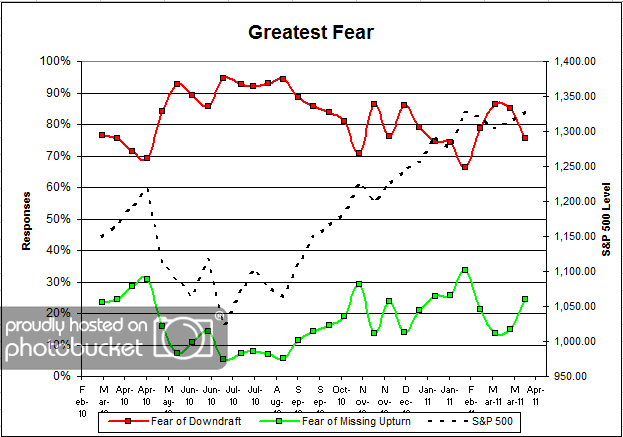
greatestfear 33 Dorsey, Wright Client Sentiment Survey Results   7/15/11

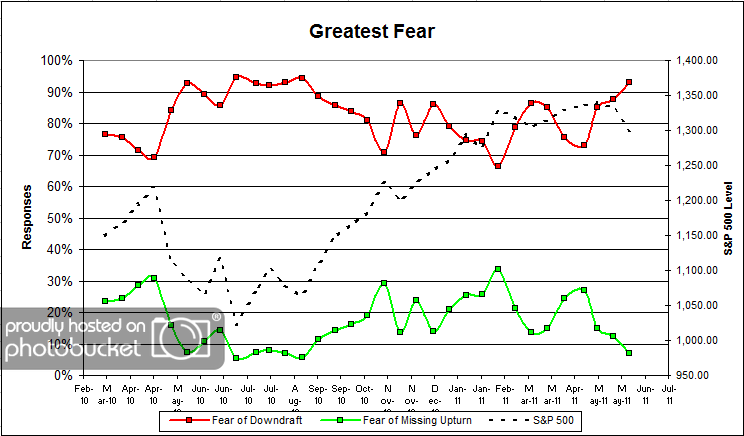
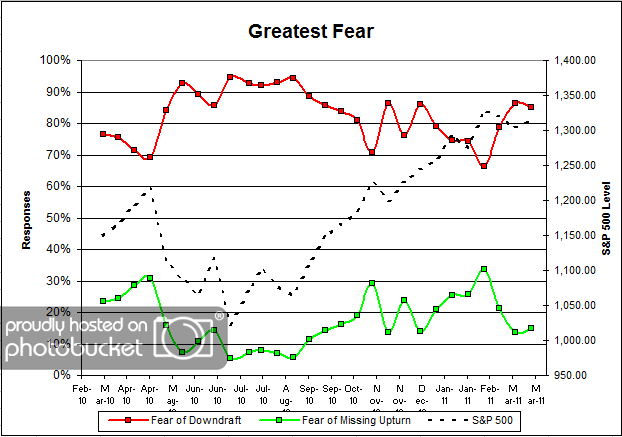
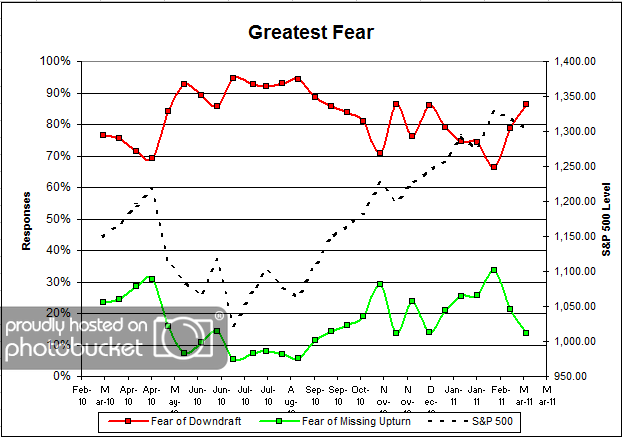
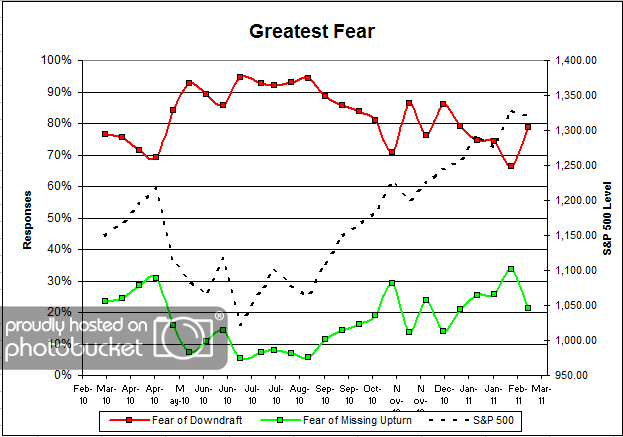
Chart 1: Greatest Fear. From survey to survey, the S&P fell -1.7%, but client fear levels managed to inch lower. Usually on any down move, we’ll see an uptick in client fear. It seems like the rally from two surveys ago (+5%) has left most clients with enough positivity to push fear levels lower.

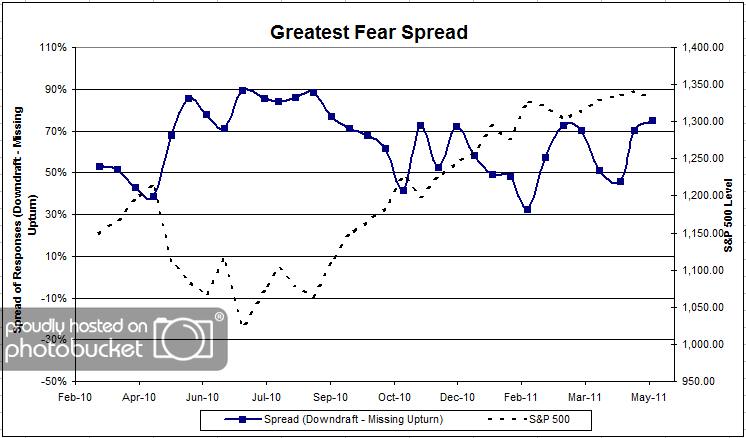
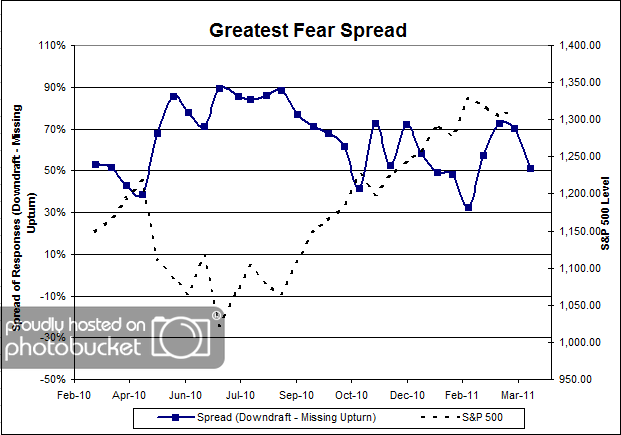
greatestfearspread 35 Dorsey, Wright Client Sentiment Survey Results   7/15/11

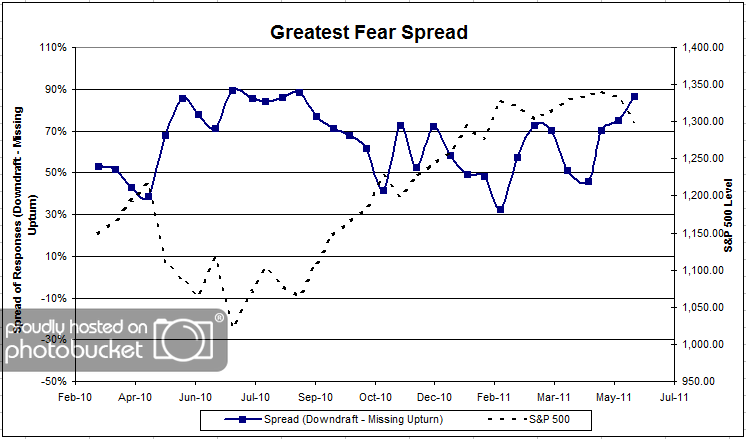
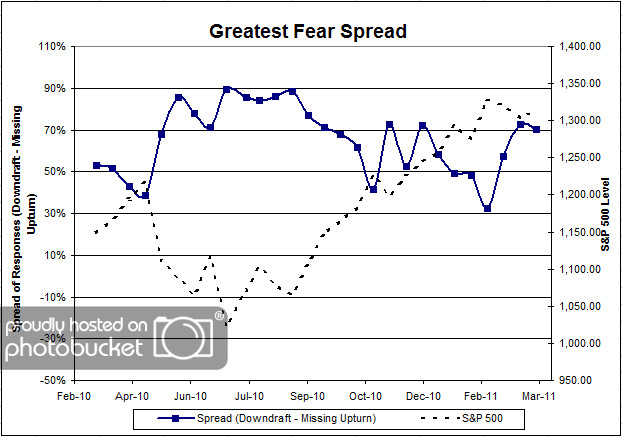
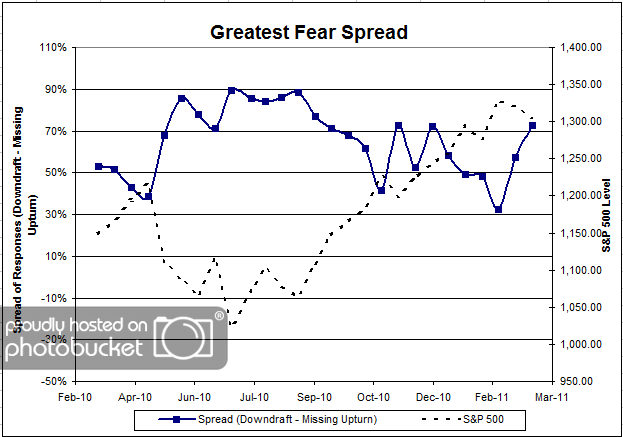
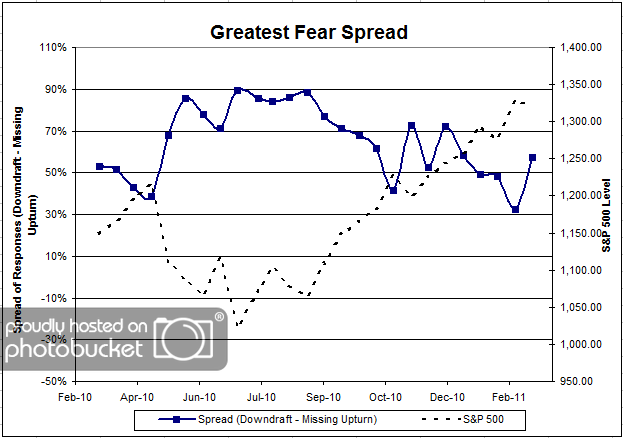
Chart 2. Greatest Fear Spread. Another way to look at this data is to examine the spread between the two groups. Like the overall fear numbers, the spread nudged lower this round from 63% to 56%.

Question 2. Based on their behavior, how would you rate your clients’ current appetite for risk?

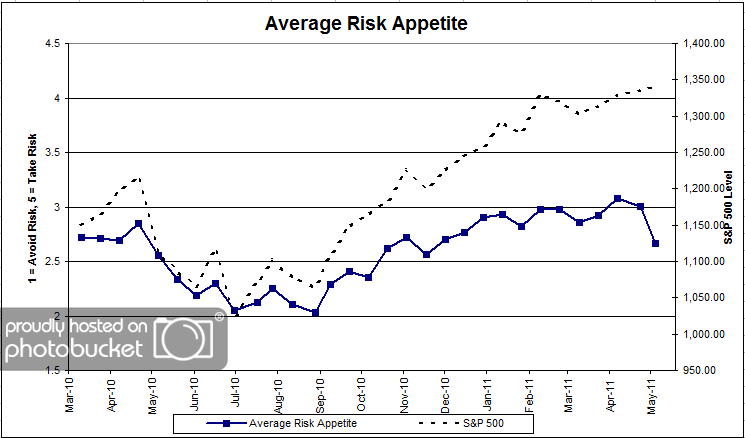
avgriskapp 26 Dorsey, Wright Client Sentiment Survey Results   7/15/11

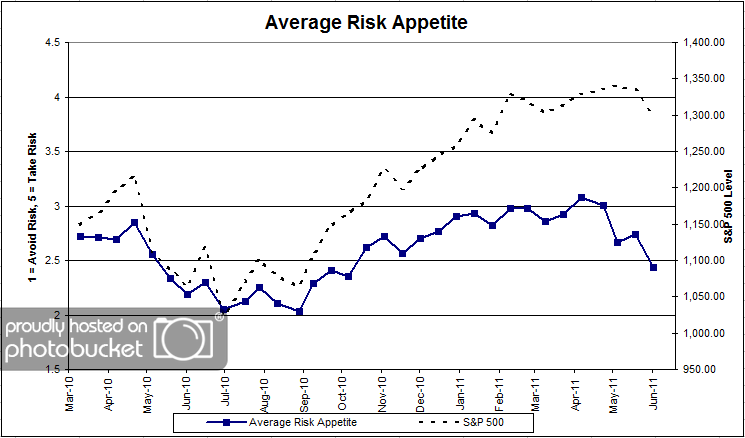
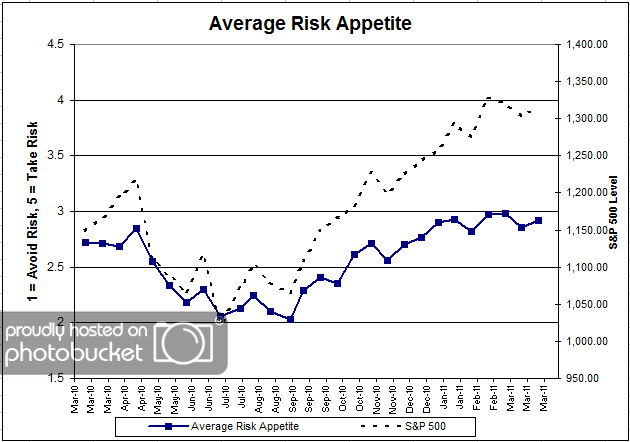
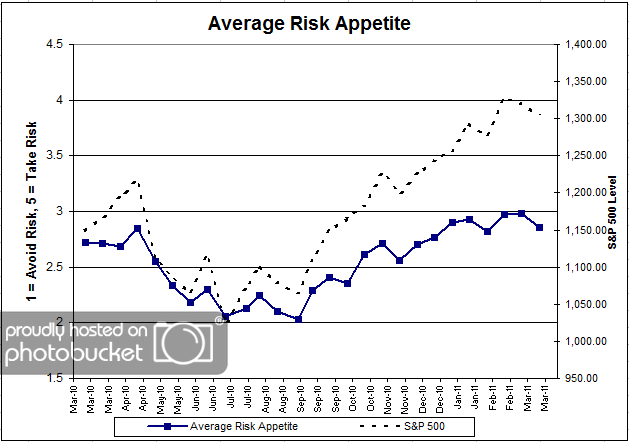
Chart 3: Average Risk Appetite. Unlike the overall fear numbers, the average risk appetite fell in-line with the market, from 2.68 to 2.42. If I had to pick just one indicator to gauge client sentiment real-time, it would have to be the overall average risk appetite number. For some reason, the overall number seems to follow our expectations nearly every survey. Following an up move, average risk goes up, and vice versa.

riskappbellcurve 21 Dorsey, Wright Client Sentiment Survey Results   7/15/11

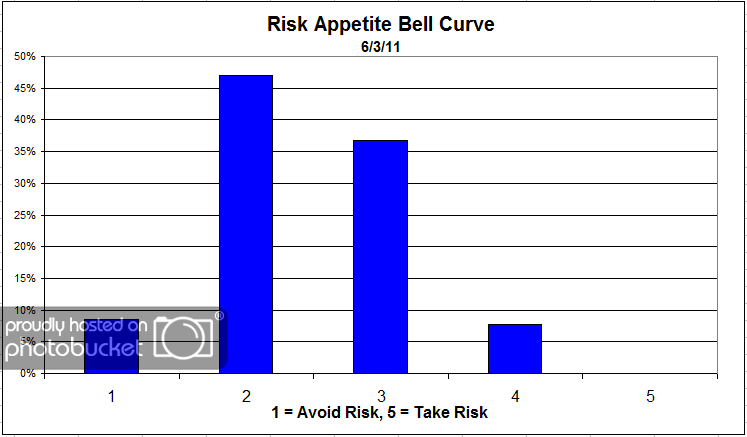
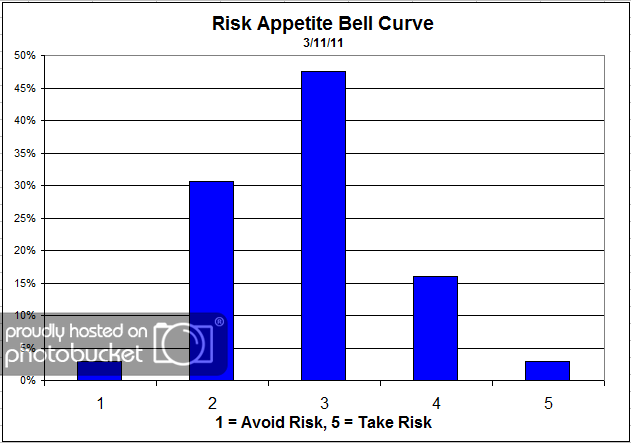
Chart 4: Risk Appetite Bell Curve. This chart uses a bell curve to break out the percentage of respondents at each risk appetite level. Fear is slowly moderating, but still in command. 2′s were the most common response this around (49%), trailed by 3′s (37%).

riskappbellcurvegrouppp Dorsey, Wright Client Sentiment Survey Results   7/15/11

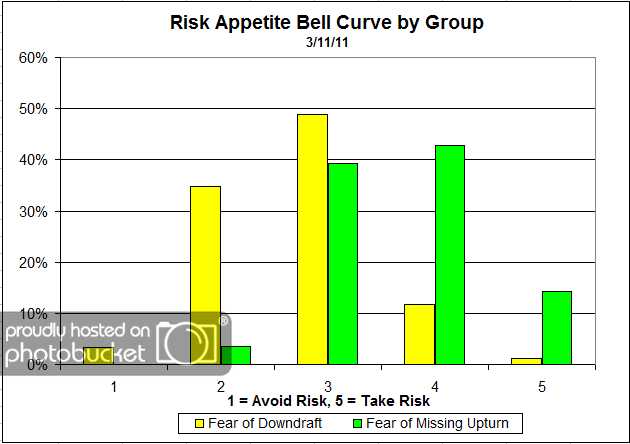
Chart 5: Risk Appetite Bell Curve by Group. The next three charts use cross-sectional data. This chart plots the reported client risk appetite separately for the fear of downdraft and for the fear of missing upturn groups. This chart also sorts out pretty much as expected, with the fear group wanting less risk and the opportunity group wanting more. Note there are zero responses with a risk appetite of 5.

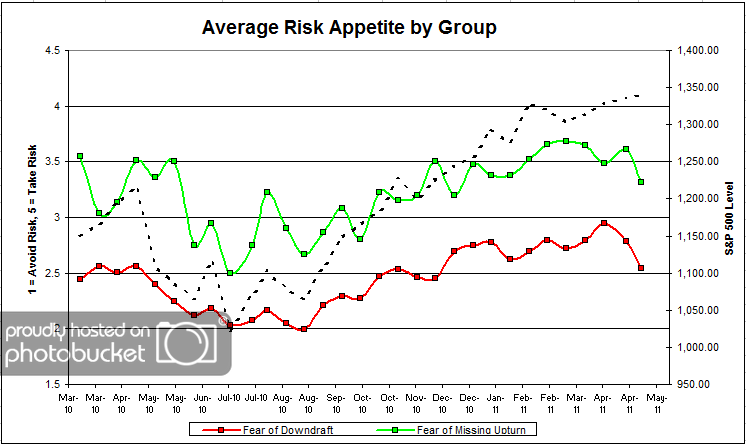
avgriskappgroup 17 Dorsey, Wright Client Sentiment Survey Results   7/15/11

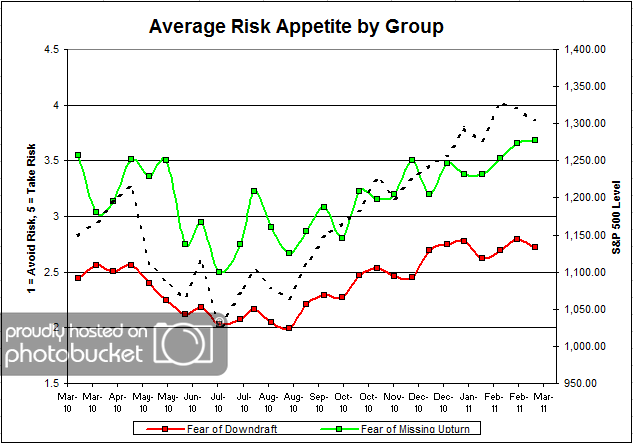
Chart 6: Average Risk Appetite by Group. A typical result this week (and the exact opposite of last week): investors fearful of a downturn had a lower risk appetite, while investors fearing missing an upturn increased their risk appetite. The opportunity investors seem ready to add risk despite a minor pullback.

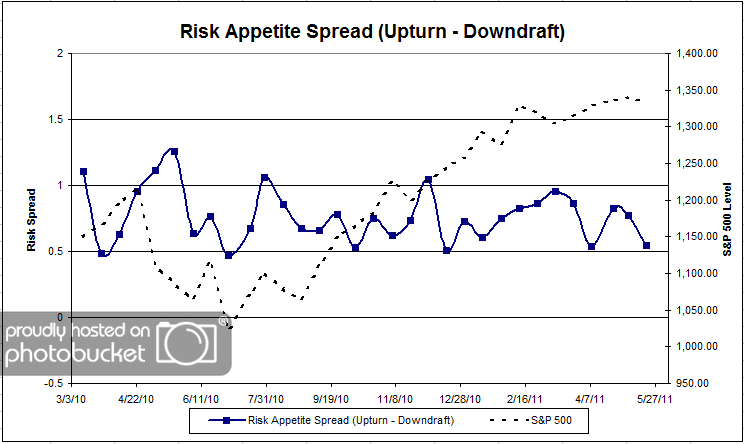
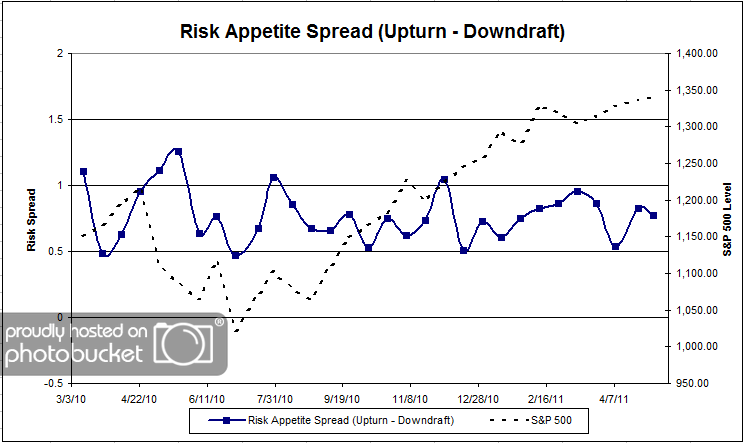
riskappspreaddd Dorsey, Wright Client Sentiment Survey Results   7/15/11

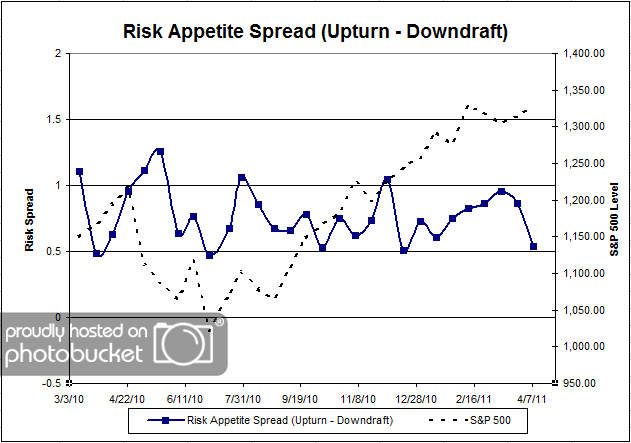
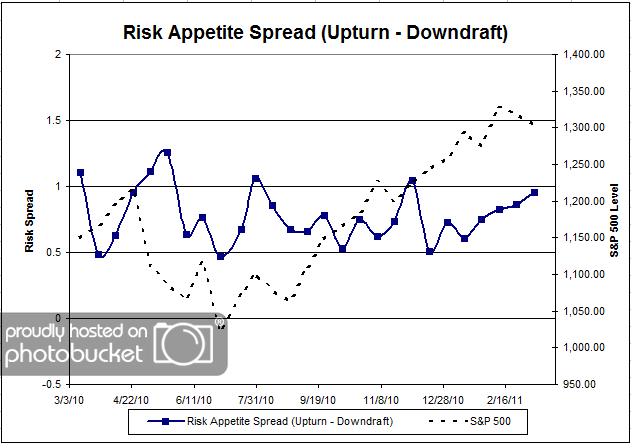
Chart 7: Risk Appetite Spread. This is a spread chart constructed from the data in Chart 6, where the average risk appetite of the downdraft group is subtracted from the average risk appetite of the missing upturn group. The spread shot right back up on the market downswing, after falling last round.

This survey round presents a few anomalies. First, the overall fear numbers did the opposite of what we would expect in a falling market. We saw a continued drop in fear levels, despite a market pullback. I’d guess that move could be explained as a follow-through from the survey before, when we saw fear levels plummet on a +5% market move. On the other hand, we saw average risk appetite move in-line with the market, falling as the market dropped. The overall average risk appetite numbers continue to perform the most consistently through the week-to-week market noise.

No one can predict the future, as we all know, so instead of prognosticating, we will sit back and enjoy the ride. A rigorously tested, systematic investment process provides a great deal of comfort for clients during these types of fearful, highly uncertain market environments. Until next time, good trading and thank you for participating.

Posted by:


Dorsey, Wright Client Sentiment Survey - 7/15/11

July 15, 2011

Here we have the next round of the Dorsey, Wright Sentiment Survey, the first third-party sentiment poll. Participate to learn more about our Dorsey, Wright Polo Shirt raffle! Just follow the instructions after taking the poll, and we’ll enter you in the contest. Thanks to all our participants from last round.

As you know, when individuals self-report, they are always taller and more beautiful than when outside observers report their perceptions! Instead of asking individual investors to self-report whether they are bullish or bearish, we’d like financial advisors to weigh in and report on the actual behavior of clients. It’s two simple questions and will take no more than 20 seconds of your time. We’ll construct indicators from the data and report the results regularly on our blog–but we need your help to get a large statistical sample!

Click here to take Dorsey, Wright’s Client Sentiment Survey.

Contribute to the greater good! It’s painless, we promise.

Posted by:


Dorsey, Wright Client Sentiment Survey Results-7/1/2011

July 11, 2011

Our latest sentiment survey was open from 7/1/11 to 7/8/11. The Dorsey, Wright Polo Shirt Raffle continues to drive advisor participation, and we greatly appreciate your support! This round, we had 98 advisors participate in the survey. If you believe, as we do, that markets are driven by supply and demand, client behavior is important. We’re not asking what you think of the market—since most of our blog readers are financial advisors, we’re asking instead about the behavior of your clients. Then we’re aggregating responses exclusively for our readership. Your privacy will not be compromised in any way.

After the first 30 or so responses, the established pattern was simply magnified, so we are comfortable about the statistical validity of our sample. Most of the responses were from the U.S., but we also had multiple advisors respond from at least four other countries. Let’s get down to an analysis of the data! Note: You can click on any of the charts to enlarge them.

Question 1. Based on their behavior, are your clients currently more afraid of: a) getting caught in a stock market downdraft, or b) missing a stock market upturn?

greatestfear 32 Dorsey, Wright Client Sentiment Survey Results  7/1/2011

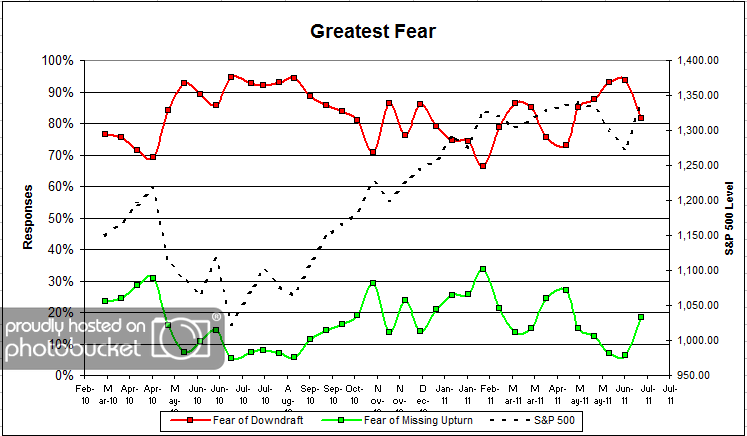
Chart 1: Greatest Fear. From survey to survey, the S&P was up 5.3%, and client fear levels ticked lower from 94% to 82%. Although fear is still at a relatively high level given how well the market has done over the past year, the recent bounce in the market has caused clients to be a little less worried.

When the market hit fear levels in the mid-90s last summer, the market had a very good following year. We can only hope that history will repeat itself!

greatestfearspread 34 Dorsey, Wright Client Sentiment Survey Results  7/1/2011

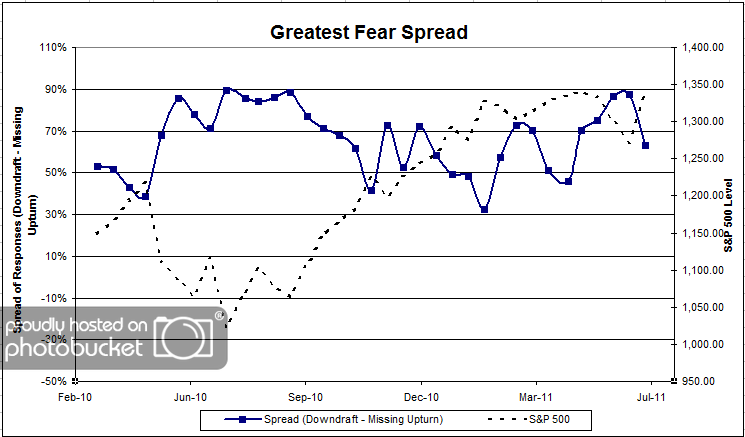
Chart 2. Greatest Fear Spread. Another way to look at this data is to examine the spread between the two groups. The spread dropped dramatically, from 88% to 63% this round.

Question 2. Based on their behavior, how would you rate your clients’ current appetite for risk?

averageriskapp 4 Dorsey, Wright Client Sentiment Survey Results  7/1/2011

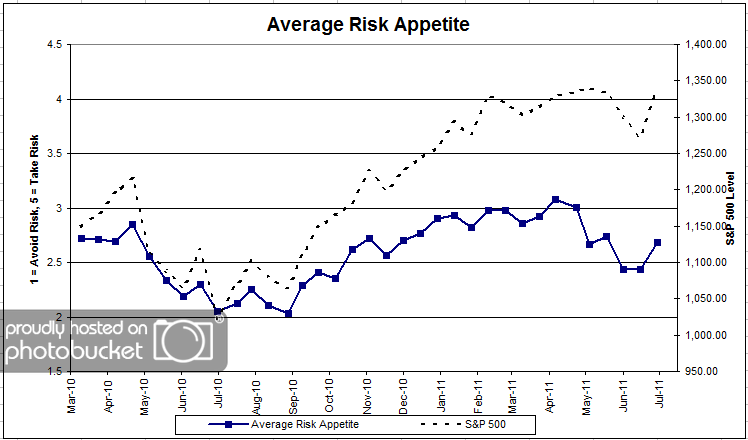
Chart 3: Average Risk Appetite. Average risk moved higher from survey to survey, from 2.44 to 2.68. Clients normally respond to recent activity in the market, and since the market was up over 5% since the last survey, the increase in risk appetite is not a big surprise. One positive: clients did not go off the deep end this summer during the correction like they did last summer. Last year, average risk appetite dropped as low as 2.03 during the worst client pessimism. This summer it reached only 2.44.

riskappbellcurve 20 Dorsey, Wright Client Sentiment Survey Results  7/1/2011

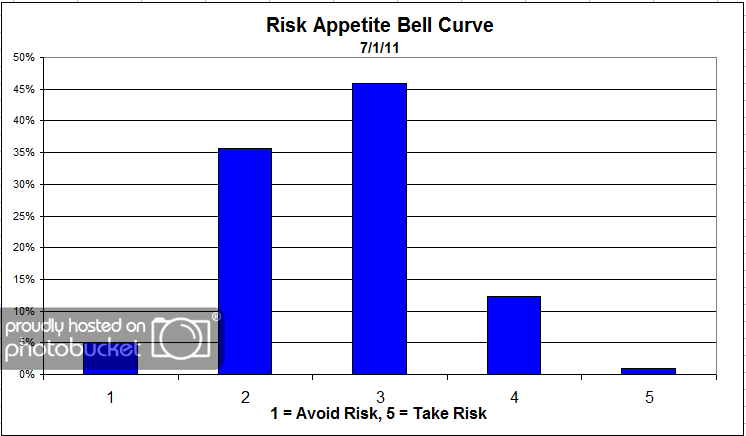
Chart 4: Risk Appetite Bell Curve. This chart uses a bell curve to break out the percentage of respondents at each risk appetite level. Fear is slowly moderating. The central tendency is a risk appetite of 3, but there are still many more 2s (a robust 36%) than 4s (only 12%).

riskbellcurvegroup 1 Dorsey, Wright Client Sentiment Survey Results  7/1/2011

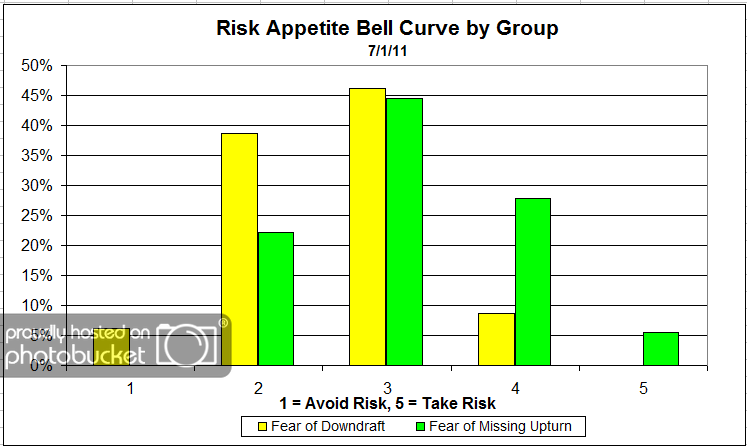
Chart 5: Risk Appetite Bell Curve by Group. The next three charts use cross-sectional data. This chart plots the reported client risk appetite separately for the fear of downdraft and for the fear of missing upturn groups. This chart also sorts out pretty much as expected, with the fear group wanting less risk and the opportunity group wanting more.

avgriskgroup 4 Dorsey, Wright Client Sentiment Survey Results  7/1/2011

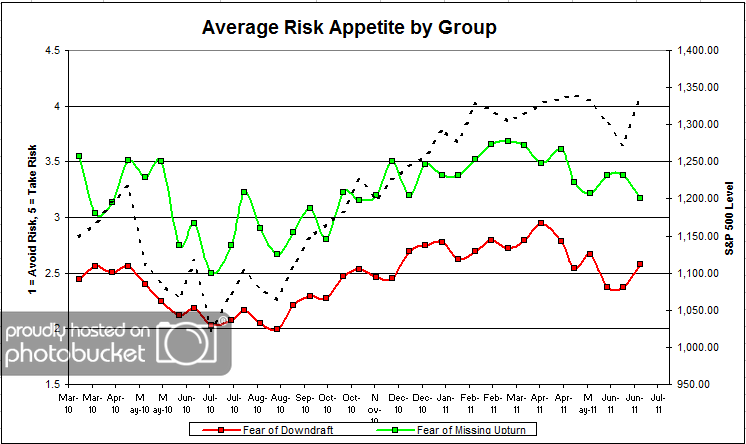
Chart 6: Average Risk Appetite by Group. An interesting result this week: investors fearful of missing an upturn had a lower risk appetite, while investors fearing a downturn increased their risk appetite. Fearful investors seem to have some concern about the market getting away from them on the upside.

riskappspread 26 Dorsey, Wright Client Sentiment Survey Results  7/1/2011

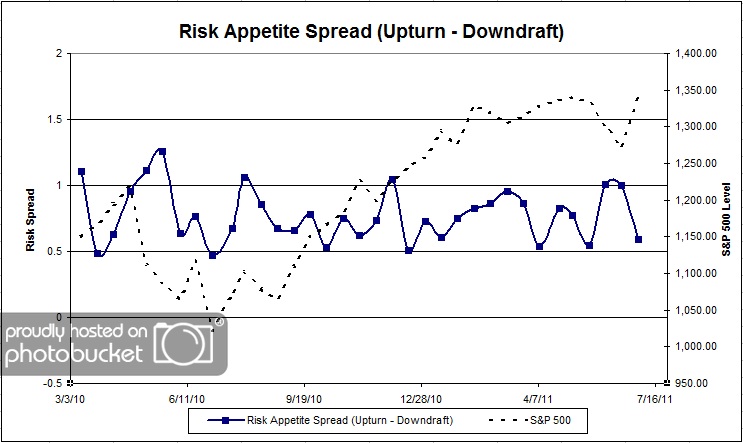
Chart 7: Risk Appetite Spread. This is a spread chart constructed from the data in Chart 6, where the average risk appetite of the downdraft group is subtracted from the average risk appetite of the missing upturn group. The spread took a pronounced drop this week, although it’s still in the 0.5 to 1.0 range where it has stayed most of the past couple of years.

Although fear continues to dominate sentiment, we got a tick up in risk appetite this survey for the first time in a number of weeks. It will be interesting to see if clients respond to the news environment around the budget compromise or if they stay primarily responsive to the market as they have in the past.

No one can predict the future, as we all know, so instead of prognosticating, we will sit back and enjoy the ride. A rigorously tested, systematic investment process provides a great deal of comfort for clients during these types of fearful, highly uncertain market environments. Until next time, good trading and thank you for participating.


Posted by:


Chart of the Day: Sentiment and Market Rallies

July 5, 2011

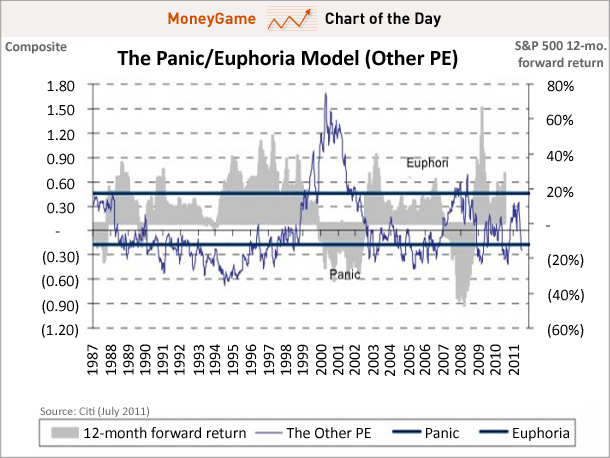
Clusterstock posted a great chart today, courtesy of Tobias Levkovich at Citi. What we’re looking at is a proprietary measure of market sentiment, coupled with a forward-looking market return of 12 months. Despite a major market rally, investors are still freaked out!! And, going by the looks of this chart, and our more-limited survey data, this could bode well for the market in the coming year.

Again we ask…how long will the market rally before investors feel confident enough to jump on board? Only time will tell.

chart of the day paniceuphoria model july 2011 Chart of the Day: Sentiment and Market Rallies

Panic/Euphoria...time to rally?

(click to enlarge)

Posted by:


Dorsey, Wright Client Sentiment Survey - 7/1/11

July 1, 2011

Here we have the next round of the Dorsey, Wright Sentiment Survey, the first third-party sentiment poll. Participate to learn more about our Dorsey, Wright Polo Shirt raffle! Just follow the instructions after taking the poll, and we’ll enter you in the contest. Thanks to all our participants from last round.

As you know, when individuals self-report, they are always taller and more beautiful than when outside observers report their perceptions! Instead of asking individual investors to self-report whether they are bullish or bearish, we’d like financial advisors to weigh in and report on the actual behavior of clients. It’s two simple questions and will take no more than 20 seconds of your time. We’ll construct indicators from the data and report the results regularly on our blog–but we need your help to get a large statistical sample!

Click here to take Dorsey, Wright’s Client Sentiment Survey.

Contribute to the greater good! It’s painless, we promise.


Posted by:


Dorsey, Wright Client Sentiment Survey Results - 6/17/11

June 27, 2011

Our latest sentiment survey was open from 6/17/11 to 6/24/11. The Dorsey, Wright Polo Shirt Raffle continues to drive advisor participation, and we greatly appreciate your support! This round, we had 128 advisors participate in the survey. If you believe, as we do, that markets are driven by supply and demand, client behavior is important. We’re not asking what you think of the market—since most of our blog readers are financial advisors, we’re asking instead about the behavior of your clients. Then we’re aggregating responses exclusively for our readership. Your privacy will not be compromised in any way.

After the first 30 or so responses, the established pattern was simply magnified, so we are comfortable about the statistical validity of our sample. Most of the responses were from the U.S., but we also had multiple advisors respond from at least four other countries. Let’s get down to an analysis of the data! Note: You can click on any of the charts to enlarge them.

Question 1. Based on their behavior, are your clients currently more afraid of: a) getting caught in a stock market downdraft, or b) missing a stock market upturn?

greatestfear 31 Dorsey, Wright Client Sentiment Survey Results   6/17/11

Chart 1: Greatest Fear. From survey to survey, the S&P was down -2.2%, and client fear levels ticked higher from 93% to 94%. Right now, the market is down -5% from its recent May highs, and 94% of investors are afraid of losing money in the market. As we continue to point out, the S&P is up nearly 25% in less than a year, but client sentiment continues to be dominated by fear.

In addition, since hitting fear levels in the mid-90s last summer, the market is up +25%. We can only hope that history repeats itself here.

greatestfearspread 33 Dorsey, Wright Client Sentiment Survey Results   6/17/11

Chart 2. Greatest Fear Spread. Another way to look at this data is to examine the spread between the two groups. The spread nudged higher, from 86% to 88% this round.

Question 2. Based on their behavior, how would you rate your clients’ current appetite for risk?

avgriskapp 25 Dorsey, Wright Client Sentiment Survey Results   6/17/11

Chart 3: Average Risk Appetite. Average risk remained the same from survey to survey, sticking at 2.44. Last survey we saw a huge drop in average risk appetite, as the market fell. This round, despite a similar move of -2%, average risk appetite seems to have found its footing. We’ve still got a ways to go until we reach our all-time lows from September 2010.

riskappbellcurve 19 Dorsey, Wright Client Sentiment Survey Results   6/17/11

Chart 4: Risk Appetite Bell Curve. This chart uses a bell curve to break out the percentage of respondents at each risk appetite level. Here we see more evidence of a fear-dominated atmosphere. There was only one wayward 5, and nearly half of all respondents wanted a risk appetite of 2.

riskappbellcurvegrp 2 Dorsey, Wright Client Sentiment Survey Results   6/17/11

Chart 5: Risk Appetite Bell Curve by Group. The next three charts use cross-sectional data. This chart plots the reported client risk appetite separately for the fear of downdraft and for the fear of missing upturn groups. This chart also sorts out pretty much as expected, with the fear group wanting less risk and the opportunity group wanting more. You can see the sole 5, which came from the fear group…probably a troll answer.

avgriskappgroup 16 Dorsey, Wright Client Sentiment Survey Results   6/17/11

Chart 6: Average Risk Appetite by Group. Here we see both groups’ average risk appetite remain basically the same. Same as the overall average risk appetite, the risk by group numbers sort out even from last survey’s results. It may be that the initial plunge in risk appetite from two weeks ago was large enough to buffer any additional market downside. Despite another move lower in the market, average risk stayed the same in both camps.

riskappspread 25 Dorsey, Wright Client Sentiment Survey Results   6/17/11

Chart 7: Risk Appetite Spread. This is a spread chart constructed from the data in Chart 6, where the average risk appetite of the downdraft group is subtracted from the average risk appetite of the missing upturn group. Same as average risk, the spread for average risk stayed the same.

This round, fear continues to dominate investor sentiment, as we have now had a total of three surveys (6 weeks) of down moves in the market. All of our indicators are pointing towards heightened levels of fear, with an eye towards perceived safety (and lowered risk appetite). What’s interesting about this survey’s numbers is that the market fell by the same degree as last round, but both fear levels and average risk remained mostly the same. It seems as though investors are now in “hunker down” mode, and it’s anyone guess as to whether clients will become even more bearish (they can, if the market continues to go down).

No one can predict the future, as we all know, so instead of prognosticating, we will sit back and enjoy the ride. A rigorously tested, systematic investment process provides a great deal of comfort for clients during these types of fearful, highly uncertain market environments. Until next time, good trading and thank you for participating.


Posted by:


Dorsey, Wright Client Sentiment Survey - 6/17/11

June 17, 2011

Here we have the next round of the Dorsey, Wright Sentiment Survey, the first third-party sentiment poll. Participate to learn more about our Dorsey, Wright Polo Shirt raffle! Just follow the instructions after taking the poll, and we’ll enter you in the contest. Thanks to all our participants from last round.

As you know, when individuals self-report, they are always taller and more beautiful than when outside observers report their perceptions! Instead of asking individual investors to self-report whether they are bullish or bearish, we’d like financial advisors to weigh in and report on the actual behavior of clients. It’s two simple questions and will take no more than 20 seconds of your time. We’ll construct indicators from the data and report the results regularly on our blog–but we need your help to get a large statistical sample!

Click here to take Dorsey, Wright’s Client Sentiment Survey.

Contribute to the greater good! It’s painless, we promise.


Posted by:


Dorsey, Wright Client Sentiment Survey Results - 6/3/11

June 13, 2011

Our latest sentiment survey was open from 6/3/11 to 6/10/11. The Dorsey, Wright Polo Shirt Raffle is back once again, due to popular demand. Thank you to all who continue to participate. This round, we had 117 advisors participate in the survey. If you believe, as we do, that markets are driven by supply and demand, client behavior is important. We’re not asking what you think of the market—since most of our blog readers are financial advisors, we’re asking instead about the behavior of your clients. Then we’re aggregating responses exclusively for our readership. Your privacy will not be compromised in any way.

After the first 30 or so responses, the established pattern was simply magnified, so we are comfortable about the statistical validity of our sample. Most of the responses were from the U.S., but we also had multiple advisors respond from at least five other countries. Let’s get down to an analysis of the data! Note: You can click on any of the charts to enlarge them.

Question 1. Based on their behavior, are your clients currently more afraid of: a) getting caught in a stock market downdraft, or b) missing a stock market upturn?

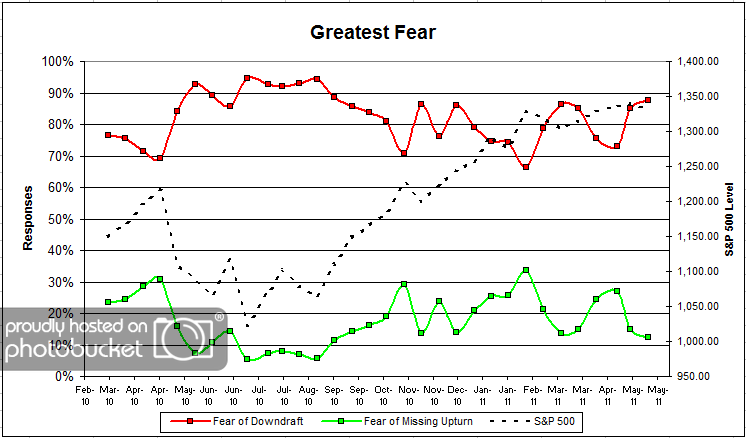
greatestfear 30 Dorsey, Wright Client Sentiment Survey Results   6/3/11

Chart 1: Greatest Fear. From survey to survey, the S&P was down -2.5%, and client fear levels rose to 93%. Client fear levels are now at the highest levels we’ve seen since August of 2010. Historically, retail investors have a terrible track record at timing the market (see DALBAR), so we would be inclined to take a contrarian position given these sentiment numbers.

Keep in mind that since the all-time fear highs of July 2010 (at 94%), the stock market has rallied +27%.

greatestfearspread 32 Dorsey, Wright Client Sentiment Survey Results   6/3/11

Chart 2. Greatest Fear Spread. Another way to look at this data is to examine the spread between the two groups. The spread rocketed higher this round from 75% to 86%.

Question 2. Based on their behavior, how would you rate your clients’ current appetite for risk?

avgriskapp 24 Dorsey, Wright Client Sentiment Survey Results   6/3/11

Chart 3: Average Risk Appetite. Average risk fell dramatically this round, from 2.73 to 2.44. After finally clearing an overall average of 3 earlier this year, average risk appetite is down big on the year. We’ve still got a ways to go until we reach our all-time lows from September 2010.

riskappbellcurve 18 Dorsey, Wright Client Sentiment Survey Results   6/3/11

Chart 4: Risk Appetite Bell Curve. This chart uses a bell curve to break out the percentage of respondents at each risk appetite level. Here we see more evidence of a fear-dominated atmosphere. There were zero 5′s, and nearly half of all respondents were looking for a risk appetite of 2.

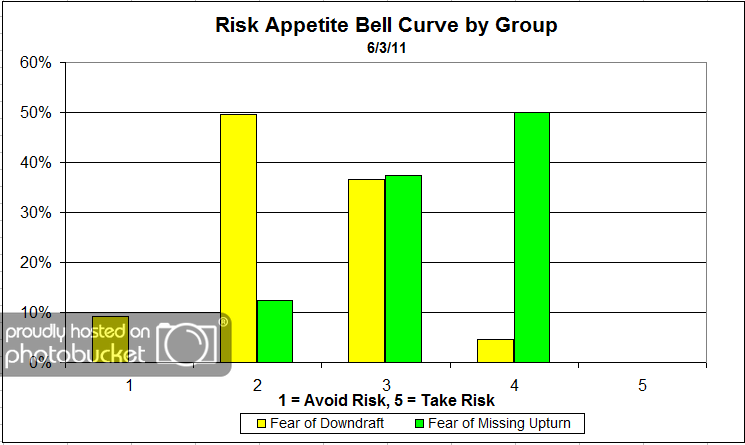
avgriskbellcurvgrp Dorsey, Wright Client Sentiment Survey Results   6/3/11

Chart 5: Risk Appetite Bell Curve by Group. The next three charts use cross-sectional data. This chart plots the reported client risk appetite separately for the fear of downdraft and for the fear of missing upturn groups. This chart also sorts out pretty much as expected, with the fear group wanting less risk and the opportunity group wanting more. When the fear levels become as extended as they are now, it creates a few problems with the average risk by group number. Namely, there are so few respondents in the opportunity group, we begin to lose the smoothing effect of having a large number of participants.

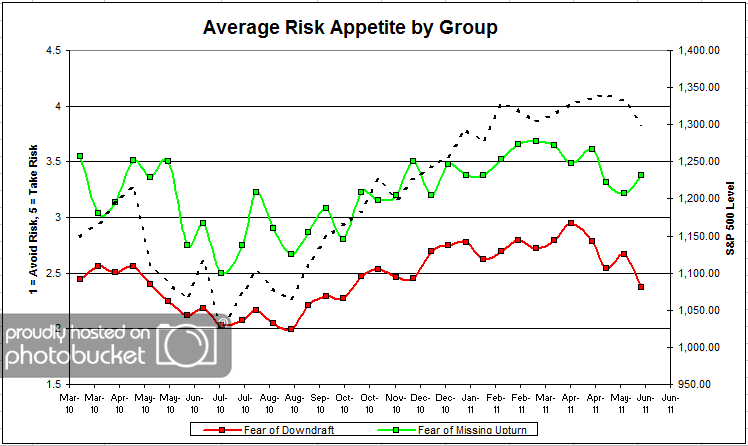
avgriskappgroup 15 Dorsey, Wright Client Sentiment Survey Results   6/3/11

Chart 6: Average Risk Appetite by Group. Here we see the fear group’s risk appetite plunge, while the opportunity group’s appetite actually rises. Earlier I mentioned that because there are so few respondents in the opportunity group, it has less statistical validity because we lose the smoothing effect of having a large number of responses. I’d wager that the number bounced so much on account of the number of participants, rather than that group actually wanting to add risk that badly.

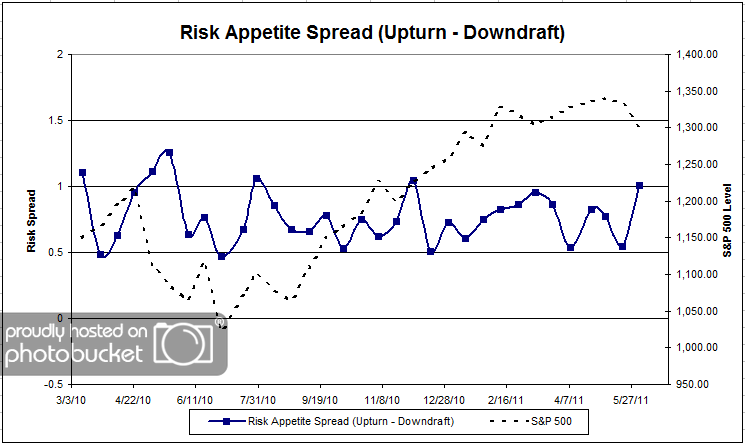
riskappspread 24 Dorsey, Wright Client Sentiment Survey Results   6/3/11

Chart 7: Risk Appetite Spread. This is a spread chart constructed from the data in Chart 6, where the average risk appetite of the downdraft group is subtracted from the average risk appetite of the missing upturn group. The spread jumped this round, due to a move in the opposite direction for both groups.

This round, we hit fear levels that we haven’t seen since August of 2010. On one hand, that’s a bad thing because clients are scared and probably less willing to allocate to anything except “super-safe” investments like bonds and cash. On the other hand, some studies have shown that it might be profitable to add money during the times when retail investors are the most freaked out. For example the market has rallied nearly 30% since fear levels were hovering in the mid-90s in the summer of 2010.

No one can predict the future, as we all know, so instead of prognosticating, we will sit back and enjoy the ride. A rigorously tested, systematic investment process provides a great deal of comfort for clients during these types of fearful, highly uncertain market environments. Until next time, good trading and thank you for participating.

Posted by:


Dorsey, Wright Client Sentiment Survey Results - 5/20/11

May 31, 2011

Our latest sentiment survey was open from 5/20/11 to 5/27/11. The Dorsey, Wright Polo Shirt raffle was a huge success! The winning advisor will receive an email today. Thanks to everyone who participated. This round, we had 117 advisors participate in the survey. If you believe, as we do, that markets are driven by supply and demand, client behavior is important. We’re not asking what you think of the market—since most of our blog readers are financial advisors, we’re asking instead about the behavior of your clients. Then we’re aggregating responses exclusively for our readership. Your privacy will not be compromised in any way.

After the first 30 or so responses, the established pattern was simply magnified, so we are comfortable about the statistical validity of our sample. Most of the responses were from the U.S., but we also had multiple advisors respond from at least five other countries. Let’s get down to an analysis of the data! Note: You can click on any of the charts to enlarge them.

Question 1. Based on their behavior, are your clients currently more afraid of: a) getting caught in a stock market downdraft, or b) missing a stock market upturn?

 Dorsey, Wright Client Sentiment Survey Results   5/20/11

Chart 1: Greatest Fear. From survey to survey, the S&P was down fractionally (-0.5%). Client fear levels nudged higher from 85% to 88%, which is what we would expect to see. On the other side, the missing opportunity group fell from 15% to 12%.

Considering how big the fear move was the round before, we expected to see these type of numbers. Despite the S&P’s 2-year performance track record (hint: it’s up nearly +30% since June of 2010), client fear levels hover near 90% on a measly -2% pullback from survey to survey. Andy’s weekly “Fund Flows” posts also back this up, with client assets still flooding into taxable bond funds (fear).

 Dorsey, Wright Client Sentiment Survey Results   5/20/11

Chart 2. Greatest Fear Spread. Another way to look at this data is to examine the spread between the two groups. The spread edged higher this round from 70% to 75%.

Question 2. Based on their behavior, how would you rate your clients’ current appetite for risk?

 Dorsey, Wright Client Sentiment Survey Results   5/20/11

Chart 3: Average Risk Appetite. Average risk appetite bounced slightly this round, from 2.66 to 2.73. We saw a significant decline in client risk appetite last round, despite the market moving higher. This could be a case of minor mean reversion, as clients settle into a new risk profile in light of the big, bad scary pullback. We’re still well off the recent all-time risk appetite highs.

 Dorsey, Wright Client Sentiment Survey Results   5/20/11

Chart 4: Risk Appetite Bell Curve. This chart uses a bell curve to break out the percentage of respondents at each risk appetite level. Here we see the majority of clients are looking for moderate to less risk, as evidenced by the large percentage of 2′s and 3′s.

 Dorsey, Wright Client Sentiment Survey Results   5/20/11

Chart 5: Risk Appetite Bell Curve by Group. The next three charts use cross-sectional data. This chart plots the reported client risk appetite separately for the fear of downdraft and for the fear of missing upturn groups. We had a few outliers in the fear camp who were looking for a risk appetite of 5. Are those mis-clicks or trolling on the part of survey takers? Because there was more than just 1 respondent doing that, I’m going to guess that there are people who are afraid of losing money, but also want a risk appetite of 5. Other than those few participants, the rest of the bell curve sorts out normally, with the fear group wanting less risk and the opportunity group wanting more risk.

 Dorsey, Wright Client Sentiment Survey Results   5/20/11

Chart 6: Average Risk Appetite by Group. Here we can see that the overall risk appetite number’s bounce probably came from the fear group, which jumped from 2.54 to 2.66. The opportunity group’s risk fell, which is what we expect to see when the market falls. This particular chart has a history of being more volatile than the others, and also bucking the usual trend.

 Dorsey, Wright Client Sentiment Survey Results   5/20/11

Chart 7: Risk Appetite Spread. This is a spread chart constructed from the data in Chart 6, where the average risk appetite of the downdraft group is subtracted from the average risk appetite of the missing upturn group. The spread fell moderately this round but seems to be sticking within a fairly stable range.

This round, the market fell fractionally from survey to survey, and fear levels continued to rise. The S&P 500 is up around 30% in less than a year, but still almost 90% of clients are more afraid of losing money than missing a rally. As we see in the weekly Fund Flows post by Andy, clients are still in total fear and safety mode, adding assets to taxable bond funds at a rate of 3:1 over others. Once the market has rallied +XYZ%, we will inevitably see a huge swing towards opportunity and risk, but we aren’t there yet.

No one can predict the future, as we all know, so instead of prognosticating, we will sit back and enjoy the ride. A rigorously tested, systematic investment process provides a great deal of comfort for clients during these types of fearful, highly uncertain market environments. Until next time, good trading and thank you for participating.

Posted by:


Bullish Sentiment Freaks Out

May 26, 2011

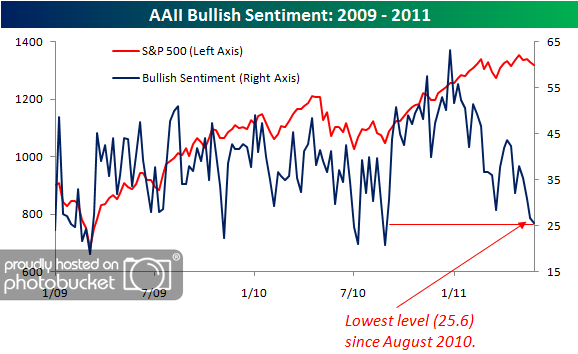
Bespoke has a nice chart today of the AAII sentiment poll, which indicates that retail investors rapidly became very bearish, even though the last correction has been very shallow.

 Bullish Sentiment Freaks Out

Source: Bespoke Investments (click to enlarge)

By the way, our own poll on investor risk appetite shows the same thing.

 Bullish Sentiment Freaks Out

Source: Dorsey, Wright Money Management (click to enlarge)

Retail investors aren’t always wrong, but if you have to bet, that’s the way to play it.

Posted by:


Dorsey, Wright Client Sentiment Survey - 5/20/11

May 20, 2011

Here we have the next round of the Dorsey, Wright Sentiment Survey, the first third-party sentiment poll. We’re also featuring a Dorsey, Wright Polo Shirt Giveaway Contest & this is your last chance to enter! Participate to learn more.

As you know, when individuals self-report, they are always taller and more beautiful than when outside observers report their perceptions! Instead of asking individual investors to self-report whether they are bullish or bearish, we’d like financial advisors to weigh in and report on the actual behavior of clients. It’s two simple questions and will take no more than 20 seconds of your time. We’ll construct indicators from the data and report the results regularly on our blog–but we need your help to get a large statistical sample!

Click here to take Dorsey, Wright’s Client Sentiment Survey.

Contribute to the greater good! It’s painless, we promise.


Posted by:


Dorsey, Wright Client Sentiment Survey - 5/6/11

May 16, 2011

Our latest sentiment survey was open from 5/6/11 to 5/13/11. The Dorsey, Wright Polo Shirt raffle continues to drive advisor participation — thank you for taking the time! Please remember, the first drawing will be held on June 1, so keep playing to increase your odds of winning. This round, we had 127 advisors participate in the survey. If you believe, as we do, that markets are driven by supply and demand, client behavior is important. We’re not asking what you think of the market—since most of our blog readers are financial advisors, we’re asking instead about the behavior of your clients. Then we’re aggregating responses exclusively for our readership. Your privacy will not be compromised in any way.

After the first 30 or so responses, the established pattern was simply magnified, so we are comfortable about the statistical validity of our sample. Most of the responses were from the U.S., but we also had multiple advisors respond from at least five other countries. Let’s get down to an analysis of the data! Note: You can click on any of the charts to enlarge them.

Question 1. Based on their behavior, are your clients currently more afraid of: a) getting caught in a stock market downdraft, or b) missing a stock market upturn?

 Dorsey, Wright Client Sentiment Survey   5/6/11

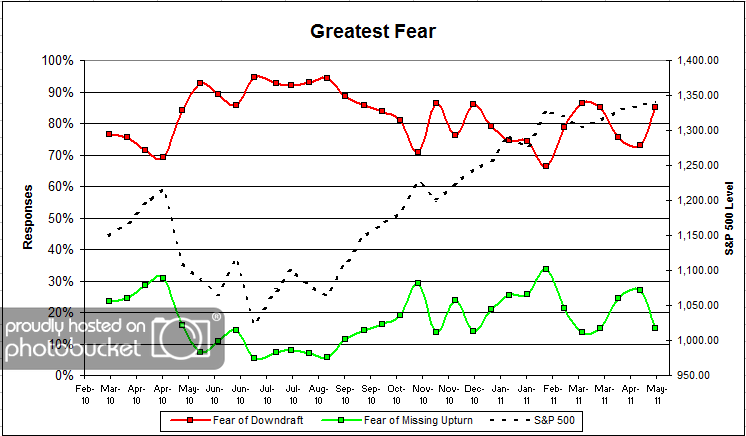
Chart 1: Greatest Fear. From survey to survey, the S&P was up fractionally (+0.3%). However, recent volatility in the broader market (especially commodities) seems to have sent client fear levels soaring. This round, client fear levels shot from 73% to 85%. On the other side, the missing opportunity group fell from 27% to 15%.

Keeping in mind that the market did fluctuate after the official date we’ve set for the survey results, client fear levels are at 85% - yet the stock market is at all-time survey highs. The S&P 500 is up over +30% since July of 2010, yet client psychology remains heavily skewed towards fear of a downdraft.

 Dorsey, Wright Client Sentiment Survey   5/6/11

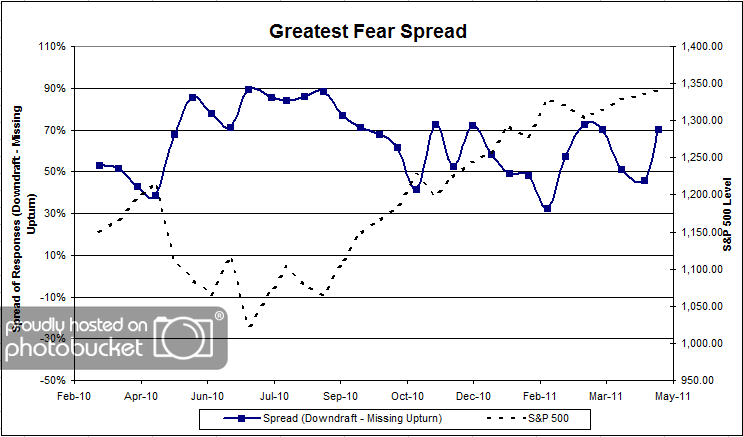
Chart 2. Greatest Fear Spread. Another way to look at this data is to examine the spread between the two groups. The spread jumped this round from 46% to 70%.

Question 2. Based on their behavior, how would you rate your clients’ current appetite for risk?

 Dorsey, Wright Client Sentiment Survey   5/6/11

Chart 3: Average Risk Appetite. Average risk plummeted this round, from 3.01 to 2.66. Here again, we see a huge disconnect between what’s happening in the market from survey to survey, versus client sentiment. The market is still up big over the medium to long term (6 months to 2 years). Why is client risk appetite stuck below 3? Only time will tell just how big of a rally it’s going to take before we see more aggressive client participation.

 Dorsey, Wright Client Sentiment Survey   5/6/11

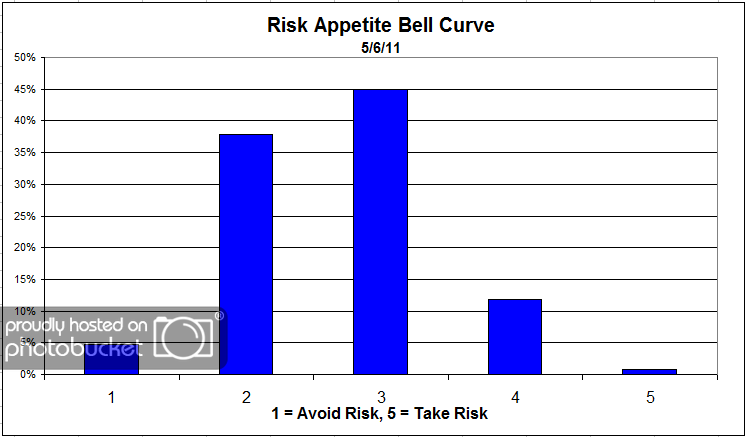
Chart 4: Risk Appetite Bell Curve. This chart uses a bell curve to break out the percentage of respondents at each risk appetite level. Here we see more evidence of fearful clients, with the majority of respondents answering 2 and 3 (over 82% of all clients, combined).

 Dorsey, Wright Client Sentiment Survey   5/6/11

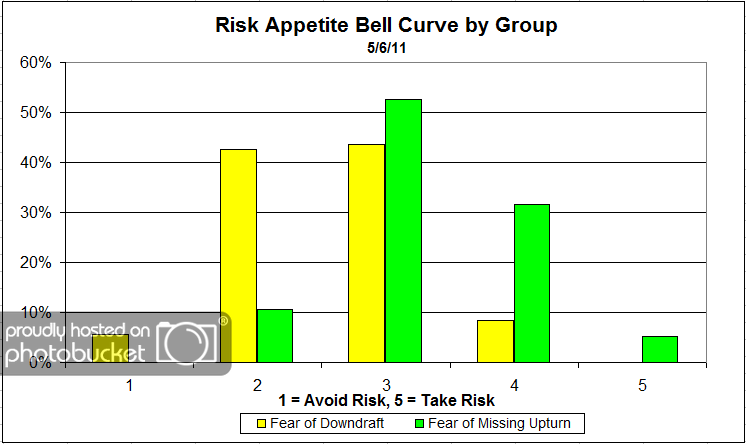
Chart 5: Risk Appetite Bell Curve by Group. The next three charts use cross-sectional data. This chart plots the reported client risk appetite separately for the fear of downdraft and for the fear of missing upturn groups. This chart sorts out perfectly, save one person in the missing upturn group who desired a risk appetite of 1. The fear group is looking for lower risk (3′s through 1′s), while the opportunity group is looking for more risk (3′s through 5′s).

 Dorsey, Wright Client Sentiment Survey   5/6/11

Chart 6: Average Risk Appetite by Group. The average risk appetite by group chart reflects what we saw in the overall risk appetite chart from above — a sharp move away from risk, in both camps. Again, from survey to survey the market is doing fine. It appears that the volatility outside the stock market-in other markets such as commodities and the US dollar— has shaken up client sentiment significantly.

 Dorsey, Wright Client Sentiment Survey   5/6/11

Chart 7: Risk Appetite Spread. This is a spread chart constructed from the data in Chart 6, where the average risk appetite of the downdraft group is subtracted from the average risk appetite of the missing upturn group. Despite big moves in the both camps, the spread remained mostly the same this round.

This round, the market rallied around +0.3% from survey to survey, but client fear levels rose significantly on market volatility. We would expect that, as the market continues to rally, fear levels subside and clients begin to add more risk. However, it’s obvious that clients are still more worried about losing money than about losing the opportunity to make money. We hyphothesize that eventually, the tide will swing in the other direction once the market has tacked on strong gains over a number of years.

No one can predict the future, as we all know, so instead of prognosticating, we will sit back and enjoy the ride. A rigorously tested, systematic investment process provides a great deal of comfort for clients during these types of fearful, highly uncertain market environments. Until next time, good trading and thank you for participating.

Posted by:


Dorsey, Wright Client Sentiment Survey - 5/6/11

May 6, 2011

Here we have the next round of the Dorsey, Wright Sentiment Survey, the first third-party sentiment poll. We’re also featuring a Dorsey, Wright Polo Shirt Giveaway Contest for the next few months. Participate to learn more.

As you know, when individuals self-report, they are always taller and more beautiful than when outside observers report their perceptions! Instead of asking individual investors to self-report whether they are bullish or bearish, we’d like financial advisors to weigh in and report on the actual behavior of clients. It’s two simple questions and will take no more than 20 seconds of your time. We’ll construct indicators from the data and report the results regularly on our blog–but we need your help to get a large statistical sample!

Click here to take Dorsey, Wright’s Client Sentiment Survey.

Contribute to the greater good! It’s painless, we promise.


Posted by:


Dorsey, Wright Client Sentiment Survey Results - 4/25/11

May 2, 2011

Our latest sentiment survey was open from 4/25/11 to 4/29/11. The Dorsey, Wright Polo Shirt raffle continues to drive advisor participation — thank you for taking the time! Please remember, the first drawing will be held on June 1, so keep playing to increase your odds of winning. This round, we had 133 advisors participate in the survey. If you believe, as we do, that markets are driven by supply and demand, client behavior is important. We’re not asking what you think of the market—since most of our blog readers are financial advisors, we’re asking instead about the behavior of your clients. Then we’re aggregating responses exclusively for our readership. Your privacy will not be compromised in any way.

After the first 30 or so responses, the established pattern was simply magnified, so we are comfortable about the statistical validity of our sample. Most of the responses were from the U.S., but we also had multiple advisors respond from at least five other countries. Let’s get down to an analysis of the data! Note: You can click on any of the charts to enlarge them.

Question 1. Based on their behavior, are your clients currently more afraid of: a) getting caught in a stock market downdraft, or b) missing a stock market upturn?

 Dorsey, Wright Client Sentiment Survey Results   4/25/11

Chart 1: Greatest Fear. From survey to survey, the S&P rallied around +0.5%, not that much. Client fear levels dropped from 76% to 73%, also not that much. On the other side, we see the fear of missed opportunity group rise from 24% to 27%.

Nothing much to say here. We saw the market rally barely, and client fear levels drop by around the same. Once again, it’s great to see the indicators performing as we hypothesized they would.
 Dorsey, Wright Client Sentiment Survey Results   4/25/11

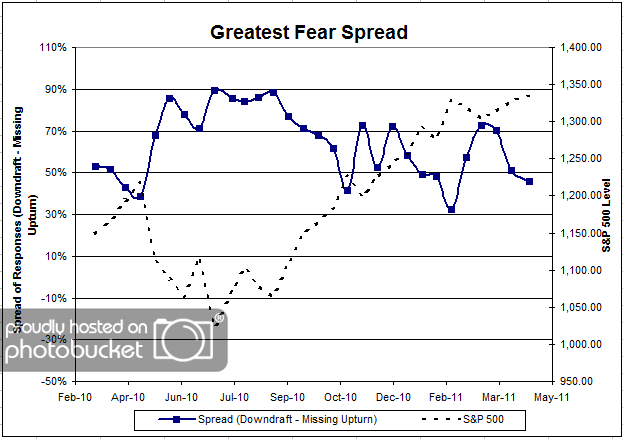
Chart 2. Greatest Fear Spread. Another way to look at this data is to examine the spread between the two groups. The spread also remained fairly stable, dropping from 51% to 46%.

Question 2. Based on their behavior, how would you rate your clients’ current appetite for risk?
 Dorsey, Wright Client Sentiment Survey Results   4/25/11

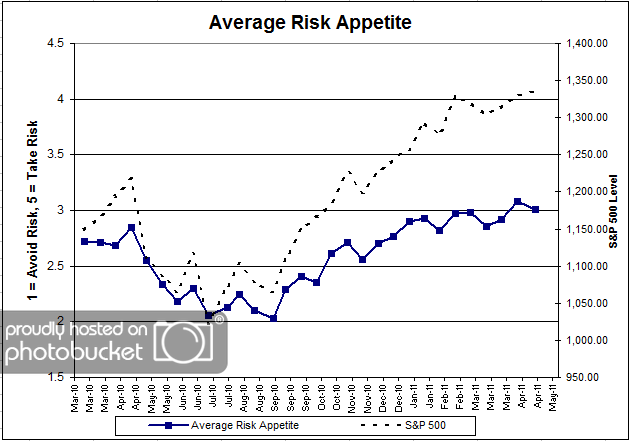
Chart 3: Average Risk Appetite. Average risk appetite dropped barely, from 3.07 to 3.01. Last survey’s risk appetite number ranked the highest since we started the survey. Considering the market’s tepid rally from the previous survey, it’s not too surprising to see client risk appetite fall back a little from those levels. Again, we’re seeing our sentiment indicators match the strength of the market moves. Big rally = big sentiment move. Small rally = small sentiment move.
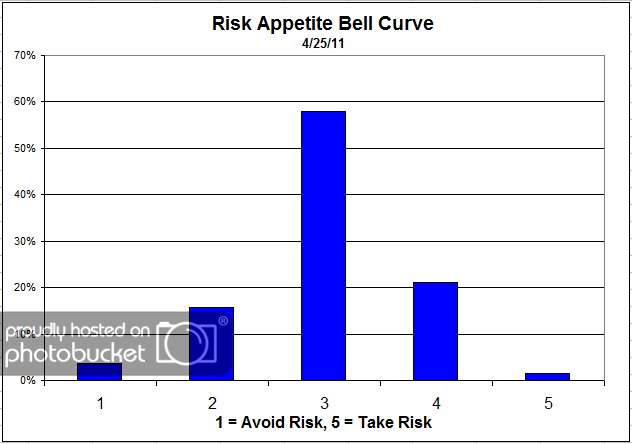
 Dorsey, Wright Client Sentiment Survey Results   4/25/11

Chart 4: Risk Appetite Bell Curve. This chart uses a bell curve to break out the percentage of respondents at each risk appetite level. The majority of respondents continue to desire a risk appetite of 3, while there are not as many clients at the tail ends of either side of the bell curve. We’ve been seeing this bell-curve pattern for a few weeks now, and expect it to continue as long as the market keeps treading water.
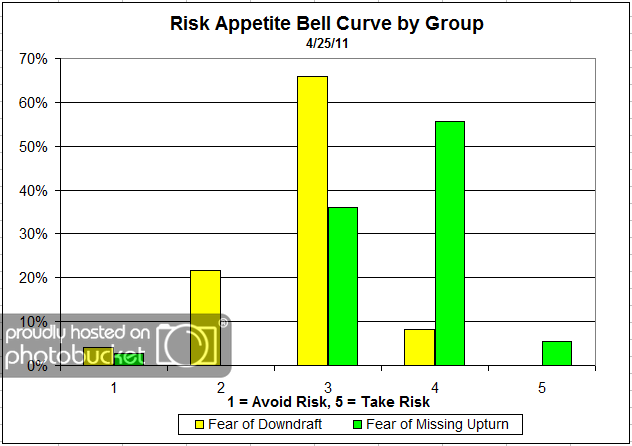
 Dorsey, Wright Client Sentiment Survey Results   4/25/11

Chart 5: Risk Appetite Bell Curve by Group. The next three charts use cross-sectional data. This chart plots the reported client risk appetite separately for the fear of downdraft and for the fear of missing upturn groups. This chart sorts out perfectly, save one person in the missing upturn group who desired a risk appetite of 1. The fear group is looking for lower risk (3′s through 1′s), while the opportunity group is looking for more risk (3′s through 5′s).
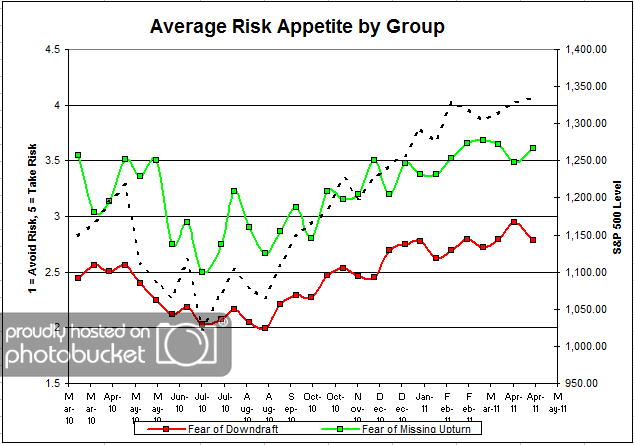
 Dorsey, Wright Client Sentiment Survey Results   4/25/11

Chart 6: Average Risk Appetite by Group. Leave it up to the average risk appetite by group graph to mix it up a bit. We’ve long noticed that this particular chart is one of the most interesting out of the group, in that we see more divergences from our expectations. Here we see the upturn group’s risk appetite jump by a pretty large degree, while the exact opposite happens in the downturn group.

In acting this way, both groups have resorted to their default mode, in that both groups made a big push towards what we would expect their desired risk appetite would be. The upturn group had a big push to more risk, and the downturn group had a big push to less risk.
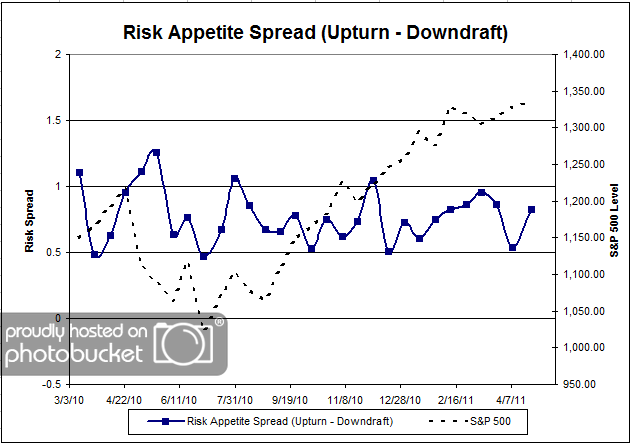
 Dorsey, Wright Client Sentiment Survey Results   4/25/11

Chart 7: Risk Appetite Spread. This is a spread chart constructed from the data in Chart 6, where the average risk appetite of the downdraft group is subtracted from the average risk appetite of the missing upturn group. The spread is normally one of the least volatile indicators, but in the last 2 surveys we have seen some relatively large swings in this indicator.

This round, the market rallied around +0.5% from survey to survey, and the overall fear numbers moved by around the same degree (not that much). This is what we would expect, as we’ve noticed that large market moves lead to large fear swings, and smaller market moves lead to muted fear swings. All in all,the survey indicators are performing exactly as expected.

One of my favorite indicators is the overall risk appetite average, which has been one of the most reliable proxies for determining what the clients “really feel” when compared to the overall fear numbers. Having barely pulled back from all-time highs above the 3.0 level, it will be fun to watch this one move in relation to the market going forward.

No one can predict the future, as we all know, so instead of prognosticating, we will sit back and enjoy the ride. A rigorously tested, systematic investment process provides a great deal of comfort for clients during these types of fearful, highly uncertain market environments. Until next time, good trading and thank you for participating.

Posted by:


The #1 Threat to US Stocks

April 28, 2011

The debt crisis spreading across parts of Europe is seen as the biggest threat to the performance of the U.S. stock market over the next 12 months, according to a survey of professional money managers.

In its latest quarterly survey of investment professionals by Russell Investments, respondents ranked European economic issues above all other major threats, with a top ranking of 73%.

Here’s the catch: this is from an article in Investment News from June 23, 2010! At the moment, the European debt crisis was big news. Now look at it, less than a year later. Besides Greece, both Ireland and Portugal have blown up and agreed to bailouts—and no one cares. Most Americans probably couldn’t find Greece on a map now.

How soon we forget that the burning problems of today are completely forgotten tomorrow! Keep your perspective about the news of the day and don’t get emotionally sucked in. Headline risk is only risk if you are making goofy decisions because of the news environment. To paraphrase G.K. Chesterton’s quip about exercise, if you have an urge to trade on news, lie down until it passes.

 The #1 Threat to US Stocks

Source: www.wembleymattersblogspot.com

Posted by:


Dorsey, Wright Client Sentiment Survey - 4/25/11

April 25, 2011

Here we have the next round of the Dorsey, Wright Sentiment Survey, the first third-party sentiment poll. We’re also featuring a Dorsey, Wright Polo Shirt Giveaway Contest for the next few months. Participate to learn more.

As you know, when individuals self-report, they are always taller and more beautiful than when outside observers report their perceptions! Instead of asking individual investors to self-report whether they are bullish or bearish, we’d like financial advisors to weigh in and report on the actual behavior of clients. It’s two simple questions and will take no more than 20 seconds of your time. We’ll construct indicators from the data and report the results regularly on our blog–but we need your help to get a large statistical sample!

Click here to take Dorsey, Wright’s Client Sentiment Survey.

Contribute to the greater good! It’s painless, we promise.

Posted by:


Dorsey, Wright Client Sentiment Survey Results - 4/18/11

April 18, 2011

Our latest sentiment survey was open from 4/8/11 to 4/15/11. The Dorsey, Wright Polo Shirt raffle continues to drive advisor participation — thank you for taking the time! Please remember, the first drawing will be held on June 1, so keep playing to increase your odds of winning. This round, we had 127 advisors participate in the survey. If you believe, as we do, that markets are driven by supply and demand, client behavior is important. We’re not asking what you think of the market—since most of our blog readers are financial advisors, we’re asking instead about the behavior of your clients. Then we’re aggregating responses exclusively for our readership. Your privacy will not be compromised in any way.

After the first 30 or so responses, the established pattern was simply magnified, so we are comfortable about the statistical validity of our sample. Most of the responses were from the U.S., but we also had multiple advisors respond from at least five other countries. Let’s get down to an analysis of the data! Note: You can click on any of the charts to enlarge them.

Question 1. Based on their behavior, are your clients currently more afraid of: a) getting caught in a stock market downdraft, or b) missing a stock market upturn?

 Dorsey, Wright Client Sentiment Survey Results   4/18/11

Chart 1: Greatest Fear. From survey to survey, the S&P 500 rallied just over +1%. Client fear levels, however, dropped by a substantial margin, from 85% to 76%. On the flip side, we saw the percentage of clients who were more afraid of missing a rally rise from 15% to 24%.

What’s interesting about this round is the relatively large move in fear levels, when the market only rose slightly. Compare that with last round’s results, where we had a +1% rally in the market, with a corresponding 1% drop in fear levels (compared to this round’s 10% move).

 Dorsey, Wright Client Sentiment Survey Results   4/18/11

Chart 2. Greatest Fear Spread. Another way to look at this data is to examine the spread between the two groups. The spread also staged a respectable drop, from 70% to 51%.

Question 2. Based on their behavior, how would you rate your clients’ current appetite for risk?

 Dorsey, Wright Client Sentiment Survey Results   4/18/11

Chart 3: Average Risk Appetite. Average risk appetite hit all-time survey highs this round at 3.07 up from 2.92. That’s pretty big news considering that we have been running the survey for just over a year, and the market is up around 90% since the lows of March 2009. Historically, we’ve noticed that the overall risk appetite number has been one of the more consistent of these indicators. Generally, when the market rises, risk appetite rises too, and vice versa when the market is going down.

 Dorsey, Wright Client Sentiment Survey Results   4/18/11

Chart 4: Risk Appetite Bell Curve. This chart uses a bell curve to break out the percentage of respondents at each risk appetite level. The majority of respondents continue to desire a risk appetite of 3, while there are not as many clients at the tail ends of either side of the bell curve.

 Dorsey, Wright Client Sentiment Survey Results   4/18/11

Chart 5: Risk Appetite Bell Curve by Group. The next three charts use cross-sectional data. This chart plots the reported client risk appetite separately for the fear of downdraft and for the fear of missing upturn groups. This chart sorts out as exactly as we would expect. We have the majority of respondents as 2′s, 3′s and 4′s, sorted by group. The upturn group is looking to add risk, and the downturn group is searching for moderate to “safe” risk.

 Dorsey, Wright Client Sentiment Survey Results   4/18/11

Chart 6: Average Risk Appetite by Group. Here we have a nice anomaly just to make things interesting. We already know that overall risk appetite rose to all-time highs, but you can clearly see that the upturn group’s risk appetite actually fell in the face of a rising market! On the other hand, the downturn group ramped up its risk appetite, which no doubt propelled the overall numbers to new highs.

The question is this: does the upturn group’s divergence from the norm signal that we are due for a correction?

 Dorsey, Wright Client Sentiment Survey Results   4/18/11

Chart 7: Risk Appetite Spread. This is a spread chart constructed from the data in Chart 6, where the average risk appetite of the downdraft group is subtracted from the average risk appetite of the missing upturn group. The spread is normally one of the least volatile indicators, but we saw a massive plunge in the spread, due to the downturn group’s rising risk appetite.

This round, the market rallied less than 1% from survey to survey, and client fear levels dropped significantly. Compared with last round’s fear level shift (based on a similar 1% market move), we would consider this a substantial drop in fear levels. Also, combine that with the fact that the overall risk appetite average is sitting at new highs above 3.0 for the first time in survey history, we’d say this is a survey to remember! It’s great to know that clients are keeping things interesting.

No one can predict the future, as we all know, so instead of prognosticating, we will sit back and enjoy the ride. A rigorously tested, systematic investment process provides a great deal of comfort for clients during these types of fearful, highly uncertain market environments. Until next time, good trading and thank you for participating.

Posted by:


Dorsey, Wright Client Sentiment Survey - 4/8/11

April 11, 2011

Here we have the next round of the Dorsey, Wright Sentiment Survey, the first third-party sentiment poll. We’re also featuring a Dorsey, Wright Polo Shirt Giveaway Contest for the next few months. Participate to learn more.

As you know, when individuals self-report, they are always taller and more beautiful than when outside observers report their perceptions! Instead of asking individual investors to self-report whether they are bullish or bearish, we’d like financial advisors to weigh in and report on the actual behavior of clients. It’s two simple questions and will take no more than 20 seconds of your time. We’ll construct indicators from the data and report the results regularly on our blog–but we need your help to get a large statistical sample!

Click here to take Dorsey, Wright’s Client Sentiment Survey.

Contribute to the greater good! It’s painless, we promise.

Posted by:


Dorsey, Wright Client Sentiment Survey Results - 3/25/11

April 4, 2011

Our latest sentiment survey was open from 3/25/11 to 4/1/11. The Dorsey, Wright Polo Shirt raffle continues to drive advisor participation — thank you for taking the time! Please remember, the first drawing will be held on June 1, so keep playing to increase your odds of winning. This round, we had 134 advisors participate in the survey. If you believe, as we do, that markets are driven by supply and demand, client behavior is important. We’re not asking what you think of the market—since most of our blog readers are financial advisors, we’re asking instead about the behavior of your clients. Then we’re aggregating responses exclusively for our readership. Your privacy will not be compromised in any way.

After the first 30 or so responses, the established pattern was simply magnified, so we are comfortable about the statistical validity of our sample. Most of the responses were from the U.S., but we also had multiple advisors respond from at least five other countries. Let’s get down to an analysis of the data! Note: You can click on any of the charts to enlarge them.

Question 1. Based on their behavior, are your clients currently more afraid of: a) getting caught in a stock market downdraft, or b) missing a stock market upturn?

 Dorsey, Wright Client Sentiment Survey Results   3/25/11

Chart 1: Greatest Fear. From survey to survey, the S&P 500 rallied by less than 1%, and client fear levels abided slightly. Around 85% of respondents said their clients were afraid of a downdraft, down slightly from last survey’s reading of 86%. On the flip side, we had 14% of clients more afraid of missing out on a rally.

Since bottoming out in March of 2009, the S&P 500 is up well over 90%, yet 85% of clients are more worried about the market going down than of missing a rally. Cognitive disconnect, anyone?

 Dorsey, Wright Client Sentiment Survey Results   3/25/11

Chart 2. Greatest Fear Spread. Another way to look at this data is to examine the spread between the two groups. The spread fell slightly from 73% to 70%.

Question 2. Based on their behavior, how would you rate your clients’ current appetite for risk?

 Dorsey, Wright Client Sentiment Survey Results   3/25/11

Chart 3: Average Risk Appetite. Average risk appetite nudged higher along with the market, up to 2.92 from 2.85. The overall risk appetite number has held up much better than the overall fear numbers. You’ll notice that the recent market pullback had a much less pronounced effect on risk appetite than the fear numbers. That disconnect is a great example of why we ask both sets of questions — when using the two separate questions together, we can get a more well-rounded snapshot of client sentiment.

 Dorsey, Wright Client Sentiment Survey Results   3/25/11

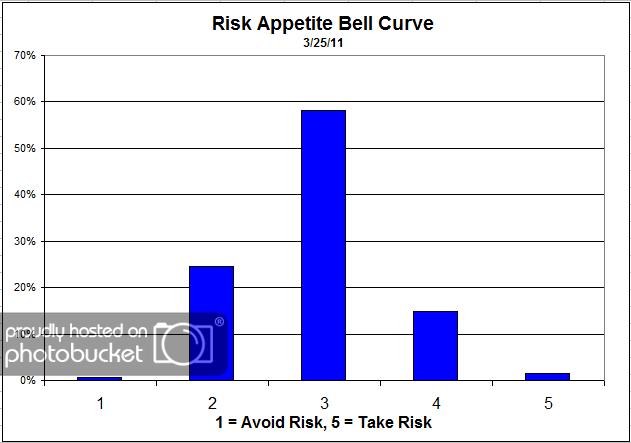
Chart 4: Risk Appetite Bell Curve. This chart uses a bell curve to break out the percentage of respondents at each risk appetite level. We saw a big rise in the number of 3′s this round, with nearly 60% of clients responding there. Click here to see last survey’s chart for comparison.

 Dorsey, Wright Client Sentiment Survey Results   3/25/11

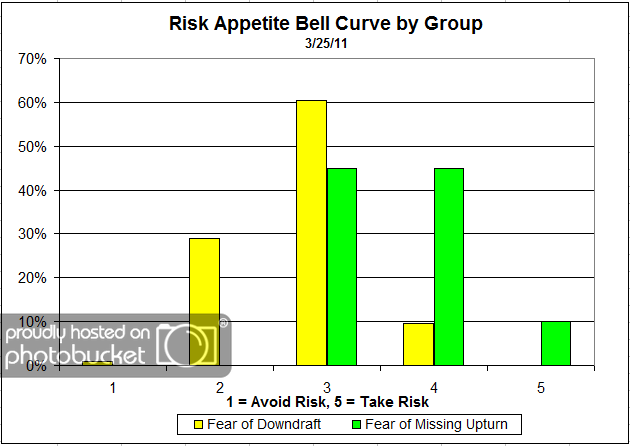
Chart 5: Risk Appetite Bell Curve by Group. The next three charts use cross-sectional data. This chart plots the reported client risk appetite separately for the fear of downdraft and for the fear of missing upturn groups. This chart sorts out as exactly as we would expect. You can see that upturn group is more sure of itself, with zero respondents at 1 or 2, whereas the downturn group has a number of respondents answering 4.

 Dorsey, Wright Client Sentiment Survey Results   3/25/11

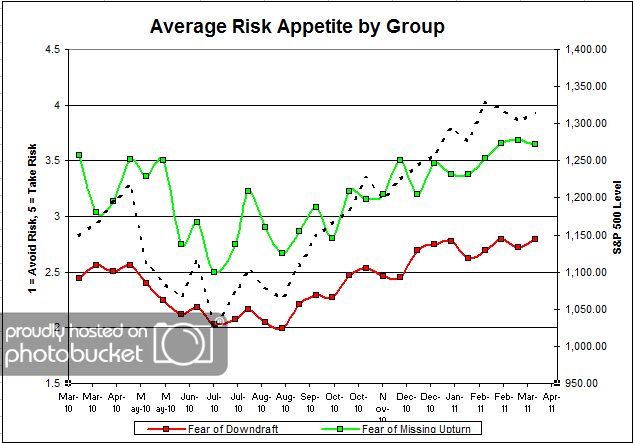
Chart 6: Average Risk Appetite by Group. Despite a rising market, we saw the upturn group’s risk appetite tick lower this round. Don’t be alarmed though, this group has historically had a much more volatile risk appetite. The fear of downdraft group rose slightly in-line with the market. Notice how both risk appetites have managed to trudge higher for the last 6-8 months in-line with the market.

 Dorsey, Wright Client Sentiment Survey Results   3/25/11

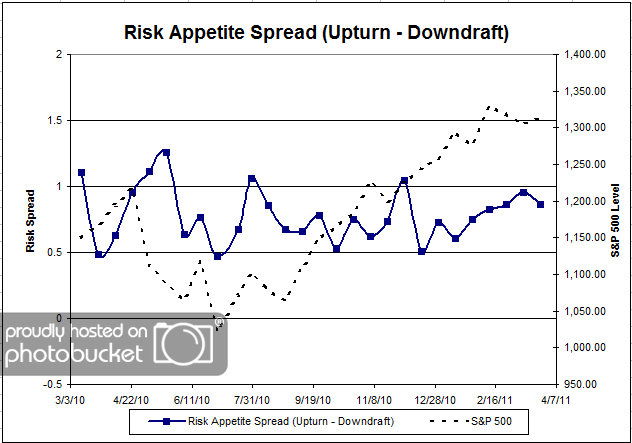
Chart 7: Risk Appetite Spread. This is a spread chart constructed from the data in Chart 6, where the average risk appetite of the downdraft group is subtracted from the average risk appetite of the missing upturn group. The spread is one of the less volatile indicators found in the survey, and fell this round.

This round, the market rallied less than 1% from survey to survey, and client fear levels abated slightly. It’s amazing that the broad market is up nearly +100% in two years, but 85% of clients are more afraid of a downturn than missing a rally.

No one can predict the future, as we all know, so instead of prognosticating, we will sit back and enjoy the ride. A rigorously tested, systematic investment process provides a great deal of comfort for clients during these types of fearful, highly uncertain market environments. Until next time, good trading and thank you for participating.

Posted by:


Dorsey, Wright Client Sentiment Survey - 3/25/11

March 25, 2011

Here we have the next round of the Dorsey, Wright Sentiment Survey, the first third-party sentiment poll. We’re also featuring a Dorsey, Wright Polo Shirt Giveaway Contest for the next few months.Participate to learn more.

As you know, when individuals self-report, they are always taller and more beautiful than when outside observers report their perceptions! Instead of asking individual investors to self-report whether they are bullish or bearish, we’d like financial advisors to weigh in and report on the actual behavior of clients. It’s two simple questions and will take no more than 20 seconds of your time. We’ll construct indicators from the data and report the results regularly on our blog–but we need your help to get a large statistical sample!

Click here to take Dorsey, Wright’s Client Sentiment Survey.

Contribute to the greater good! It’s painless, we promise.


Posted by:


Buying The Dips

March 22, 2011

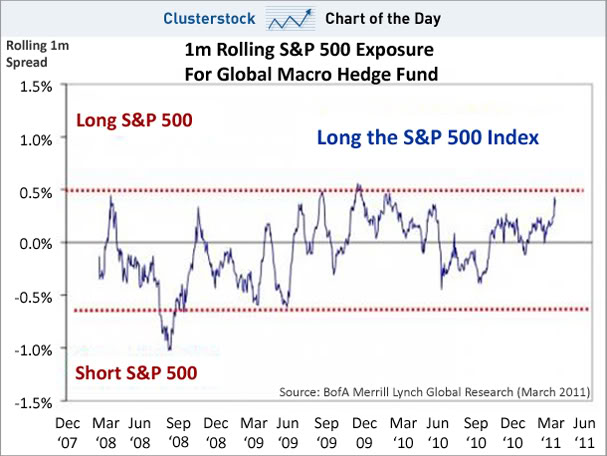
Retail investors and hedge funds have taken opposing views on the most recent stock market correction. Clusterstock has a short post on what Global Macro hedge funds did during the dip (click here for the original post). The graph below (taken from the original Clusterstock post) was produced by BofA ML and shows net exposure to the S&P 500 Index for Global Macro Hedge Funds.

 Buying The Dips

(Click To Enlarge)

You can see spike up in long exposure to equities over the last month. Our own sentiment survey (the full results of the most recent survey can be seen here), and the most recent AAII survey both show retail investors have become more bearish over the last month. These two surveys don’t measure actual exposure like the BofA survey does, but I think it is safe to assume that retail investors are not increasing equity exposure while they are becoming more bearish on stocks.

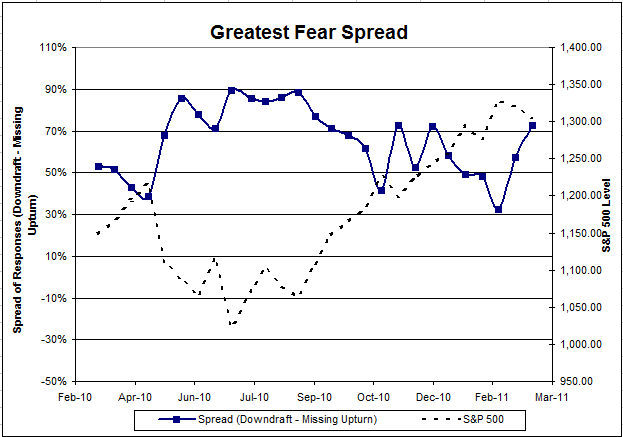
greatestfearspread 25 Buying The Dips

(Click To Enlarge)

In our survey we ask financial professionals whether their clients are becoming more fearful. As equities rallied, their clients became less worried about a downturn. But as the S&P 500 corrected over the last month their clients became more worried about getting caught in a downdraft.

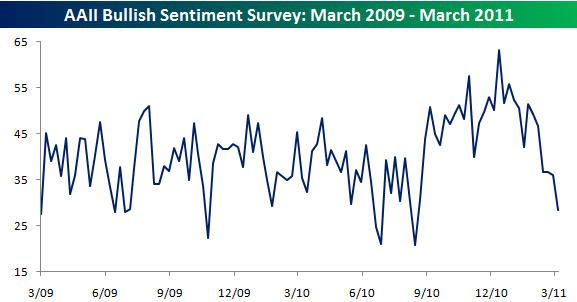
AAII030909 Buying The Dips(Click To Enlarge)

The AAII poll asks individual investors directly whether they are bullish or bearish. This chart was taken from Bespoke and clearly shows individual investors became more bearish very quickly during the decline.

Only time will tell which group is correct. However, I think it is a positive sign for equity markets that there are large pools of money ready to move into stocks during very small corrections. It is also a positive sign that not everyone is buying the dips! When everyone is excited to buy dips you are often closer to a top than a bottom.

Posted by:


Dorsey, Wright Client Sentiment Survey Results - 3/11/11

March 21, 2011

Our latest sentiment survey was open from 3/11/11 to 3/18/11. The Dorsey, Wright Polo Shirt raffle continues to drive advisor participation — thank you for taking the time! Please remember, the first drawing will be held on June 1, so keep playing to increase your odds of winning. We hit a new all-time high of participation, with 206 advisors chiming in. If you believe, as we do, that markets are driven by supply and demand, client behavior is important. We’re not asking what you think of the market—since most of our blog readers are financial advisors, we’re asking instead about the behavior of your clients. Then we’re aggregating responses exclusively for our readership. Your privacy will not be compromised in any way.
After the first 30 or so responses, the established pattern was simply magnified, so we are comfortable about the statistical validity of our sample. Most of the responses were from the U.S., but we also had multiple advisors respond from at least five other countries. Let’s get down to an analysis of the data! Note: You can click on any of the charts to enlarge them.

Question 1. Based on their behavior, are your clients currently more afraid of: a) getting caught in a stock market downdraft, or b) missing a stock market upturn?

 Dorsey, Wright Client Sentiment Survey Results   3/11/11

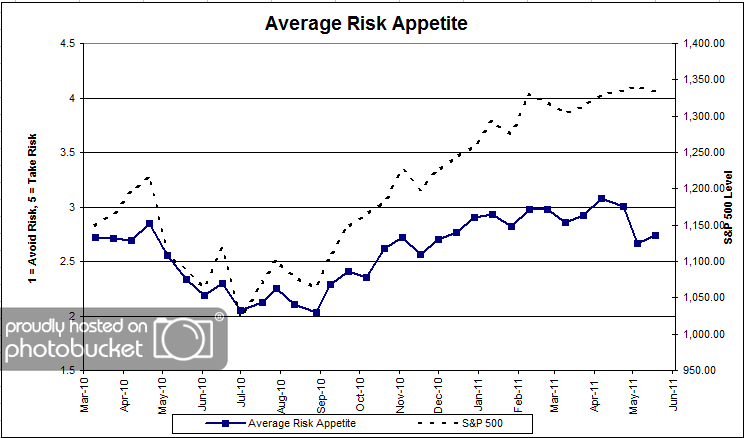
Chart 1: Greatest Fear. From survey to survey, the S&P 500 fell by around -1.1%. That was enough to send fear levels much higher, from 79% last round to 86% this round. In the last two surveys, we’ve had total losses of -1.8%, yet we’ve seen fear levels move from 66% to 86%. Classic!

On the flip side, the fear of missed opportunity group went from 21% to 14%. It’s amazing how much a 2% market pullback can affect client sentiment. And no, we’re not forgetting about the tsunami, the possible nuclear meltdown, the Arab revolts, or any other harbingers of the apocalypse. That’s one of the great things about this survey — we are only using price points from one day per every two weeks, so a lot of the “noise” gets cancelled out.

 Dorsey, Wright Client Sentiment Survey Results   3/11/11

Chart 2. Greatest Fear Spread. Another way to look at this data is to examine the spread between the two groups. The spread continued to move higher, up to 73% from 57%.

Question 2. Based on their behavior, how would you rate your clients’ current appetite for risk?

 Dorsey, Wright Client Sentiment Survey Results   3/11/11

Chart 3: Average Risk Appetite. Average risk appetite finally succumbed to the pressures of the pullback, as average risk moved from 2.98 to 2.85. Average risk appetite seems to be holding up much better than the overall fear numbers, given the relatively small move downward (compared to the huge jump in fear levels).

 Dorsey, Wright Client Sentiment Survey Results   3/11/11

Chart 4: Risk Appetite Bell Curve. This chart uses a bell curve to break out the percentage of respondents at each risk appetite level. The most common risk appetite was 3 this round (again!), with just under half of all respondents.

 Dorsey, Wright Client Sentiment Survey Results   3/11/11

Chart 5: Risk Appetite Bell Curve by Group. The next three charts use cross-sectional data. This chart plots the reported client risk appetite separately for the fear of downdraft and for the fear of missing upturn groups. This chart sorts out as exactly as we would expect. The fear group is looking for less risk than the missed opportunity group. Also, note the relatively high percentage of 5′s in the upturn group.

 Dorsey, Wright Client Sentiment Survey Results   3/11/11

Chart 6: Average Risk Appetite by Group.

The fear of missed opportunity group’s risk appetite continued to rise, even in the face of two consecutive down readings in the market. On the other side, we see the fear of losing money lower their average risk appetite, in line with the market.

The upturn group is sticking to their guns, wanting to add risk despite a falling market.

 Dorsey, Wright Client Sentiment Survey Results   3/11/11

Chart 7: Risk Appetite Spread. This is a spread chart constructed from the data in Chart 6, where the average risk appetite of the downdraft group is subtracted from the average risk appetite of the missing upturn group. The spread is one of the less volatile indicators found in the survey, and continues to rise with the market.

This round we saw a continuation of the S&P 500 pullback, with losses nearing a full -2%. Unsurprisingly, more clients became afraid of losing money in the market, despite a relatively small market correction. Here’s the bottom line for this survey: the S&P 500 is up around 93% since its March ’09 lows, yet a -2% pullback is enough to get 86% of clients scared of losing money! Does that make sense?

No one can predict the future, as we all know, so instead of prognosticating, we will sit back and enjoy the ride. A rigorously tested, systematic investment process provides a great deal of comfort for clients during these types of fearful, highly uncertain market environments. Until next time, good trading and thank you for participating

Posted by:


Dorsey, Wright Client Sentiment Survey - 3/11/11

March 11, 2011

Here we have the next round of the Dorsey, Wright Sentiment Survey, the first third-party sentiment poll. We’re also featuring a Dorsey, Wright Polo Shirt Giveaway Contest for the next few months. Participate to learn more.

As you know, when individuals self-report, they are always taller and more beautiful than when outside observers report their perceptions! Instead of asking individual investors to self-report whether they are bullish or bearish, we’d like financial advisors to weigh in and report on the actual behavior of clients. It’s two simple questions and will take no more than 20 seconds of your time. We’ll construct indicators from the data and report the results regularly on our blog–but we need your help to get a large statistical sample!

Click here to take Dorsey, Wright’s Client Sentiment Survey.

Contribute to the greater good! It’s painless, we promise.

Posted by:


Dorsey, Wright Client Sentiment Survey Results - 2/25/11

March 8, 2011

Our latest sentiment survey was open from 2/25/11 to 3/4/11. The Dorsey, Wright Polo Shirt raffle offer was a great success! Please remember, the first drawing will be held on June 1, so keep playing to increase your odds of winning. We had nearly 3 times as many participants as last round, with 192 advisors responding. If you believe, as we do, that markets are driven by supply and demand, client behavior is important. We’re not asking what you think of the market—since most of our blog readers are financial advisors, we’re asking instead about the behavior of your clients. Then we’re aggregating responses exclusively for our readership. Your privacy will not be compromised in any way.
After the first 30 or so responses, the established pattern was simply magnified, so we are comfortable about the statistical validity of our sample. Most of the responses were from the U.S., but we also had multiple advisors respond from at least five other countries. Let’s get down to an analysis of the data! Note: You can click on any of the charts to enlarge them.

Question 1. Based on their behavior, are your clients currently more afraid of: a) getting caught in a stock market downdraft, or b) missing a stock market upturn?

 Dorsey, Wright Client Sentiment Survey Results   2/25/11

Chart 1: Greatest Fear. From survey to survey, the S&P 500 fell by around -0.7%. Although the market move wasn’t that dramatic, there was plenty of volatility and a few down days in a row in the days leading up to when we opened the survey. With that in mind, the greatest fear numbers spiked right back up after hitting all-time survey lows — 79% of clients were more afraid of losing money, up from 66%. On the other side, 21% of clients were more afraid of missing a rally, down from 34%. Unfortunately, all it takes is a minor drawdown and some volatility, and clients run for the hills…this is what we expect to see.

 Dorsey, Wright Client Sentiment Survey Results   2/25/11

Chart 2. Greatest Fear Spread. Another way to look at this data is to examine the spread between the two groups. The spread also shot higher after hitting all-time lows, up to 57% from 32% the survey before.

Question 2. Based on their behavior, how would you rate your clients’ current appetite for risk?

 Dorsey, Wright Client Sentiment Survey Results   2/25/11

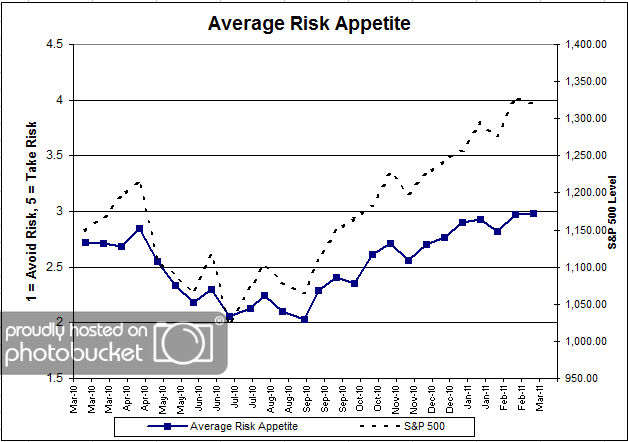
Chart 3: Average Risk Appetite. Average risk appetite managed to click up a hundreth of a point, from 2.97 to 2.98. This represents an interesting reading, as the usually unflappable indicator went against the grain to move higher in the face of a falling market. Also, keep in mind that average risk appetite is still sitting at all-time survey highs!

What does this mean? It could mean that despite the minor correction, more and more clients are unwilling to sit on the sidelines anymore and watch the S&P just go higher and higher. The emotional pain of sitting out a huge rally is taking its toll on sentiment, and clients are becoming unwilling to lower their risk appetite in the face of perceived risk (a minor correction).

 Dorsey, Wright Client Sentiment Survey Results   2/25/11

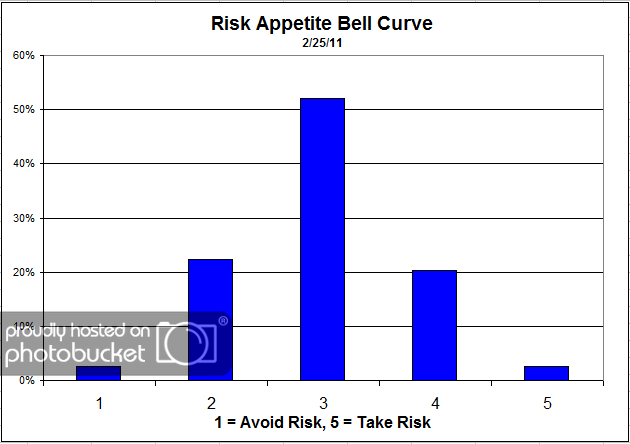
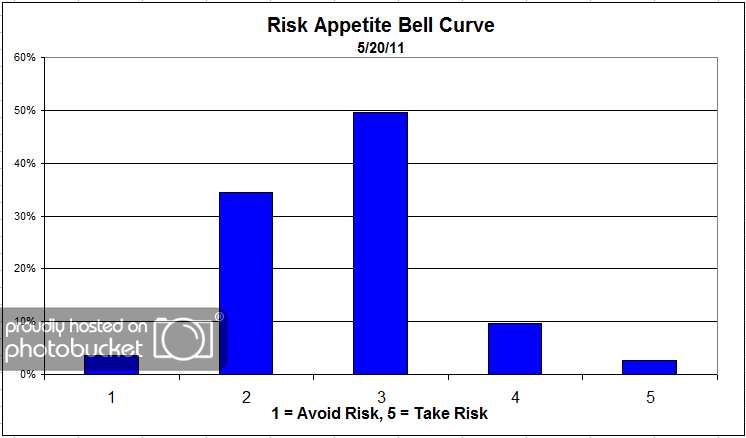
Chart 4: Risk Appetite Bell Curve. This chart uses a bell curve to break out the percentage of respondents at each risk appetite level. The most common risk appetite was 3 this round, with just over half of all respondents. We had a large number of 5′s this round, and you can see that the average risk appetite number also matches nicely with this graph (the average is 2.98, and the majority of respondents answered 3).

 Dorsey, Wright Client Sentiment Survey Results   2/25/11

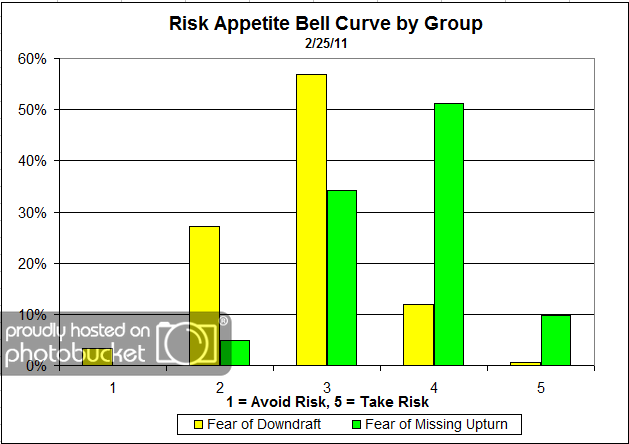
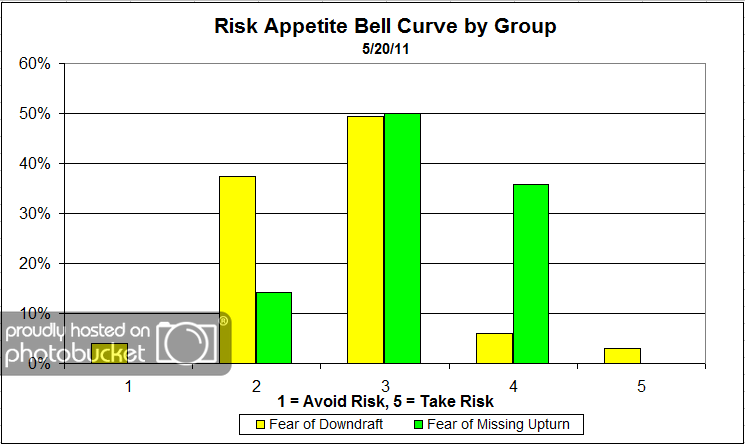
Chart 5: Risk Appetite Bell Curve by Group. The next three charts use cross-sectional data. This chart plots the reported client risk appetite separately for the fear of downdraft and for the fear of missing upturn groups. We’re noticing that more and more of the missed opportunity group is responding 4, whereas in previous surveys we saw mostly 3′s from this group. Also take note of the respondents from the downturn group wanting to add risk (with 4′s and even a 5)…more evidence that even those who are afraid of losing money, are also looking to add risk.

 Dorsey, Wright Client Sentiment Survey Results   2/25/11

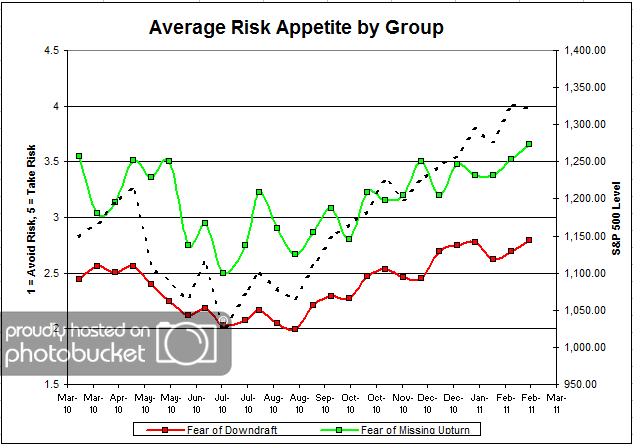
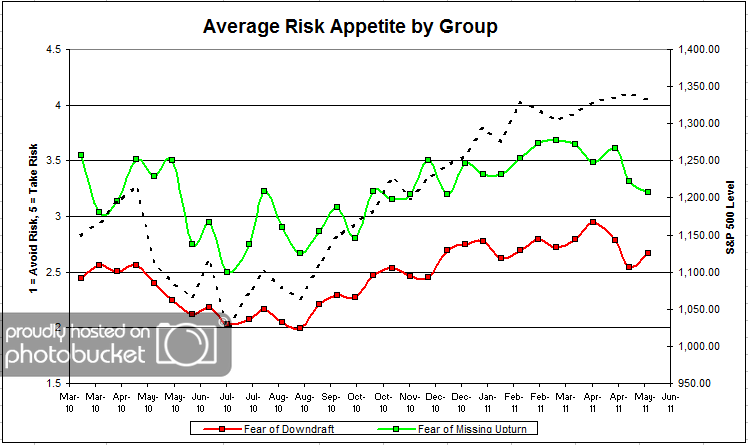
Chart 6: Average Risk Appetite by Group. The average risk appetite by group this survey syncs up with the overall average risk appetite numbers. Both groups are looking to add risk, despite a market correction. The missed opportunity group is now sitting at all-time highs, with a risk appetite of 3.66. We expect both groups’ average to move higher as the market continues to rise.

 Dorsey, Wright Client Sentiment Survey Results   2/25/11

Chart 7: Risk Appetite Spread. This is a spread chart constructed from the data in Chart 6, where the average risk appetite of the downdraft group is subtracted from the average risk appetite of the missing upturn group. The spread is one of the less volatile indicators found in the survey, and continues to trade within a fairly stable range.

This round we saw a minor correction in the S&P 500, and client fear levels jumped as a result. However, the big standout would have to be the average risk appetite indicator (and its corollary), as risk appetite managed to climb even higher despite a market pullback. This points towards an underlying trend of clients wanting to get in the market, with the S&P 500 up around +19% over the past 12 months. Clients may eventually be unable to contain their greed, and may jump head-first into a hot market!

No one can predict the future, as we all know, so instead of prognosticating, we will sit back and enjoy the ride. A rigorously tested, systematic investment process provides a great deal of comfort for clients during these types of fearful, highly uncertain market environments. Until next time, good trading and thank you for participating

Posted by: