When Cash Isn’t Safe

August 19, 2011

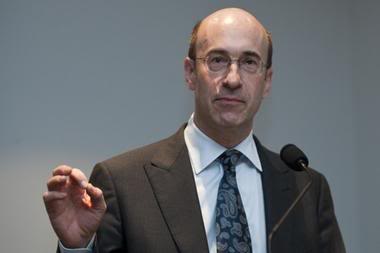
Marc Faber on why the conventional wisdom of going to cash for safety might not be too wise:

Given his bleak assessment of the U.S. dollar, it’s no surprise that Faber doesn’t recommend holding cash as a long-term cushion against portfolio shocks.

“It would be very dangerous to say ‘I don’t trust stocks, gold, real estate, I want to keep my money in cash.’ That’s a way to end up losing a lot of money,” Faber said.

Specifically, the problem in Faber’s view is the loss of purchasing power as inflation whittles away the value of money.

“We’re in a paradoxical situation where under a traditional monetary system the safest places are cash, Treasury deposits, government bonds,” Faber said. Nowadays, he noted, “they have been made by monetization into the most unsafe assets from a longer term perspective.

“Weak economies usually have higher inflation rates than stronger economies,” Faber added. “In weak economies you have loose fiscal policies and money printing. And the U.S. is the world champion in loose monetary policies. I don’t believe a single word of what the Bureau of Labor Statistics is printing about inflation figures.

dollar 3 300x133 When Cash Isnt Safe

Posted by:


Why An Adaptive Model is Critical

August 19, 2011

Theory and reality are not the same thing. One of the pervasive problems of economic modeling and financial market modeling is that it does not account for the really wide range of outcomes that occur but, in theory, shouldn’t.

The Psy-Fi blog had a recent article that archly discusses this problem:

By the late 1980′s there was a growing recognition that the existing understanding of financial systems was flawed. Not only did markets not behave as the economic theories predicted but they often exhibited behaviour that didn’t seem to have any pattern or cause at all.

In response to this a number of economists began looking at some of the research emerging from physics, biology and computer science in the area of complex adaptive systems and this led, in 1987, to a group of economists and scientists getting together at the Santa Fe Institute. The program of work that came out of this seminal event is still unfolding today, but suggests why academics and traders have had such different views on markets: one set lives in the real world, and the other doesn’t.

That’s a good introduction to the problem. Markets don’t behave the way traditional economic theories suggest. A good bit of the problem is in some of the assumptions that theory makes:

To the physicists involved in the original Santa Fe seminars it was obvious that the basis of economic quantification was highly suspect: indeed it was perfectly clear that the assumptions behind the models – stuff like people being perfectly rational – had been introduced to make the maths work, rather than being realistic assumptions.

At the heart of the problem with economics was the focus on equilibrium, the idea that there’s some perfect steady state of the economy in which everything is in balance (see Exit the Walras, Followed by Equilibrium). Essentially equilibrium economics defines the desirable outcome as a static position, then asks what conditions can give rise to this, then assumes that these conditions are present. This is a bit like deciding that riding a bicycle is a good thing, identifying the balance of forces needed to achieve this successfully and then declaring that this balance is the natural order of things.

And then ignoring what happens if you try to go cycling in a typhoon.

Beyond the problem with faulty assumptions, physicists were no strangers to the observer problem in science. They quickly recognized something that the economists did not. Economic systems themselves are reflexive; the actions of the participants can change the course of events:

Equilibrium economics is designed to ignore psychology, because it assumes that a person never changes their mind: they’ve already considered all possible outcomes and rejected all but the most economically rational. In the new economics we can’t assume this: we must work on the basis that if the world changes then a person’s expectations also change. This is a reflexive world, not a static one.

Suddenly, human behaviour matters in economic models in a way it never did before. Psychology, having been banished out of the front door, has crept in the back and has started cooking itself a three course dinner with all the trimmings.

The outcome of the Santa Fe meeting was a focus on non-equilibrium approaches to economics. In fact non-equilibrium economics doesn’t claim that equilibrium conditions don’t occur, only that they’re not guaranteed. The reason for this is human behaviour: we’re not external to the economic machinery, we’re part of it, and our expectations about the future have a critical impact on how it develops. All of which means that the future is not predictable and models that assume it is so are just wrong.

The reality is that people are reflexive and markets are adaptive. One begets the other and in a world where traders are forever trying to anticipate what other traders are going to do the last thing markets will ever be, in the short-term, is efficient and in equilibrium. But, of course, the trick to riding a bike is not falling off, no matter what the weather throws at you.

Source: Elite Bicycles

If the future is not predictable because equilibrium will change each time expectations change, it is essential to have a model that adapts to markets. Relative strength provides just such an adaptive framework. As expectations change, different stocks or asset classes become strong or weak. Relative strength drives the portfolio toward the strongest areas, where the most positive changes in expectations are occurring. Unlike classical models of market or economic behavior, relative strength models do not make any assumptions about potential returns, about correlations between different assets, or about volatility of different assets. Indeed, in the real world these things change all the time-as the expectations of participants change. Behavior that economic models find aberrational, like periods of stability interrupted by intense bouts of volatility, are, in fact, the norm.

The problem with Modern Portfolio Theory and strategic asset allocation is that they are based on the optimization of equilibrium models. If equilibrium is not guaranteed, you can assume the model will fail every time equilibrium conditions don’t exist—which is much of the time. (The fact that these models have failed bear market stress tests repeatedly somehow has not convinced their supporters that they are fatally flawed. Imagine if NASA had insisted on repeatedly using O-rings that cracked in cold weather like the ones that brought down the Challenger. )

Tactical asset allocation driven by relative strength can sometimes be buffeted by rapidly changing expectations, but the underlying drive is always toward adapting to the current environment. Since we cannot predict what will happen going forward, a systematic relative strength process seems like a more robust solution to the asset allocation problem.

Posted by:


Gold: Letting Your Winners Run

August 19, 2011

From Bespoke Investment Group comes a nice reminder why trend followers don’t sell just because something is “overbought” (it can become significantly more overbought).

A bull market is defined as a rally of at least 20% that was preceded by a decline of at least 20%. The current gold bull market — in which the metal is up 158.67% - has now crossed the 1,000-day mark (it currently sits at 1,008 days). The last 20% decline for gold came from September 22nd, 2008 through November 13th, 2008 when the metal fell 22.04%. As shown below, the median gold bull market since 1975 has lasted 418 days, so the current bull is well over double the median. The median gain seen during gold bull markets since 1975 has been 64.03%, so the current bull is about 2.5 times the median.

Disclosure: Dorsey Wright currently has a position in DGL. A list of all holdings for the trailing 12 months is available upon request.

Posted by:


Riding the ETF Wave

August 18, 2011

The first exchange-traded fund (SPY) debuted in 1997. More ETFs were developed over the next decade or so, but the industry has really exploded over the last five years. A recent ETF Trends article reports that:

Global assets in exchange traded funds could rocket to nearly $5 trillion within four years, according to a report released Tuesday by McKinsey & Co.

ETF assets under management may grow from approximately $1.5 trillion today to between $3.1 trillion and $4.7 trillion by the end of 2015, according to the study.

“Not since the advent of index funds, hedge funds or possibly the mutual fund itself, has the asset management industry witnessed an innovation as profound as ETFs,” McKinsey & Co. says.

For investment managers using tactical asset allocation, ETFs have been a boon. They are transparent—something appreciated by clients— and liquid. More important, they have given retail investors access to a variety of asset classes that were previously only available to large investment pools or hedge funds, something that was addressed in the McKinsey study:

One factor driving the industry’s growth is that ETFs have given investors low-cost, liquid exposure to more asset classes by “democratizing” markets to a greater degree, the paper argues.

Something like our Global Macro strategy, which incorporates domestic and international equities, fixed income, commodities, real estate, currencies, and inverse funds would not have been possible even five years ago. Since its introduction a few years ago, it has quickly become our largest separate account, something that also speaks to client acceptance of ETFs.

There is nothing magic about ETFs. Most ETFs are just index funds or sector funds, instruments that have been around for a long time in different wrappers. An ETF is just a better mousetrap in terms of liquidity and cost than what had been available before. Active ETFs have yet to get much traction, but there has been good acceptance of alternative beta ETFs using other than capitalization-weighting schemes. Even so, ETF assets have grown at a 30% rate over the last ten years, compared to a 6% annual growth rate for traditional mutual funds.

I’m hoping that clients will continue to benefit from additional solutions-oriented products, whether they are active or alternative beta products. Lots of small or ill-conceived ETFs will no doubt shut down over the next few years—the land rush might be over—but I also think we have many years of innovation and fruitful product development ahead. We’ll try to stay on the crest of the wave.

To obtain a fact sheet and prospectus for the Arrow DWA Tactical Fund (DWTFX), clickhere.

To receive a brochure for our Systematic RS portfolios, please click here. Click here for disclosures from Dorsey Wright Money Management. Past performance is no guarantee of future results.

Posted by:


Go-Anywhere Funds Deliver as Promised

August 16, 2011

That’s the title of an article from Investment News about mutual funds in Morningstar’s World Allocation category:

If last week’s volatility was a test, go-anywhere funds passed.

Classified by Morningstar Inc. as “world allocation” funds, go-anywhere funds have been growing in popularity as a core holding, having the flexibility to allocate globally among stocks, bonds, cash, gold and other asset classes intended to hedge risk.

From July 1 through Aug. 9, the world allocation category declined by 5.66% while the S&P 500 was down 11.06%, according to Morningstar. Year-to-date through Aug. 9, the category was off 2.82%, compared with a 5.7% loss for the S&P 500.

For comparison, our entrant in the World Allocation category, the Arrow DWA Tactical Fund (DWTFX) was down only 3.51% from July 1 and year-to-date through August 9, was actually up 0.22%.

One can only wish that we had been mentioned in the article along with some of our better known competitors! [Especially since we are outperforming most of them. DWTFX through 8/15/2011 was up 20.78% for the trailing 12 months and was in the 1st (top) percentile within the peer group of other World Allocation funds.]

DWTFX versus peers

Source: Morningstar

Investment News focused on the risk management characteristics of go-anywhere funds, but these funds can make money on the upside too. Although most of them are designed for risk diversification, many of the funds can also have heavy allocations to growth-type assets in good market environments.

To obtain a fact sheet and prospectus for the Arrow DWA Tactical Fund (DWTFX), click here.

To receive a brochure for our Systematic RS portfolios, please click here. Click here for disclosures from Dorsey Wright Money Management. Past performance is no guarantee of future results.

Posted by:


Efficient Market Theorists in Hiding

August 10, 2011

…according to Bespoke Investment Group. In a recent article, they discussed the amazing volatility the market has exhibited lately:

…the S&P 500 has averaged a daily hi/lo spread of 5.33% over the last five trading days. It’s been a truly remarkable trading period, and efficient market theorists are currently in hiding.

Source: Bespoke

You can look at the volatility in a couple of ways.

First, I think it shows how important it is to try to distinguish the underlying trend from the noise. When markets get very choppy like this, you’ve got to have an intermediate to long-term model. Otherwise you just get whipsawed to death.

Second, as Bespoke remarks, if the market were actually efficient it wouldn’t whip around nearly this much. The underlying value of the companies is obviously not changing nearly as rapidly as the market price. What’s going on is pure psychology—market participants trying to handicap supply and demand.

Strategic asset allocation relies on assumptions for returns, correlations, and volatility to generate the optimal pie chart. If you’re just a little off on some of the factors, your allocation can be way, way off. It’s safe to say that a few volatility estimates might have been revised over the past couple of days.

In contrast, tactical asset allocation driven by relative strength does not make any assumptions about returns, correlations, or volatility. It just tries to stay with the strongest trends at any given time. Simple, and effective too.

Posted by:


Oh, What A Difference A Day Makes!

August 10, 2011

As we pointed out yesterday, DWAFX was in the 14th percentile at its five-year mark. One day later, and our five-year percentile rank is 10th percentile. Top-decile performer over five years has a nice ring to it!

Source: Morningstar

Click here for disclosures.

Posted by:


High Marks For DWAFX After 5 Years

August 9, 2011

After five years of managing The Arrow DWA Balanced Fund (DWAFX), it was very rewarding to go to Morningstar this morning to find out how we stack up against the other 704 funds in the Morningstar Moderate Risk Category. The answer: 14th percentile (we outperformed 86% of our peers!)

Source: Morningstar

This global balanced fund can hold US equities, international equities, fixed income, and alternative investments.

Source: Arrow Funds

To learn more about why this fund should be part of your business, click the links below:

What is a Balanced Fund, and Why Should You Care?

What Do Clients Really Want?

The Arrow DWA Balanced Fund (DWAFX)

The Endowment Portfolio Rides Again

Click here for disclosures.

Posted by:


Gold is the Gold Standard

August 8, 2011

Commentary is flying this morning on the news of the S&P downgrade of US government debt. I had to chuckle at one comment from a Wall Street Journal story that I saw by way of Yahoo. Here is the quote that made me laugh:

“Double-A-plus is the new triple-A,” said Abdullah Karatash, head of U.S. fixed-income credit trading at Natixis in New York. “Treasurys will remain the world’s gold standard. What has the market spooked is not the downgrade per se, but the weak underlying macroeconomic fundamentals and the ongoing mess in Europe.”

I put the funny part in bold. Now, Mr. Karatash is arguably correct that US debt is still in better shape than debt from many other countries, but it does point out a lack of imagination or a lack of knowledge about alternative assets.

When our Global Macro strategy looks across a broad universe of assets including equities, fixed income, commodities, currencies, real estate, and inverse funds, one area that ranks highly is precious metals, which we group into the commodity category.

It seems as if precious metals have responded to sovereign credit concerns already, by outperforming most of them. Below, for example, is a 2-year chart of a gold ETF compared to an ETF for the US 7-10 year Treasury. You can see that the phenomenon is not just a recent one.

Gold is the gold standard

(Click to enlarge.) Source: Yahoo! Finance

Apparently gold is the gold standard. Rather than argue about whether S&P is right about the downgrade and which political party is responsible for overspending, wouldn’t it just make more sense to respond tactically by positioning part of your portfolio in the assets that are the strongest?

To obtain a fact sheet and prospectus for the Arrow DWA Tactical Fund (DWTFX) or the Arrow DWA Balanced Fund (DWAFX), click here.

To receive a brochure for our Systematic RS portfolios, please click here. Click here for disclosures from Dorsey Wright Money Management. Past performance is no guarantee of future results.

Posted by:


The Tactical Alternative

August 8, 2011

Proving that even after “the lost decade” many still haven’t learned the lessons of the failures of traditional asset allocation, Ron Lieber, journalist for The New York Times, repeats the same-old investment dogma in his column over the weekend:

Most of us should be the third kind of investor, the one who rebalances by selling the winners in well-balanced portfolios and buying the losers after large percentage declines.

His first two types of investors are those who adhere to “knee-jerk investment strategies” and make dramatic allocation changes or those who simply go to cash when their fear levels rise. Using logic, and market history as a guide, entire asset classes have shown the ability to spend extended periods of time in or out of favor (i.e. secular bull and bear markets). How then does it make sense to regularly cut back exposure to to asset classes that may be in secular bull markets, while regularly adding to those asset classes that may be in secular bear markets? That doesn’t strike me as anything other than a recipe for mediocrity, at best.

Tactical Asset Allocation, by comparison, makes allocation changes that are neither based on emotions or failed dogma. Rather, allocation changes are made only within the context of a relative strength-ranking methodology. This trend-following approach seeks to provides exposure to strong asset classes as long as they remain in favor, while seeking to minimize or eliminate exposure to weak asset classes.

Click here to read Relative Strength and Asset Class Rotation, by John Lewis, to learn more about the effectiveness of this tactical approach to asset allocation. Or, click here to view a 14-minute video on our Global Macro portfolio.

To receive the brochure for our Global Macro strategy, click here. For information about the Arrow DWA Tactical Fund (DWTFX), click here.

Click here and here for disclosures. Past performance is no guarantee of future returns.

Posted by:


Global Macro Video

August 3, 2011

When a manager is given the flexibility to seek out the strongest trends from a global investment universe the probability of finding good investment opportunities increase significantly. Effectively allocating among a broad range of asset classes (US equities, international equities, currencies, commodities, real estate, fixed income, and inverse equities) is precisely the goal of our Global Macro portfolio.

Please click here to view a 14 minute video about this portfolio

globalmacrovideo 1 Global Macro Video

To receive the brochure for our Global Macro strategy, click here. For information about the Arrow DWA Tactical Fund (DWTFX), click here.

Click here and here for disclosures. Past performance is no guarantee of future returns.

Posted by:


“The Italian Finance and Banking System is Solid”

August 3, 2011

The Wall Street Journal carried a denial from Italy this morning:

Economy Minister Giulio Tremonti convened a meeting of top Italian officials, who later released a statement noting that Italy has been hit by “tensions stemming from international uncertainty.” It added, “The Italian finance and banking system is solid.”

Of course, in the usual topsy-turvy world of politics, a denial is often a form of confirmation. Portugal, Ireland, and Greece all made official statements of denial before eventually taking bailouts as well.

What may be more telling is the price action—that’s the story behind the story. Judging from the price action in Italy and Spain, they may be the next to have problems. The same Wall Street Journal article included a nice graphic showing stock and bond market performance of the two countries.

If you have a choice between believing the market or believing the finance minister, I’d go with the market every time. You may still be wrong occasionally, but the odds are in your favor.

If you’re an investor, you can try to keep up with the news and all of the subsequent revisions or you can just watch how the market is handicapping things. Since relative strength models run on relative price performance, they use the market data exclusively. It allows the portfolio to adapt as market expectations change-or don’t change, as the case may be. That’s why tactical asset allocation makes sense.

Of course, in many cases, the day-to-day news is just noise and the underlying trend persists.

2 Years of Underlying Trend

Source: Yahoo! Finance

This chart is pretty clear, I think. Let’s put it in the form of an easy multiple choice question. Which is more reliable: a) your own two eyes, or b) a politician? If what you can see—the price action—is ultimately more reliable that what is said, why are you listening to the news?

Posted by:


From the Archives: Master of Disaster

July 29, 2011

Ken Rogoff is just a brilliant guy. First of all, he is an International Grandmaster in chess and in the 1970s won the U.S. Under 21 Championship when he was only 16. After getting his Ph.D. in Economics from M.I.T., he served as the chief economist at the International Monetary Fund, where he had to deal with systemic banking failures in a number of nations. He and Carmen Reinhart have written insightfully on the banking crisis in the past. Mr. Rogoff might know more about how to solve banking crises than anyone, and certainly more than Congress or their lobbyists.

His latest piece is important reading. He concludes “within a few years, western governments will have to sharply raise taxes, inflate, partially default, or some combination of all three.” Possibly like the rest of us, he sees little prospect that Congress will ever actually cut spending.

Most western nations, and certainly the U.S., have not been in that position in the recent past. If Mr. Rogoff’s scenario comes to pass, having a Global Macro-type portfolio could be a lifesaver. The only way to protect hard-earned capital might be to have investment access to a wide range of asset classes around the globe.

Click here for disclosures from Dorsey Wright Money Management.

—-this article originally appeared 8/27/2009. We’re two years down the road now and it looks like all of these things are going to happen, or have already. As the saying goes, “There’s nothing new under the sun, just history you haven’t read yet.”

Posted by:


Slouching Towards Debt-lehem…

July 29, 2011

Markets are undergoing a lot of changes in traditional relationships right now. For example, Barron’s reports that corporates are the new Treasurys:

U.S. government debt is priced in the credit-default swap (CDS) market as having a higher-default risk than 22% of investment-grade corporate bonds. This means the CDS market, which influences the prices of corporate bonds, stocks, and the implied volatility of equity options, perceives Treasuries to be riskier than bonds issued by companies including Coca-Cola (ticker: KO), Oracle (ORCL) and Texas Instruments (TXN).

“This suggests corporates are the new sovereigns,” Thomas Lee, J.P. Morgan’s equity strategist, advised clients in a research note late last week, referring to corporate debt.

The phenomenon is also evident in Europe. J.P. Morgan’s Lee notes that 100% of corporate-debt issuers in Spain, Greece, and Portugal trade inside their government CDS spreads, while 60% of Italian corporate bonds trade inside that government’s spreads.

Historically, sovereign debt –bonds issued by governments – were considered low risk because governments can raise taxes or print money to pay their bills. During the credit crisis of 2007, governments all over the world printed money, and slashed interest rates to rescue the financial system, and are now saddled with massive debts. Now, some corporations might be financially healthier than governments.

There are also sharp changes in historical relationships going on in the commodity world, according to Reuters:

According to fund flows research company EPFR Global, commodity sector funds that invest in physical products, futures or the equities of commodity companies such as miners, attracted $1.465 billion in net inflows globally in the first two weeks of July.

The push into commodities in July reverses a trend in the second quarter, when investors pulled a net $3.9 billion out of commodities, according to Barclays Capital.

The move explains a divergence of stocks and commodities, with correlation dropping from more than 80 percent positive to around 40 percent negative over the past two weeks.

“Commodities could be seen in some ways as the least-worst option, given what is happening with other markets,” said Amrita Sen, an oil analyst at Barclays Capital who looks closely at fund allocations into commodities. “Some investors have not liquidated positions in commodities, while they have exited some other asset classes such as equities.”

All of the machinations with the debt ceiling and the associated market dislocations have posed a number of important questions for investors.

Q1) What happens to traditional asset allocations when traditional relationships break down?

Q2) How can we tell if the dislocations are a result of temporary factors or represent a permanent paradigm shift?

No one has all of the answers, least of all me, but a couple of things occur to me.

A1) The same thing that always happens when these ephemeral relationships change—your allocation doesn’t behave anything like you thought it would. Although the current uncertainties have highlighted the issues above, this kind of thing happens all the time. In the current investment hierarchy, debt is seen as safer than equity because it is higher up in the capital structure—but that’s only true for a corporate balance sheet. Sovereign debt always depends on the willingness of the sovereign to repay it. Anyone who is old enough to be familiar with the term “Brady Bonds” knows what I am talking about. If 100% of the corporate debt issuers in Spain trade inside the government debt spread, it’s not inconceivable for the same thing to happen in the US. In other words, there’s no a priori reason for government debt to be safer than other debt.

What about commodities then? Strategic asset allocation usually treats them like poor cousins, giving them a small seat at the children’s table. What if they really are the “least worst option” and deserve a major slice of the portfolio due to their performance? After all, commodities are at least tangible and do not rely on the willingness of a sovereign to be worth something. What if the correct safety hierarchy is a) high-grade corporate debt, b) equity in companies with growing revenues, earnings, and dividends, c) commodities, and d) sovereign debt, especially in countries with a ton of obligations and a sketchy political process?

A2) We can’t. That’s one of the issues with a paradigm shift—at the beginning, you can’t tell if it is temporary or permanent. Around 1900, it looked like the US might supplant the UK as the world’s industrial power. That turned out to be lasting. Around 1990, it looked like Japan might supplant the US as the world’s industrial power. That turned out to be temporary. Around 2010, it looked like China might supplant the US as the world’s industrial power—and we have no idea right now if that is a temporary conceit or will become a permanent feature of the landscape.

Constantly changing relationships along with an inability to distinguish between a temporary and a permanent state of affairs, to me, argues strongly in favor of tactical asset allocation. It simply makes sense to go where the returns are (or where the values exist, depending on your orientation). Money always goes where it is treated best, and if you wish to win the battle for investment survival, you would be well-advised to do the same thing.

Posted by:


The Home Rentership Society

July 26, 2011

A recent report by a major firm, covered in Bloomberg, indicates that the home ownership rate is declining:

The U.S. homeownership rate has fallen below 60 percent when delinquent borrowers are excluded, a sign of the country’s move toward a “rentership society,” Morgan Stanley said in a report today.

The national rate, which stood at 66.4 percent at March 31, would be 59.7 percent without an estimated 7.5 million delinquent homeowners who may be forced into renting, according to Morgan Stanley analysts led by Oliver Chang. The lowest U.S. homeownership rate on record was 62.9 percent in 1965, the first year the Census Bureau began reporting the data.

The homeownership rate reached an all-time high of 69.2 percent in 2004 as relaxed lending standards fueled home sales and President George W. Bush promoted an “ownership society.” Mortgage delinquencies, foreclosures and tighter credit for housing loans are reducing property buying, Chang said.

“Taken together they are forcibly moving the country away from being an ownership society,” Chang, based in San Francisco, said in an e-mail. “This change is only beginning, and is moving the country towards becoming a rentership society.”

The analyst discussed the investment implications of the change:

The shift provides opportunities for builders of multifamily homes and investors in single-family houses leased to renters, Chang said in a phone interview. The U.S. apartment vacancy rate fell to 6 percent in the second quarter, the lowest in more than three years, research firm Reis Inc. said July 7.

Here’s the part I find interesting: the market figured this out long ago, as you can see from the two-year chart below comparing REZ to the S&P 500.

REZ vs. S&P 500

Click to enlarge. Source: Yahoo! Finance

Based on price action, you can see how much stronger residential REITs have been than the general market. Of course, no one ever knows how long a trend will continue, but this particular trend has already lasted long enough to be quite exploitable by typical relative strength methodologies. As usual, price responds more quickly than the analytic community.

Disclosure: Dorsey, Wright Money Management owns various REIT equities and ETFs across many different account classes.

Posted by:


DWTFX Excelling in 2011

July 26, 2011

With a return of 8.06% YTD, 2011 is turning out to be a very good year for the Arrow DWA Tactical Fund (DWTFX). It has outperformed 92% of its peers YTD, 97% of its peers in June, and 94% over the past year.

Source: Morningstar, as of 7/25/2011

Holdings of this go-anywhere-fund, are shown below:

To receive the brochure for our Global Macro strategy, click here. For information about the Arrow DWA Tactical Fund (DWTFX), click here.

Click here and here for disclosures. Past performance is no guarantee of future returns.

Posted by:


Winners Rise To The Top - Int’l Edition

July 20, 2011

Apparently, German companies aren’t waiting around for Italy, Portugual, Spain, Greece…to get their acts together. Today’s New York Times article “Europe’s Economic Powerhouse Drifts East” offers an interesting profile of a number of German companies who are proactively finding robust growth in the East, while much of Europe staggers under a debt crisis.

Germany has long sat at the center of the European economy, but Europe is no longer as central to Germany as it used to be.

With large parts of Europe still in an economic rut and struggling to cope with a debt crisis, Germany is increasingly deploying its money and energy outside the euro zone to fuel its robust growth.

The shift in focus, while still in its early stages, could have profound economic and political implications because it comes at a critical time when the rest of Europe is counting on Germany to continue its traditional role as the locomotive of the Continent’s economy.

Profiled in the article, is Fresenius, a German healthcare company in Bad Homburg, near Frankfurt, which also happens to be a holding in our PowerShares DWA Developed Markets Technical Leaders ETF (PIZ).

Last year, Fresenius recorded a sales increase in Asia of 20 percent, to €1.3 billion, or $1.8 billion. That compared with its sales in Europe of €6.5 billion, up 8 percent.

Fresenius’s chief executive, Mark Schneider, said he expected the trend to continue, noting that China was trying to create a universal health care system that would ensure its people access to kidney dialysis and infusion therapies — the sort of products that Fresenius provides.

Fresenius is one of many companies that reflect the trend. Corporate investment in Western Europe is still rising in absolute terms, said Mr. Schneider, but “capital spending and employment is not rising as much as we are seeing in emerging markets.”

The best companies always rise to the top and find a way to thrive, in spite of macroeconomic conditions if necessary. We think relative strength is an ideal method of identifying and capitalizing on those winners.

(click to enlarge) Source: StockCharts.com

See www.powershares.com for more information about PIZ.

Posted by:


A Fate Worse than Debt?

July 14, 2011

Is there a fate worse than debt? If there is, it seems to be not dealing with the debt.

When there is too much leverage in the system, there is always a risk that things go wrong quickly and unexpectedly. Ken Rogoff and Carmen Reinhart have an op-ed piece on Bloomberg today about the debt overhang and its implications for economic growth. They are the only commentators who have been consistently correct about the path of the financial crisis, probably because they are the only one who have studied the actual data. That, and maybe because Ken Rogoff is a genius. But I digress.

KenRogoff A Fate Worse than Debt?

Source: www.csmonitor.com

Here is Rogoff and Reinhart on the debt crisis:

As public debt in advanced countries reaches levels not seen since the end of World War II, there is considerable debate about the urgency of taming deficits with the aim of stabilizing and ultimately reducing debt as a percentage of gross domestic product.

Our empirical research on the history of financial crises and the relationship between growth and public liabilities supports the view that current debt trajectories are a risk to long-term growth and stability, with many advanced economies already reaching or exceeding the important marker of 90 percent of GDP. Nevertheless, many prominent public intellectuals continue to argue that debt phobia is wildly overblown.

Although we agree that governments must exercise caution in gradually reducing crisis-response spending, we think it would be folly to take comfort in today’s low borrowing costs, much less to interpret them as an “all clear” signal for a further explosion of debt.

Those who would point to low servicing costs should remember that market interest rates can change like the weather. Debt levels, by contrast, can’t be brought down quickly. Even though politicians everywhere like to argue that their country will expand its way out of debt, our historical research suggests that growth alone is rarely enough to achieve that with the debt levels we are experiencing today.

Those who remain unconvinced that rising debt levels pose a risk to growth should ask themselves why, historically, levels of debt of more than 90 percent of GDP are relatively rare and those exceeding 120 percent are extremely rare. Is it because generations of politicians failed to realize that they could have kept spending without risk? Or, more likely, is it because at some point, even advanced economies hit a ceiling where the pressure of rising borrowing costs forces policy makers to increase tax rates and cut government spending, sometimes precipitously, and sometimes in conjunction with inflation and financial repression (which is also a tax)?

The relationship between growth, inflation and debt, no doubt, merits further study; it is a question that cannot be settled with mere rhetoric, no matter how superficially convincing.

In the meantime, historical experience and early examination of new data suggest the need to be cautious about surrendering to “this-time-is-different” syndrome and decreeing that surging government debt isn’t as significant a problem in the present as it was in the past.

I’ve done a massive cut-and-paste job with their essay and tried to hit the highlights. I recommend that you read the whole piece, which is more extensive and covers additional topics. Their thinking is important because they are neither alarmists nor happy talkers, just economists who have actually done a careful study of how debt levels affect economies.

Why do I even bother with this, since I am certainly not an economist? I have two motivations in mind. 1) I think it’s important to focus on the actual historical data, as Rogoff and Reinhart do. Without data, you’re just another dude with an opinion. Americans have been subjected to way, way too much idealogy from blowhards in both parties in Congress on the debt issue—and no one is looking at the data. 2) How debt is handled will have a big impact on investment opportunities around the globe.

Think about the differences from country to country! The UK showed a stiff upper lip and enacted austerity measures immediately. Greeks are protesting in the streets about the debt, corruption, and proposed austerity and are edging ever closer to restructuring—a polite term for a partial default. Spain is pretending they don’t have a problem at all. Japan has endured 20 years of financial repression—20 years!!—with low interest rates for savers, no economic growth, and has piled on even more debt. The US has gone from hoping for a grand bargain on tax reform and deficits to a mini-plan to squabbling about doing anything at all.

The investment climates will be very different as a result, and money always goes where it is treated best. Traditional strategic asset allocation will be very difficult in this environment, where responses to the debt problem are still being formulated. Reliance on past returns, correlations, and volatilities could be ruinous, much as they would have been in Japan in 1990. It seems to me that a relatively flexible, tactical solution is called for that allows investment in a wide variety of markets, to seek out returns wherever they may be found.

Posted by:


Global Flexible Investing: “Nonsensical…any other way”

July 14, 2011

Investment News recently asked Dennis Stattman, long-time manager of the BlackRock Global Allocation Fund, about the appeal of global asset allocation funds:

I believe that global flexible investing is what most investors ought to have at the foundation of their portfolios. It’s almost nonsensical to me to think, for most investors, that it would be any other way. Why would an investor not elect to choose from the broadest universe of investment possibilities that she or he could?

Anyone interested in the benefits of global tactical asset allocation, driven by relative strength, really should read Relative Strength and Asset Class Rotation by John Lewis, CMT, republished in February 2011.

whitepaper 2 Global Flexible Investing: Nonsensical...any other way

I would agree with Dennis Stattman that these types of flexible asset allocation strategies ought to make up the foundation of most investor’s portfolios. From the perspective of seeking to manage volatility and seeking to earn favorable returns in a wide variety of market environments, this flexible global asset allocation mandate just makes sense.

To receive the brochure for our Global Macro strategy, click here. For information about the Arrow DWA Tactical Fund (DWTFX), click here.

Click here and here for disclosures. Past performance is no guarantee of future returns.

Posted by:


Hedging Your Bets

July 8, 2011

Some wags have described hedge funds as “a compensation scheme masquerading as an investment strategy.” It is true that hedge funds are typically quite expensive: the industry standard fee is 2% annually, as well as 20% of any new profit above the previous high water mark. You can imagine the payday for a hedge fund manager with a $10 billion fund that has a 30%-up year ($200 million to “keep the lights on” and another $600 million in the form of a performance fee)! $800 million is a pretty good year for anyone. (On the other hand, that $600 million comes out of gains that would otherwise accrue to the investors in the fund.)

So what is it that a hedge fund is actually doing in terms of investment strategy? Well, that depends on the type of fund. Leverage (borrowed money that will magnify both gains and losses) is often used and many funds are both long and short. Some funds specialize in a particular asset like distressed debt, while others focus on a specific strategy like merger arbitrage. Some funds seek out the most attractive securities regardless of where they may be found. Funds with a ”go-anywhere” mandate are often referred to as global macro funds.

Going anywhere, according to a recent article in Reuters, doesn’t mean that making money is easy:

Only six months ago, few investors would have forecast that as of June 30, [John] Paulson’s flagship Advantage Fund would have lost 15 percent, or [David] Einhorn’s Greenlight Capital would be down 5 percent. Even Louis Bacon’s flagship Moore Global fund, which has boasted average annual returns of 19 percent for more than two decades, was down 5 percent for the year through June 16.

The article makes reference to all of the cross-currents in the global markets this year, including “events like Japan’s earthquake and nuclear disaster, the uneven U.S. economic recovery, enormous volatility in commodity prices and ongoing concerns about Greece and the solvency of other European nations.”

You could hire a hedge fund manager to navigate global markets for you—or, as an alternative, you could consider the Global Macro portfolio, our go-anywhere strategy, where our systematic relative strength process does the navigating for you. We’ve written before about its potential use as a hedge fund substitute. The investment universe is broad and encompasses domestic and international equities, fixed income, commodities, currencies, real estate, and inverse funds. Unlike a hedge fund, however, our Global Macro strategy does not use leverage and we don’t charge 20% of the profits as a performance fee.

Although we think it’s pretty good, relative strength is certainly not an infallible process. At least this year, however, it seems to have done a better job dealing with all of the conflicting macro forces than some of the hedge fund replication ETFs and than some of the prominent funds themselves.

Look Ma, no performance fee!

Click to enlarge. Source: Yahoo! Finance

To obtain a fact sheet and prospectus for the Arrow DWA Tactical Fund (DWTFX) or the Arrow DWA Balanced Fund (DWAFX), click here.

Click here for disclosures. Past performance is no guarantee of future results.

Posted by:


The Coming Debt Hurricane

July 5, 2011

Research Affliliates’ Rob Arnott was the subject of a recent article on Marketwatch, ably written by Jonathan Burton. He discusses what he believes is the actual debt situation—we have much more than most people realize—and discusses investment strategies to cope with the debt hurricane going forward. You can read the whole article for his take, but his short list is as follows:

1) Dump traditional asset allocation.

2) Buy inflation-linked bonds.

3) Stock up on commodities.

4) Embrace emerging markets.

5) Reach for high-yield bonds.

Other heavyweights like Bill Gross of PIMCO have talked before about the problems with the traditional 60/40 policy portfolio. What these market mavens are getting at, I think, is that your portfolio construction process needs to be more flexible to deal with risks and opportunities. I agree with this, whether you are constructing your own portfolio pieces or using an all-in-one tactical solution like the Arrow DWA funds (DWAFX, DWTFX) that incorporate a wide variety of global asset classes. The markets are global and your portfolio construction process needs to reflect that.

To obtain a fact sheet and prospectus for the Arrow DWA Tactical Fund (DWTFX) or the Arrow DWA Balanced Fund (DWAFX), click here.

Click here for disclosures. Past performance is no guarantee of future results.

Posted by:


Secular Inflation

July 1, 2011

Commodity prices have been in decline lately. Inflation is off the table. The inflation trade’s sudden disappearance apparently caught a few Wall Street firms off guard as well. However, an Advisor One article suggests that advisors not be so quick to dismiss inflation as a possibility.

PIMCO’s Mihir Worah says that it’s time to wake up and understand the new dynamics affecting inflation in 2011 and beyond, which he explained in a commentary piece for the fund group on Monday. Overall, he expects inflation to average between 3% and 5% a year worldwide.

Worah (left) says “the goldilocks days of the ’90s,” when countries could have both strong economic growth and low inflation at the same time “are gone.” While in the ‘90s and afterward, emerging markets could export disinflation to developed markets, the situation today is “turning around” as emerging markets go through “a particularly commodity and energy intensive phase of growth,” the portfolio manager explains.

“Inflationary pressure from commodities will be even higher within emerging markets … [since] commodities are such a large part of their consumption basket – for example, nearly 60% in India, compared to about 25% in the U.S.,” he wrote in an opinion piece released by PIMCO on June 27.

“Rising commodity prices along with reflationary policies from many developed-market central banks should result in modestly higher inflation going forward,” Worah added. “We expect developed market inflation to average about 3% and developing market inflation to average about 5% over the secular horizon.”

If Mr. Worah is correct, it’s going to be important to figure out ways to deal with secular inflation in client portfolios. Many advisors working today simply do not remember the 1970s, when the US had its last bout of secular inflation. Investors have the tendency to extrapolate what has been happening lately far into the future—and that rarely works. Often, price changes carry within them the seeds of their own destruction. For example, rising oil prices often lead to slower economic growth, which then leads to weaker oil prices due to falling demand.

Because price levels are so dynamic, I think it is important to allow the portfolio to adapt tactically to the changes in the markets. Relative strength is one very good way to accomplish that. Incorporating inflation-sensitive assets into the investment universe and then having a disciplined process to manage them tactically could be important to investment results if a secular inflation forecast proves correct.

Posted by:


Financial Repression

June 13, 2011

Bill Gross of PIMCO can’t say anything these days without creating a big stir in the market—and having his every thought criticized. He probably liked it better twenty years ago when he didn’t have the financial paparazzi trailing him around. That being said, he’s an interesting thinker. Advisor Perspectives carried his most recent letter on financial repression and summarized it as follows:

If the government is going to artificially repress yield, then focus on the parts of a bond that are less repressed! Rather than outright default, many countries attempt rather successfully to keep nominal interest rates lower than would otherwise prevail. Over the long term, this “financial repression” results in a transfer of wealth from savers to borrowers. Investors shouldn’t give their money away, and at the moment, the duration component of a bond portfolio comes close to doing just that – because it doesn’t yield enough relative to inflation.
Financial repression is a term coined by Carmen Reinhart indicating that government bond yields are being artificially held down in order to serve the needs of the government—and their needs are at odds with the objectives of bondholders. Bill Gross thinks the mostly likely outcome down the road will be inflation, but the bond market doesn’t currently agree with him.
No one knows which camp will be right in the long run so it’s important to have a very flexible investment policy that can accommodate a wide range of outcomes.

Posted by:


Global Macro: Part of the New World Order?

June 9, 2011

Bloomberg has an interesting article discussing the proliferation of investment managers running ETF-only products. According to the article, the trend is not a fad:

Morningstar Inc., the Chicago-based research firm that has rated mutual funds for more than 20 years, rolled out a database this month tracking managers offering asset-allocation models with more than 50 percent of their money in ETFs. The list includes 49 companies overseeing $7.7 billion in 179 products.

Informa Investment Solutions Inc., in White Plains, New York, which rates the performance of institutional investment strategies, tracks 269 ETF-based asset-allocation products from 88 firms managing $17.6 billion. New York’s BlackRock Inc., the largest ETF provider, publishes an annual guide to the field, the latest edition covering 83 firms and $18 billion.

“The growth in this area is undeniable, and it’s not a fad,” Scott Burns, head of ETF research for Morningstar, said in a telephone interview. “There’s a shift going on from seeking outperformance on an individual-company basis to seeking it on a macro basis.”

We started down this road in 2006, with the Arrow DWA Balanced Fund (DWAFX). We enlarged our footprint with our Global Macro separate account, with the strategy later extended to the Arrow DWA Tactical Fund (DWTFX). The breadth of ETF products now available allows for Global Macro to act like a hedge fund alternative, something that was not really possible on a retail level even ten years ago. Apparently we are one of the heavyweights, as our current assets in these strategies is near $800 million, much higher than the average firm assets indicated in the various databases, which ranged from $157 to $216 million.

On the other hand, while ETF allocation managers are not a fad, I don’t really think we have a new world order. Our research indicates that there is additional value to be added when granularity is increased. The additional return will likely come at the cost of more volatility, but products focused at the individual security level may still provide the best long-term returns. We think ETF-based products are great, but there’s more than one way to skin a cat.

To obtain a fact sheet and prospectus for the Arrow DWA Tactical Fund (DWTFX) or the Arrow DWA Balanced Fund (DWAFX), click here.

Click herefor disclosures. Past performance is no guarantee of future results.

Posted by:


The $61 Trillion Hole

June 8, 2011

USA Today had a nice piece on government accounting today. Although it is little known to the public, corporations are required to use accrual accounting, while government entities are allowed to use cash accounting. The difference is profound:

Corporations would be required to count these new liabilities when they are taken on — and report a big loss to shareholders. Unlike businesses, however, Congress postpones recording spending commitments until it writes a check.

Unlike a corporation, Congress (and also smaller government entities like states, counties, and cities) is allowed to make a promise to pay out something, but is not required to reserve for that event. It is akin to an insurance company collecting your policy premiums but not setting anything aside to pay the eventual claims. According to the article, USA Today has calculated federal finances based on standard accounting rules since 2004 using information from the Medicare and Social Security annual reports and the audited financial report of the federal government.

Once standard corporate accounting rules are used, here’s the real picture:

The $61.6 trillion in unfunded obligations amounts to $527,000 per household. That’s more than five times what Americans have borrowed for everything else — mortgages, car loans and other debt.

Ken Rogoff and Carmen Reinhart have discussed debt levels in relation to economies and point out that debt-induced sclerosis—very slow economic growth—results when the debt becomes too unwieldly to service. Based on historical precedent, they point out that very slow growth tends to occur when debt grows to about 90 % of GDP. If eventual liabilities are taken into account, given the US GDP for the last fiscal year was about $14.66 trillion, we are already over 400%.

An American contemplates the national debt

This is scary stuff. Most households in this country could not readily service a $527,000 loan. Resolution can come in a variety of ways, however: outright default, debt restructuring, repudiation of some of the future promises made, dollar devaluation, inflation, austerity, and so on. Even just muddling along will work for some amount of time—probably. As Mr. Rogoff points out, the timing of a crisis is inexact:

It’s very hard to call the timing of a crisis. You can see that an economy is vulnerable, and maybe even fairly reliably say you’ll have a crisis in 5 to10 years, but until it’s upon you, it’s hard to narrow the window down with any precision. Many of the people who say they predicted the crisis in a precise way had actually been predicting a crisis for years. There’s irreducible uncertainty coming from fragile confidence and political factors. The analogy is someone who’s vulnerable to a heart attack. You can go to the doctor and they can see your cholesterol is high and you have a number of risk factors, but you might go on for 20 years without anything happening. Or it might be 20 hours.

Each of the different scenarios for resolution will create very different investment outcomes. The best way, I think, to deal with the $61 trillion dollar hole, was expressed very eloquently by Andy in an earlier article:

Investing is always disconcerting because of the real and perceived risks to the capital markets and to the global economy. Professor Rogoff’s point about timing a financial crisis based on known fundamental data is an important one. Risks may be in place to cause a crisis, but if the likely window of time for those risks to actually result in crisis range from the next couple months to the next several decades the investor is left with the decision of how to incorporate those known risks into an investment plan. It is one thing to be aware of great fundamental risks and it is another to be able to translate that knowledge into profitable investment returns.

Again, we see why pragmatists gravitate to tactical asset allocation. The tactical asset allocator accepts the reality that timing market moves based on fundamental data is nearly impossible. Therefore, the tactical asset allocator embraces the concept of reacting to trends in a disciplined fashion. It is the next best thing to having a crystal ball.

Posted by: