Consistency of Momentum Returns

June 19, 2014

Long-time critic of “Smart Beta” strategies, Richard Ferri, had the following to say at a recent Morningstar conference:

Not only is “smart beta” more expensive than traditional beta investment products, but it isn’t as safe. “There is always more risk when get away from beta,” he said. “Any other beta is additional beta, not smart beta.” The third disadvantage is there are long periods of time when these strategies underperform the market, noting that small cap value products under performed for two decades.

I won’t speak to every “Smart Beta” strategy out there, but I will address that statement as it relates to momentum. As pointed out in John Lewis’ recent white paper Point and Figure Relative Strength Signals, momentum actually tends to have relatively short periods of underperformance (this white paper studied momentum over a 24 year period from 1990 to 2013).

On a rolling 3 year basis, the Buy in X’s basket outperformed the S&P 500 Total Return Index 85% of the months, and it outperformed the equal weighted universe in 76% of the months. These numbers are right in line with what we have seen in other studies on the consistency of momentum returns.

The table below summarizes the findings of the white paper:

momentum table 06.19.14 Consistency of Momentum Returns

At least when it comes to momentum as a “Smart Beta” factor, the data makes the case that both the long-term results and the frequency of outperformance are indeed compelling.

The relative strength strategy is NOT a guarantee. There may be times where all investments and strategies are unfavorable and depreciate in value.

Posted by:


Index Changes Bring Success for PowerShares DWA Sector ETFs

June 17, 2014

ETF Trends has a nice article about the strong growth in assets in the PowerShares DWA Sector ETFs since the changeover in Februrary:

Invesco PowerShares, the fourth-largest U.S. ETF issuer, made significant changes to its lineup of sector ETFs in February when it transitioned nine sector funds along with the PowerShares DWA NASDAQ Momentum Portfolio (DWAQ) to Dorsey Wright indices based on momentum and relative strength strategies. [Index Changes for 10 PowerShares ETFs]

Prior to the conversion of those 10 funds to Dorsey Wright indices, Invesco PowerShares had a long-standing relationship with the index provider that includes successful ETFs such as the $1.26 billion PowerShares DWA Momentum Portfolio (PDP) and $465.3 million PowerShares DWA SmallCap Momentum Portfolio (DWAS) .

Since the index conversions, the nine PowerShares sector ETFs, a group that includes the PowerShares DWA Healthcare Momentum Portfolio (PTH) and the PowerShares DWA Industrials Momentum Portfolio (PRN) , have gained nearly $85 million in new assets, Invesco PowerShares said in an interview with ETF Trends.

Those robust inflows indicate advisors and investors were not shaken by the March/April sell-off in momentum stocks despite the fact that each of the nine PowerShares sector ETFs has “momentum” in their names.

Past performance is no guarantee of future returns. These relative strength strategies are NOT a guarantee. There may be times where all investments and strategies are unfavorable and depreciate in value. See www.powershares.com for more information.

Posted by:


Relative Strength Spread

June 17, 2014

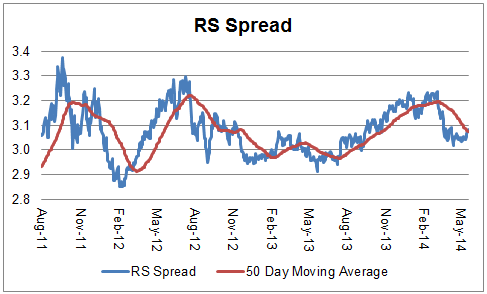
The chart below is the spread between the relative strength leaders and relative strength laggards (universe of mid and large cap stocks). When the chart is rising, relative strength leaders are performing better than relative strength laggards. As of 6/16/14:

spread 06.17.14 Relative Strength Spread

This example is presented for illustrative purposes only and does not represent a past recommendation. The performance above is based on pure price returns, not inclusive of dividends or all transaction costs. Investors cannot invest directly in an index. Indexes have no fees. Past performance is not indicative of future results. Potential for profits is accompanied by possibility of loss.

Posted by:


May Arrow DWA Funds Review

June 15, 2014

5/31/2014

The Arrow DWA Balanced Fund (DWAFX)

At the end of May, the fund had approximately 39% in U.S. equities, 26% in Fixed Income, 24% in International equities, and 11% in Alternatives.

We generally has positive returns in each of the different sleeves (U.S. equities, Fixed Income, International equities, and Alternatives) of the fund in May—something not always seen in a diversified balanced fund like DWAFX. We had a number of trades in May: sold Large-Cap Growth, Small-Cap Growth, and Consumer Cyclicals and bought Mid-Cap Value, Small-Cap Value, and Basic Materials. We also slightly reduced our U.S. Equity exposure and increased our Int’l Equity Exposure. While there were relatively few trades in the fund in 2013, this year has brought a number of changes.

DWAFX gained 1.23% in May, and is up 1.57% YTD through 5/31/14.

We believe that a real strength of this strategy is its balance between remaining diversified, while also adapting to market leadership. When an asset class is weak its exposure will tend to be towards the lower end of the exposure constraints, and when an asset class is strong its exposure in the fund will trend toward the upper end of its exposure constraints. Relative strength provides an effective means of determining the appropriate weights of the strategy.

dwafx May Arrow DWA Funds Review

The Arrow DWA Tactical Fund (DWTFX)

At the end of May, the fund had approximately 70% in U.S. equities, 19% in International equities, and 10% in Commodities.

Our U.S. equity exposure was reduced from 90% to 70% in May and we added another position to European equities and a position to Commodities. U.S. equities continue to be the dominant asset class from a relative strength perspective, but we have seen better performance from other asset classes as well this year. Relative strength in general had a strong month in May after pulling back in March and part of April.

DWTFX gained 0.87% in May, and is up 1.07% YTD through 5/31/14.

This strategy is a go-anywhere strategy with very few constraints in terms of exposure to different asset classes. The strategy can invest in domestic equities, international equities, inverse equities, currencies, commodities, real estate, and fixed income. Market history clearly shows that asset classes go through secular bull and bear markets and we believe this strategy is ideally designed to capitalize on those trends. Additionally, we believe that this strategy can provide important risk diversification for a client’s overall portfolio.

dwtfx1 May Arrow DWA Funds Review

A list of all holdings for the trailing 12 months is available upon request. Past performance is no guarantee of future returns. These relative strength strategies are NOT a guarantee. There may be times where all investments and strategies are unfavorable and depreciate in value. See www.arrowfunds.com for a prospectus.

Posted by:


Weekly RS Recap

June 15, 2014

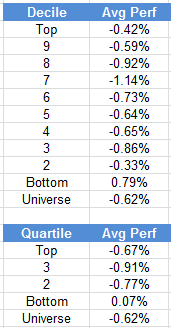
The table below shows the performance of a universe of mid and large cap U.S. equities, broken down by relative strength decile and quartile and then compared to the universe return. Those at the top of the ranks are those stocks which have the best intermediate-term relative strength. Relative strength strategies buy securities that have strong intermediate-term relative strength and hold them as long as they remain strong.

Last week’s performance (6/9/14 - 6/13/14) is as follows:

ranks 06.15.14 Weekly RS Recap


This example is presented for illustrative purposes only and does not represent a past recommendation. The performance above is based on pure price returns, not inclusive of dividends or all transaction costs. Past performance is not indicative of future results. Potential for profits is accompanied by possibility of loss.

Posted by:


PnF Relative Strength Signals White Paper

June 15, 2014

Earlier this week we released a whitepaper on Point and Figure Relative Strength signals. If you haven’t had a chance to read the paper you can access a copy of it here. The current paper covers the basics of how different Point and Figure Relative Strength patterns perform over time. In the coming months, we hope to release a few follow up papers that will look at some other aspects of a momentum strategy.

Relative Strength (also known as momentum) has been an incredibly robust factor for quite some time. Technicians have used momentum as a primary tool for over 100 years, but it has been in the last 20 years or so that research into the factor has really taken off. In 1993, “Returns to Buying Winners and Selling Losers” was published and the exploration of the momentum factor really began by the academics. There are hundreds of papers in the public domain that have found the momentum factor works across asset classes and within asset classes. As long as there is some volatility and some dispersion in the universe you can generally make a relative strength strategy work over time.

Most of the current research centers around time-based calculations of momentum. For example, you sort securities by their trailing 12 month price return and then put the top decile into the portfolio. Point and Figure, on the other hand, ignores time and really looks at volatility. The more volatile something is versus its benchmark the more columns you will have moving across the page. What all of these methods have in common is ranking on an intermediate term time horizon. If you use too short of a time window or too small of a point and figure box size you wind up trading on the noise rather than the trend. If you use too long of a window or too large of a box size you get into an area where mean reversion rather than trend continuation is the rule.

Every momentum study I have seen comes to the same conclusions. Buying the stuff with the best momentum works very well over time. You can short the stocks with weak momentum, but that presents two big problems. First, not everyone can sell positions short. And second, the laggard rallies off of bear market bottoms are a killer on the short side. You can see that in the performance table in the whitepaper in 2003 and 2009. The laggards tend to do very well off the bottom and the leaders tend to underperform. But otherwise, momentum is a very robust and consistent factor.

So why does momentum work, and why does it get such a bad rap in the press? I think the latter is easy to explain. Everyone understands the concept of getting something at a discount. If I want a roll of paper towels why would I buy one for $1.00 when I could get the same roll on sale for $0.50? Everyone can identify with that, and deals with those decisions on a daily basis. But not all stocks are the same! Buying IBM is not similar to buying AAPL. Each stock has its own identity. It is similar to betting on the NBA Finals right now. After the Spurs embarrassed the Heat the last two games who would you bet on to win the finals? Probably the Spurs because they have now demonstrated the ability to outperform the Heat. A good momentum stock does the same thing. It demonstrates the ability to outperform. Why not buy something that is doing well rather than betting on the Heat and hoping Mario Chalmers remembers how to shoot and Ray Lewis sends Dwayne Wade some deer antler spray for his creaky knee? Vegas figured this out a long time ago! If they didn’t set odds on the series everyone would bet on the Spurs right now because they have a high probability of winning. They aren’t a sure thing to win, but the odds are definitely in their favor. They have to entice people to bet on the Heat to try to even the money on both sides of the bet. The Heat can certainly still win, but it is going to take a major change in what we have seen so far in the series. When you are buying stocks there are no odds! The stocks on a buy signal and in a column of x’s have a high probability of outperforming over time. Why not just buy those rather than bottom fishing? You don’t get 2:1 odds if you buy the beaten down stock. You don’t get worse odds if you buy the winner. It’s all even odds. It is a great gift just sitting there waiting to be opened. Merry Christmas.

The conclusion we hope everyone eventually reaches is simple: disciplined implementation of the strategy is the ultimate key to success. Step back and think about what is the the BX group, for example. There are stocks with good fundamentals, bad fundamentals, some on pullbacks, and some on spikes. I’m sure that BX group contained tons of stocks that were bought right at the top and then sold very shortly after they were purchased. There were stocks that pulled back, fell out of the top group, and then turned around and shot to new highs. It is important to realize that all those potential problems didn’t matter in the long run. Somehow that best group kept right on chugging. The real issue is the opportunity cost of not constantly packing the portfolio in to the best momentum names. Hoping a stock turns around because you just bought it and your clients might be upset, not buying a strong relative strength name because it is on a spike, and not re-buying a strong stock after you had to sell it are not included in the BX group equity curve. The opportunity cost of leaving things that aren’t strong in the portfolio is what kills performance over time. Weak stocks are for value buyers. If you are going to buy high relative strength stocks you have to keep strong names in the portfolio.

Posted by:


Hoarding Cash

June 15, 2014

I would never argue against holding some cash (say 6-9 months worth of non-discretionary expenses), but holding this much??

According to new research on investors in 16 countries by State Street’s Center for Applied Research, retail investors globally were holding an average of 40 percent of their assets in cash, up from 31 percent two years ago. That’s a compounded annual growth rate of a whopping 13 percent.

The lowest levels of cash holdings were in India, at 26 percent, and China, at 30 percent; the highest was 57 percent in Japan. The United States was in the middle at 36 percent, but that was an increase of 10 percentage points in just two years. The survey, done by State Street, one of the world’s largest asset managers and custodians, was conducted in the first quarter of this year. It considered cash to be money held in savings and checking accounts as well as cash equivalents like money market funds.

Despite the run-up in equity markets, people have resisted rushing into stocks and have instead added to cash. They’ve done this regardless of their age or amount of wealth. The study found that millennials who are under 33 and have the longest time to invest their money were increasing their cash positions at the same rate as baby boomers, who will need to draw on their investments soon.

So, the amount of cash being held has gone up over the past two years even though there has been a rising market…doesn’t really support the position of some that we’re starting to see risk-taking come back in a major way. It also doesn’t strike me as the type of behavior you might see at a major market top.

Posted by:


Fund Flows

June 5, 2014

Mutual fund flow estimates are derived from data collected by The Investment Company Institute covering more than 95 percent of industry assets and are adjusted to represent industry totals.

ici 06.05.14 Fund Flows

This data is presented for illustrative purposes only and does not represent a past recommendation.

Posted by:


The Case for Tactical Asset Allocation

June 4, 2014

One of the realities for a typical investor preparing for retirement is that they do not have an unlimited time for their investments to work out. Take, for example, a 55 year old client with $1.5 million in investable assets. Whether this investor earns a return of 4% or 8% on their portfolio over the next several decades is going to dramatically change their standard of living. Yet, I think few clients have an appreciation for just how much variability there can be in returns to different asset classes that commonly make up a diversified portfolio. For example, consider the variation in returns over the last couple of decades in U.S. stocks, commodities, bonds, and real estate as shown in the table below.

asset class 06.04.14 The Case for Tactical Asset Allocation

Source: Global Financial Markets and FactSet. *Data through 5/28/14. This example is presented for illustrative purposes only and does not represent a past recommendation. The performance above is based on total returns, inclusive of dividends, but does not include all transaction costs. Investors cannot invest directly in an index. Indexes have no fees. Past performance is not indicative of future results. Potential for profits is accompanied by possibility of loss.

The column in green highlights the dispersion between the best and worst performing decade for that asset class. There really is no such thing as stability in the financial markets! Think about the implications that this might have on different approaches to building an asset allocation. One approach to dealing with the amount of variability in asset class returns could be to simply equal weight exposure to a broad range of asset classes. That may work out okay over time, but I think is susceptible the behavioral weaknesses of most investors, as pointed out in the quote below.

The problem with the person who thinks he’s a long-term investor and impervious to short-term gyrations is that the emotion of fear and pain will eventually make him sell badly. -Robert Wibbelsman

A tactical approach to asset allocation, driven by a relative strength, has a number of potential performance and client management advantages over many alternative approaches to asset allocation. As shown in the images below, a trend following approach to asset allocation seeks to identify and overweight those asset classes that are in favor and to underweight those asset classes that are out of favor.

arrow trend following The Case for Tactical Asset Allocation

Source: Arrow Funds

One of the developments over the past decade that has made a tactical approach to asset allocation even more accessible to individual investors is the expansion of the ETF universe to include a broad range of asset classes like U.S. equities, international equities, currencies, commodities, real estate, and fixed income.

To learn more about our “Global Macro” approach to asset allocation, please click here.

A relative strength strategy is NOT a guarantee. There may be times where all investments and strategies are unfavorable and depreciate in value.

Posted by:


High RS Diffusion Index

June 4, 2014

The chart below measures the percentage of high relative strength stocks that are trading above their 50-day moving average (universe of mid and large cap stocks.) As of 6/3/2014.

diffusion 06.04.14 High RS Diffusion Index

High RS stocks have rebounded sharply since mid-April. The 10-day moving average of this indicator is 72% and the one-day reading is 85%.

This example is presented for illustrative purposes only and does not represent a past recommendation. The performance above is based on pure price returns, not inclusive of dividends or all transaction costs. Investors cannot invest directly in an index. Indexes have no fees. Past performance is not indicative of future results. Potential for profits is accompanied by possibility of loss.

Posted by:


Relative Strength Spread

June 3, 2014

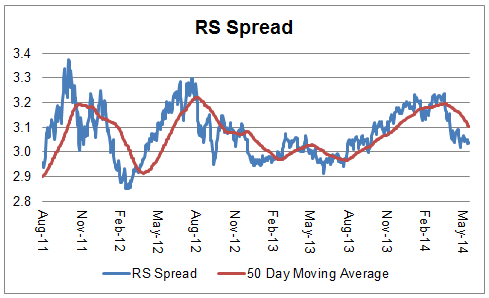
The chart below is the spread between the relative strength leaders and relative strength laggards (universe of mid and large cap stocks). When the chart is rising, relative strength leaders are performing better than relative strength laggards. As of 6/2/14:

spread 06.03.14 Relative Strength Spread

The RS Spread has moved above its 50 day moving average after spending a couple months below.

This example is presented for illustrative purposes only and does not represent a past recommendation. The performance above is based on pure price returns, not inclusive of dividends or all transaction costs. Investors cannot invest directly in an index. Indexes have no fees. Past performance is not indicative of future results. Potential for profits is accompanied by possibility of loss.

Posted by:


Power 4 Model Holdings

June 2, 2014

Current holdings of the DWA PowerShares Sector 4 Model are shown below:

power 42 Power 4 Model Holdings

Click here for model details.

The information contained herein has been prepared without regard to any particular investor’s investment objectives, financial situation, and needs. Accordingly, investors should not act on any recommendation (express or implied) or information in this material without obtaining specific advice from their financial advisors and should not rely on information herein as the primary basis for their investment decisions. Any statements nonfactual in nature constitute only current opinions, which are subject to change without notice. Neither the information nor any opinion expressed shall constitute an offer to sell or a solicitation or an offer to buy any securities, commodities or exchange traded products. This document does not purport to be complete description of the securities or commodities, markets or developments to which reference is made.

The PowerShares DWA Sector Portfolios are calculated by NYSE Euronext or its affiliates (NYSE Euronext). The PowerShares DWA Sector Momentum ETFs, which are based on Dorsey Wright indexes, are not issued, endorsed, sold, or promoted by NYSE Euronext, and NYSE Euronext makes no representation regarding the advisability of investing in such product.

NYSE EURONEXT MAKES NO EXPRESS OR IMPLIED WARRANTIES, AND HEREBY EXPRESSLY DISCLAIMS ALL WARRANTIES OF MERCHANTABILITY OR FITNESS FOR A PARTICULAR PURPOSE WITH RESPECT TO THE DORSEY WRIGHT INDEXES OR ANY DATA INCLUDED THEREIN. IN NO EVENT SHALL NYSE EURONEXT HAVE ANY LIABILITY FOR ANY SPECIAL, PUNITIVE, INDIRECT, OR CONSEQUENTIAL DAMAGES (INCLUDING LOST PROFITS), EVEN IF NOTIFIED OF THE POSSIBILITY OF SUCH DAMAGES.

Posted by:


Weekly RS Recap

May 31, 2014

The table below shows the performance of a universe of mid and large cap U.S. equities, broken down by relative strength decile and then compared to the universe return. Those at the top of the ranks are those stocks which have the best intermediate-term relative strength. Relative strength strategies buy securities that have strong intermediate-term relative strength and hold them as long as they remain strong.

Last week’s performance (5/27/14 - 5/30/14) is as follows:

perf 05.31.14 Weekly RS Recap

This example is presented for illustrative purposes only and does not represent a past recommendation. The performance above is based on pure price returns, not inclusive of dividends or all transaction costs. Past performance is not indicative of future results. Potential for profits is accompanied by possibility of loss.

Posted by:


Relative Strength Spread

May 30, 2014

The chart below is the spread between the relative strength leaders and relative strength laggards (universe of mid and large cap stocks). When the chart is rising, relative strength leaders are performing better than relative strength laggards. As of 5/29/14:

spread 05.30.14 Relative Strength Spread

This example is presented for illustrative purposes only and does not represent a past recommendation. The performance above is based on pure price returns, not inclusive of dividends or all transaction costs. Investors cannot invest directly in an index. Indexes have no fees. Past performance is not indicative of future results. Potential for profits is accompanied by possibility of loss.

Posted by:


Sector Performance

May 30, 2014

The chart below shows performance of US sectors over the trailing 12, 6, and 1 month(s). Performance updated through 5/29/14.

s c 5.30.14 Sector Performance

The performance above is based on pure price returns, not inclusive of dividends or all transaction costs. Past performance is not indicative of future results. Potential for profits is accompanied by possibility of loss. Source: iShares

Posted by:


Maintaining Flexibility

May 23, 2014

Morgan Housel recently shared an excellent way to think about one of the biggest challenges facing investors—failure to think outside their own viewpoint:

Statistics genius Nate Silver spoke at a conference in Seattle a few weeks ago. He made a point that stuck with me. Radar technology was in its infancy in the early 1940s. To protect U.S. interests like the Pacific Fleet in Pearl Harbor, Navy planes circled the Hawaiian Islands, searching for threats. “You were just sending a couple of planes that would go around a circumference until they ran out of fuel and then head back to base,” Silver said.

Alas, the Japanese military knew exactly how large that circumference was, and in November, 1941, sent its aircraft carriers just beyond the range our reconnaissance planes could fly. On December 7th, it attacked.

“My point is that everyone has a viewpoint,” Silver said, and that viewpoint usually shows just a fraction of the whole picture. There are important events sitting outside your viewpoint that, if you knew about them, would totally change how you view the world.

There’s a similar problem with investors and history. Your view of history is heavily influenced by your own experiences. But just like the Navy, your own experiences are an incomplete view of the world, arbitrarily blocked by when and where you were born — the equivalent of reconnaissance planes with limited fuel range. There are important events sitting outside your viewpoint that, if you experienced them, would totally change how you view the world.

This has important implications for how to design an asset allocation. If one looks at too narrow a slice of history when determining the exposure constraints for different asset classes an investor could easily optimize those constraints to fit just that last 20 or 30 years. Depending on what 20 or 30 year period you look at you may wish you had more exposure to U.S. equities, International equities, Inverse Equities, Currencies, Commodities, Real Estate, or Fixed Income. Since none of us have a crystal ball to know which asset classes will be most rewarding over the next 20-30 years, it makes sense to maintain flexibility. This is precisely the reason that we have given ourselves so much flexibility in The Arrow DWA Tactical Fund (DWTFX), which we sub-advise.

The Arrow DWA Tactical Fund (DWTFX) invests in various asset classes and market segments exhibiting positive relative strength. In essence, the model works by reallocating to various market segments in response to the changing patterns of returns available in the global markets. The table below shows the Fund’s potential allocation ranges.

dwtfx Maintaining Flexibility

Source: Arrow Funds

Investors may greatly benefit by not painting themselves into a corner when it comes to asset allocation.

A relative strength strategy is NOT a guarantee. There may be times where all investments and strategies are unfavorable and depreciate in value. See www.arrowfunds.com for a prospectus for DWTFX.

Posted by:


Systematic RS International Portfolio

May 22, 2014

International equities continue to rank just behind U.S. equities in Dorsey Wright’s Dynamic Asset Level Investing (DALI) tool, reflecting this asset class’s favorable relative strength. DALI, one of the most widely used tools on Dorsey Wright’s research database, provides a clear way for investors to identify leadership from an asset class perspective. While most investors are likely to have some portion of their overall asset allocation always exposed to International equities, those advisors who look to provide a tactical overlay may seek to overweight those asset classes with the best longer-term relative strength and to underweight those with the weakest relative strength.

dali 05.22.14 Systematic RS International Portfolio

Source: Dorsey Wright. This example is presented for illustrative purposes only and does not represent a past recommendation.

One way that advisors may consider gaining exposure to International equities is through our Systematic RS International portfolio (available as a separately managed account). We have been managing this strategy since March 31, 2006 and it is an area where we have been able to generate some meaningful outperformance over time.

Intl perf Systematic RS International Portfolio

Source: Dorsey Wright, March 31, 2006 - April 30, 2014. The performance above is based on total returns, inclusive of dividends and transaction costs. Investors cannot invest directly in an index. Indexes have no fees.

As shown above, this strategy has outperformed its benchmark by 4.19% annually on a net basis since its inception, over eight years ago. A description of the strategy is found below:

The Dorsey Wright Systematic RS International strategy seeks to provide long-term capital appreciation through exposure to international equities, primarily using American Depository Receipts (ADRs).

The strategy holds approximately 30-40 equities that demonstrate, in our opinion, favorable relative strength characteristics. The strategy is constructed pursuant to Dorsey Wright’s proprietary macroeconomic sector ranking and individual stock rotation methodology.

This strategy is uniquely positioned from an investment opportunity perspective because it is not limited by style (value or growth), investment capitalization (small, mid or large), or even classification of international market (emerging or developed). Rather, the Systematic Relative Strength International strategy is allowed the flexibility to seek out strong trends wherever they may be found within our universe of International equities.

The allocation of this portfolio is currently tilted towards developed international markets, as shown below:

Intl alloc 05.22.141 Systematic RS International Portfolio

Source: Dorsey Wright

Relative strength works all over the world! We certainly aren’t experts in analyzing the financials of foreign companies, but price is universal. With a relative strength strategy, you can succeed in many different markets and asset classes without specialized knowledge of the fundamentals of each country. Click here to see where this separately managed account is currently available. E-mail [email protected] or call 626-535-0630 to receive the brochure for this portfolio.

The performance represented in this brochure is based on monthly performance of the Systematic Relative Strength International Model. Net performance shown is total return net of management fees for all Dorsey, Wright & Associates managed accounts, managed for each complete quarter for each objective, regardless of levels of fixed income and cash in each account. The advisory fees are described in Part II of the adviser’s Form ADV. The starting values on 3/31/2006 are assigned an arbitrary value of 100 and statement portfolios are revalued on a trade date basis on the last day of each quarter. All returns since inception of actual Accounts are compared against the MSCI EAFE Total Return Index. The MSCI EAFE Total Return Index is a stock market index that is designed to measure the equity market performance of developed markets outside of the United States and Canada and is maintained by MSCI Barra. A list of all holdings over the past 12 months is available upon request. The performance information is based on data supplied by the Manager or from statistical services, reports, or other sources which the Manager believes are reliable.

There are risks inherent in international investments, which may make such investments unsuitable for certain clients. These include, for example, economic, political, currency exchange, rate fluctuations, and limited availability of information on international securities.

Past performance does not guarantee future results. In all securities trading, there is a potential for loss as well as profit. It should not be assumed that recommendations made in the future will be profitable or will equal the performance as shown. Investors should have long-term financial objectives when working with Dorsey, Wright & Associates.

Posted by:


Fund Flows

May 22, 2014

Mutual fund flow estimates are derived from data collected by The Investment Company Institute covering more than 95 percent of industry assets and are adjusted to represent industry totals.

ici 05.22.14 Fund Flows

This data is presented for illustrative purposes only and does not represent a past recommendation.

Posted by:


Relative Strength Spread

May 20, 2014

The chart below is the spread between the relative strength leaders and relative strength laggards (universe of mid and large cap stocks). When the chart is rising, relative strength leaders are performing better than relative strength laggards. As of 5/19/2014:

spread 05.20.14 Relative Strength Spread

This example is presented for illustrative purposes only and does not represent a past recommendation. The performance above is based on pure price returns, not inclusive of dividends or all transaction costs. Investors cannot invest directly in an index. Indexes have no fees. Past performance is not indicative of future results. Potential for profits is accompanied by possibility of loss.

Posted by:


Power 4 Model Holdings

May 19, 2014

Current holdings of the DWA PowerShares Sector 4 Model are shown below:

power 42 Power 4 Model Holdings

Click here for model details.

The information contained herein has been prepared without regard to any particular investor’s investment objectives, financial situation, and needs. Accordingly, investors should not act on any recommendation (express or implied) or information in this material without obtaining specific advice from their financial advisors and should not rely on information herein as the primary basis for their investment decisions. Any statements nonfactual in nature constitute only current opinions, which are subject to change without notice. Neither the information nor any opinion expressed shall constitute an offer to sell or a solicitation or an offer to buy any securities, commodities or exchange traded products. This document does not purport to be complete description of the securities or commodities, markets or developments to which reference is made.

The PowerShares DWA Sector Portfolios are calculated by NYSE Euronext or its affiliates (NYSE Euronext). The PowerShares DWA Sector Momentum ETFs, which are based on Dorsey Wright indexes, are not issued, endorsed, sold, or promoted by NYSE Euronext, and NYSE Euronext makes no representation regarding the advisability of investing in such product.

NYSE EURONEXT MAKES NO EXPRESS OR IMPLIED WARRANTIES, AND HEREBY EXPRESSLY DISCLAIMS ALL WARRANTIES OF MERCHANTABILITY OR FITNESS FOR A PARTICULAR PURPOSE WITH RESPECT TO THE DORSEY WRIGHT INDEXES OR ANY DATA INCLUDED THEREIN. IN NO EVENT SHALL NYSE EURONEXT HAVE ANY LIABILITY FOR ANY SPECIAL, PUNITIVE, INDIRECT, OR CONSEQUENTIAL DAMAGES (INCLUDING LOST PROFITS), EVEN IF NOTIFIED OF THE POSSIBILITY OF SUCH DAMAGES.

Posted by:


Weekly RS Recap

May 19, 2014

The table below shows the performance of a universe of mid and large cap U.S. equities, broken down by relative strength decile and quartile and then compared to the universe return. Those at the top of the ranks are those stocks which have the best intermediate-term relative strength. Relative strength strategies buy securities that have strong intermediate-term relative strength and hold them as long as they remain strong.

Last week’s performance (5/12/14 - 5/16/14) is as follows:

ranks 05.19.14 Weekly RS Recap

Posted by:


Sector Performance

May 16, 2014

The chart below shows performance of US sectors over the trailing 12, 6, and 1 month(s). Performance updated through 5/15/14.

sector 05.16.14 Sector Performance

Numbers shown are price returns only and are not inclusive of transaction costs. Source: iShares

Posted by:


Fund Flows

May 15, 2014

Mutual fund flow estimates are derived from data collected by The Investment Company Institute covering more than 95 percent of industry assets and are adjusted to represent industry totals.

ici 05.15.14 Fund Flows

Posted by:


Adaptive Asset Allocation

May 14, 2014

Vitaliy Katsenelson in Institutional Investor doesn’t mince words when it comes to Modern Portfolio Theory (MPT):

Teachers will teach what is teachable; they’ll default to solving a mathematical equations (while stuffing it with arbitrary numbers for the most part), because that is what they know how to do. They can learn MPT by reading their predecessors’ textbooks, and therefore that is what they’ll teach, too. The beauty of MPT, at least from a teaching perspective, is that it turns investing into a math problem, with elegant equations that always spit out precise, albeit random numbers.

But please don’t tell anyone I said this, because as an investor I’d love for MPT to be taught starting in kindergarten. It would make my job easier: I’d be competing against imbeciles who still believe the world is flat. However, as a well-wishing person dispensing advice, I’d say, spend as little time as you can studying MPT.

Among the more dubious assumption in MPT are that correlations between assets are fixed and constant forever and that the volatility of an asset is known in advance and is also constant. Yea, about that… See below for a chart that is a couple years old, but the point should be pretty clear—correlations change!

rex2 Adaptive Asset Allocation

Source: Rex Macey, Investments & Wealth Monitor

The five-year correlation between domestic large stocks (Russell 1000) and the MSCI EAFE index varied but never exceeded 0.6 from the start of the dataset until the late 1990s. Consultants used this data to argue for international diversification. Who would have expected based on historical data that the correlation would rise to the 0.9 level matching the correlation of large U.S. stocks with small U.S. stocks? I suspect those relying on international diversification were quite disappointed.

It has been estimated that there is some $7 trillion invested in accordance with the tenets of MPT, so this is far from being just an academic exercise.

So, what’s the alternative? How about Tactical Asset Allocation for one. Rather than relying on an approach to asset allocation that makes assumptions about how the future should look, why not embrace a tactical approach to asset allocation that is designed to adapt? Correlations can change, variances can change, and returns can change and tactical asset allocation still has the potential to produce favorable returns over time.

Click here to read an FAQ on our Global Macro strategy, which provides a truly tactical alternative to MPT.

Posted by:


The Economist: “The Mo the Merrier”

May 14, 2014

If you don’t want to take the time to read the recently released white paper Fact, Fiction and Momentum Investing by Israel, Frazzini, Moskowitz, and Asness, you might want to read the summary published by The Economist:

IF THERE is a greater mystery in financial markets than momentum, it is hard to think of one. Why should stocks that have been rising keep going up? Surely this is widely avaialble information that will be quicky exploited by investors, if the market is remotely efficient? And yet the momentum effect has been remarkably persistent.

In a new paper, renowned quant Cliff Asness, some colleagues from AQR and Tobias Moskowitz of the University of Chicago examine what they call “Fact, Fiction and Momentum Investing”. The most important point is the size and volatility of the return; some dismiss momentum as too small and sporadic a factor to exploit.

Here are the numbers. The table needs a bit of explanation. SMB refers to the well-known smallcap effect; this portfolio goes long smallcap stocks and short largecap. HML refers to the value effect, specificially the tendency of companies that are cheap, relative to their book value, to outperform. So this portfolio goes long stocks with a high book value, relative to their market cap, and short companies with a low book value. And UMD is the momentum measure; a portfolio that goes long stocks that have performed strongest over the last 12 months and short the stocks that have been weakest. The returns are annual.

SMB HML UMD

1927-2013 2.9% 4.7% 8.3%

1963-2013 3.1% 4.5% 8.4%

1991-2013 3.3% 3.6% 6.3%

As you can see, momentum is the biggest of the three effects. Lots of people practice value investing and smallcap investing, even though the returns have been lower than for momentum.

The full Economist article can be found here.

Posted by: