Target Date Fund Follies

March 7, 2013

Target date and lifecycle funds have taken off since 2006, when they were deemed qualified default investment alternatives in the Pension Protection Act. I’m sure it seemed like a good idea at the time. Unfortunately, it planted the idea that a glidepath that moved toward bonds as the investor moved toward retirement was a good idea. Assets in target date funds were nearly $400 billion at the end of 2011—and they have continued to grow rapidly.

In fact, bonds will prove to be a good idea if they perform well and a lousy idea if they perform poorly. Since 10-year future returns correlate closely with the current coupon yield, prospects for bonds going forward aren’t particularly promising at the moment. I’ve argued before that tactical asset allocation may provide an alternative method of accumulating capital, as opposed to a restrictive target-date glidepath.

A new research paper by Javier Estrada, The Glidepath Illusion: An International Perspective, makes a much broader claim. He looks at typical glidepaths that move toward bonds over time, and then at a wide variety of alternatives, ranging from inverse glidepaths that move toward stocks over time to balanced funds. His findings are stunning.

This lifecycle strategy implies that investors are aggressive with little capital and conservative with much more capital, which may not be optimal in terms of wealth accumulation. This article evaluates three alternative types of strategies, including contrarian strategies that follow a glidepath opposite to that of target-date funds; that is, they become more aggressive as retirement approaches. The results from a comprehensive sample that spans over 19 countries, two regions, and 110 years suggest that, relative to lifecycle strategies, the alternative strategies considered here provide investors with higher expected terminal wealth, higher upside potential, more limited downside potential, and higher uncertainty but limited to how much better, not how much worse, investors are expected to do with these strategies.

In other words, the only real question was how much better the alternative strategies performed. (I added the bold.)

Every strategy option they considered performed better than the traditional glidepath! True, if they were more focused on equities, they were more volatile. But, for the cost of the volatility, you ended up with more money—sometimes appreciably more money. This data sample was worldwide and extended over 110 years, so it wasn’t a fluke. Staying equity-focused didn’t work occasionally in some markets—it worked consistently in every time frame in every region. Certainly the future won’t be exactly like the past, so there is no way to know if these results will hold going forward. However, bonds have had terrific performance over the last 30 years and the glidepath favoring them still didn’t beat alternative strategies over an investing lifetime.

Bonds, to me, make sense to reduce volatility. Some clients simply must have a reduced-volatility portfolio to sleep at night, and I get that. But Mr. Estrada’s study shows that the typical glidepath is outperformed even by a 60/40-type balanced fund. (Balanced funds, by the way, are also designated QDIAs in the Pension Protection Act.) Tactical asset allocation, where bonds are held temporarily for defensive purposes, might also allow clients to sleep at night while retaining a growth orientation. The bottom line is that it makes sense to reduce volatility just enough to keep the client comfortable, but no more.

I’d urge you to read this paper carefully. Maybe your conclusions will be different than mine. But my take-away is this: Over the course of an investing lifetime, it is very important to stay focused on growth.

Posted by:


Target-Date Fund-mageddon

September 26, 2012

Markets are rarely tractable, which is one reason why significant flexibility is required over an investment lifespan. Flexibility is something that target-date funds don’t have much of. In fact, target-date funds have a glidepath toward a fixed allocation at a specified time. I’ve written about the problems with target-date funds extensively—and why I think balanced funds are a much better QDIA (Qualified Default Investment Alternative). It appears that my concerns were justified, now that Rob Arnott at Research Affiliates has put some numbers to it. According to an article in Smart Money on target-date funds:

A target-date fund is a one-decision mutual fund that you can invest in over the course of your entire career.

Each fund is designed for those aiming to retire at a certain date. The fund starts with a lot of “risky” stocks, and over time it moves to “safer” bonds. The fundamental idea is that at any given moment between age 21 and age 65 you should be invested in a particular balance of assets — more stocks when you are younger, and more bonds when you are older.

The track to retirement, according to the industry jargon, is a “glidepath.”

Billions of dollars are invested in these target-date funds. They are today the default investment option in many 401(k) plans. Now comes Rob Arnott, the chairman of Research Affiliates and one of the handful of serious money managers in the country. In a new research paper he published yesterday, “The Glidepath Illusion,” he has blown this idea full of holes. “Shockingly,” he says, “the basic premise upon which these billions [of dollars] are invested is flawed.”

When Mr. Arnott investigated the results of such target-date funds, he found them to be incredibly variable—and possibly upside-down. (I put the fun part in bold.)

Arnott has mined data from the stock and bond markets going back to 1871 and then run simulations to see how these target-date portfolios would have worked in practice. He considered a fund that started out with 80% stocks and 20% bonds, and then adjusted gradually over an investing life of 41 years so that it ended up 80% bonds and 20% stocks. He considered an investor who invested $1,000 a year, adjusted for inflation, from the day she started work at age 22 to when she retired at 63.

Bottom line? This investor could have done very well — or very badly. Far from enjoying a smooth “glidepath” to a secure retirement, she could have retired with as little as $50,000 in savings or as much as $211,000. She could have ended up with a retirement annuity of $2,400 a year — or $13,100 a year. There was no way of knowing in advance.

That wasn’t all. Arnott found that in most eras, investors would have actually been better off if they had stood this target-date strategy on its head — in other words, if they had started out with 80% bonds, and then took on more risk as they got older, so that they ended up with 80% stocks.

No kidding. Really.

The median person following the target date strategy ended up with $120,000 in savings. The median person who did the opposite, Arnott’s team found, ended up with $148,000. The minimum outcome from doing the opposite was better. The maximum outcome of doing the opposite was also better.

Amazing. Even the minimum outcome from going opposite the glidepath was better! Using even a static 50/50 balanced fund was also better. Perhaps this will dissuade a client or two from piling into bonds only because they are older. No doubt path dependence had something to do with the way returns laid out, but it’s clear that age-based asset allocation is a cropper.

Asset allocation, diversification, and strategy selection are important. Decision of this magnitude need to be made consciously, not put on autopilot.

[You can read Mr. Arnott's full article here. Given that most 401k investors are unfortunately using target-date funds instead of balanced funds, this is a must read. I would modestly suggest the Arrow DWA Balanced Fund as a possible alternative!]

Click here to visit ArrowFunds.com for a prospectus & disclosures. Click here for disclosures from Dorsey Wright Money Management.

Posted by:


Are 401k Investors Making a Mistake with Hybrid Funds?

September 26, 2012

I think this is an open question after reading some commentary by Bob Carey, the investment strategist for First Trust. He wrote, in his 9/11/2012 observations:

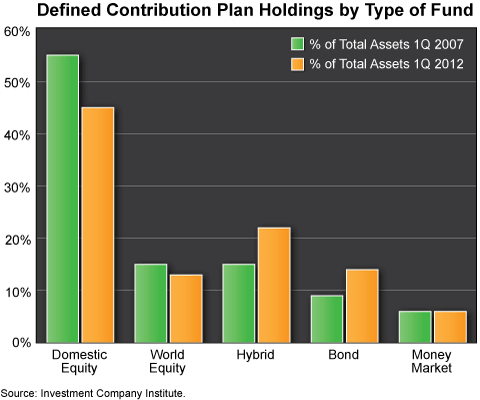
  • Hybrid funds, which tend to be comprised primarily of domestic and foreign stocks and bonds, but can extend into such areas as commodities and REITs, saw their share of the pie rise from 15% in Q1’07 to 22% in Q1’12.
  • One of the more popular hybrid funds for investors in recent years has been target-date funds. These funds adjust their asset mix to achieve a specific objective by a set date, such as the start of one’s retirement.
  • In 2010, target-date fund assets accounted for 12.5% of all holdings in employer-sponsored defined-contribution retirement accounts. They are expected to account for 48% by 2020, according to Kiplinger.
  • Plans are shifting away from the more traditional balanced funds to target-date funds for their qualified default investment alternative (QDIA).

There’s a nice graphic to go along with it to illustrate his point about the growing market share of hybrid funds.

hybrid Are 401k Investors Making a Mistake with Hybrid Funds?

Are 401k Investors Making a Mistake?

Source: First Trust, Investment Company Institute (click to enlarge)

He points out that 401k assets in hybrid funds are rising, but the growth area within the hybrid fund category has been target-date funds. It troubles me that many 401k plans are moving their QDIA option from balanced funds to target-date funds. QDIAs are designed to be capable of being an investor’s entire investment program, so the differences between them are significant.

There is a huge advantage that I think balanced funds have-much greater adaptability to a broader range of economic environments. Balanced funds, particularly those with some exposure to alternative assets, are pretty adaptable. The manager can move more toward fixed income in a deflationary environment and more toward equities (or alternative assets) in a strong economy or during a period of inflation.

Most target-date funds have a glide path that involves a heavier and heavier allocation to bonds as the investor ages. While this might be worthwhile in terms of reducing volatility, it could be ruinous in terms of inflation protection. Inflation is one of the worst possible environments for someone on a fixed income (i.e. someone living off the income from their retirement account). Owning bonds just because you are older and not because it is the right thing to do given the market environment seems like quite a leap of faith to me.

Asset allocation decisions, whether strategic or tactical, should be investment decisions.

Posted by:


The Big Trend: Professional Asset Management Within the 401k

July 10, 2012

According to a Vanguard report, one of the big trends in the 401k market is the move toward professional asset management. An article at AdvisorOne on this topic says:

One-third of all Vanguard 401(k) plan participants invested their entire account balance in a professionally managed asset allocation and investment option in 2011, according to Vanguard’s How America Saves 2012, an annual report on how U.S. workers are saving and investing for retirement.

The report notes that “the increasing prominence of so-called professionally managed allocations—in a single target-date or balanced fund or through a managed account advisory service—is one of the most important trends in 401(k) and other defined contribution (DC) plans today.”

Two things concerned me about the report. I’m not at all surprised by more and more 401k participants moving toward professionally managed allocations. QDIAs (qualified default investment alternatives) make sense for a lot of participants because they are legally allowed to be your entire investment program. I was surprised about the make-up of the account allocations, given the problems encountered by target-date funds during the last bear market.

In 2011, 33% of all Vanguard participants were invested a professionally managed allocation program: 24% in a single target-date fund (TDF); 6% in a single traditional balanced fund, and 3% in a managed account advisory program. The total number is up from 9% at the end of 2005.

I am amazed that target-date funds are preferred to balanced funds. No doubt target-date funds are an improvement over investors hammering themselves by trading in and out, but target-date funds have some well-publicized problems, not the least of which is that they tend to push the portfolio more toward bonds as the target date nears. That could end up exposing retirees to significant inflation risk right at the time they can least cope with it. It seems to me that a balanced fund with some ability to tactically adjust the portfolio allocation over time is a much better solution.

The other significant problem I see is that savings rates are still far too low. Consider these statements from the AdvisorOne article:

The average participant deferral rate rose to 7.1% and the median (the median reflects the typical participant) was unchanged at 6%.

and then…

Vanguard’s view is that investors should save 12% to 15% or more.

I added the emphasis, but it’s easy to see the disconnect. Investors are saving 6%, but they probably need to be saving more than 15%!

Advisors, for the most part, have very little control over their client’s 401k plans. Clients sometimes ask for advice informally, but advisors are often not compensated for the advice and firms are sometimes reluctant to let them provide it for liability reasons anyway. (A few advisors handle client 401k’s through the independent brokerage window, but not every plan has that option and not every firm lets advisors do it. It would be great if the financial powers-that-be could figure out a way to reverse this problem, but the recent Department of Labor regulations appear to be going in the other direction.)

If you’re an advisor, it’s probably worthwhile to have a serious discussion with your clients about their 401k plans. They may not be handling things in the optimal way and they could probably use your help.

401k The Big Trend: Professional Asset Management Within the 401k

Your client may need your help

Source: investortrip.com

Posted by: