Laggards & Energy Today

May 29, 2009

The market staged quite a recovery in the last hour or so of trading today. Throughout the day the RS laggards were outperforming the RS leaders, but that spread widened during the last hour. The best performing groups today were Energy (+6.60%) and Financials (+4.79%). But when you break out performance by quartile and group you can really see where today’s action was:

quartile1 Laggards & Energy Today

The bottom quartile stocks in the Energy and Financial groups were on fire today with returns well above the +2.69% equal weighted average for the universe. The goal of any RS strategy is to avoid the lowest ranked stocks in the universe so it’s tough to capitalize on these types of moves.

Posted by:


Peer Pressure

May 28, 2009

In the 1950′s, a psychologist named Solomon Asch made a startling discovery about the power of peer pressure. He asked experimental subjects to determine the length of one line relative to three other lines. When there was no peer pressure, subjects found it to be a simple test and had 100% correct answers. When there was peer pressure-in the form of confederates of the experimenter who all loudly gave the wrong answer-more than 75% of the subjects also gave an incorrect answer in order not to be out of step with the crowd. It was clear from the control group results that none of the subjects were really confused about the length of the lines, but when faced with group members who all apparently saw the same thing, lots of subjects buckled under.

Every time I see a press release from the CFA Society (full disclosure: I am an affiliate member) that details how many people take the CFA exam every year, I think about Solomon Asch. This year, for example, 128,600 candidates from 154 countries have registered for the June exams. (You can see the press release here.) That is a lot of CFAs in training! There is no doubt that their particular form of fundamental analysis is the dominant method of securities analysis in the world today. More than that, their influence has spread to infect thinking about diversification, asset allocation, portfolio theory and beyond. They’ve developed a large curriculum of readings to reinforce their position and these days it is hardly ever questioned.

Technical analysis is a much older form of securities analysis, one that relies not on theories about how markets operate but on market-generated data such as price and volume. It often continues to be useful when markets don’t operate according to the rules, i.e., most of the time. Technical analysts tend to be a pragmatic lot. They go with what is working, and when it stops working, they get off and go on to the next thing.

The CFA program, in contrast, promotes deep thinking about complex systems, fundamentals, and causation. It doesn’t surprise me that it is hard to be right about things that have so many variables. And I always wonder if they might be missing something by all approaching the problem with the same mindset. Is there pressure to conform to the accepted theories? Do all the lines look the same length to them?

In the financial markets, when everyone is looking at a market and thinking the same way about it, usually it does the opposite of what is expected. I suspect there is a lot of value in approaching asset allocation from a different point of view.

Posted by:


Laggard to Leader?

May 28, 2009

Now that Financials have put up spectacular performance since March 9th, you may be wondering how much further Financials have to go.

To gain some insight into how things may play out, consider how the Technology sector fared following its boom and bust a decade ago.

After initially being a market leader off the bottom of the ’00-’02 bear market, Technology slugged along for years rather than remaining strong.

While anything is possible, I am not counting on Financials to provide market leadership for any extended period of time.

Posted by:


More Dispersion

May 28, 2009

Yesterday I posted about the outperformance of the top decile of RS stocks versus the bottom decile. Today that action was reversed. Most of today’s outperformance came from the bottom deciles of our RS ranks. The top decile of RS stocks were actually down on the day!

decile3 More Dispersion

Energy and Financials had good days, while Consumer Cyclicals, Healthcare, and Consumer Staples all performed much worse than average. Technology, a group that has been gaining a lot of strength lately, was a market performer.

For the first part of the rally off the bottom that began in March, there was consistent outperformance by the lower ranked RS stocks (the laggard rally). It seems we have now moved into a period of increasing performance dispersion between the leaders and laggards. One group dramatically outperforms the other on a day-to-day basis, but there is no follow-through yet one way or the other.

Posted by:


Today’s Performance Dispersion

May 27, 2009

Today’s sell-off was broad based. Breaking out today’s performance by relative strength decile shows just about everything performed relatively close to the universe average….. except the highest and lowest deciles.

decile2 Todays Performance Dispersion

The top relative strength stocks did about twice as well as the equal weighted average of the universe, and the bottom ranked stocks did much worse than the average. The list of bottom decile stocks that dragged down performance is no surprise: GM (on the verge of bankruptcy) and a bunch of financials (SLG, MI, GNW, PL, CNB, SNV, DRE). Could we finally be seeing a turn in the RS spread? Only time will tell.

On a sector basis, Technology continued to outperform the universe averages. Energy stocks, which had underperformed the past couple of days, also performed well.

Posted by:


Emotional Asset Allocation

May 27, 2009

Yesterday, I received a memo on money market fund yields. I had to ask for the memo because I noticed that this particular clearing firm had removed the money market fund yield statistics from their statements. So I was curious. It turned out that the yield on the highest yielding money market funds (1-day yield) was 0.0000365%. If you multiply it out, the memo showed that the 7-day SEC yield was 0.00%. Yes, you read that right! Z-E-R-O. This particular money market fund shall remain nameless, but I am sure that most of their brethren are in the same ballpark.

This is one of the consequences of emotional asset allocation. According to the Investment Company Institute, retail money market funds have current assets of $1.276 trillion dollars. (You can see their press release here.) Much of this, I have to believe, was recently scared into money market funds due to the difficult stock market over the past 18 months. I’m sure some of these investors are consciously holding cash because they have short-term obligations to meet, but the fact remains that something over a trillion dollars is earning bupkis, largely because investors panicked.

It seems to me that some sort of systematic investment process with a long-term time horizon is going to be a much better solution than sitting in cash with a zero return.

Posted by:


Early retirement claims increase dramatically

May 24, 2009

The Social Security system is reporting a major surge in early retirement claims despite the fact that benefits will be reduced by as much as 25% if they retire at age 62 instead of 66.

The correct solutions keep getting put off by Americans: save more, invest wisely, work longer.

Posted by:


Static vs. Dynamic

May 22, 2009

Neal Templin’s column in today’s WSJ, “Honey, I Shrunk the Nest Egg,” is an excellent illustration of the need for Tactical Asset Allocation—even though, on the surface, his column had nothing to do with Tactical Asset Allocation.

“For years, my wife and I have had an understanding. Clarissa would spend the money, and I would save it.

Well, Clarissa is still holding up her end of the bargain, but I’m an abject failure. My company retirement accounts, despite what I thought was a relatively conservative mix, were down close to 35% in early March from the fall of 2007. That, in turn, forced me to do some painful thinking about how much risk I can stomach on my family’s behalf, and how much money we can expect to have in retirement…

My conclusion: My longtime portfolio allocation of 50% stocks and 50% bonds wasn’t safe enough. I’ve already begun gradually trimming back my stock position each time the market rises. When I’m done with this transition — and it could take a couple of years — I will have a portfolio that can better ride out storms. But it will also be a portfolio less likely to produce a big nest egg.” —Neal Templin

I suspect that millions of investors have come to the same conclusion as Mr. Templin—they intend to move to an allocation that is dominated by fixed income so that they never again have to face devastating losses in their retirement savings. Mr. Templin, and many others, make asset allocation decisions in order to create the “ideal” allocation, given their risk tolerance. Up until this bear market, Mr. Templin’s asset allocation consisted of 50% stocks, 50% bonds. Now, he will dramatically overweight bonds.

A Tactical Asset Allocation approach address the issue of managing risk from a totally different perspective. Instead of creating a static asset allocation, a tactical approach shifts exposure to asset classes based on the relative strength of each of the asset classes. Tactical Asset Allocation will certainly experience losses along the way, but it is a much more dynamic approach. Instead of deciding to be either aggressive, moderate, or conservative, a tactical asset allocation simply says that we’ll let the markets determine the allocation.

Posted by:


Correlation Does Not Imply Causality

May 21, 2009

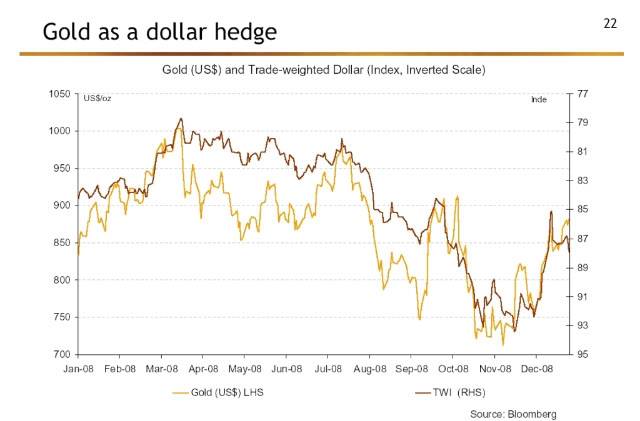
This is an interesting chart that I dredged out of an article by Mebane Faber reporting on a global asset allocation summit. At least during 2008, when the dollar fell, gold went up. (The dollar chart is inverted.) Or is it that when gold went up, the dollar fell? This type of chart can only ever show correlation—and correlation does not imply causality. Who knows what causes what? The problem is that many strategic asset allocation models are built with correlations. The models often assume that the correlations are stable, but experience has shown that they are not. (This is no less a problem for Modern Portfolio Theory.) Models that are built with correlations fail each time there is a regime change where the correlations shift or adjust to a “new” normal. Things that are impossible in finance textbooks happen all the time in real life.

Our Systematic Relative Strength models are not built this way. We look at the relative strength ranking of each item on its own merits. If gold is highly ranked in the Global Macro universe, for example, it would likely be in the portfolio. If the dollar is also highly ranked, it would happily coexist with gold until the rankings dictated that one of them was removed from the portfolio. Relative strength doesn’t make any assumptions about the asset correlations, and we think that is one of its strengths.

 Correlation Does Not Imply Causality

Correlations

Click here for disclosures from Dorsey Wright Money Management.

Posted by:


What’s It Like to Work at Dorsey Wright Money Management?

May 21, 2009

My name is JP Lee, and I’m the youngest member of the team here at DWA Money Management.

John, Andy and Mike have dominated the serious posts so far. I won’t try to compete with them in the data analysis department; instead, I’ll bring a little humanity to the equation. Some soul, if you will. So here goes.

One of the first questions that you ask somebody when you get to know them is, “What do you do for a living?” Depending on who’s asking, I say a number of things.

I’m an assistant at a money management firm.

You know what stocks are, right? I work with stocks.

I work in Pasadena….in an office building.

I stuff envelopes for a living.

Once in a blue moon I’ll meet someone who follows the market or is an investor (I’m 25 years old, I don’t hang out in the Chairman’s Club). It’s always funny to me when people give me their opinions on this stock or that stock, or a brief rundown on what the economy “really” needs to get going again. Rants about corporate greed, the housing market and the next Great Depression, lifted straight out of Newsweek and Time. It’s fun to smile and nod along with market mavens.

At the end of the day, I wear a lot of hats. I answer the phone, send out new client welcome packets, reconcile monthly account statements, and help organize quarterly statements and billing. Every once in a while I might liquidate a new account’s holdings and get the cash ready to invest in the DWA strategy. There’s a lot going on in the office, and there’s only 5 people here. It’s fun and exciting.

As the only member of Generation Y in the office, I consider myself lucky to be here. Just today I saw a headline about college graduates in 2009 that showed that LESS THAN 20% of those who graduate this year will be employed. That’s a scary number.

Stuffing envelopes never sounded so fun. I love this job!

Posted by:


DWA Podcast

May 20, 2009

John Lewis, Tom Dorsey, & Tammy DeRosier discuss market leadership coming out of bear markets, time horizons required for investing in relative strength strategies, and ideas of how to position relative strength strategies as part of an asset allocation.

Posted by:


Systematic Tactical Asset Allocation

May 20, 2009

For those interested in Tactical Asset Allocation, Mebane Faber’s paper A Quantitative Approach to Tactical Asset Allocation is a must read. When tested on various markets, risk-adjusted returns were almost universally improved by using a simple trend-following methodology.

Regular and painful drawdowns in asset classes are just that - regular. TAA is an effective way of addressing those drawdowns.

Posted by:


Wisdom from Peter Lynch

May 20, 2009

The real key to making money in stocks is not to get scared out of them.
-Peter Lynch

One of the most difficult tasks every investor faces is dealing with adversity. Dealing with a strong period of performance is easy, but handling downturns or periods of underperformance is always exceptionally difficult. Relative strength strategies, after having gone through a sustained period of outperformance from 2007 to mid-2008, are currently in a funk. We’ve commented a lot on the recent laggard rally, but that doesn’t mean it’s easy to sit tight.

Peter Lynch’s comment, I think, is very valid-but, of course, it is easier said than done. One thing that might give some comfort is the nature of our systematic process. Our systematic strategy is rules-based and adaptive. While relative strength strategies can go in and out of favor (as now), they typically do not stay out of favor for significant parts of the market cycle. A systematic process will not make giant swings in asset allocation that are emotional reactions to the current market environment. Instead, it will steadily grind away and continue to try to adapt as trends and market themes change over time.

Relative strength strategies have historically outperformed over time, and not getting scared out of the strategy during a period of under-performance is the best way to take advantage of that characteristic.

Posted by:


Stairway To Heaven… Highway To Hell

May 19, 2009

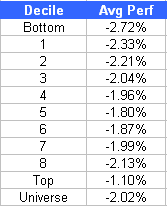
It all depends on your perspective. If you owned a bunch of laggard stocks at the market low you have been climbing the stairway to heaven. If you owned the high relative strength stocks it’s been another story. The performance by relative strength decile from the market low through May 18 is striking. It’s a perfect stair step - it’s also highly unusual. Generally, this graph would show a progression up to the right, not up to the left like it is now. This just indicates how well the laggards have performed during this rally off the bottom. If you owned anything in the top 6 deciles, you underperformed on average!

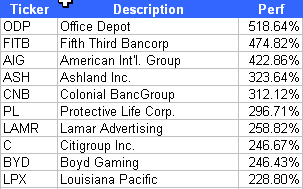
decileperf Stairway To Heaven...  Highway To HellWhat would you have had to own to get the out-sized returns from the laggards? A bunch of stuff that everyone thought was about to go out of business. Here is a list of the top 10 gainers from our bottom decile:

gainers Stairway To Heaven...  Highway To Hell

I’m sure you all owned a bunch of those!

These out-sized returns from the lower deciles are rare. Either the laggards will run out of gas and return to under-performance, or they will keep going and become the leaders. If you are buying high relative stocks it has been a tough environment since the low, but it can’t last forever.

Posted by:


At Least This Is How The Advisor Sees It!

May 19, 2009

Posted by:


The Laggard Rally Continues

May 18, 2009

We are not the only ones to have noticed that the stocks rallying the most since March are poor quality. Here, Bob Doll of BlackRock Inc. also comments on the phenomenon in an article in Investment News. Click here for article.

We would not be so bold as to predict if and when the rally will end, but sustainable bull markets have typically reverted back to the relative strength leaders before long.

Posted by:


The Stock Market and Employment

May 16, 2009

Eddy Elfenbein points out that higher unemployment has coincided with above average stock market returns. Check it out here.

Posted by:


The Only Thing New Under the Sun is the History You Haven’t Read Yet

May 15, 2009

This is the foreword to a stock market book published in 1938. Citizens now want the same thing-economic improvement and security against a repetition of disaster. Then, like now, most are willing to be flexible about the methods as long as the desired outcome is achieved. There is no way to know if we are really heading down the same path as the 1930s, but it is comforting to reflect on the fact that relative strength will continue to adapt regardless of the market circumstances. Ken French’s studies of a simple relative strength model showed that it was able to adapt effectively even during the 1930s. If we ever head into uncharted territory, it’s good to know that our guide is likely to be reliable.

Timing: When to Buy and Sell in Today’s Markets, by John Durand, Copyright 1938.

There are only two kinds of economic systems. In one, private initiative, however circumscribed, is the dominant force. In the other the State is master.

In the year 1929 the American capitalist system seemed secure. Capping a long record of high achievement, it had produced our greatest era of prosperity. It appeared to be a “sound” prosperity—until the dream suddenly blew up before our startled eyes. Then came nearly three years of grinding deflation and rising unrest, out of which was born the political overturn of 1932. A frightened and despairing people turned to the Federal Government for economic guidance.

The New Deal Government had no coherent plan at hand for remaking our economic and social order. Its instinctive leanings were to the Left, but the election had given no mandate on a clear-cut issue between capitalism and collectivism. The people wanted economic improvement and security against a repetition of disaster. They had no composite opinion as to methods.

The Government turned promptly to inflationary measures, threw the full force of its credit into the breach and began launching a series of hastily improvised reforms. For more than three years it pumped deficit-financed purchasing power into the economic system at a rate of some $4,000,000,000 a year. Throughout that period it was the
assumption of the New Dealers and of a majority of the American people that the measures taken were guiding us toward some kind of a modified, reformed and regulated capitalist system—neither the pre-1929 capitalist system nor full collectivism, but a democratic compromise between the two. It was further assumed that this modified system would take over and carry on economic expansion when the time came for tapering off Federal “reflation.”

That time came late in 1936. The Government turned its emphasis from stimulation to control. It believed we were on the verge of a private credit boom, although up to that time the Government itself had been the sole expander of bank credit and private loans had actually declined. Nevertheless, the brakes were set against potential private credit expansion, and the President took public issue with the validity of prevailing price levels.

What followed is painful history now familiar to all. By the fourth quarter of 1937 we were skidding down in the fasted depression of all time. The prestige of political “monetary management” and “economic planning” had suffered a major blow. It became clear that the 1933-1937 recovery cycle was the temporary creation of New Deal spending; that our modified and reformed capitalism was not prepared to carry on when the oxygen of Federal pump-priming was cut off; and that in reality the New Deal had succeeded in paralyzing our former capitalist system without at the same time establishing any effective substitute for it. This brief record is of vital significance to the investor, for the trends therein sketched inevitably imply that 1938 and 1939 will be years of politico-economic transition vastly affecting the future of American business, of profits, of values. Within the space of seven years we have had a depression under private management and a depression under government management. To what will we turn now?

Posted by:


Analyst Biases

May 14, 2009

Jason Goepfert had a nice post on his blog today (check it out here) about analysts’ buy/sell recommendations. A new research paper (available here) shows that sell side analysts are prone to behavioral biases and let their investment banking relationships cloud their judgement.

We have long argued that injecting your emotions and biases into the investment process is problematic. These sell side analysts are smart people and analyze securities for a living - and they can’t even avoid the common behavioral biases that affect all of us! It’s easier said than done to get the emotional biases out of the process. One way is to run a disciplined, systematic process that lets the computer do the day-to-day analysis. All of the human intervention goes into the process upfront in the design phase. This technique requires a lot of experience and know-how to make it work. It’s not something every investor can easily do. What everyone can do, however, is examine your process (assuming you have one) from beginning to end to see where your biases might be creeping in. Setting rules or guidelines for these areas of your process will no doubt improve your results over time.

Posted by:


Frequency of Outperformance

May 13, 2009

Those investors interested in investing based on empirical evidence should find great value in Professor Ken French’s data library http://mba.tuck.dartmouth.edu/pages/faculty/ken.french/data_library.html. His data library contains the returns of models based on various investment factors. At the data library, French has ten portfolios listed by momentum (see “10 Portfolios Formed on Momentum”). He gets his data from the Center for Research in Security Prices at the University of Chicago.

From the beginning of 1927 through the end of 2008, the overall market has returned an average of 9.28% a year. The highest momentum stocks (as defined by 12 month price return) returned an average of 16.83% per year. The frequency of outperformance of high momentum stocks is as impressive as the magnitude of outperformance. The table below shows the percentage of time periods where his highest momentum portfolio outperformed the market.

What’s more, this is just the returns of his value-weighted portfolio. The returns of the equal-weighted portfolio, which gives more weight to smaller-cap stocks, are even more impressive.

Dr. French’s models are completely systematic and emotions are banished.

Anyone care to argue that the markets are efficient?

Posted by:


Today’s Performance

May 13, 2009

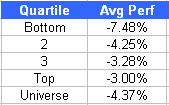
The market got crushed today, but the real damage was in the laggard stocks. These are the stocks that had actually been driving the market higher off the bottom in March. The table shows today’s performance by Relative Strength Quartile:

quartile Todays Performance

The returns above are simple equal weighted returns. Large Caps did much better than mid or small caps today so our Universe return is much worse than a cap-weighted return. But no matter how you look at it, the worst performing area today were the low relative strength stocks.

Insurance stocks did particularly poorly today as did many of the other Financials. On a relative basis, Healthcare and Consumer Staples did much better than the broad market. This has been the case for the past couple of days, and has been a positive development for RS strategies.

Posted by:


Target Date Funds

May 13, 2009

Target Date Funds were first introduced in the 1990s, but their popularity has increased significantly in recent years. From the end of 2005 to March of 2009, target-date-fund assets increased from $66 billion to $152 billion, peaking at $178 billion in 2007, according to Mary Schapiro, chairwoman of the Securities and Exchange Commission.

After the losses sustained in Target Date Funds in 2008, the easy question is whether or not it is prudent to have 45 plus percent of a portfolio, with a 2010 Target Date, allocated to equities.

Crashing into the Target

Source: Craig L. Israelsen, Target Date Analytics, LLC

While these funds are currently receiving criticism for too much equity exposure, in an inflationary environment they will, no doubt, receive criticism for having to much exposure to fixed income.

The bigger question is whether or not it is appropriate to allocate a portfolio based on a target date, and not based on the current merits of the assets in the investment universe. A tactical asset allocation approach (managed using relative strength) allocates based on the current relative strength merits of each of assets in the investment universe…a more enlightened approach, in my opinion.

Posted by:


Good Day For High RS

May 11, 2009

It seems like it has been a long time since the Relative Strength Leaders outperformed the Laggards. Since the market low in March, stocks with poor RS rankings have dramatically outperformed the stocks with high RS rankings. Today that was not the case. The RS leaders outperformed the laggards by a wide margin. If you are implementing a high RS strategy you most likely outperformed the broad market today.

Today’s performance by RS decile stacks up as follows (note, CNB was +50% today and skews the results of the bottom decile):

Decile

Avg Perf

Perf ex CNB

Bottom

-3.61%

-4.41%

1

-4.16%

-4.16%

2

-4.18%

-4.18%

3

-3.13%

-3.13%

4

-2.32%

-2.32%

5

-2.21%

-2.21%

6

-1.61%

-1.61%

7

-1.54%

-1.54%

8

-1.18%

-1.18%

Top

-0.16%

-0.16%

The worst performing macro sectors were Energy and Financials. After an impressive run, bank stocks finally took it on the chin today. Excluding the performance of CNB, our equal weighted Financial sector performance was down more than double the equal weighted performance of the universe.

Posted by:


The Last Shall Be First

May 8, 2009

“So the last shall be first, and the first shall be last.”

Although Jesus probably wasn’t talking about the tendency for the most beaten down stocks in a bear market to become the best performing stocks coming off the bottom, this scripture in Matthew is certainly an accurate description of what has taken place in the stock market over the past two months.

The S&P 500 declined 57% from its peak on October 10, 2007 to its low on March 9, 2009. Over the last two months, the S&P 500 has rallied over 35%. However, the returns of individual stocks has been highly discriminate since the low. To highlight the discrepancy of individual stock returns, consider the table below:

Signal

Column

Avg Return Since 3/9/09

Buy

X

28.12%

Buy

O

45.72%

Sell

X

52.85%

Sell

O

102.24%

The table above categorizes all of the mid and large cap stocks in the S&P 900 by their Point & Figure relative strength rank on March 9, 2009 and shows each group’s performance since that time. For those who may be unfamiliar with Point & Figure Charting, the following explanation may be helpful:

Combination

Description

Buy Signal / Column of Xs

Strong LT RS / Strong ST RS

Buy Signal / Column of Os

Strong LT RS / Weak ST RS

Sell Signal / Column of Xs

Weak LT RS / Strong ST RS

Sell Signal / Column of Os

Weak LT RS / Weak ST RS

Although extremely unpleasant for High RS strategies right now, one of the virtues of RS is its ability to adapt to new leadership over time!

Posted by:


Emotional Asset Allocation

May 8, 2009

The steep losses experienced by investors over the last year and a half have led to many changes in investor behavior. The personal savings rate is ticking up, some measure of frugality has returned to the consumer, and the asset allocation framework in place for many investors is being seriously questioned. Among the changes has been a dramatic reduction in appetite for risk among investors. In fact, 56% of Baby Boomers have now concluded that the stock market is too risky for people their age (San Francisco Business Times, 2/13/09).

This change in appetite for risk is manifested in the floods of money pouring into bond funds, as can be seen in the table below (Investment News, 5/4/09):

Morningstar Category

1Q’09 Net Flows

1. Intermediate-term bond $24,076
2. Precious metals 14,991
3. High-yield bond 7,673
4. Natural resources 6,765
5. Short-term bond 6,210
6. Municipal national short 5,214
7. Long-term bond 4,647
8. Inflation-protected bond 4,551
9. Municipal national intermediate 3,423
10. Intermediate government 3,395

As investors throw their hands up in despair, torn between putting the bulk of their assets in bonds or embarking on an experiment with day-trading financial stocks, I suggest presenting them with the following data. Right now, you may be thinking that you are about to read some fascinating new piece of data. Fascinating is probably not the adjective for life expectancy-data, but perhaps nothing is more important to consider when deciding what changes investors should make right now. The following data is taken from the Centers for Disease Control and Prevention, updated through 2005.

U.S. Life expectancy at birth

Men

75.2 years

Women

80.4

U.S. Life expectancy at age 65

Men

82.2 years

Women

85.0

U.S Life expectancy at age 75

Men

85.8 years

Women

87.8

Emotions are running extremely high right now, which means that investors are very susceptible to making poor investment decisions. Any radical changes in framework for asset allocation should be done with the long-term in mind, especially now. Keep in mind that life expectancy means that one-half of the sample will live shorter than the expectancy, and one-half of the sample will live longer. After all, it is very likely that many of your clients will live well in to their eighties or nineties. With that in mind, a diversified bond portfolio doesn’t make a whole lot of sense; nor does it make much sense to embark on some unproven trading strategy.

When empirical evidence is used, relative strength and tactical asset allocation appear in a very favorable light.

Posted by: