Frequency of Outperformance

May 13, 2009

Those investors interested in investing based on empirical evidence should find great value in Professor Ken French’s data library http://mba.tuck.dartmouth.edu/pages/faculty/ken.french/data_library.html. His data library contains the returns of models based on various investment factors. At the data library, French has ten portfolios listed by momentum (see “10 Portfolios Formed on Momentum”). He gets his data from the Center for Research in Security Prices at the University of Chicago.

From the beginning of 1927 through the end of 2008, the overall market has returned an average of 9.28% a year. The highest momentum stocks (as defined by 12 month price return) returned an average of 16.83% per year. The frequency of outperformance of high momentum stocks is as impressive as the magnitude of outperformance. The table below shows the percentage of time periods where his highest momentum portfolio outperformed the market.

What’s more, this is just the returns of his value-weighted portfolio. The returns of the equal-weighted portfolio, which gives more weight to smaller-cap stocks, are even more impressive.

Dr. French’s models are completely systematic and emotions are banished.

Anyone care to argue that the markets are efficient?

Posted by:


Today’s Performance

May 13, 2009

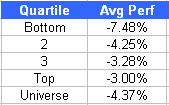
The market got crushed today, but the real damage was in the laggard stocks. These are the stocks that had actually been driving the market higher off the bottom in March. The table shows today’s performance by Relative Strength Quartile:

quartile Todays Performance

The returns above are simple equal weighted returns. Large Caps did much better than mid or small caps today so our Universe return is much worse than a cap-weighted return. But no matter how you look at it, the worst performing area today were the low relative strength stocks.

Insurance stocks did particularly poorly today as did many of the other Financials. On a relative basis, Healthcare and Consumer Staples did much better than the broad market. This has been the case for the past couple of days, and has been a positive development for RS strategies.

Posted by:


Target Date Funds

May 13, 2009

Target Date Funds were first introduced in the 1990s, but their popularity has increased significantly in recent years. From the end of 2005 to March of 2009, target-date-fund assets increased from $66 billion to $152 billion, peaking at $178 billion in 2007, according to Mary Schapiro, chairwoman of the Securities and Exchange Commission.

After the losses sustained in Target Date Funds in 2008, the easy question is whether or not it is prudent to have 45 plus percent of a portfolio, with a 2010 Target Date, allocated to equities.

Crashing into the Target

Source: Craig L. Israelsen, Target Date Analytics, LLC

While these funds are currently receiving criticism for too much equity exposure, in an inflationary environment they will, no doubt, receive criticism for having to much exposure to fixed income.

The bigger question is whether or not it is appropriate to allocate a portfolio based on a target date, and not based on the current merits of the assets in the investment universe. A tactical asset allocation approach (managed using relative strength) allocates based on the current relative strength merits of each of assets in the investment universe…a more enlightened approach, in my opinion.

Posted by: