Rogoff and Ferguson on the Global Economy

October 29, 2009

Click here to listen to a fascinating discussion on Bloomberg with Kenneth Rogoff and Niall Ferguson about the global economy. Rogoff is an International Chess Master, Harvard professor, and former Director of Research at the International Monetary Fund. Ferguson is a British historian, Harvard professor, and author of The Ascent of Money.

The issues that they discuss have a direct impact on all of our investments. They are big fans of emerging markets, commodities, and think that it will actually be good for America if we were to see double digit inflation in the coming years.

After listening to Rogoff and Ferguson, you may find the presentations on our Global Macro strategy to be especially interesting. Click here to view (financial advisors only).

Click here for disclosures from Dorsey Wright Money Management.

Posted by:


The Rise of the Rest

October 28, 2009

…We are now living through the third great power shift of the modern era. It could be called “the rise of the rest.” Over the past few decades, countries all over the world have been experiencing rates of economic growth that were once unthinkable. While they have had booms and busts, the overall trend has been unambiguously upward. This growth has been most visible in Asia but is no longer confined to it. That is why to call this shift “the rise of Asia” does not describe it accurately…

…Look around. The tallest building in the world is now in Taipei, and it will soon be overtaken by one being built in Dubai. The world’s richest man is Mexican, and its largest publicly traded corporation is Chinese. The world’s biggest plane is built in Russia and Ukraine, its leading refinery is under construction in India, and its largest factories are all in China. By many measures, London is becoming the leading financial center, and the United Arab Emirates is home to the most richly endowed investment fund. Once quintessentially American icons have been appropriated by foreigners. The world’s largest Ferris wheel is in Singapore. Its number one casino is not in Las Vegas but in Macao, which has also overtaken Vegas in annual gambling revenues. The biggest movie industry in terms of both movies made and tickets sold, is Bollywood, not Hollywood. Even shopping, America’s greatest sporting activity, has gone global. Of the top ten malls in the world, only one is in the United States: the world’s biggest is in Beijing. Such lists are arbitrary, but it is striking that only ten years ago, America was at the top in many, if not most, of these categories…

…At the politico-military level, we remain in a single-superpower world. But in every other dimension-industrial, financial, educational, social, cultural-the distribution of power is shifting, moving away from American dominance. That does not mean we are entering an anti-American world. But we are moving into a post-American world, one defined and directed from many places and by many people…

The Post-American World, by Fareed Zakaria

What kinds of opportunities and challenges do these changes present to the U.S. investor? Many will succumb to home-country bias and keep their investments in just U.S. securities. Others will internalize these changes and will broaden their investment universe, they will change their approach to asset allocation, and they will position themselves to capitalize on the investment opportunities wherever they may be found in the world.

Posted by:


Building Bridges

October 27, 2009

In article entitled “Mentor Your Boss,” in the WSJ, the author briefly examines new ways that younger employers are contributing at work. A lot of the commentary surrounding the United States’ newest generation of workers has focused on the negative aspects of this ADD-addled group. No deep motivation to get the job done, wanting a raise right off the bat, the need for immediate recognition and ego-stroking. These characteristics have been broadly attributed to an entire generation of young adults, who are entering the job market in record numbers during a deep recession.

Employers are finding out that these whipper-snappers have a huge edge in figuring out how to maximize exposure & efficiency on social networking sites like Facebook and Twitter. Managers are turning to younger employees for new-media marketing solutions.

It’s a brief article, but worth the quick read. To me, the most important concept here is for younger employees to establish a “real” connection with their managers. A CEO who was interviewed for the article said, “Usually, I’m mentoring [younger] employees. This gives them this…powerful opportunity to mentor me so that I get to know them and to respect the talent that they have.”

Ultimately, the Olds are going to catch up with the Youngs in certain respects. How hard is it to set up a blog or a Facebook page? Not very. What’s important here is that bridges are being built between the generations to facilitate learning, improvement and a mutual understanding.

The Youngs and the Olds are going to need those communication bridges for the great Social Security Debates coming soon to a Town Hall near you!

Posted by:


Some Perspective

October 27, 2009

Given that the S&P; 500 Total Return Index has lost an annualized 1.45% this decade, it is only natural that investors rethink their commitment to equities. Some historical perspective is helpful. The table below shows the returns of the S&P; 500 since 1918 (S&P; 90 before 1957):

Source: Global Financial Data

That’s right – still 10.09% annualized return over a stretch of nearly 92 years that saw horrible world wars, peace, booming economies, depressions, good politicians, bad politicians and everything in between.

We will be the first to admit that indexing may not be appropriate for everyone. In fact, many of our products follow a methodology that seeks to rotate into other asset classes during extended periods of weakness in U.S. equities. However, it hard to look at the table above and not realize that the stock market offers the masses access to one of the most effective ways to build real wealth over time known to man.

Posted by:


Fed Kicks Out the Stool

October 27, 2009

We are about to see an interesting collision in the bond market. On the one hand, we’ve seen record buying of bonds by retail investors this year. On the other hand, we’ve seen record issuance of debt by the Federal government. This week, on October 29, the Fed is planning to end their $300 billion Treasury support program, where they’ve been buying up Treasurys to help soak up the heavy supply. A spooky prospect for Halloween, indeed.

Posted by:


Coincidence? I think not!

October 26, 2009

The WSJ reports that weekday circulation for the largest U.S. newspapers dropped 10.6%, based on a cumulative average for the six months ended Sept. 30 compared to a year earlier. It was the sharpest falloff in more than a decade.

In related news, Dorsey Wright’s blog was launched in early 2009!

Posted by:


Economists Forgot One Little Thing

October 26, 2009

We have a finite supply of fossil fuel and economic models don’t take that into account. Oops.

Incorrect assumptions in models of reality can lead to big problems in the real world. This article is eye-opening on a topic that no one else is thinking about. I can’t think of a more important reason to use an adaptive, systematic investment process. A lot of things could put us into a ditch—things we don’t necessarily see coming from a long way off—but a systematic model just keeps adapting to what is actually happening in real time. It allows tactical adjustment as conditions change.

Posted by:


Treasury Tries to Lock In Low Rates

October 26, 2009

Apparently even the U.S. Treasury expects inflation to be higher in the future, as they are planning to extend the duration on the Federal debt. As a citizen, I’m happy to see them do this—it saves all of us money. If I had the bulk of my assets in bonds, however, I would be signficantly less excited. There are only a few practical things that can be done to alleviate the deficit as a percentage of GDP: 1) cut spending, 2) increase taxes, or 3) inflate. Congress shows no inclination to cut spending and the public shows no inclination to support higher tax rates on themselves. Inflation doesn’t require anyone to vote and might turn out to be the path of least resistance.

Posted by:


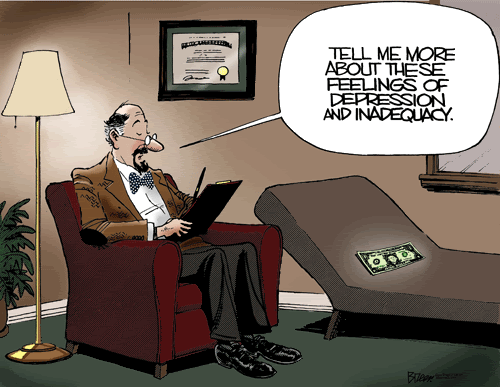
Look Who’s In Counseling

October 26, 2009

Posted by:


Weekly RS Recap

October 26, 2009

The table below shows the performance of a universe of mid and large cap U.S. equities, broken down by relative strength decile and quartile and then compared to the universe return. Those at the top of the ranks are those stocks which have the best intermediate-term relative strength. Relative strength strategies buy securities that have strong intermediate-term relative strength and hold them as long as they remain strong.

Last week’s performance (10/19/09 – 10/23/09) is as follows:

Pretty good week in relative performance for high relative strength stocks as the top quartile outperformed the universe returns. High relative strength stocks have had a good showing for three out of the last four weeks.

Posted by:


Stops Degrade Performance

October 23, 2009

Ok,I wrote that just to tweak you. But it is true–most of the time. Perry Kaufman, in his book Smarter Trading discusses (and provides evidence) stops and the effect they have on trading systems. Most of the time, they make your performance worse–but that doesn’t mean you can do without risk management entirely. At the very least, you need some kind of catastrophe insurance, whether it is a very wide stop loss or some kind of exposure regulation for an entire portfolio.

This graphic from our friend at Blackstar Funds, Eric Crittenden, by way of Michael Covel’s Trend Following website, shows that a lot more stocks go boom than academics would predict, making that catastrophe insurance quite handy. And they don’t always come back, by the way, a fact that makes bottom-fishing kind of like running through a dynamite factory with a match. You might live, but you’re still an idiot.

Posted by:


Common Flaws in Investor Thinking

October 23, 2009

D.E. Shaw is one of the largest quantitative funds in the world ($30 billion or so) and David Shaw himself is reputed to be worth over $2.5 billion. The firm has more than a little investment knowledge.

This Market Insights piece from D.E. Shaw discusses some common errors, especially in path dependence and continuity, that investors make. Worth the time to read.

Posted by:


Performance Chasing

October 23, 2009

Jason Zweig, in an interview with Morningstar, points out that performance chasing is seen in all parts of the investment world:

There was a beautiful study that was published in the The Journal of Finance a couple of years ago about the selection of institutional money managers. It basically found that the professionals who pick money managers, in this case it was pension funds, tend to buy high and fire low. They invest in whichever managers have the best trailing three-year performance and then sell whichever have the worst trailing three-year performance. The study showed that if they had flipped their decisions–if they had bought the ones with the worst three-year performance and sold the ones with the best–they actually would have gotten better returns. And of course if they had done nothing–if they had just put the portfolio on ice–they also would have done better. Performance-chasing, despite all the propaganda you hear in the financial industry, is not purely the province of retail investors. It’s not the so-called “dumb money” on Main Street that buys high and sells low. Everyone does it.

You have three choices: you can go with a manager when they are hot, you can go with a manager when they are cold, or you can do nothing. Investors, in aggregate, make the worst choice of the three! If you don’t have the emotional resilience to go against the grain, at least have the patience to sit on your hands.

Posted by:


Dollar Bonds

October 23, 2009

This is an indication of how comfortable everyone feels forecasting a further decline in the dollar. Pay your interest in dollars–it’s practically free! Russia is not alone in this, by the way. Google around for a few minutes and you will find that lots of people are getting in on the act.

The only people in the world who are not aware of the weak U.S. dollar are American investors.

Posted by:


What It Takes to Manage Money

October 23, 2009

William Bernstein has an eclectic background and is well-known in the world of finance. He’s done a lot of thinking about asset allocation and runs the Efficient Frontier website as well. An excerpt from the foreword of his new book has a discussion of the qualities it takes to manage money well. The emphasis is mine.

Successful investors need four abilities. First, they must possess an interest in the process. It is no different from carpentry, gardening, or parenting. If money management is not enjoyable, then a lousy job inevitably results, and, unfortunately, most people enjoy finance about as much as they do root canal work.

Second, investors need more than a bit of math horsepower, far beyond simple arithmetic and algebra, or even the ability to manipulate a spreadsheet. Mastering the basics of investment theory requires an understanding of the laws of probability and a working knowledge of statistics. Sadly, as one financial columnist explained to me more than a decade ago, fractions are a stretch for 90 percent of the population.

Third, investors need a firm grasp of financial history, from the South Sea Bubble to the Great Depression. Alas, as we shall soon see, this is something that even professionals have real trouble with.

Even if investors possess all three of these abilities, it will all be for naught if they do not have a fourth one: the emotional discipline to execute their planned strategy faithfully, come hell, high water, or the apparent end of capitalism as we know it. “ Stay the course ” : It sounds so easy when uttered at high tide. Unfortunately, when the water recedes, it is not. I expect no more than 10 percent of the population passes muster on each of the above counts. This suggests that as few as one person in ten thousand (10 percent to the fourth power) has the full skill set. Perhaps I am being overly pessimistic. After all, these four abilities may not be entirely independent: if someone is smart enough, it is also more likely he or she will be interested in finance and be driven to delve into financial history.

But even the most optimistic assumptions — increase the odds at any of the four steps to 30 percent and link them — suggests that no more than a few percent of the population is qualified to manage their own money. And even with the requisite skill set, more than a little moxie is involved. This last requirement — the ability to deploy what legendary investor Charley Ellis calls “ the emotional game ” — is completely independent of the other three; Wall Street is littered with the bones of those who knew just what to do, but could not bring themselves to do it.

I am most interested in the emotional game. We use a systematic investment process that is objective and unemotional for just that reason, but our firm is rare in the industry. Most everyone else flies by the seat of their pants for security selection and asset allocation. It’s very possible to have some remarkable successes that way when you hit something just right, but it’s very difficult to sustain the success, especially when, as Bernstein phrases it, the tide goes out.

I was working late last night on proxies (fun, fun) and happened to answer a call from an investor interested in using our services. He talked a good game, told me all about his views on the dollar and the market, and told me that he was a “sophisticated investor.” But what had he done? He was invested with a value manager and hung in until November 2008, when he finally lost his nerve and sold out. He mocked the value manager for continuing to buy on the way down because securities were perceived bargains, although that is pretty much the job description for a value manager. He felt good that he had missed a few months of the bear market, from November to March 2009. But he never had the nerve to get back in, and railed against the rise in the market as a “false rally.” I’m sure that characterizing market action that way helped ease the sting of completely missing the boat. Since the S&P; 500 is now higher than it was in November, his emotions have cost him a fair amount of money. This is a very typical investor and a very typical sequence–the first story or impression you get is rarely the whole story. The client was pretty sophisticated about markets, but totally lacking in emotional resilience.

Following the path of least emotional discomfort is a road to failure. In my view, using a tested, systematic process is the only way to succeed in the very long run.

Posted by:


Quantitative Easing and the Dollar

October 23, 2009

This article in The Economist discusses the plight of the U.S. dollar. Near the end of the article, the two horns of the dilemma are delineated: currency weakness/quantitative easing or rapidly rising interest rates. It comes down to supply and demand. If the world is flooded with dollars from easing, the dollar will stay weak. But if the easing stops, interest rates will shoot up.

This pretty much reflects the consensus view of the dollar. Everyone is bearish now, as if dollar weakness was a foregone conclusion. I don’t know how everything will settle out, but I do know that lots of things happen in markets that finance textbooks say are impossible. It might be wiser to give your portfolio a large amount of tactical flexibility to respond to surprising developments, as opposed to locking yourself into one view.

Posted by:


Correlation Misbehavior

October 23, 2009

Gamblers dream of achieving a trifecta: picking the first three horses, in the right order, in a given race. The payout is huge but so are the odds against success.

The same could be said, in financial markets, of a strategy that backed equities, gold and government bonds. The three asset classes do not tend to perform well at the same time. Both gold and equities can be classed as inflation hedges but government bonds are hard hit by higher consumer prices. Both gold and government bonds could be bracketed as havens for risk-averse investors but equities are definitely classed as risky assets.

The bet has paid off this year, however. According to Dhaval Joshi of RAB Capital, a fund-management firm, the three asset classes have all produced double-digit returns over the past three months. That has occurred only twice before in the past 50 years.

Read more here.

Moral of the story: don’t rely on historical correlations to forecast future correlations.

Posted by:


Rethinking the 401k

October 22, 2009

Time recently carried a long article that, depending on your point of view, is an expose of the problems with 401k plans or a hatchet job. The article relates the problems with 401ks by telling the stories of a number of retirees from Occidental Petroleum, which was one of the first large corporations to adopt this type of defined contribution plan. The writers contend that in most cases, the employee would have been better off in a traditional defined benefit pension plan. So let’s take a look at their criticisms of the 401k.

The first retiree case study is Robert Shively. He is now age 68 and holds a part-time job. The article suggests that he would have been better off with a fixed $1308/month pension than his current pension of $405/month plus his $70,000 remaining 401k balance. A lot of information is missing, so it’s hard to tell what the deal is. We don’t know when Mr. Shively retired, what his original 401k balance was, what percentage of his income he was saving in his 401k while he was working, and how much he is spending. So despite the article’s contention, I think the information here is inadequate to make a reasonable judgement.

The second retiree case study is Ernie Lucantonio. He retired in 2005 at age 57 with $350,000 in his 401k. The article implies that he would have been better off with a pension of $3,100/month. Ernie, too, took a part-time job. Elsewhere in the article, it states that Mr. Lucantonio was saving 6% of his salary in his 401k. So what is the culprit here? Is it the 401k or is it the fact that the client a) needed to save much more than 6%, probably 10-15%, b) retired early, and c) retired with inadequate savings? It’s also not clear what Mr. Lucantonio’s spending habits are like because it does indicate that he bought a tricked-out vacation cabin after he retired. Score: 401k 1, client’s financial planning and acumen 0.

The third retiree case study is Dennis O’Neil. He also retired early, but the article does not say when. He is now age 63 and has $500,000 left in his 401k. The article suggests he would have been better off to have a defined benefit pension payment of $2,200/month. Mr. O’Neil is worried about running through his 401k in the next decade, and no wonder! The article says he spends $75,000 per year. Somehow, no matter how I do the math, the great pension of $2,200/month comes to only $26,400 annually, which would still not even come close to supporting Mr. O’Neil’s spending habits. (Mr. O’Neil is trying to play the market to stay in the clover–always a clever idea for retirees.) Again, what is the culprit here? Is it the 401k or is it the fact that the client a) retired early, b) with inadequate savings, and c) is overspending to an enormous degree? Score: 401k 2, client’s financial planning and acumen 0.

The article cites the biggest problem with 401ks as the fact that they could drop a lot in the year you decide to retire. Apparently, risk management and asset allocation do not enter the equation–like maybe it would be a good idea to scale back your risk level in the few years before you retire. The proposed solution to the 401k crisis is to pay into a plan that will give you a guaranteed income–you put in 6% of your salary and get a guaranteed 26% of your salary in retirement. Wait a minute here! Didn’t Mr. Lucantonio save 6% of his salary in his 401k? If he had had the miracle income guarantee plan suggested by Time, with his pre-retirement salary of “nearly $80,000,” he would be able to draw a guaranteed income of $20,800 ($80,000 x .26) or $1,733/month. Or alternatively, Mr. Lucantonio could take his stated $350,000 401k balance when he retired and buy an immediate annuity. I went on to an immediate annuity website to calculate what a joint annuity would be. Guess what–$1,735/month! Of course, interest rates were a little higher in 2005 when Mr. Lucantonio actually retired, which likely would have made for a larger payout. If the annuity did not cover a spouse, the payout is also higher by $200/month or so. Son of a gun! The miracle program is apparently already in existence, disguised as an immediate annuity.

Certainly a lot can be done to improve client’s retirement readiness with a 401k. Help with investment decision-making, counseling on the appropriate savings level, and assistance with asset allocation and risk management are all needed. And let’s not forget why individuals clamored for 401k plans in the first place: the age of lifetime employment was over and workers were tired of forfeiting pensions with 5-year or 10-year cliff vesting when they changed jobs. 401k plans are portable and always fully vested.

After reading the article carefully, almost every problem these retirees are having has little to do with the structure of the 401k plan. Almost every problem stems from:

1. inadequate savings rate

2. overspending

3. lack of risk management and/or poor asset allocation decisions as client nears retirement

4. lack of knowledge of other retirement income products

I find it hard to believe that any competent financial advisor would have suggested retirement, let alone early retirement, to any of these individuals. And let’s face it: math is math. If you don’t save enough while you are working, you won’t have enough when you retire. There’s no magic income guarantee plan that doesn’t exist already. You might want to read this article, because investors are reading it and they need answers.

Posted by:


Sector Relative Strength Charts

October 22, 2009

The charts below show the relative strength of the S&P; 500 sectors versus the overall index.

(Click to Enlarge)

Source: Bespoke Investment Group

Consumer Discretionary, Technology, and Materials all have great looking relative strength charts. Not so much for some of the others.

Posted by:


The SRI Concern

October 22, 2009

There is an unspoken concern that many investors have about Socially Responsible Investing (SRI). In short, the concern is that if you invest in socially responsible companies, your investments will not do very well, or at least not as well as they would have otherwise. I was reminded of this recently while reading an article by Stephen Mauzy, CFA of The Motley Fool. While I recognize that the article was meant to be humorous, (not that I find the idea of mixing firearms and alcohol to be funny) it still perpetuates the concern that there will be a performance penalty with SRI.

When we put together an SRI account, we took a different approach. We knew that our core systematic relative strength strategy had historically outperformed. The challege was to adapt that same process in an SRI account.

We engaged KLD Research & Analytics to screen our universe of domestic mid- and large-cap stocks for environmental, social, and corporate governance factors. KLD goes about their screening in an interesting way. Rather than taking the typical approach of throwing out certain companies on an absolute basis because of their involvement with some perceived negative, KLD groups companies by industry and then boots the companies that score the worst on their environmental, social, and corporate governance scales. It allows the investment universe to have broad industry representation, which is not necessarily typical of other SRI screening processes. The advantage for the manager is that we can get exposure to every industry, so that we can potentially benefit when that industry is in favor.

Our next step was to apply the exact same core systematic relative strength process to the screened SRI universe as we do to our standard mid- and large-cap universe. Lo and behold, the long-term performance is virtually identical between the two universes! Same process, same results, even though one universe has low-scoring SRI companies removed. It turns out that there is no functional difference between our regular core account and our SRI core account. As a result, clients need not have any trepidation about a performance penalty in SRI. You can do well even when doing good.

Posted by:


Drudge Did It

October 21, 2009

The real reason for the dollar’s decline: Drudge did it.

Posted by:


New All-Time High For AAPL

October 20, 2009

AAPL, the largest holding of the DWA Technical Leaders Index (basis for managing PDP) has now hit an all-time high after reporting a 47% jump in quarterly profit.

Top Holdings for the DWA Technical Leaders Index as of 9/30/09:

This has been a great year for PDP. Through 10/19, PDP is +26.57% while the S&P; 500 is +21.55%.

Posted by:


Weekly RS Recap

October 19, 2009

The table below shows the performance of a universe of mid and large cap U.S. equities, broken down by relative strength decile and quartile and then compared to the universe return. Those at the top of the ranks are those stocks which have the best intermediate-term relative strength. Relative strength strategies buy securities that have strong intermediate-term relative strength and hold them as long as they remain strong.

Last week’s performance (10/12/09 – 10/16/09) is as follows:

The relative strength laggards had the best performance last week, following two weeks of strong performance for the relative strength leaders.

I suspect that the further we get from the bear market low, the better that relative strength strategies will perform. There always seems to be major changes in leadership following bear market lows and it takes time for new leadership to assert itself.

Posted by:


Capital Flight Hits the U.S.

October 16, 2009

Unstable regimes often have capital flight. The citizens with cash decide that it is no longer a wise idea to keep their money in the country, so out it goes. (One of the reasons that there are so many Cuban-Americans in Miami, for example, is because that is where a lot of the money went when Castro came to power. Either people followed their money out of the country, or the money came with them.)

The political and economic stability of the U.S. has been a great advantage. We have been the beneficiary of capital flight from all sorts of regimes around the world. In New York, Chicago, Washington D.C., and Los Angeles you can literally find neighborhoods or authentic restaurants with emigres from every corner of the globe. Since the citizens with money are often also the best educated, the U.S. has also been the beneficiary of “brain drain” from numerous countries, especially those with repressive policies or few economic opportunities.

In recent months, however, the U.S. has seen capital drain out of the economy. It’s not entirely clear why this is happening and not all of the possible explanations are negative. Still, with the recent weakness of the dollar, it’s something to keep an eye on.

Posted by:


Housing Market Shows Massive Improvement

October 15, 2009

Wouldn’t it be nice if this headline were true? In fact, things in the housing market are still going the other way. Foreclosures are continuing to rise despite all of the efforts to stop them. And according to some sources, banks are stalling on foreclosures because they really don’t want to deal with more property right now.

In spite of obviously bad fundamentals in the real estate market, real estate stocks are doing very well. This is probably the underlying reason why emotional asset allocation is so unsuccessful. The news is scary, but if you had reacted to it with fear and sold, you would have made a poor decision as the stocks have been very good. The Alice-in-Wonderland quality of the financial markets gives retail investors fits–sometimes it just doesn’t seem to make sense. On the other hand, if you are using a systematic trend-following process, you go with what is, not with what you think is going to happen based on your intuition or fears. The disconnect is often because investors wrongly believe that the stock market reflects reality, when, in fact, it reflects expectations. (Expectations aren’t always accurate, by the way. When new information causes them to change dramatically, it can make for turbulent markets.)

As the old saying goes, in theory there is no difference between theory and practice. In practice, there is.

Posted by: