Buy-and-Really-Hold Will Suck Your Portfolio Dry

June 7, 2010

It’s not often that a passive investor committed to Modern Portfolio Theory will help make our case for active management based on relative strength, but heck, we’ll take any help we can get.

In this guest article from Money Magazine, William Bernstein of Efficient Frontier Advisors discusses findings from a study by Dimensional Fund Advisors. The article gets to the thesis early:

It’s a little-known and depressing fact, but the majority of individual securities tend to post negative returns over the long run.

This, I think, is a ringing indictment of buy-and-really-hold investing. Often individuals assume that they can purchase shares of leading companies, shower them with benign neglect, and have the portfolio perform well. But, of course, today’s leader always turns into tomorrow’s laggard. The majority of stocks, given enough time, collectively lose money. Mr. Bernstein goes on to say,

In fact, researchers at the investment management firm Dimensional Fund Advisors found that from 1980 to 2008, the top-performing 25% of stocks were responsible for all the gains in the broad market, as represented by the University of Chicago’s CRSP total equity market database.

As for the bottom 75% of stocks in the U.S. market, they collectively generated annual losses … over the past 29 years.

The following chart shows that if you miss the best 25% of stocks, you will end up losing more than 2% per year.
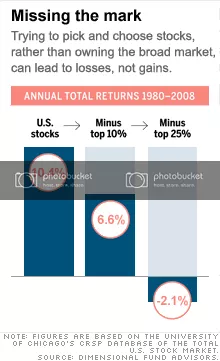
Source: Money Magazine and Dimensional Fund Advisors

The chart is offered as evidence of the futility of stock picking and the triumph of index investing. What it really reveals is this: index investing would be an abject failure if it weren’t for two things: 1) active management and/or 2) relative strength weighting. First, if indexes didn’t replace companies that went out of business or were no longer “representative,” they’d have a buy-and-hold portfolio that, by their own calculations, would lose money. Replacing losers (dead companies) with winners (live companies) is, in fact, an efficient casting out process used for active portfolio management. Second, index returns are helped immensely by increasing the weighting of the stocks that go up the most. This is actually a form of relative strength weighting, more commonly referred to by index providers as “capitalization weighting.” Emphasizing the winners at the expense of the losers also tends to help returns over time.

The alert reader will quickly discern that ”missing the best 25% of stocks” is another version of the “if you miss the 10 best days” argument. There’s one problem: while it may be impossible to pick out the 10 best days, there’s a ton of evidence to suggest that it is possible to select the strongest stocks using relative strength. Even efficient market theorists like Eugene Fama and Kenneth French have admitted that relative strength works.

Bernstein writes:

This may get you thinking: If a small list of securities accounts for the market’s long-term returns, why not avoid all the headaches and losses you’ve suffered recently by carefully choosing these superstocks?

That’s exactly what I’m thinking! Why not, indeed! I’d rather own the superstocks. And I will even let Ken French pick the stocks. Instead of buying an index fund, I’m going to let Ken French buy the best recent performers and cast out the stocks that weaken each month. This chart comes from Dr. French’s own website and shows the equity curve for large-cap, high relative strength stocks since 1927.
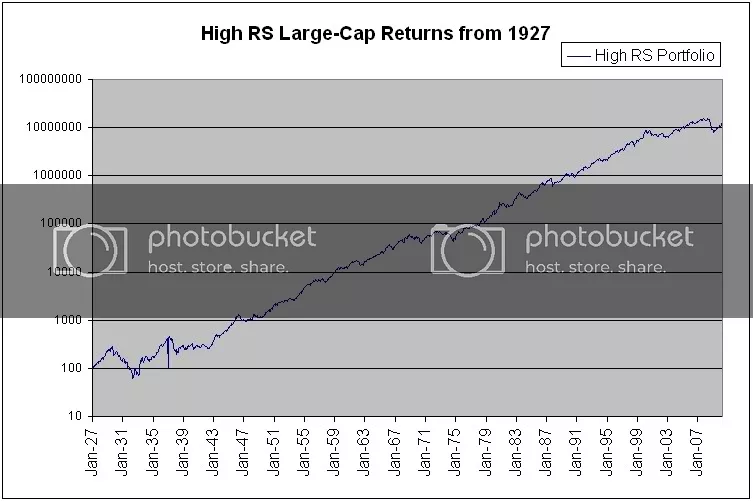
As an investor, you have three basic options. You can buy-and-really-hold which will insure that most of the companies you buy will lose money over a long time frame. You can buy an index fund, which will tend to perform better than buy-and-really-hold due to the hidden active management process of casting out and/or through capitalization weighting. Or you can identify the strongest stocks and use both casting out and relative strength weighting to manage the portfolio. Option 3 has historically provided the best returns, but it will be volatile and will go through periods of drawdown. (Of course, Options 1 and 2 will also be volatile and will go through periods of drawdown!)

As a result, I see no reason not to prefer active management using a systematic relative strength process. It’s always interesting to me how investors with a passive approach can selectively pull out data that they then claim supports an indexing approach. [Note: a major part of the reason for the cognitive dissonance in Dimensional Fund Advisors' data has to do with the original research source. The finding that 25% of all stocks account for all of the market's gains came from a Blackstar Funds research paper, The Capitalism Distribution. Blackstar's own interpretation of the findings was that such a skewed distribution of returns supported a trend-following method focused on strong stocks--exactly opposite of what DFA suggests! We happen to agree with Blackstar.]


Stock Market Investing: Not for Cupcakes

June 7, 2010

Investors are quite skittish these days. 2001-2002 was bad enough, but then 2008 came along. Most investors lost a boatload of money, in some cases enough to get them to swear off investing altogether. Although that may be understandable from a certain perspective, it’s probably not the way to go. The reality is that market volatility is to be expected. Charlie Munger, Warren Buffett’s investing partner at Berkshire Hathaway, rather unsympathetically expounds on what investors should expect (my emphasis added):

“I think it’s in the nature of long term shareholding of the normal vicissitudes, of worldly outcomes, of markets that the long-term holder has his quoted value of his stocks go down by say 50%. In fact you can argue that if you’re not willing to react with equanimity to a market price decline of 50% two or three times a century you’re not fit to be a common shareholder and you deserve the mediocre result you’re going to get compared to the people who do have the temperament, who can be more philosophical about these market fluctuations.”

I’ve seen plenty of people react to a 50% decline, but not usually with equanimity! The always excellent Psy-Fi blog has this further comment:

Munger is, as usual, spot on the money. It turns out that the odds of a 50% drawdown in any investor’s portfolio during an investing lifetime are virtually 100%. Dabble in stocks for long enough and you’re bound to lose half your net worth in a single swoop. In some recent research Guofu Zhou and Yingzi Zhu have set about demolishing the idea that our most recent set of calamities are surprising.

In other words, what markets are going through right now-although it’s clearly the unpleasant part-is just part of the normal cycle of investing. The problems come when investors create drama over what should be expected. It might be healthier to imagine one’s portfolio as having a wide range of possible values, as opposed to taking mental ownership of the equity value reflected on your best monthly statement. Psy-Fi has a couple of suggestions for reducing the unnecessary drama:

…intelligent investors should mange their holdings with the expectations that they’ll lose 50% of their value at some point. The main aim should be to ensure that such a drawdown is a temporary measure and, if you’re invested in good enough stocks, this should surely prove to be the case over a few years. This is the lesson of behavioural finance: be humble in the face of the markets, diversify wisely and don’t use leverage.

That’s a pretty good prescription: 1) think long term, 2) diversify effectively between strategies, and 3) don’t use leverage. Patience always helps, because drawdowns in most sound strategies are temporary. Diversification between strategies (not necessarily just asset classes) can help mitigate drawdowns too. We find, for example, that high relative strength strategies blend nicely with deep value strategies. Finally, the absence of leverage gives you the staying power to hold on during a drawdown. Too much borrowed money, as some overleveraged homeowners are finding out, will cause you to mail in the key to your portfolio to the margin clerk at an inopportune time.

Investing is a rough game; you’ve got to be tough to play. To paraphrase Yogi Berra, “Investing is 90% mental, the other half is rational.”


Consumer Debt-Cutting

June 7, 2010

In an earlier blog post, I cited some arguments by economist Richard Koo, who contends that monetary policy levers will not work as intended while businesses and consumers are busy repairing their balance sheets. This recent article from the Wall Street Journal reports that consumers are paying down debt with a vengeance:

On Monday, the Federal Reserve is expected to say total consumer credit outstanding fell by $1 billion in April to $2.45 trillion. While that may seem like a rounding error, it will mark the 17th monthly decline in the past two years, an unprecedented stretch in the series’ 67-year history.

The article goes on to say that the consumer still has a long way to go to reduce debt to the level of even the mid-1990s:

Even so, the consumer has more work to do. The Fed’s quarterly “flow of funds” report, due out on Thursday, is likely to show the household sector’s debt level, which includes both consumer credit and mortgage loans, remained at about 20% of total assets in the first quarter.

In the mid-1990s that ratio was around 15%, compared with a peak in the first quarter of 2009 of about 22.5%.

Koo certainly seems correct in his assessment that consumers are in the mode of repairing their balance sheets. Less clear is his contention that monetary policy may not work as intended-but I’m sure we will find out about that soon enough. In the meantime, it may pay to be flexible and tactical with one’s asset allocation.


Weekly RS Recap

June 7, 2010

The table below shows the performance of a universe of mid and large cap U.S. equities, broken down by relative strength decile and quartile and then compared to the universe return. Those at the top of the ranks are those stocks which have the best intermediate-term relative strength. Relative strength strategies buy securities that have strong intermediate-term relative strength and hold them as long as they remain strong.

Last week’s performance (5/31/10 – 6/4/10) is as follows:

High RS stocks underperformed the universe in what was a rough week for the market.