Volatility Is Not The Same Thing as Risk!

June 16, 2010

We repeat this to our investors often, so often I probably mumble it in my sleep. You can imagine, then, how excited I was to read this great article on risk and volatility by Christine Benz, the personal finance writer at Morningstar. The article makes so many outstanding points it’s hard to know where to start. I highly recommend that you read the whole thing more than once.

Ms. Benz starts with the “risk tolerance” section of the typical consulting group questionnaire. They generally ask at what level of loss an investor would become concerned and pull the plug. (In my experience, many clients are not very insightful; every advisor has seen at least one questionnaire of a self-reported aggressive investor with a 5% loss tolerance!) In truth, these questionnaires are next to worthless, and she points out why:

Unfortunately, many risk questionnaires aren’t all that productive. For starters, most investors are poor judges of their own risk tolerance, feeling more risk-resilient when the market is sailing along and becoming more risk-averse after periods of sustained market losses.

Moreover, such questionnaires send the incorrect message that it’s OK to inject your own emotion into the investment process, thereby upending what might have been a carefully laid investment plan.

But perhaps most important, focusing on an investor’s response to short-term losses inappropriately confuses risk and volatility. Understanding the difference between the two-and focusing on the former and not the latter-is a key way to make sure your reach your financial goals.

There are three different issues she addresses here, so let’s look at each of them in turn.

1) You’re a crummy judge of your own risk tolerance. We all are. That’s because our money is personal to us. One of my psychologist clients once exclaimed, “Money is my most neurotic asset!” It’s much easier to take an outside view and look at it with some psychological distance. An experienced advisor is more likely to be able to gauge your risk tolerance correctly than you are. There are also good resources like Finametrica for learning more about psychologically appropriate levels of portfolio risk. But Ms. Benz really gets to the heart of things: your risk tolerance will change depending on your emotions! That’s something no advisor can calibrate exactly, nor are you likely to guess how powerfully the swell of fear will hit you after a particularly heinous quarterly statement.

2) It’s not okay to panic. As Ms. Benz points out, discussing loss tolerance in this fashion implies that it is ok to bail out emotionally at some point. If you have losses that are uncomfortable, perhaps you need to revisit your overall plan, but it’s unlikely that major modifications are needed if you were thoughtful when you put it together in the first place. Markets, and strategies, go through tough periods and it’s important to be able to persevere.

3) At the height of emotion, volatility and risk get confused. Volatility is just a measurement of how much your investments are whipping around at the moment. Risk isn’t the same thing. Ms. Benz clarifies the difference:

…volatility usually refers to price fluctuations in a security, portfolio, or market segment during a fairly short time period-a day, a month, a year. Such fluctuations are inevitable once you venture beyond certificates of deposit, money market funds, or your passbook savings account. If you’re not selling anytime soon, volatility isn’t a problem and can even be your friend, enabling you to buy more of a security when it’s at a low ebb.

The most intuitive definition of risk, by contrast, is the chance that you won’t be able to meet your financial goals and obligations or that you’ll have to recalibrate your goals because your investment kitty come up short.

Through that lens, risk should be the real worry for investors; volatility, not so much. A real risk? Having to move in with your kids because you don’t have enough money to live on your own. Volatility? Noise on the evening news, and maybe a frosty cocktail on the night the market drops 300 points.

This is one of the best descriptions of risk I’ve ever read, one that puts opportunity cost front and center. Risk isn’t your portfolio moving around; that’s just volatility—noise, really. Risk is eating Alpo in retirement, or as she mentions, being forced to move in with your kids.

Source: Purina

Risk is the very real possibility of having a severe investment shortfall if you avoid volatility like the plague. Low volatility investments earn low returns (or worse if they are Ponzi achemes).

The challenge of every individual investor, hopefully with help from a qualified financial advisor, is how to balance volatility and return-while keeping risk from sneaking up and biting you you-know-where. Ms. Benz has some thoughts on this as well:

So how can investors focus on risk while putting volatility in its place? The first step is to know that volatility is inevitable, and if you have a long enough time horizon, you’ll be able to harness it for your own benefit. Using a dollar-cost averaging program-buying shares at regular intervals, as in a 401(k) plan-can help ensure that you’re buying securities in a variety of market environments, whether it feels good or not.

Diversifying your portfolio among different asset classes and investment styles can also go a long way toward muting the volatility of an investment that’s volatile on a stand-alone basis. That can make your portfolio less volatile and easier to live with.

Again, she makes several very cogent points, so let’s deal with them one by one.

1) Volatility is inevitable. Deal with it. Preferably by constructing your portfolio thoughtfully in the first place.

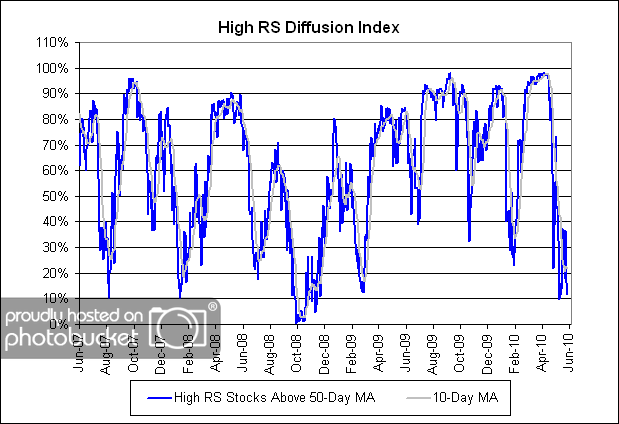
2) Better yet, volatility can be your ally. Buy on dips. (Easy to say, harder to do.) In truth, high-return, high-volatility strategies can be tremendous wealth builders because the long-term returns are good and you get plenty of opportunities to add money during the dips. Toward that end, we publish a High RS Diffusion Index each week to help identify those dips in our particular strategy.

3) Diversify appropriately. We believe it’s often more fruitful to mix strategies as opposed to asset classes. For example, relative strength strategies tend to work very well when blended with deep value strategies.

Ms. Benz lays out the real definition of risk: failing to accomplish your goals.

It also helps to articulate your real risks: your financial goals and the possibility of falling short of them. For most of us, a comfortable retirement is a key goal; the corresponding risk is that we’ll come up short and not have enough money to live the lifestyle we’d like to live.

Clearly, the biggest risk for most investors is their own behavior. They avoid volatility rather than embracing it. Instead of buying on dips and being patient with proven strategies, they sell during pullbacks and buy only after an extended period of good performance. When you start to conceptualize risk as shortfall risk, you can also see that another of your big risks is not saving enough in the first place. At the risk of sounding like my mom, if you don’t have any money, no investment advisor is going to be able to help you retire. Savings, too, is behavior that can be modified.

What can be done to help clients embrace volatility, or at least deal constructively with it? Are there any ”nudges” that can be applied in order to increase their patience and their overall good investment behavior? Ms. Benz makes a suggestion in this regard:

Many financial advisors have begun to embrace the concept of creating separate “buckets” of a portfolio-and in particular, a bucket for any cash the investor expects to need within the next couple of years. By carving out a piece of your portfolio that’s sacrosanct and not subject to volatility or risk, you can more readily tolerate fluctuations in the long-term component of your portfolio.

Sure, it’s a cheap psychological trick that plays to the mind’s natural tendency to segment things-but if it helps, why not? We’ve discussed in the past that a portfolio carved into buckets is functionally equivalent to a balanced or diversified portfolio with the same asset allocation, but if it helps clients behave better then it’s worth trying.

Whether you are an advisor or an individual investor, educating yourself about key concepts like the difference between volatility and risk will pay large dividends down the road.


High RS Diffusion Index

June 16, 2010

The chart below measures the percentage of high relative strength stocks that are trading above their 50-day moving average (universe of mid and large cap stocks.) As of 6/15/10.

This indicator is reversing up after having reached very oversold levels. The 10-day moving average has now risen to 28% after having reached a low of 21% on 6/1. Dips in this indicator have often provided good opportunities to add to relative strength strategies.


Podcast #5 Buy-and-Really-Hold

June 15, 2010

6/15/10

Podcast #5 Buy-and-Really-Hold

Mike Moody and Andy Hyer discuss research showing that the majority of individual securities collectively tend to post negative returns over the long run. Much better results can be achieved by strategies that seek to cast out the losers and hold on to the winners. It is time for a paradigm shift from buy-and-hold.


DWAFX Percentile Ranks

June 15, 2010

Our endowment-type portfolio, the Arrow DWA Balanced Fund (DWAFX), has been smoking its peers in the Morningstar Moderate Allocation Category. It is in the 5th percentile YTD (outperformed 95% of its peers), 14th percentile over the past month (outperformed 86% of its peers), 32nd percentile over the past year (outperformed 68% of its peers), and it is in the 15th percentile over the past three years (outperforming 85% of its peers.) Performance through 6/14/10. Not too shabby.

Source: Morningstar

This global balanced fund invests in U.S. stocks, international stocks, fixed income, and alternative investments. For more information about the Arrow DWA Balanced Fund (DWAFX), please go to www.arrowfunds.com. Past performance is no guarantee of future returns.


The Next Mega-Bull Market

June 15, 2010

The next major bull market is probably the last thing most investors are thinking about at this point. Sentiment surveys, including our own, suggest that investors are suffering from what Hays Advisory has referred to as PBSS, Post-Bear Stress Syndrome. Every time the market starts to move down, investors panic and run for the exits due to their recent conditioning from 2008. Giant bull markets, like most conflagrations, require two things to start: 1) fuel, and 2) a match.

Source: www.taberconsulting.com

On the matter of item 2, we still seem to be a ways away. Investors just are not comfortable committing to the stock market right now. Their reluctance shows up in a variety of ways, from outsized purchases of low-yielding bonds to expressed concern about the economy and the place of the U.S. in the new world order. The recent sentiment extremes resulting from a 10% market correction are another symptom of this. Investors seem to be willing to trade a bounce, but no one is going to “fool” them into buying stocks for the long term again! I’m not sure what it will take for investor sentiment to become less negative. It could be a variety of things: better employment data, less consumer leverage, or maybe some time just needs to pass so the memory of 2008 isn’t so sharp. This process could take weeks, months, or years.

Fuel, on the other hand, is abundant. Although struggling consumers and corporations are in the process of rebuilding their balance sheets, many successful companies and consumers with positive cash flow are squirreling the money away. They are perhaps not comfortable investing it yet, but the cash is building up quickly and is going to create a tsunami when it breaks loose.

Consider, for example, a recent article from Morningstar on the commercial real estate market. They say:

We believe the large amount of capital that REITs, pension funds, and private investment funds have amassed for commercial real estate investment has, to date, overwhelmed the available supply of assets for purchase.

Believe me, there is plenty of distressed real estate available, but so much capital has piled up that there are not enough assets to go around!

Then there’s this from a recent hotline from Al Frank Asset Management (the bold is my emphasis):

…there is still $2.8 trillion parked in money market funds where the average yield is 4 basis points. The Los Angeles Times also reported this weekend that there was $5.1 trillion at the end of May sitting in basic savings accounts at banks and thrifts, not providing much of a return either. And we heard from the Federal Reserve last week that nonfinancial companies had $1.8 trillion in cash and other liquid assets at the end of March, a 26% increase over the year prior, the biggest annual change in a history for the measure that dates back to 1952. That cash represents 7% of all company assets, the highest tally since 1963.

Literally trillions of dollars are piling up in low-yielding assets. And fuel is building up at a pace never before seen-post-bear stress syndrome indeed!

So what’s the likely path of history? Will investors be content to keep assets at 4 basis points indefinitely? While I suppose anything is possible, it seems more likely that over time memories of the 2008 bear market will fade. Investors will realize that they need equity-like returns to meet their savings and investment goals. A trickle of money will start to flow from cash and low-yielding bonds into the stock market, which will nudge the market higher. As the market begins to move up, investors will become more confident and yet more money will flow into stocks. The next thing you know, we could have another mega-bull market on our hands, although most probably won’t be willing to believe it. Plentiful fuel and public disbelief is how bull markets start and then extend themselves.

I don’t know what it will take to bring the fuel and the match together, but I’ve seen enough hillside brush fires in Southern California to know that nature abhors a lot of unburned fuel. Sooner or later, someone is going to strike a match and we will have a market that will be on fire for a long, long time.

Source: www.fire.lacounty.gov


Relative Strength Spread

June 15, 2010

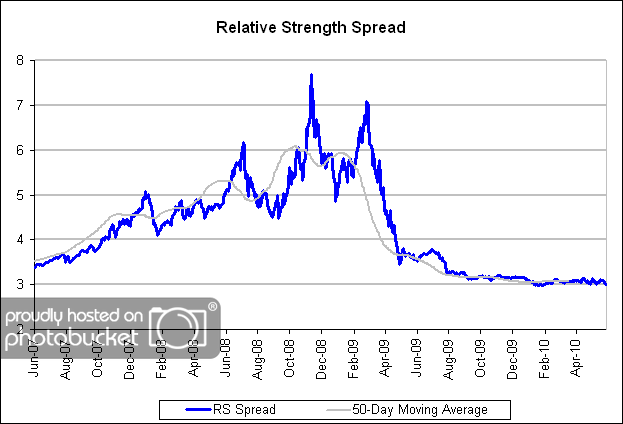
The chart below is the spread between the relative strength leaders and relative strength laggards (universe of mid and large cap stocks). When the chart is rising, relative strength leaders are performing better than relative strength laggards. As of 6/14/2010:

What is likely to follow this transitionary phase of the RS Spread over the past year? I suspect that we are setting the stage for a very favorable environment for relative strength investing in the coming years.


Are You a Stock or a Bond?

June 14, 2010

If you’re a financial advisor, you’re probably a stock. Your neighbor, the fireman, is probably a bond. In this interesting article from the Wall Street Journal, Moshe Milevsky discusses personal risk management and asset allocation from a different perspective.


Dorsey, Wright Sentiment Survey Results - 6/4/10

June 14, 2010

Our latest sentiment survey was open from 6/4/10 to 6/11/10. The response rate remained near its all-time highs, right at 183 respondents. Your input is for a good cause! If you believe, as we do, that markets are driven by supply and demand, client behavior is important. We’re not asking what you think of the market—since most of our blog readers are financial advisors, we’re asking instead about the behavior of your clients. Then we’re aggregating responses exclusively for our readership. Your privacy will not be compromised in any way.

After the first 30 or so responses, the established pattern was simply magnified, so we are comfortable about the statistical validity of our sample. Most of the responses were from the U.S., but we also had multiple advisors respond from at least two other countries. Let’s get down to an analysis of the data! Note: You can click on any of the charts to enlarge them.

Question 1. Based on their behavior, are your clients currently more afraid of: a) getting caught in a stock market downdraft, or b) missing a stock market upturn?

Chart 1: Greatest Fear. 89.1% of clients were fearful of a downturn, just a hair lower than last survey’s reading of 92.7%. The market action of the last month has pushed investor sentiment to very bearish, pessimistic levels. Investors are exhibiting extremely fearful behavior. Only 10.9% of clients were concerned about missing an up move, just slightly higher than last week’s readings of 7.3%. The fear in the market is palpable, indeed!

Chart 2. Greatest Fear Spread. Another way to look at this data is to examine the spread between the two groups. Again, we are seeing very high levels of fear evidenced in the size of this spread, which fell slightly from 85% to 78%. Chart 2 is constructed by subtracting the percentage of respondents reporting clients fearful of missing an upturn from the clients reported as fearful of a market downdraft.

Question 2. Based on their behavior, how would you rate your clients’ current appetite for risk?

Chart 3: Average Risk Appetite. The average risk appetite for this survey round moved even lower, from 2.34 to 2.18. Again, we are seeing clients’ fear trumping any type of opportunity cost, as the average risk appetite moves lock-step with the market lower. The question to ask here is how low is too low? Using only the data inputs in this survey (discounting any daily noise), the market is down about -12.5% from the recent peak. That’s not particularly unusual. Our data shows that since 1950, only one out of four -10% market corrections become full-blown bear markets (-20%). The historical record suggests that a correction is the more likely scenario. This question is designed to validate the first question, but also to gain more precision and insight about the reported risk appetite of clients.

Chart 4: Risk Appetite Bell Curve. This chart uses a bell curve to break out the percentage of respondents at each risk appetite level. Right now the bell curve is biased to the low-risk side, even more so than any of our other sentiment surveys. What we see in the bell curve is just more evidence that clients are afraid of losing money in the market. The heavy concentration of 2’s and the complete lack of any 5’s both paint a picture of a market dominated by fear.

Chart 5: Risk Appetite Bell Curve by Group. The next three charts use cross-sectional data. This chart plots the reported client risk appetite separately for the fear of downdraft and for the fear of missing upturn groups. We would expect that the fear of downdraft group would have a lower risk appetite than the fear of missing upturn group and that is what we see here. Something stands out in this bell curve compared to last week’s (link here) – note the swing of the missing upturn group from high risk appetite to low risk appetite.

Theoretically, the missing upturn group is going to have a higher risk appetite, but this survey’s chart shows an extreme move from higher risk to lower risk. It’s a bit of a disconnect, because if you report that you are more concerned about missing an upturn, you would theoretically want more risk. However, we are seeing zero 5’s and a high concentration in 2′s and 3’s in that group.

Chart 6: Average Risk Appetite by Group. A plot of the average risk appetite score by group is shown in this chart. The fear of missing downdraft group had an average risk appetite of 2.11, while the fear of missing upturn group had an average risk appetite of 2.75. Theoretically, this is what we would expect to see. However, you can see that the missing upturn group’s risk appetite has fallen significantly since the last survey. It seems like the missing upturn group has a much more volatile risk appetite, which is evidenced in the swings of their average as a group. Does this group change their mind more than the other group? Maybe market sentiment swings are powered by only a portion of the participants. Something to think about.

Chart 7: Risk Appetite Spread. This is a spread chart constructed from the data in Chart 6, where the average risk appetite of the downdraft group is subtracted from the average risk appetite of the missing upturn group. The spread is currently .63, a significant move from last week’s reading of 1.26. This major move in the spread is a direct result of the missing upturn group’s shifting risk appetite. Two weeks ago, this group had a smattering of 5’s and 4’s with a concentration of 3’s. This week, we see 1’s and 2’s, with a concentration of 3’s. What does this mean?? It means that the missing upturn group has a more volatile risk appetite – they jump around and are conflicted about being in or out of the market.

May was a brutal month for client sentiment. We’re hovering near the all-time highs of fear since this survey began in March. The big story for this round of the survey can be found in the missing upturn group’s volatile risk appetite average. Is this upturn group just more emotional than the downturn group? Or is the downturn group more self-aware, and therefore less prone to change risk outlooks? When you consider that this survey is conducted twice a month, it seems like the risk appetites should remain more stable than what we have seen so far. The shift in the spread represents a significant change in client sentiment, but for long term investors, these types of emotional swings can lead to poor decisions and harmful results.

No one can predict the future, as we all know, so instead of prognosticating, we will sit back and enjoy the ride. A rigorously tested, systematic investment process provides a great deal of comfort for clients during these types of fearful, highly uncertain market environments. Until next time, good trading and thank you for participating!


Retirees “Consumed by Fear”

June 14, 2010

So says a recent Bloomberg story about the retirement finances of Americans, and, indeed, there is ample reason to worry. According to the article, nearly half of those nearing retirement are predicted to run out of money.

Source: airanwright.com

Although we all worry about the government having a fiscal crisis, perhaps we should pay more attention to our onrushing collective personal fiscal crisis. How did everything become so dire? Part of it may have to do with the fact that traditional pension plans have been supplanted in the main by 401k plans:

In 1983, 62 percent of workers had only company-funded pensions, while 12 percent had 401(k)s, the center said. In 2007, those numbers were 17 percent and 63 percent, respectively.

Part of it may have to do with the relatively low level of Social Security benefits available to the average worker:

The average monthly Social Security benefit as of April was $1,067.

On the other hand, the biggest part of it may have to do with pre-retirees not saving enough:

The average 401(k) account balance as of March 31 was $66,900, according to Boston-based Fidelity Investments, which has 11 million participants.

A couple of solutions were mentioned in the article. One possibility is to include an annuity option to generate the highest possible income payout in retirement. However, with the savings levels cited, that’s probably not going to get it done. Another promising possibility is to indicate on the employee statements exactly how much monthly income can be expected from the portfolio. Although it might be a shock for employees on the cusp of retirement, that option might also serve as a wakeup call for workers who are not saving enough and still have enough time to do something about it.

Now that retirement is largely left up to the individual, investing decisions and disciplined saving are more important than ever. If you are not already taking a systematic approach to saving and investing, now would be a good time to start.


Two Groups of Investment Strategies

June 14, 2010

Although there are many ways to classify investment strategies, I would suggest that they can largely be placed in two broad groups: systems-based strategies and individual idea-based strategies.

The broad group of individual idea-based strategies can be easily identified by just that- individual ideas. The manager of such a strategy may be able to wax long about the most seemingly obscure minutia which serves to provide rationale for each of the given investment themes. It is hard not to be impressed with the depth of knowledge displayed during such orations. However, the success of such strategies will always hinge on the ability of the manager to translate perceived market insight into out-sized returns.

Compare this to a systems-based investment strategy (based on a deep value factor or a relative strength factor, for example). This approach proposes to view systems in a holistic manner. Consistent with systems philosophy, systems thinking concerns an understanding of a system by examining the linkages and interactions between the elements that compose the entirety of the system. Evolutionary or dynamic systems-based investment strategies are understood as open, complex systems, but with the capacity to evolve over time.

The more I interact with investors, the more I see that they naturally gravitate to either one investment approach or the other. Characteristics of those who gravitate to systems-based investment approaches generally are as follows:

  1. They are skeptical of investment gurus. They have been burned by just enough perceived experts to be skeptical of a good-sounding story.
  2. They desire a degree of consistency in their approach to investing. While the financial markets always have an element of the unpredictable, that doesn’t mean that one can’t adhere to a logical framework to deal with that uncertainty.
  3. They are generally motivated to act based on a “weight-of-the-evidence-approach.” In other words, they want to know that a given systems-based approach has been thoroughly tested and provides compelling evidence of being effective over time.
  4. They approach investing with a degree of humility. They can become comfortable with the valuable things that they do know while accepting the things that they can’t control.

Dealing With Dow Stagnation

June 14, 2010

The WSJ’s Jason Zweig points out that last week, the Dow Jones Industrial Average rose above 10,000-again. Since March 16, 1999, when it first touched 10,000 in intraday trading, the Dow has bounced over that threshold and back 63 times. Friday, the index closed 219.6 points below where it stood exactly 11 years ago.

(Click to Enlarge)

Source: www.stockcharts.com

This isn’t the first time stocks have been stuck on a seemingly endless pogo-stick ride. On Jan. 18, 1966, the Dow hit an intraday high of 1,000.50. It broke through the four-digit barrier three more times that January and Febrary, then faded. The Dow cracked 1,000 again in 1972 and 1976, then fell back both times. Not until December 1982 did the Dow finally hurdle above 1,000 and stay there.

History is under no obligation to repeat itself exactly, but this comparison does beg the question of how long before the Dow Jones Industrial Average will meaningfully rise from the 10,000 level. The fluctuations around Dow 1,000 persisted for 17 years. We have been fluctuating around Dow 10,000 for 11 years. Periods of extended Dow stagnation can test the patience of even the most forbearing equity-only investor.

One way to deal with this U.S. equity stagnation is to employ an investment strategy that has the flexibility to shift into many different asset classes in order to find those asset classes that are currently in secular bull markets. This is exactly the objective of our Global Macro strategy which tactically overweights those asset classes with the best relative strength. Consider the table below which shows the average allocation to each of the major asset classes since mid 1999:

Every major asset class goes through periods of extended stagnation - it is just part of the cyclical nature of the financial markets. Rather than making permanent commitments to any one asset class, we find it more prudent to employ a flexible global asset allocation strategy that keeps our options open.

Global Macro is available as a separately managed account. To receive a brochure, please click here. Global Macro is also available as the Arrow DWA Tactical Fund (DWTFX).

Click here to visit www.arrowfunds.com for a prospectus & disclosures. Click here for disclosures from Dorsey Wright Money Management. Past performance is no guarantee of future results.


Weekly RS Recap

June 14, 2010

The table below shows the performance of a universe of mid and large cap U.S. equities, broken down by relative strength decile and quartile and then compared to the universe return. Those at the top of the ranks are those stocks which have the best intermediate-term relative strength. Relative strength strategies buy securities that have strong intermediate-term relative strength and hold them as long as they remain strong.

Last week was excellent for high relative strength stocks as the top quartile was up 3.55% and outperformed the universe by 0.58%.


Advice From a Hedge Fund Manager

June 12, 2010

A faux radio call-in show where a few listeners ask financial questions to an out-of-touch hedge fund manager. You can read the transcript, but the audio is much funnier. Sort of.


Are ETFs Better Than Mutual Funds?

June 11, 2010

Index Universe contributor Matt Hougan contends that they are. He suggests that the advantage for long-term investors is that ETF consequences are driven entirely by your own actions:

When you buy a mutual fund, you’re exposed to the actions of others. For instance, if you buy shares in the Growth Fund of America, and then half of the investors in the fund decide to redeem out of their positions, you will bear the brunt of the trading costs as the fund sells stocks to meet those redemptions. If any capital gains are incurred, you will pay those gains, even though you didn’t sell a share and had no intention of exiting your position.

If, on the other hand, no one sells, but another $10 billion in investor cash comes into the fund, you have to pay your share of the costs of putting that money to work: the commissions, the trading spreads, the market impact, etc.

With ETFs, the only thing that matters is you. Outside of a small number of bond funds and a few alternative asset products—such as Vanguard’s ETFs, which share classes of broader mutual funds— existing investors are completely shielded from the actions of others either entering or exiting the ETF. No paying for other people’s commissions, no paying for other people’s market impact and, by and large, no capital-gains distributions driven by the actions of others.

Your investment return and tax profile are driven by your actions, and that’s it.

ETFs are great. We love them, but I don’t think the issue is quite so black and white. First of all, I’m not sure ETF investors are entirely shielded from other people’s market impact. Creation and redemption of new units could put unseen pressure on the underlying securities and might have some impact that way. The tax efficiency of most ETFs is certainly a plus, but they aren’t nearly as efficient for dollar-cost averaging as mutual funds are. Automatic investment plans-something a lot more investors should probably be using-where a fixed amount goes into a fund each month is one area in which mutual funds really shine. As with most investment products, it really depends on their use and your needs.

And then there is Mr. Hougan’s mention of the nearly mythical long-term investor! This failing obviously can’t really be attributed to the ETFs or the funds themselves. It’s a mistaken belief on his part that lots of investors like this exist. There is a marked tendency in both vehicles for investors to buy near the highs, sell near the lows, and have a holding period that is far too short.

DALBAR’s research suggests that the average mutual fund holding period is only 3-4 years, even for bond funds! Every advisor has a tale of the self-reported ”long-term investor” with a 7-10 year time horizon (on the consulting department paperwork) that pulled the account after the first down quarter. The truth is that almost any winning stategy will deliver great rewards over a long time horizon, regardless of the investment vehicle, whether it’s an ETF, mutual fund, or separate account. Find a manager that exposes a portfolio to a reputable return factor, executes the strategy in a discplined fashion, and hang on for dear life.


Coffee Spill at BP Headquarters

June 11, 2010

A comedy video imagines what happens when BP executives spill their coffee at a meeting, found on CNBC.com. Black humor, to be sure.


Sector and Capitalization Performance

June 11, 2010

The chart below shows performance of US sectors and capitalizations over the trailing 12, 6, and 1 month(s). Relative strength strategies buy securities that have strong intermediate-term relative strength and hold them as long as they remain strong. Performance updated through 6/7/2010.


Fund Flows

June 10, 2010

The Investment Company Institute is the national association of U.S. investment companies, including mutual funds, closed-end funds, exchange-traded funds (ETFs), and unit investment trusts (UITs). Members of ICI manage total assets of $11.82 trillion and serve nearly 90 million shareholders. Flow estimates are derived from data collected covering more than 95 percent of industry assets and are adjusted to represent industry totals.

The movement out of domestic equities and into taxable bonds continued in the week ending 6/2/10. Foreign equities inflows staged a significant reversal, and are now positive compared to a -3,945 reading last week.


Learning From History

June 9, 2010

The only thing we learn from history is that we learn nothing from history. — Friedrich Hegel

There are few things I enjoy more than digging into a juicy morsel of stock market history. Roger Schreiner’s excellent article from Investment Advisor magazine certainly fits the bill, with a twist. The twist is that Mr. Schreiner examines the recent history of the Japanese stock market, which holds valuable lessons when trying to decide between an active, tactical approach and a passive approach. Here, for example, is one of the charts from the article demonstrating how difficult the market has been.

Source: Investment Advisor and dshort.com

He concludes, after his discussion of the Japanese experience:

You don’t have to be a market historian to know that stock markets are risky. But proponents of buy and hold would rather that you not focus on the stock market in Japan, or anywhere else for that matter. After all, the history of the U.S. stock market reads more like a romance novel, if you ignore a few of the most recent chapters, and that’s the story they would much rather tell.

History supports the idea that buy-and-hold investing is unlikely to provide acceptable returns. Wishful thinking and cherry-picking slices of market history that support passive investing are the only ways Wall Street can justify exposing investors’ assets to a passive philosophy.

He’s right that the deflation of the asset bubble in Japan is not often discussed in the United States. When it is, it is usually dismissed as a poor analog for cultural reasons. But what if it’s not a poor analog? In fact, cross-cultural studies of investor behavior suggest that markets and investors act pretty much the same everywhere. Maybe it’s time to learn something from history for a change.


High RS Diffusion Index

June 9, 2010

The chart below measures the percentage of high relative strength stocks that are trading above their 50-day moving average (universe of mid and large cap stocks.) As of 6/8/10.

(Click to Enlarge)

The 10-day moving average of this indicator is 22% and the one-day reading is 12%. The correction in the market over the last month has brought this indicator into oversold territory. Dips in this indicator have often provided good opportunities to add to relative strength strategies.


Volatility and Subsequent Returns

June 9, 2010

CXO Advisory has an excellent piece on volatility clusters and subsequent returns in the stock market. One thing that makes investors incredibly nervous is volatility. According to the DALBAR studies, price declines often cause investors to bail out, but my experience suggests that bouts of high volatility often have the same effect. Even if prices are relatively stable, volatility scares the heck out of everyone. The media has a tendency to attach an explanatory story to each day’s trading, so during periods of high volatility, the news background can seem particularly unsettling.

CXO was responding to an article that suggested that periods of high volatility were bear market signals, but CXO had a different read on the data. They defined a volatility as a close-to-close spread of more than 1% in the S&P 500 and looked for volatility clusters where there were more than 20 such days in a 40-day period. Taking the data back to 1950, they found that volatility clusters were typically followed by better-than-average returns.

Source: CXO Advisory

The graphic above is from the CXO article. As you can see, returns after bouts of high volatility were pretty good. The returns after 30 volatile days within a 40-day period were especially noteworthy.

It makes sense that volatility and returns are connected in this way. No investor should expect to get something for nothing, and viewed in that light, volatility is simply the price to be paid for decent results. The implication that investors who suffer through extended periods of volatility will eventually be rewarded with good returns is comforting!


Pay No Attention to the Smoking Crater Where My $2.8 Trillion Used To Be

June 8, 2010

Strategic asset allocation has a powerful hold on people. Investors seem completely willing to forgive and forget all of the problems with it-apparently no matter how much pain or harm it caused. That’s my conclusion after reading an article on asset allocation from CNBC.com. The article mentions that investors started to question asset allocation because of results:

…the process of diversifying one’s portfolio across a variety of asset classes was put to the test during the 2008-2009 market meltdown. And the outcome wasn’t good.

Investors who had dutifully spread their eggs among multiple baskets and stayed the course, a.k.a. buy and hold, watched helplessly from the sidelines as their retirement accounts lost a collective $2.8 trillion between the market peak in October 2007 and the trough in March 2009, the Center for Retirement Research at Boston College reports.

We’ve written many times about one of the problems with a cornerstone of strategic asset allocation: correlations between asset classes are not stable over time. And, in fact, this is cited in the article as one of the causes of the poor outcome.

Asset allocation, of course, is predicated on the premise that investors can limit downside risk by owning a mixed bag of non-correlated securities, like stocks and bonds, which historically move in opposite directions during any given market cycle.

“You saw large-cap and small-cap stocks, international and domestic all going down together—the good stocks with the bad,” says [Elliot] Herman [an investment advisor for NFP Securities in Quincy, Mass].

The problem of unstable correlations is one of the reasons we think tactical asset allocation can be useful. If relative strength is used to drive the allocation engine, no assumptions are made about asset class relationships. The portfolio is simply allocated to whatever assets have had the best intermediate-term relative strength, whether they are supposedly correlated or not. That’s why I was stunned to read this later in the article:

Yet, hindsight brings wisdom. Now a year into a convincing market recovery, many in the financial community say standard asset allocation is still the key to the kingdom for average investors.

Excuse me? The key to the kingdom, really? That doesn’t sound like wisdom to me, even in hindsight, unless practitioners of strategic asset allocation are hoping the average investor has been clubbed into an amnesiac state. What I think it really means is this: Never mind your $2.8 trillion. As long as we still have your money, we’re going to pretend everything is a-ok with this failed paradigm.

Illustration: Pie Chart Malfunction

I’m not saying strategic asset allocation is useless: diversification and looking for uncorrelated assets are valuable principles. Incorporating some alternative asset classes might help as well. And strategic asset allocation is certainly an improvement over emotional asset allocation, which seems to be most investors’ default option. However, being beaten to death by a pie chart every couple of market cycles is not my idea of fun either. There are inherent difficulties in mean variance optimization-forecasting returns, estimating volatility, and unstable correlations between asset classes.

Tactical asset allocation done in some kind of systematic way, whether through relative strength or deep value, is certainly worth examining with an open mind as an alternative to strategic asset allocation.


Relative Strength Spread

June 8, 2010

The chart below is the spread between the relative strength leaders and relative strength laggards (universe of mid and large cap stocks). When the chart is rising, relative strength leaders are performing better than relative strength laggards. As of 6/7/2010:

The sharp decline in the RS Spread during much of the first half of 2009 has transitioned into a flat spread, which may be setting the stage for a more favorable environment for relative strength investing.


Buy-and-Really-Hold Will Suck Your Portfolio Dry

June 7, 2010

It’s not often that a passive investor committed to Modern Portfolio Theory will help make our case for active management based on relative strength, but heck, we’ll take any help we can get.

In this guest article from Money Magazine, William Bernstein of Efficient Frontier Advisors discusses findings from a study by Dimensional Fund Advisors. The article gets to the thesis early:

It’s a little-known and depressing fact, but the majority of individual securities tend to post negative returns over the long run.

This, I think, is a ringing indictment of buy-and-really-hold investing. Often individuals assume that they can purchase shares of leading companies, shower them with benign neglect, and have the portfolio perform well. But, of course, today’s leader always turns into tomorrow’s laggard. The majority of stocks, given enough time, collectively lose money. Mr. Bernstein goes on to say,

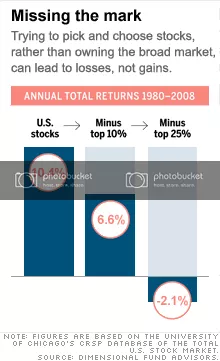
In fact, researchers at the investment management firm Dimensional Fund Advisors found that from 1980 to 2008, the top-performing 25% of stocks were responsible for all the gains in the broad market, as represented by the University of Chicago’s CRSP total equity market database.

As for the bottom 75% of stocks in the U.S. market, they collectively generated annual losses … over the past 29 years.

The following chart shows that if you miss the best 25% of stocks, you will end up losing more than 2% per year.

Source: Money Magazine and Dimensional Fund Advisors

The chart is offered as evidence of the futility of stock picking and the triumph of index investing. What it really reveals is this: index investing would be an abject failure if it weren’t for two things: 1) active management and/or 2) relative strength weighting. First, if indexes didn’t replace companies that went out of business or were no longer “representative,” they’d have a buy-and-hold portfolio that, by their own calculations, would lose money. Replacing losers (dead companies) with winners (live companies) is, in fact, an efficient casting out process used for active portfolio management. Second, index returns are helped immensely by increasing the weighting of the stocks that go up the most. This is actually a form of relative strength weighting, more commonly referred to by index providers as “capitalization weighting.” Emphasizing the winners at the expense of the losers also tends to help returns over time.

The alert reader will quickly discern that ”missing the best 25% of stocks” is another version of the “if you miss the 10 best days” argument. There’s one problem: while it may be impossible to pick out the 10 best days, there’s a ton of evidence to suggest that it is possible to select the strongest stocks using relative strength. Even efficient market theorists like Eugene Fama and Kenneth French have admitted that relative strength works.

Bernstein writes:

This may get you thinking: If a small list of securities accounts for the market’s long-term returns, why not avoid all the headaches and losses you’ve suffered recently by carefully choosing these superstocks?

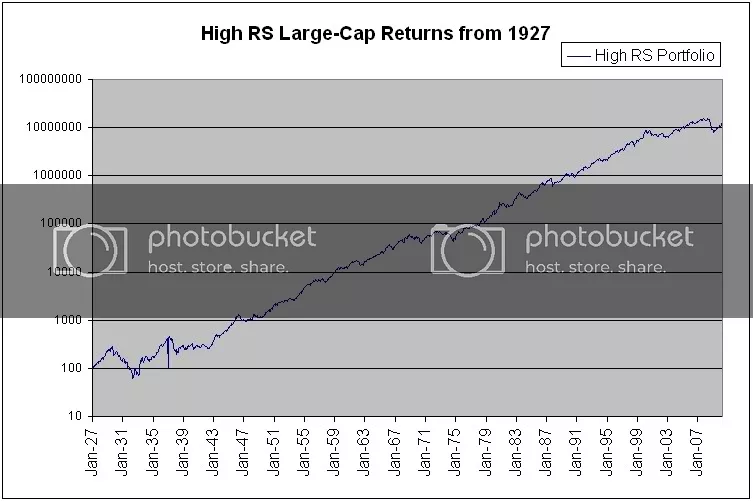
That’s exactly what I’m thinking! Why not, indeed! I’d rather own the superstocks. And I will even let Ken French pick the stocks. Instead of buying an index fund, I’m going to let Ken French buy the best recent performers and cast out the stocks that weaken each month. This chart comes from Dr. French’s own website and shows the equity curve for large-cap, high relative strength stocks since 1927.

As an investor, you have three basic options. You can buy-and-really-hold which will insure that most of the companies you buy will lose money over a long time frame. You can buy an index fund, which will tend to perform better than buy-and-really-hold due to the hidden active management process of casting out and/or through capitalization weighting. Or you can identify the strongest stocks and use both casting out and relative strength weighting to manage the portfolio. Option 3 has historically provided the best returns, but it will be volatile and will go through periods of drawdown. (Of course, Options 1 and 2 will also be volatile and will go through periods of drawdown!)

As a result, I see no reason not to prefer active management using a systematic relative strength process. It’s always interesting to me how investors with a passive approach can selectively pull out data that they then claim supports an indexing approach. [Note: a major part of the reason for the cognitive dissonance in Dimensional Fund Advisors' data has to do with the original research source. The finding that 25% of all stocks account for all of the market's gains came from a Blackstar Funds research paper, The Capitalism Distribution. Blackstar's own interpretation of the findings was that such a skewed distribution of returns supported a trend-following method focused on strong stocks--exactly opposite of what DFA suggests! We happen to agree with Blackstar.]


Stock Market Investing: Not for Cupcakes

June 7, 2010

Investors are quite skittish these days. 2001-2002 was bad enough, but then 2008 came along. Most investors lost a boatload of money, in some cases enough to get them to swear off investing altogether. Although that may be understandable from a certain perspective, it’s probably not the way to go. The reality is that market volatility is to be expected. Charlie Munger, Warren Buffett’s investing partner at Berkshire Hathaway, rather unsympathetically expounds on what investors should expect (my emphasis added):

“I think it’s in the nature of long term shareholding of the normal vicissitudes, of worldly outcomes, of markets that the long-term holder has his quoted value of his stocks go down by say 50%. In fact you can argue that if you’re not willing to react with equanimity to a market price decline of 50% two or three times a century you’re not fit to be a common shareholder and you deserve the mediocre result you’re going to get compared to the people who do have the temperament, who can be more philosophical about these market fluctuations.”

I’ve seen plenty of people react to a 50% decline, but not usually with equanimity! The always excellent Psy-Fi blog has this further comment:

Munger is, as usual, spot on the money. It turns out that the odds of a 50% drawdown in any investor’s portfolio during an investing lifetime are virtually 100%. Dabble in stocks for long enough and you’re bound to lose half your net worth in a single swoop. In some recent research Guofu Zhou and Yingzi Zhu have set about demolishing the idea that our most recent set of calamities are surprising.

In other words, what markets are going through right now-although it’s clearly the unpleasant part-is just part of the normal cycle of investing. The problems come when investors create drama over what should be expected. It might be healthier to imagine one’s portfolio as having a wide range of possible values, as opposed to taking mental ownership of the equity value reflected on your best monthly statement. Psy-Fi has a couple of suggestions for reducing the unnecessary drama:

…intelligent investors should mange their holdings with the expectations that they’ll lose 50% of their value at some point. The main aim should be to ensure that such a drawdown is a temporary measure and, if you’re invested in good enough stocks, this should surely prove to be the case over a few years. This is the lesson of behavioural finance: be humble in the face of the markets, diversify wisely and don’t use leverage.

That’s a pretty good prescription: 1) think long term, 2) diversify effectively between strategies, and 3) don’t use leverage. Patience always helps, because drawdowns in most sound strategies are temporary. Diversification between strategies (not necessarily just asset classes) can help mitigate drawdowns too. We find, for example, that high relative strength strategies blend nicely with deep value strategies. Finally, the absence of leverage gives you the staying power to hold on during a drawdown. Too much borrowed money, as some overleveraged homeowners are finding out, will cause you to mail in the key to your portfolio to the margin clerk at an inopportune time.

Investing is a rough game; you’ve got to be tough to play. To paraphrase Yogi Berra, “Investing is 90% mental, the other half is rational.”


Consumer Debt-Cutting

June 7, 2010

In an earlier blog post, I cited some arguments by economist Richard Koo, who contends that monetary policy levers will not work as intended while businesses and consumers are busy repairing their balance sheets. This recent article from the Wall Street Journal reports that consumers are paying down debt with a vengeance:

On Monday, the Federal Reserve is expected to say total consumer credit outstanding fell by $1 billion in April to $2.45 trillion. While that may seem like a rounding error, it will mark the 17th monthly decline in the past two years, an unprecedented stretch in the series’ 67-year history.

The article goes on to say that the consumer still has a long way to go to reduce debt to the level of even the mid-1990s:

Even so, the consumer has more work to do. The Fed’s quarterly “flow of funds” report, due out on Thursday, is likely to show the household sector’s debt level, which includes both consumer credit and mortgage loans, remained at about 20% of total assets in the first quarter.

In the mid-1990s that ratio was around 15%, compared with a peak in the first quarter of 2009 of about 22.5%.

Koo certainly seems correct in his assessment that consumers are in the mode of repairing their balance sheets. Less clear is his contention that monetary policy may not work as intended-but I’m sure we will find out about that soon enough. In the meantime, it may pay to be flexible and tactical with one’s asset allocation.