Although it always seems counterintuitive for incredibly simple momentum strategies to be able to beat the market, yet more evidence is provided in a brief article from CXO Advisory. (Relative strength is often called “momentum” in academic literature.)
Their method was simple. They used the nine domestic sector SPDRs, held the top one based on a simple momentum ranking, and revisited the ranks monthly, switching if necessary. Three simple models were used: 1) top 6-month return, 2) top 6-month return ending 1 month ago, and 3) top 6-month return or cash if the top sector SPDR was below its 10-month moving average (a la Mebane Faber’s paper).
You can see the equity curve below, although there is better detail in the original article. (The model that can go to cash was obviously helped by two big bear markets in the last ten years; in an up market decade it might be different.)
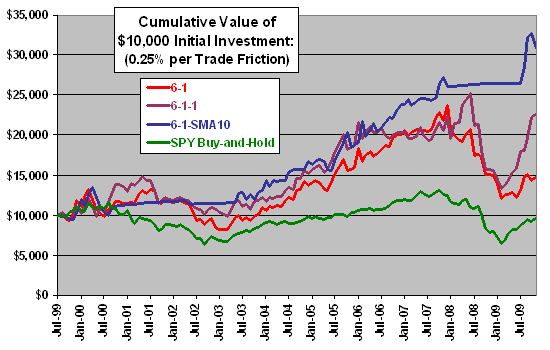
Now, I’m not sure any compliance department would sign off on a strategy that only held one sector at a time, but it is certainly eye-opening that all three strategies outperformed the market. This finding is rampant throughout many, many academic and practitioner studies, including ones archived on our website. Systematic use of relative strength works.
—-this article was originally published 12/22/2012. Evidence for the effectiveness of relative strength continues to pile up, most recently in the five-year performance of PDP.







