Our separate account portfolios are quite concentrated, typically only 20-25 stocks at one time. Having a concentrated portfolio creates a little bit of additional volatility, but it also increases the odds that a strong performer will have an outsized positive impact on the account. A recent article in Advisor Perspectives discussed this and other benefits of portfolio concentration.
Investors who avoid concentrated equity miss out on the triple benefits of excess returns, lower risk, and lower correlations. A portfolio concentrated in best-idea stocks has an excellent chance of generating excess returns. In turn, the cumulative excess return to investors lowers the risk of underperformance over time. Finally, a portfolio comprised of a small number of stocks is characterized by a low stock-market correlation. Thus the concentrated equity triple play: higher returns, lower risk, and lower correlations.
Concentrating a portfolio on a few choice assets dramatically increases an investor’s chance of superior performance. Nonetheless, most advisors and investors shun portfolio concentration as unacceptably risky. To a great extent, this is driven by the myth that adequate diversification is impossible unless one holds many stocks…
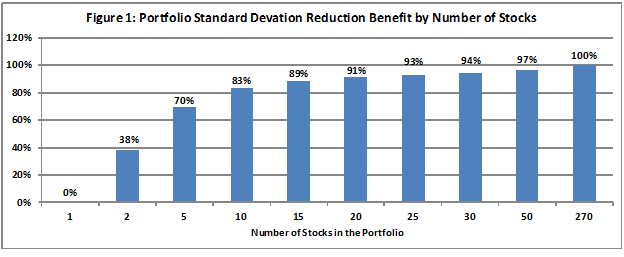
Many believe that concentrated portfolios are much more volatile than are broadly diversified index portfolios. It turns out the diversification benefit of adding additional stocks to a one-stock portfolio is largely captured within the first few additions, as shown [in Figure 1] below.
The author, C. Thomas Howard, includes a graphic that shows clearly how rapidly additional diversification is achieved by adding stocks to a portfolio.
Source: Advisor Perspectives (click on image to enlarge)
With 20 stocks, you’ve already eliminated more than 90% of the standard deviation from the market! In our particular portfolios, given that we also enforce a certain amount of macrosector diversification, the reduction in tracking error may occur even more rapidly.
The author discusses a number of papers (which are in the appendix of his article) that point out that “best ideas” have a strong likelihood of outperforming and that more stocks just tend to water down returns.
Instead of limiting themselves to their 10 or so best ideas, the typical active equity mutual fund manager holds 100 stocks. As shown in Figure 2, the “last”-ranked stock earns a negative excess return of between -2% and -3%. In fact, excess returns go negative somewhere around 30th-best stock. Thus, the typical portfolio is comprised of 30 positive excess-return stocks and 70 negative excess-return stocks. Not exactly a recipe for success!
So why don’t funds limit themselves to their best ideas? There are powerful institutional incentives to overdiversify and destroy performance.
The primary incentive is that mutual funds earn fees based on assets under management (AUM) — the bigger, the better. But getting big makes it increasingly difficult to focus strictly on best ideas; thus the resulting purchase of many more stocks in order to “round out” the portfolio. The need to fit a particular style box and closely track a “style index” can also force advisors to water down their portfolios, as can the need to soothe investor fears by keeping volatility low.
Collectively, these incentives encourage a fund manager to move away from a concentrated portfolio; all too often, he or she may essentially become a closeted indexer.
In short, there are institutional incentives to move away from concentrated portfolios, often to the detriment of long-term investor returns. I added bold type to the tidbit that excess returns go negative somewhere around the 30th best stock. If that is the case, there is no point in adding more names beyond those that have a prospect of adding excess returns.
What’s the downside of a concentrated portfolio? Well, there’s certainly more short-term volatility, even if the long-term returns are higher. And a concentrated portfolio isn’t exactly designed to “soothe investor fears.” As always, the road to better returns is usually psychologically uncomfortable!
To receive the brochure for our Separately Managed Accounts, click here.
Click here and here for disclosures. Past performance is no guarantee of future returns.









