Diversification, risk management, and returns are all important in investing. Increasingly, factor exposure is being used to accomplish these goals. A Wall Street Journal article covered the issue very well (may be behind a pay wall, sorry).
By changing the way you spread out your stock holdings, you can reduce risk and boost returns—even in a highly correlated market like today’s.
The trick? A concept known as “factor investing,” which originated in academia two decades ago and now is finding favor among institutional investors and high-end financial advisers.
Factor investing replaces traditional asset allocation—such as a portfolio with 30% in U.S. stocks, 20% in developed international markets, 10% in emerging markets and 40% in bonds—by focusing on specific attributes that researchers say drive returns. These “risk factors” include the familiar—like small versus large-size companies or growth versus value stocks—as well as more esoteric measures such as volatility, momentum, dividend yield, economic sensitivity and the health of a company’s balance sheet.
As a reader of this blog, you’re probably already familiar with factor investing through relative strength—something that academics call momentum. Using factors rather than style boxes has some advantages.
“There are a lot of nuances you may be missing by focusing only on style and size,” says Savita Subramanian, head of equity and quantitative strategy at BofA Merrill Lynch Global Research. “You may be missing a whole layer of outperformance you could have gotten.”
Some fairly high-end investors are converting portfolios to focus on factor exposures. By converting to factor exposure, investors are trying to drill down to the actual return drivers.
Big investors are taking heed. In 2009, researchers assigned to analyze the Norwegian Government Pension Fund recommended it reorient its portfolio around risk factors. And the California Public Employees’ Retirement System underwent a similar change in approach in 2010.
After 2008, big investors discovered that they had factor exposure anyway—it was just exposure they were not aware of and hadn’t controlled. There’s a lot less potential for surprise if the factor exposures are constructed deliberately!
New products are becoming available to feed the demand for factor exposure as well.
Until recently, it was hard for small investors to dabble in factor investing. But that is changing.
In the past year at least six firms—BlackRock’s iShares, Russell Investments, Invesco PowerShares, Factor Advisors, QuantShares and State Street Global Advisors—have launched factor-based exchange-traded funds, or have filed paperwork to do so.
Of course, overlooked among the rush of big firms racing to create factor exposure is the grand-daddy of relative strength, the Powershares DWA Technical Leaders Index (PDP). It’s actually been around more than five years and has performed nicely over that time, beating the S&P 500 despite a market environment that has been hostile to relative strength strategies. (We’re looking forward to seeing how it performs in a better RS market!)
One of the big advantages of factor exposure is that some factors offset one another beautifully. We’ve written before about the nice efficient frontier that is created by combining relative strength and low volatility. (You can see the chart below.) These factors work well together because the excess returns are uncorrelated.
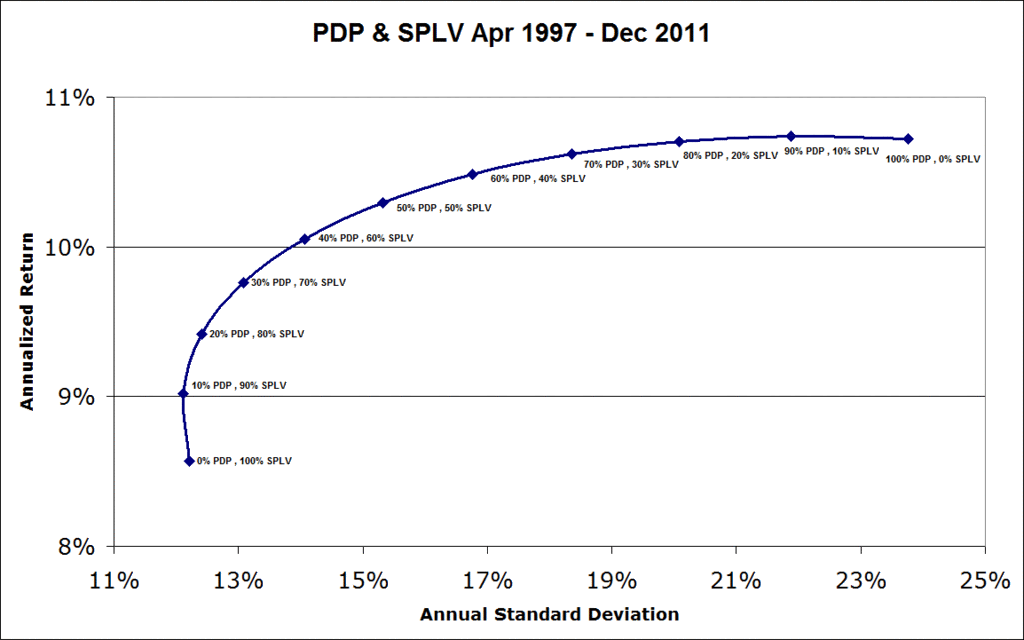
Source: Dorsey Wright (click to enlarge to full size)
In short, there’s more to portfolio construction than asset allocation and style boxes. Factor exposure should be considered as well if the result is a better portfolio for the client.
See www.powershares.com for more information about PDP. Past performance is no guarantee of future returns. A list of all holdings for the trailing 12 months is available upon request.









[...] “There’s more to portfolio construction than asset allocation and style boxes.” (Systematic Relative Strength) [...]
How is it determined that the recent environment has been hostile to relative strength strategies? I see that many who use this approach have struggled but what’s going on in the markets that is causing this?
http://systematicrelativestrength.com/2012/01/12/its-not-you-its-me/
Joe,
I’ve included a link to an earlier post that describes one of the ways to assess how the market and the strategy are interacting. We usually update our data annually. The current paper can be found at http://www.dorseywrightmm.com on the resources tab.
http://systematicrelativestrength.com/2012/05/08/relative-strength-spread-57/
This is another way to assess how RS is doing versus the market. We post this on a regular basis. The long-term trend is steadily up, but there are periods where the spread moves down or is choppy. We’ve had a lot more of that lately.