Hedge Fund Alternatives

May 29, 2012

From Barron’s, an interesting insight into the alternative space:

Investor interest in hedge-fund strategies has never been higher—but it’s the mutual-fund industry that seems to be benefiting.

Financial advisors and institutions are increasingly turning to alternative strategies to manage portfolio risk, though the flood of money into that area tapered off a bit last year, according to an about-to-be-released survey of financial advisors and institutional managers conducted by Morningstar and Barron’s. Many of them are finding the best vehicle for those strategies to be mutual funds.

Very intriguing, no? There are quite a few ways now, through ETFs or mutual funds, to get exposure to alternatives. We’ve discussed the Arrow DWA Tactical Fund (DWTFX) as a hedge fund alternative in the past as well. Tactical asset allocation is one way to go, but there are also multi-strategy hedge fund trackers, macro fund trackers, and absolute-return fund trackers, to say nothing of managed futures.

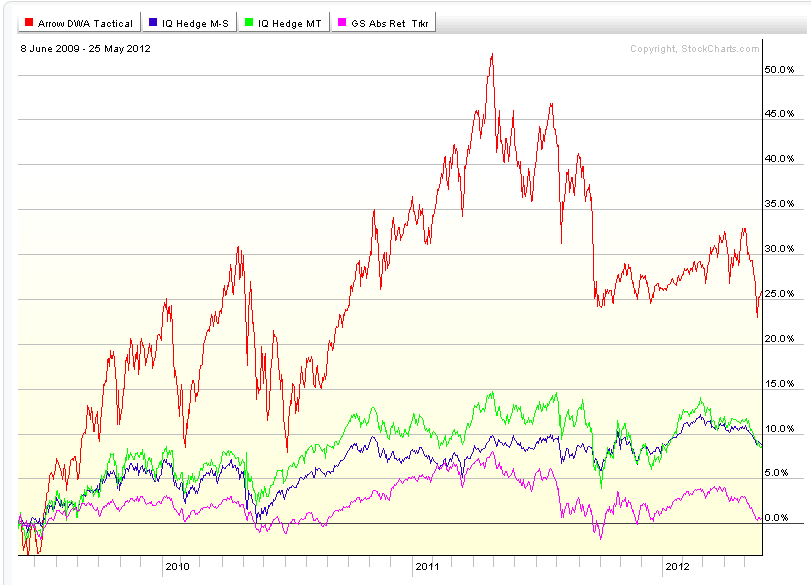
Each of these options has a different set of trade-offs in terms of potential return and volatility. For example, the chart below shows the Arrow DWA Tactical Fund, the IQ Hedge Macro Tracker, the IQ Hedge Multi-Strategy Tracker, and the Goldman Sachs Absolute Return Fund for the maximum period of time that all of the funds have overlapped.
hedgefundalternatives Hedge Fund Alternatives

(click on image to enlarge)

You can see that each of these funds moves differently. For example, the Arrow DWA Tactical Fund, which is definitely directional, has a very different profile than the Goldman Sachs Absolute Return Fund, which presumably is not (as) directional.

Very few of these options were even available to retail investors ten years ago. Now they are numerous, giving individuals the opportunity to diversify like never before. With proper due diligence, it’s quite possible you will find an alternative strategy that can improve your overall portfolio.


Are Equities Dead or Just Resting?

May 29, 2012

CNBC carried an article today, via Financial Times, that talked about how much investors hate stocks. Some excerpts from the article:

…institutional investors, from pension funds to mutual funds sold directly to the public, have slashed holdings in the past decade. Stocks have not been so far out of favor for half a century. Many declare the “cult of the equity” dead.

Compared with bonds, stocks have not looked so cheap for half a century. During this period, the dividend yield — the amount paid out in dividends per share divided by the share price, a key measure of value — has been lower than the yield paid by bonds (which moves in the opposite direction to prices). In other words, investors were happy to take a lower interest rate from stocks than from bonds, despite their greater volatility, reflecting their confidence that returns from stocks would be higher in the long run.

But now investors want a higher yield from equities. According to Robert Shiller of Yale University, the dividend yield on U.S. stocks is today 1.97 percent — above the 1.72 percent yield on 10-year U.S. Treasury bonds.

Some hope that the cycle is about to turn and that the preconditions for a new cult of the equity will emerge even if it takes time. Few people doubt, however, that the old cult of the equity — which steered long-term savers into loading their portfolios with shares — has died.

Indeed, equities have not been so cheap relative to bonds since 1956, which turned out to be one of the best moments in history to have bought stocks.

In the U.S., inflows to bond funds have exceeded equity inflows every year since 2007, with outright net redemptions from equity funds in each of the past five years.

I swear I’m not making this up. Side-by-side, the article discusses the death of the equity cult while it mentions that stocks are at the best buying point in 50 years, apparently without irony. Wow.

Somewhere down the road there will be a catalyst—I have no idea what it will be, but it could be much sooner than most think. Contrary opinion would suggest that we look closely at the presumption that equities are really dead. It’s quite possible that stocks, like Monty Python’s Norwegian Blue, are just resting. When sentiment gets so highly tilted to one side it is worth examining to see if, in fact, the opposite is true.

deadparrot Are Equities Dead or Just Resting?

Are Equities Dead or Just Resting?


From the Archives: Is Modern Portfolio Theory Obsolete?

May 29, 2012

It all depends on who you ask. Apologists for MPT will say that diversification worked, but that it just didn’t work very well last go round. That’s a judgment call, I suppose. Correlations between assets are notoriously unstable and nearly went to 1.0 during the last decline, but not quite. So I guess you could say that diversification “worked,” although it certainly didn’t deliver the kind of results that investors were expecting.

Now even Ibbotson Associates is saying that certain aspects of modern portfolio theory are flawed, in particular using standard deviation as a measurement of risk. In a recent Morningstar interview, Peng Chen, the president of Ibbotsen Associates, addresses the problem.

It’s one thing to say modern portfolio theory, the principle, remained to work. It’s another thing to examine the measures. So when we started looking at the measures, we realized, and this has been documented by many academics and practitioners, we also realized that one of the traditional measures in modern portfolio theory, in particular on the risk side, standard deviation, does not work very well to measure and present the tail risks in the return distribution.

Meaning that, when you have really, really bad market outcomes, modern portfolio theory purely using standard deviation underestimates the probability and severity of those tail risks, especially in short frequency time periods, such as monthly or quarterly.

Leaving aside the issue of how the theory could work if the components do not, this is a pretty surprising admission. Ibbotson is finally getting around to dealing with the “fat tails” problem. It’s a known problem but it makes the math much less tractable. Essentially, however, Mr. Chen is arguing that market risk is actually much higher than modern portfolio theory would have you believe.

In my view, the debate about modern portfolio theory is pretty much done. Stick a fork in it. Rather than grasping about for a new theory, why not look at tactical asset allocation, which has been in plain view the entire time?

Tactical asset allocation, when executed systematically, can generate good returns and acceptable volatility without regard to any of the tenets of modern portfolio theory. It does not require standard deviation as the measure of risk, and it makes no assumptions regarding the correlations between assets. Instead it makes realistic assumptions: some assets will perform better than others, and you ought to consider owning the good assets and ditching the bad ones. It’s the ultimate pragmatic solution.

—-this article originally appeared 1/21/2010. As we gain distance from the 2008 meltdown, investors are beginning to forget how badly their optimized portfolios performed and are beginning to climb back on the MPT bandwagon. Combining uncorrelated strategies always makes for a better portfolio, but the problem of understated risk remains. The tails are still fat. Let’s hope that we don’t get another chance to experience fat tails with the Eurozone crisis. Tactical asset allocation, I think, may still be the most viable solution to the problem.


Weekly RS Recap

May 29, 2012

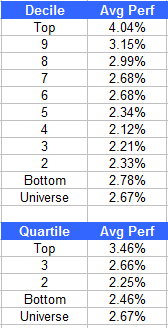
The table below shows the performance of a universe of mid and large cap U.S. equities, broken down by relative strength decile and quartile and then compared to the universe return. Those at the top of the ranks are those stocks which have the best intermediate-term relative strength. Relative strength strategies buy securities that have strong intermediate-term relative strength and hold them as long as they remain strong.

Last week’s performance (5/21/12 – 5/25/12) is as follows:

ranks52912 Weekly RS Recap

After weeks of decline, the market found some traction last week. High relative strength stocks performed well—the top quartile outperformed the universe by 0.79%.