From the Archives: A Wakeup Call for Investors

June 5, 2012

If you have money left over after paying your bills, you fall into the category of “investor.” You could invest your surplus money in having a good time in Vegas, a mattress, a bank savings account, or any manner of financial instruments. Some investments have a financial return; others only a psychic return if you are lucky.

Most people invest for a simple reason: to provide income when they are no longer able to work. Some people might actually want to retire, so they invest to provide income for the time after they voluntarily choose to stop working. To get from “investor” status to actual retirement status, a few difficult things have to happen correctly.

1. You actually need to save money. And you have to save a lot. In today’s America, this means becoming a cultural outlaw and foregoing some current consumption. Welcome to the radical underground.

2. You need to save the money in assets that produce income or capital gains. (Income-producing assets are nice, but capital gains can be spent just as effectively.) These assets are often volatile, leveraged like real estate, or intangible like stocks and bonds. Scary stuff, in other words. Investing your surplus funds in Budweiser, while it may confer certain social benefits, will not provide a retirement income.

3. You need to manage not to muck up your returns. The DALBAR numbers don’t lie. To earn decent real returns, you need to select quality money managers and/or funds and then leave them to do their work.

4. You need to be able to do realistic math. For example, most people think their home is a great investment—but they never subtract from the returns all of the property taxes and maintenance that are required, or remove the effects of leverage. Every study that does shows that homes are not a good financial investment. In addition, in order to make a projection of how much money you will require to retire, you need to be able to make a reasonable estimate of your real net-net-net returns (after inflation, taxes, and expenses) over your compounding period. Investors, imbued with overconfidence, almost always make assumptions that are far too bullish.

Jason Zweig has an excellent article in the Wall Street Journal discussing realistic assumptions for net-net-net rates of return.

Since 1926, according to Ibbotson Associates, U.S. stocks have earned an annual average of 9.8%. Their long-term, net-net-net return is under 4%.

All other major assets earned even less. If, like most people, you mix in some bonds and cash, your net-net-net is likely to be more like 2%.

Mr. Zweig points out that many investors, even some institutional investors, are assuming net-net-net returns of 7% or more. When he asked truly sophisticated investors what return they thought was reasonable, he got very different answers.

I asked several investing experts what guaranteed net-net-net return they would accept to swap out their own assets. William Bernstein of Efficient Frontier Advisors would take 4%. Laurence Siegel, a consultant and former head of investment research at the Ford Foundation: 3%. John C. Bogle, founder of the Vanguard Group of mutual funds: 2.5%. Elroy Dimson of London Business School, an expert on the history of market returns: 0.5%.

The reality is pretty shocking, isn’t it? This is why the investor has an uphill battle. And the consequences of messing any of the four steps up along the way can be pretty steep. In Mr. Zweig’s eloquent words,

The faith in fancifully high returns isn’t just a harmless fairy tale. It leads many people to save too little, in hopes that the markets will bail them out. It leaves others to chase hot performance that cannot last. The end result of fairy-tale expectations, whether you invest for yourself or with the help of a financial adviser, will be a huge shortfall in wealth late in life, and more years working rather than putting your feet up in retirement.

Saving too little can become a big problem. I would add that ruining your returns by thrashing about impulsively will only add to the amount you will need to save. Almost everyone has a number in mind for the amount of assets they will need in retirement. Try redoing the math with realistic numbers and see if you are really saving enough.

—-this article originally appeared 1/19/2010. Americans are still under-saving to an alarming extent. Given that we are currently in a very low yield environment, a high savings level is more important than ever.


Relative Strength, Decade by Decade

June 5, 2012

This post explores relative strength success by decade, dating back to the 1930s. Once again we’ve used the Ken French data library and CRSP database data. You can click here for a more complete explanation of this data.

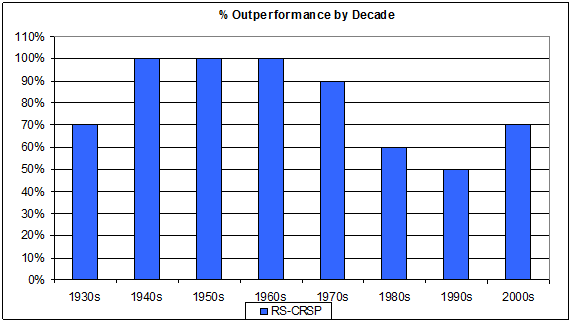
Chart 1: Percent Outperformance by Decade. This chart shows the number of years in which relative strength has outperformed the CRSP universe each decade. Relative strength outperformance has occurred in at least half of all years each decade.

OutperformancebyDecade Relative Strength, Decade by Decade

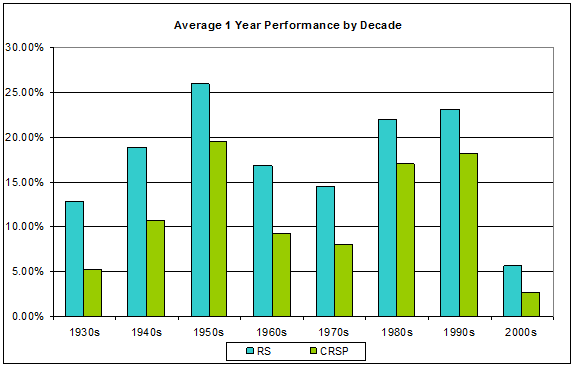
Chart 2: Average 1-Year Performance by Decade. This chart shows the average yearly growth by decade of a relative strength portfolio and of the CRSP universe. Each decade, the average performance of relative strength has been greater than the average performance of the CRSP universe. Generally speaking, when the market’s average performance is increasing, relative strength outperforms CRSP by a greater percentage than it does when the market is doing poorly.

Average1YearPerformancebyDecadeBar Relative Strength, Decade by Decade

In short, relative strength has been a durable return factor for a very long time.


The Art of Doing Nothing

June 5, 2012

The Wall Street Journal had a fascinating article over the weekend on a training simulation for pension plan trustees. Teams compete with one another, with advice and guidance from employees of Brandes Investment Partner, the developers of the simulation. What participants should focus on—and what they do focus on—are often two different things.

What the participants should focus on, [Brandes research analyst Nick Magnuson] says, are the results over longer periods and the information they have about the people, philosophy and processes at the 13 hypothetical money-management firms. In most cases, long-term performance is “a byproduct” of those aspects, Mr. Magnuson explains, while short-term results can be “noisy” rather than predictive.

Yet, the trustees playing the simulation often find that it’s hard to resist a manager on a hot streak—and it’s tempting to dump a long-term winner in a slump. Typically, when Brandes conducts what it calls its Manager Challenge, at least one-third of the teams pick managers based on three-year records, says Barry Gillman, a consultant to Brandes who previously was head of the firm’s portfolio strategies group. “The ingrained patterns are too hard to break,” he says.

The key to success, as it is so often, is being thoughtful about your decisions and then sticking with them.

Participants in these investing simulations, as in the real world, tend to trade too much, the Brandes officials say. Last month, some teams made 10 trades a round. By contrast, the winning team made a total of just five trades after picking its initial portfolio—the fewest in the game.

Sometimes even less trading has paid off. At a few contests in the past, the Brandes folks saw teams select their initial portfolios, slip out of the room to spend their time elsewhere, and come back to find themselves the winners. “We don’t really want people to figure that out” and miss out on the full experience, Mr. Gillman says. “But the reality is many of them would really be better off doing that.”

Winning by doing nothing should be a big lesson to all investors. Select your managers carefully based on people, philosophy, and process (we happen to like relative strength)—and then leave it alone. Assuming the people haven’t turned over and the philosophy and process are unchanged, that should be simple to do. All too often, however, it is not done.

Look at it this way: financial markets are going to bounce up and down no matter what managers you select. Sometimes markets will be smooth for extended periods; at other times they will be frustrating and turbulent. Again, this will occur regardless of the managers you select. You cannot let your confidence in the process be derailed by the inevitable bumps in the market.

There is a fine art to doing nothing. Resisting the urge to tinker once your due diligence is complete actually requires a conscious decision not to intervene at each temptation. It’s harder than it looks—and that’s often the difference between winning and losing.


Relative Strength Spread

June 5, 2012

The chart below is the spread between the relative strength leaders and relative strength laggards (universe of mid and large cap stocks). When the chart is rising, relative strength leaders are performing better than relative strength laggards. As of 6/4/2012:

In a positive sign for high relative strength stocks, the RS Spread has continued to rise during the correction of the last month.