How Long Might Your Portfolio Last?

February 21, 2013

When it comes to retirement, you want your portfolio to last at least as long as you do. From BlackRock comes a useful table for estimating how long your portfolio will last, given return and withdrawal rate assumptions:

withdrawal 02.21.13 How Long Might Your Portfolio Last?

(Click to enlarge)

It is very interesting that choosing a 5 percent withdrawal rate rather than 6 percent resulted in an additional portfolio life of 11 years in this study! A client who has amassed $1 million may be feeling like they must be set for retirement. However, when they realize that this means $50,000 a year (increased annually for inflation), they may no longer feel so good. The earlier that clients begin to think about the concept of withdrawal rates, the more time they will have to affect the absolute value of those withdrawals (through saving and investment decisions) and be able to set themselves up for a comfortable lifestyle.

Posted by:


Waiting for Clarity

February 21, 2013

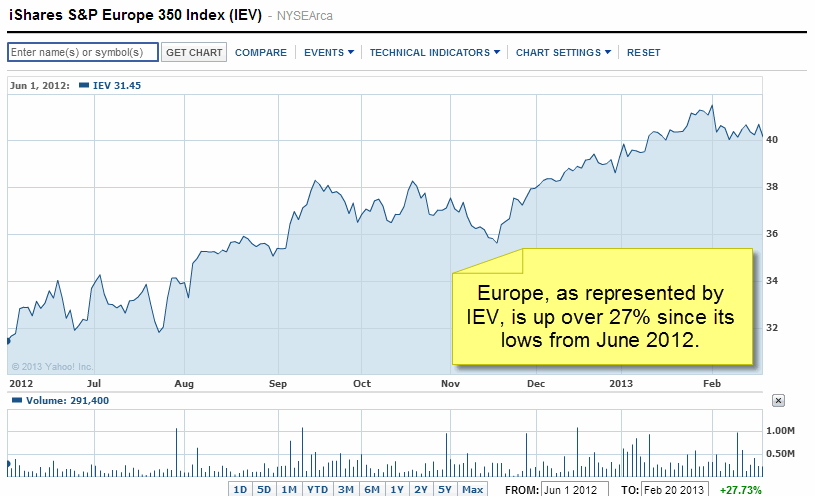
Grim rhetoric about Europe’s economic prospects are plentiful. For example, consider Martin Wolf’s view, as recently detailed in the Financial Times:

Those who believe the eurozone’s trials are now behind it must assume either an extraordinary economic turnaround or a willingness of those trapped in deep recessions to soldier on, year after grim year. Neither assumption seems at all plausible.

And then there is the chart:

iev Waiting for Clarity

Source: Yahoo! Finance

So what gives? Perhaps, Martin Wolf is just plain wrong and there is reason for optimism in Europe. Alternatively, maybe the market is just failing to see how bad things really are in Europe and Wolf will eventually be proven correct. Maybe investors should just sit this one out and wait for some clarity.

This type of thought process goes on constantly with investors. As is obvious to anyone who has been around the markets for a while, waiting for clarity before making an investment is a recipe for disaster. Markets climb a wall of worry—an adage that has been around for decades is a market reality. Trend following doesn’t wait for clarity. It leads investors to enter positions after signs of strength and to exit after signs of weakness. Europe is currently strong. We have seen the trends and relative strength of international equities, including Europe, improve dramatically in recent months. Of course we don’t know whether or not this trend has legs (one never does until after the fact), but trend followers can’t be overly concerned about whether or not each particular trade will work out. Some trades will quickly fail, while others will lead to long-term investments that produce spectacular gains. Embracing a logical methodology, like trend following, is likely to be a much more productive exercise than trying to gain investment wisdom from the current market prognosticators.

HT: Abnormal Returns

Dorsey Wright currently owns IEV and other positions in Europe. A list of all holdings for the trailing 12 months is available upon request. Past performance is no guarantee of future returns.

Posted by:


Fund Flows

February 21, 2013

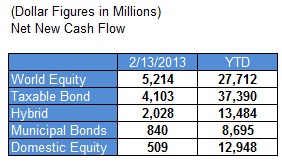
Mutual fund flow estimates are derived from data collected by The Investment Company Institute covering more than 95 percent of industry assets and are adjusted to represent industry totals.

ici 02.21.13 Fund Flows

Posted by:


From the Archives: Rob Arnott and the Key to Better Returns

February 21, 2013

Rob Arnott is a thought leader in tactical asset allocation, currently well-known for his RAFI Fundamental Indexes. In his recent piece, Lessons from the Naughties, he discusses how investors will need to find return going forward.

The key to better returns will be to respond tactically to the shifting spectrum of opportunity, especially expanding and contracting one’s overall risk budget.

It’s a different way to view tactical asset allocation–looking at it from a risk budget point of view. The general concept is to own risk assets in good markets and safe assets in bad markets.

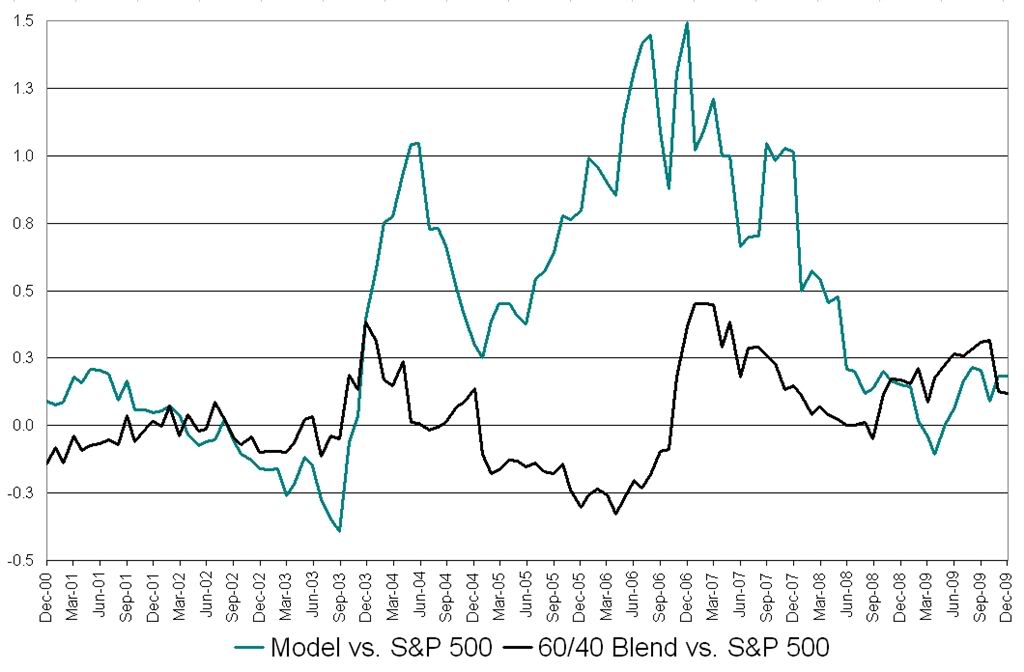
It turns out that systematic application of relative strength accomplishes this very well. The good folks at Arrow Funds recently asked us to take a look at how the beta in a tactically managed portfolio changed over time. When we examined that issue, it showed that as markets became risky, relative strength reduced the beta of the portfolio by moving toward low volatility (strong) assets. When markets were strong, allocating with relative strength pushed up the beta in the portfolio, thus taking good advantage of the market strength.
 From the Archives: Rob Arnott and the Key to Better Returns

click to enlarge

Using relative strength to do tactical asset allocation, the investor was not only able to earn an acceptable rate of return over time, but was able to have some risk mitigation going on the side. That’s a pretty tasty combination in today’s markets.

—-this article originally appeared on 2/26/2010. Amid all of the publicity given recently to risk parity, Arnott’s approach, which is to vary the risk budget over time depending on the opportunities available, has been largely ignored. I think this is unfortunate. His approach, although perhaps not easy, has merit. Tactical asset allocation driven by relative strength is one way to do that.

Posted by: