Mutual fund flow estimates are derived from data collected by The Investment Company Institute covering more than 95 percent of industry assets and are adjusted to represent industry totals.
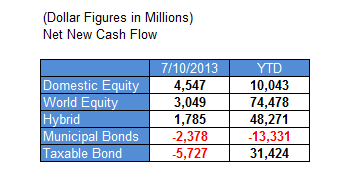
Mutual fund flow estimates are derived from data collected by The Investment Company Institute covering more than 95 percent of industry assets and are adjusted to represent industry totals.
 Leave a Comment » |
  Markets |
  Permalink

Posted by: JP Lee
Factor investing is one of the new frontiers in portfolio construction. We love this trend because relative strength (known as momentum to academics) is one of the premier factors typically used when constructing portfolios. The Technical Leaders ETFs that we construct for Powershares have really benefited from the movement toward factor investing.
Larry Swedroe recently wrote a glowing article on factor investing for Index Universe that serves as a good introduction. His article is full of great points distilled from a paper in the Journal of Index Investing. (The link to the journal paper is included in his article if you want to read the original source.)
The basic idea is that you can generate superior performance by building a portfolio of return factors. A corollary benefit is that because some of the factors are negatively correlated, you can often reduce the portfolio volatility as well. A couple of excerpts from his article should give you the flavor:
The evidence keeps piling up that investors can benefit from building portfolios that diversify across factors that not only explain stock market returns but that also generate superior returns.
The authors found that investors benefited not only from the exposure to each of the factors individually, but also from the low or negative correlations across these factors. The result was more efficient portfolios than ones that were concentrated in a market portfolio or in single factors.
They concluded: “The fact that momentum and value independently deliver market outperformance, with negatively correlated active returns and a low probability of simultaneous market underperformance, provides the motivation for pursuing a momentum and value diversification strategy.”
We concur with the research that shows momentum and value make a great pairing in a portfolio. The table included in the article showed that these two factors were negatively correlated over the period of the study, 1979-2011.
What brought a smile is that Mr. Swedroe is a well-known and passionate advocate for “passive” investing. Factor investing is about as far from passive investing as you can get.
Think about how a value index or relative strength index is constructed—you have to build it actively, picking and choosing to get the focused factor exposure you want. What is a value stock at the beginning of one period may not be a value stock after an extended run-up in price, so activity is also required to reconstitute and rebalance the index on a regular basis. Stocks that lose their high relative strength ranking similarly need to be actively replaced at every rebalance. Whether the picking and choosing is done in a systematic, rules-based fashion or some other way is immaterial.
Market capitalization-weighted indexes, as a broad generality, might be able to “kinda sorta” claim the passive investing label because they don’t generally have to be constantly rebalanced—although the index component changes are active. A factor index, on the other hand, might require a lot of activity to reconstitute and rebalance it on a regular schedule. But that’s the point—the end result of the activity is focused factor exposure designed to generate superior performance and volatility characteristics.
And spare me the argument that indexing is passive investing. Take a look at the historical level of turnover in indexes like the S&P 500, the S&P Midcap 400, the S&P Smallcap 600, or the Russell 2000 and then try to make the argument that nothing active is going on. I don’t think you can do it. The only real difference is that you have hired the S&P index committee to manage your portfolio instead of some registered investment advisor. (In fact, the index committees typically incorporate some element of relative strength in their decisions as they dump out poor performers and add up-and-coming stocks. Look at the list of additions and deletions if you don’t believe me.) Certainly the level of turnover in a value or momentum index belies the passive label as well.
Index investing is active investing.
I think where passive investing advocates get confused is on the question of cost. Index investing is often low-cost investing—and cost is an important consideration for investors. I suspect that many fans of passive investing are more properly described as fans of low-cost investing. I’m not sure they are really even fans of indexing, since research shows that many so-called actively managed funds are really closet index funds. Presumably their objection is the big fee charged for indexing while masquerading as an active fund, not the indexing itself. (But the same research suggests that an active fund that is truly active—one with high active share—is not necessarily a bad deal.)
Even a factor index is active by definition, but if it is well-constructed and low cost to boot, it might worth taking a close look at.
7 Comments | Portfolio Theory, Relative Strength and Value, Thought Process | Tagged: factor investing, relative strength | Permalink
Posted by: Mike Moody
You are currently browsing the Systematic Relative Strength blog archives for the day Thursday, July 18th, 2013.








