Warren Buffett and Charlie Munger’s Best Advice

November 26, 2013

…talk about the best advice they have even gotten in a short piece from Fortune. I think it clarifies the difference between a blind value investor and an investor who is looking for good companies (not coincidentally, many of those good companies have good relative strength). Warren Buffett and Charlie Munger have made a fortune implementing this advice.

Buffett: I had been oriented toward cheap securities. Charlie said that was the wrong way to look at it. I had learned it from Ben Graham, a hero of mine. [Charlie] said that the way to make really big money over time is to invest in a good business and stick to it and then maybe add more good businesses to it. That was a big, big, big change for me. I didn’t make it immediately and would lapse back. But it had a huge effect on my results. He was dead right.

Munger: I have a habit in life. I observe what works and what doesn’t and why.

I highlighted the fun parts. Buffett started out as a Ben Graham value investor. Then Charlie wised him up.

Valuation has its place, obviously. All things being equal, it’s better to buy cheaply than to pay up. But Charlie Munger had observed that good businesses tended to keep on going. The same thing is typically true of strong stocks—and most often those are the stocks of strong businesses.

Buy strong businesses and stick with them as long as they remain strong.

warrenbuffettcharliemunger zps0622d20f Warren Buffett and Charlie Mungers Best Advice

Source: CNN/Money (click on image to enlarge)

Posted by:


Nasdaq 4000

November 26, 2013

Why investing can be so frustrating (especially if you ignore the technicals):

Tech investors in 2000 were right about the possibilities of the Internet and mobile computing. But they were dead wrong about which companies would be in the vanguard and how long those advances would take.

And they paid the price.

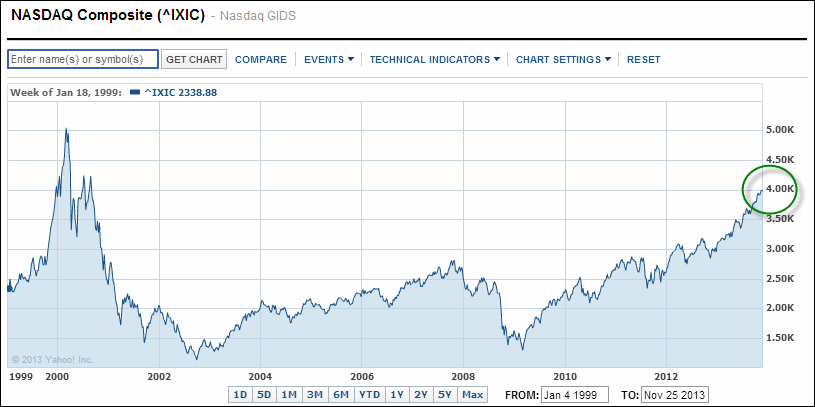
Returning to 4000 — first crossed in December 1999 and last seen in September 2000 — is a symbolic end to more than a decade of pain. Legions of investors plunged into the tech-stock craze of the late 1990s in search of easy riches and ended up falling victim to the worst crash since the Great Depression.

The Nasdaq fell 78% in 2½ years. Many investors worried it might be a long time before they got their money back. But few could have imagined it would be this long.

“It’s taken 13 years to get back,” says Jack Ablin of BMO Private Bank. “It just shows the magnitude of that bubble we expanded back in 1999 and 2000.”

My emphasis added. It’s not enough to be generally right about the fundamental story. The technicals (i.e. trends of the stocks themselves) cannot be ignored.

Nasdaq Nasdaq 4000

Source: Yahoo! Finance

Posted by:


Relative Strength Spread

November 26, 2013

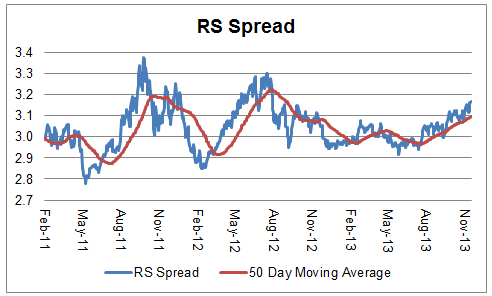
The chart below is the spread between the relative strength leaders and relative strength laggards (universe of mid and large cap stocks). When the chart is rising, relative strength leaders are performing better than relative strength laggards. As of 11/25/2013:

spread 11.26.13 Relative Strength Spread

The RS Spread continues to trade above its 50 day moving average—reflecting a generally positive environment for relative strength strategies.

Posted by: