Longevity Risk Increases With Age

November 13, 2013

Insightful post by Wade Pfau on longevity risk:

What the figure shows, for a same-age couple, is their median remaining life expectancy for each age beyond 50. For a 50-year old couple, there is a 50% chance that at least one member of the couple will live at least for just under another 42 years to age 92. By the time they reach 75, there is a 50% chance that at least one will live for a little more than 17 more years to age 92. This is the age range where mortality starts to pick up. If both are still alive at age 92, there is a 50% change that at least one will live for at least 4.6 more years to 96.6, and so on.

What is also shown in the figure are the remaining life expectancies at the 90th and 10th percentiles as well. At 50, 10% of couples will see at least one spouse live for more than another 50.3 years, and 10% of couples will experience both spouses dying in less than 30.7 years. And so on.

What is important to highlight is that the relative gap between median life expectancy and the 90th percentile grows with age. This is because mortality rates are lower at younger ages, and the differences between the median and 90th percentiles only start to build up by staying alive at the higher ages.

So at age 50, 50% of couples will see someone live another 41.8 years, while 10% of couples will see someone live another 50.3 years. It’s not that big of difference, relatively speaking.

However, by age 100, for instance, the median remaining life expectancy is 2.1 years, while the 90th percentile is 5.7 years. This is a big relative difference. The implication is that a variable strategy in which withdrawal rates are guided by remaining life expectancy, which I think is an important component of developing an optimal strategy, become much more exposed to longevity risk at the higher ages.

lifeexpectancy Longevity Risk Increases With Age

As people become familiar with the basics of longevity risk they will naturally become increasingly serious about an effective savings and investment plan to build an adequate nest egg. Furthermore, thinking about the very real possibility of living to 90+ can also temper the appetite for unsustainable spending patterns in retirement.

Posted by:


High RS Diffusion Index

November 13, 2013

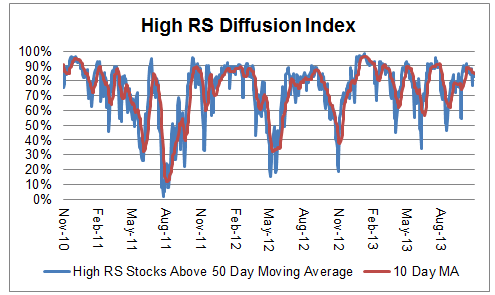
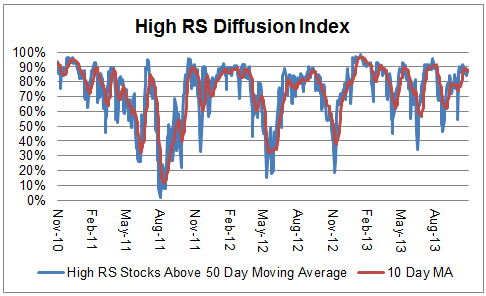
The chart below measures the percentage of high relative strength stocks that are trading above their 50-day moving average (universe of mid and large cap stocks.) As of 11/12/13.

diffusion 11.13.13 High RS Diffusion Index

The 10-day moving average of this indicator is 85% and the one-day reading is 83%.

Posted by:


Your Plan vs. Reality

November 12, 2013

Great pic from @ThinkingIP:

plan thinkingip1 Your Plan vs. Reality

Posted by:


Relative Strength Spread

November 12, 2013

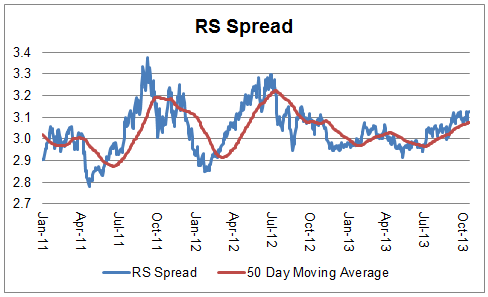
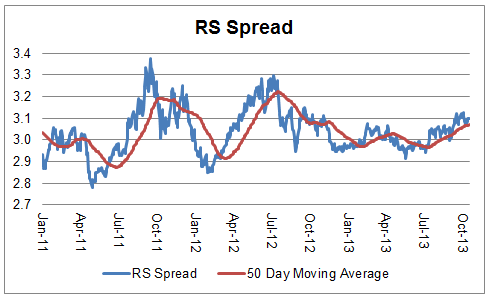
The chart below is the spread between the relative strength leaders and relative strength laggards (universe of mid and large cap stocks). When the chart is rising, relative strength leaders are performing better than relative strength laggards. As of 11/11/2013:

spread 11.12.13 Relative Strength Spread


The RS Spread is in a healthy rising trend, reflecting an environment that tends to be favorable for relative strength strategies.

Posted by:


Weekly RS Recap

November 11, 2013

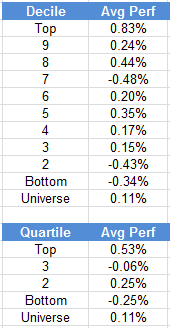
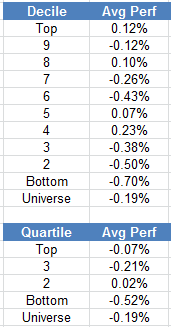
The table below shows the performance of a universe of mid and large cap U.S. equities, broken down by relative strength decile and quartile and then compared to the universe return. Those at the top of the ranks are those stocks which have the best intermediate-term relative strength. Relative strength strategies buy securities that have strong intermediate-term relative strength and hold them as long as they remain strong.

Last week’s performance (11/4/13 – 11/8/13) is as follows:

ranks 11.11.13 Weekly RS Recap

Posted by:


October Arrow DWA Funds Review

November 7, 2013

10/31/2013

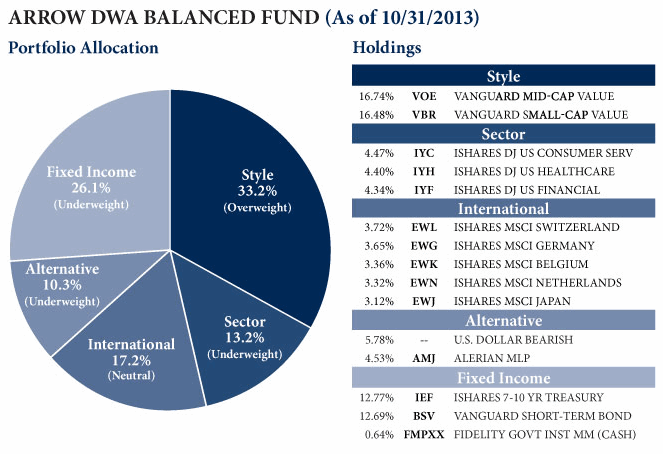
The Arrow DWA Balanced Fund (DWAFX)

At the end of October, the fund had approximately 47% in U.S. Equities, 25% in Fixed Income, 17% in International Equities, and 11% in Alternatives.

We had strong gains from our equity positions in October. For the month of October, Germany was up 5.54%, our Consumer Cyclical position was up 5.04%, Netherlands was up 4.95%, and our Mid-Cap Value position was up 4.65%. Our fixed income and currency positions were fairly flat for the month.

In U.S. equities, Small and Mid-Caps continue to have superior relative strength versus Large-Caps. Also, the composition of our international equity holdings has changed significantly over the last year. For most of 2012, the majority of our international holdings were from Emerging Markets. However, we started to see some important relative strength changes between Developed International Markets and Emerging Markets towards the middle of 2012. Currently, all five of our international holdings are from developed markets.

In the Alternative sleeve, we have exposure to MLPs and currencies. Commodities remain weak and are not represented in the fund.

DWAFX rose 2.75% in October, and is up 12.52% through 10/31/13.

We believe that a real strength of this strategy is its balance between remaining diversified, while also adapting to market leadership. When an asset class is weak its exposure will tend to be towards the lower end of the exposure constraints, and when an asset class is strong its exposure in the fund will trend toward the upper end of its exposure constraints. Relative strength provides an effective means of determining the appropriate weights of the strategy.

dwafx 11.07.13 October Arrow DWA Funds Review

The Arrow DWA Tactical Fund (DWTFX)

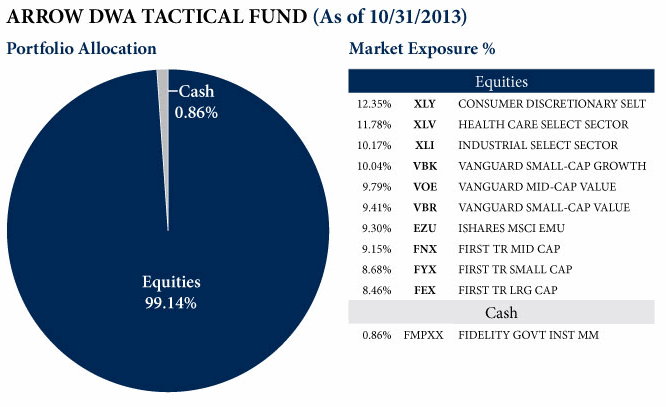
At the end of October, the fund had approximately 90% in U.S. equities and 9% in International equities.

Some years it is helpful to remain widely diversified and other years it is better to be more concentrated. This is a year where our concentration in U.S. equities has really helped the performance of the fund as U.S. equities have generated some impressive returns. We did have a number of trades in October. We removed a Large Cap Value position, a Financial sector position, Japan, and a dividend-focused ETF. We added two Small-Cap ETFs, a European equity ETF, and an Industrials sector position. As is the nature of relative strength, if positions aren’t keeping up with other options in a rising market they can be sold even if they are rising (albeit more slowly than other positions in the universe).

DWTFX was up 3.60% in October, and has gained 19.71% through 10/31/13.

This strategy is a go-anywhere strategy with very few constraints in terms of exposure to different asset classes. The strategy can invest in domestic equities, international equities, inverse equities, currencies, commodities, real estate, and fixed income. Market history clearly shows that asset classes go through secular bull and bear markets and we believe this strategy is ideally designed to capitalize on those trends. Additionally, we believe that this strategy can provide important risk diversification for a client’s overall portfolio.

dwtfx 11.07.13 October Arrow DWA Funds Review

A list of all holdings for the trailing 12 months is available upon request. See www.arrowfunds.com for more information.

Posted by:


High RS Diffusion Index

November 6, 2013

The chart below measures the percentage of high relative strength stocks that are trading above their 50-day moving average (universe of mid and large cap stocks.) As of 11/5/13.

diffusion 11.06.13 High RS Diffusion Index

The 10-day moving average of this indicator is 87% and the one-day reading is also 87%.

Posted by:


Relative Strength Spread

November 5, 2013

The chart below is the spread between the relative strength leaders and relative strength laggards (universe of mid and large cap stocks). When the chart is rising, relative strength leaders are performing better than relative strength laggards. As of 11/4/2013:

spread 11.05.13 Relative Strength Spread

Since June of this year, the RS Spread has generally been trending higher—a potentially positive sign for relative strength strategies.

Posted by:


The Top Ten Ways to Sabotage Your Portfolio

November 4, 2013

Good portfolio management is difficult, while poor portfolio management is almost effortless! In the spirit of David Letterman’s Top Ten list, here is my contribution to the genre of things to avoid, with a special nod to our brand of investing. I made a version of this presentation originally at a 1996 Dorsey Wright Broker Institute.


THE TOP TEN WAYS TO SABOTAGE YOUR PORTFOLIO

1. BE ARROGANT. Assume your competition is lazy and stupid. Don’t do your homework and don’t bother with a game plan. Panic if things don’t go well.

2. WHEN A SECTOR OR THE MARKET REVERSES UP, WAIT UNTIL YOU FEEL COMFORTABLE TO BUY. This is an ideal method for catching stocks 10 points higher.

3. BE AFRAID TO BUY STRONG STOCKS. This way you can avoid the big long-term relative strength winners.

4. SELL A STOCK ONLY BECAUSE IT HAS GONE UP. This is an excellent way to cut your profits short. (If you can’t stand prosperity, trim if you must, but don’t sell it all.)

5. BUY STOCKS IN SECTORS THAT ARE SUPER EXTENDED BECAUSE IT’S DIFFERENT THIS TIME. Not.

6. TRY TO BOTTOMFISH A STOCK IN A DOWNTREND. Instead, jump off a building and try to stop 5 floors before you hit the ground. Ouch.

7. BUY A STOCK ONLY BECAUSE IT’S A GOOD VALUE. There are two problems with this. 1) It can stay a good value by not moving for the next decade, or worse 2) it can become an even better value by dropping another 10 points.

8. HOLD ON TO LOSING STOCKS AND HOPE THEY COME BACK. An outstanding way to let your losses run. Combined with cutting your profits short, over time you can construct a diversified portfolio of losers and register it with the Kennel Club.

9. PURSUE PERFECTION. There are two diseases. 1) Hunting for the perfect method. Trying a new “system” each week will not get you to your goal. It requires remaining focused on one method, maintaining consistency and discipline, and making incremental improvements. 2) Waiting for the perfect trade. The sector is right, the market is supporting higher prices, the chart is good—try to buy it a point cheaper and miss it entirely. Doh. Better to be approximately right than precisely wrong.

10. MAKE INVESTMENT DECISIONS BASED ON A MAGAZINE COVER, MEDIA ARTICLES, OR PUNDITS. Take investment advice from a journalist or a hedge fund manager talking his book! Get fully engaged with your emotions of fear and greed! This is the method of choice for those interested in the fastest route to the poorhouse.

Posted by:


Quote of the Week

November 4, 2013

It is remarkable how much long-term advantage people like us have gotten by trying to be consistently not stupid, instead of trying to be very intelligent.—-Charlie Munger

Warren Buffett and Charlie Munger think that some of their advantage is just in trying not to do anything stupid. Indeed, it is doing stupid stuff that is usually the problem in investing. Of course, it doesn’t seem stupid at the time—indeed, it usually seems very compelling—which is why it is difficult to recognize and stop. I follow with my contribution to the genre.

HT: Morgan Housel and Abnormal Returns

Posted by:


‘Smart Beta’ Equity ETFs Gather $45B YTD

November 4, 2013

IndexUniverse reports:

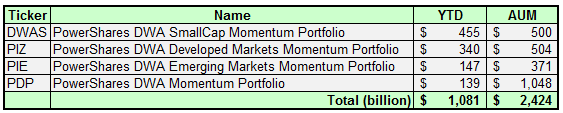
Investors have poured $45.93 billion into so-called “smart beta” equities ETFs so far this year, in what amounts to a 20 percent increase in total assets in the segment. The increase reflects just how strong an appetite there is for nonmarket-cap-weighted funds seeking excess returns—or outperformance—in one form or another.

Our contribution to that growth is as follows:

ps 11.04.13 Smart Beta Equity ETFs Gather $45B YTD

Source: PowerShares (click to enlarge)

With this year’s growth, the assets in our four momentum ETFs has nearly doubled.

Posted by:


Weekly RS Recap

November 4, 2013

The table below shows the performance of a universe of mid and large cap U.S. equities, broken down by relative strength decile and quartile and then compared to the universe return. Those at the top of the ranks are those stocks which have the best intermediate-term relative strength. Relative strength strategies buy securities that have strong intermediate-term relative strength and hold them as long as they remain strong.

Last week’s performance (10/28/13 – 11/1/13) is as follows:

ranks 11.04.13 Weekly RS Recap


High relative strength stocks generally performed better than the universe and better than the laggards last week.

Posted by: