From the Archives: The Future of Decision-Making

June 13, 2012

Man versus machine, art versus science, intuition versus logic—all of these are ways of expressing what we often think of as contradictory approaches to problem solving. Should we be guided more by data and precedent, or is it more important to allow for the human element? Is it critical to be able to step aside and say, with the benefit of our judgment, “maybe this time really is different?”

The Harvard Business Review recently took on this topic and a few of their points were quite provocative.

A huge body of research has clarified much about how intuition works, and how it doesn’t. Here’s some of what we’ve learned:

  • It takes a long time to build good intuition. Chess players, for example, need 10 years of dedicated study and competition to assemble a sufficient mental repertoire of board patterns.
  • Intuition only works well in specific environments, ones that provide a person with good cues and rapid feedback . Cues are accurate indications about what’s going to happen next. They exist in poker and firefighting, but not in, say, stock markets. Despite what chartists think, it’s impossible to build good intuition about future market moves because no publicly available information provides good cues about later stock movements. [Needless to say, I don't agree with his assessment of stock charts!] Feedback from the environment is information about what worked and what didn’t. It exists in neonatal ICUs because babies stay there for a while. It’s hard, though, to build medical intuition about conditions that change after the patient has left the care environment, since there’s no feedback loop.
  • We apply intuition inconsistently. Even experts are inconsistent. One study determined what criteria clinical psychologists used to diagnose their patients, and then created simple models based on these criteria. Then, the researchers presented the doctors with new patients to diagnose and also diagnosed those new patients with their models. The models did a better job diagnosing the new cases than did the humans whose knowledge was used to build them. The best explanation for this is that people applied what they knew inconsistently — their intuition varied. Models, though, don’t have intuition.
  • We can’t know or tell where our ideas come from. There’s no way for even an experienced person to know if a spontaneous idea is the result of legitimate expert intuition or of a pernicious bias. In other words, we have lousy intuition about our intuition.
  • It’s easy to make bad judgments quickly. We have many biases that lead us astray when making assessments. Here’s just one example. If I ask a group of people “Is the average price of German cars more or less than $100,000?” and then ask them to estimate the average price of German cars, they’ll “anchor” around BMWs and other high-end makes when estimating. If I ask a parallel group the same two questions but say “more or less than $30,000″ instead, they’ll anchor around VWs and give a much lower estimate. How much lower? About $35,000 on average, or half the difference in the two anchor prices. How information is presented affects what we think.

We’ve written before about how long it takes to become world-class. Most studies show that it takes about ten years to become an expert if you apply yourself diligently. Obviously, the “intuition” of an expert is much better than the intuition of a neophyte. If you think about that for a minute, it’s pretty clear that intuition is really just judgment in disguise. The expert is better than the novice simply because they have a bigger knowledge base and more experience.

Really, the art versus science debate is over and the machines have won it going away. Nowhere is this more apparent than in chess. Chess is an incredibly complex mental activity. Humans study with top trainers for a decade to achieve excellence. There is no question that training and practice can cause a player to improve hugely, but it is still no contest. As processing power and programming experience has become more widespread, a $50 CD-ROM off-the-shelf piece of software can defeat the best players in the world in a match without much problem. Most of the world’s top grandmasters now use chess software to train with and to check their ideas. (In fact, so do average players since the software is so cheap and ubiquitous.)

How did we get to this state of affairs? Well, the software now incorporates the experience and judgment of many top players. Their combined knowledge is much more than any one person can absorb in a lifetime. In addition, the processing speed of a standard desktop computer is now so fast that no human can keep it with it. It doesn’t get tired, upset, nervous, or bored. Basically, you have the best of both worlds—lifetimes of human talent and experience applied with relentless discipline.

A 2000 paper on clinical versus mechanical prediction by Grove, Zald, Lebow, Snitz, & Nelson had the following abstract:

>The process of making judgments and decisions requires a method for combining data. To compare the accuracy of clinical and mechanical (formal, statistical) data-combination techniques, we performed a meta-analysis on studies of human health and behavior. On average, mechanical-prediction techniques were about 10% more accurate than clinical predictions. Depending on the specific analysis, mechanical prediction substantially outperformed clinical prediction in 33%–47% of studies examined. Although clinical predictions were often as accurate as mechanical predictions, in only a few studies (6%–16%) were they substantially more accurate. Superiority for mechanical-prediction techniques was consistent, regardless of the judgment task, type of judges, judges’ amounts of experience, or the types of data being combined. Clinical predictions performed relatively less well when predictors included clinical interview data. These data indicate that mechanical predictions of human behaviors are equal or superior to clinical prediction methods for a wide range of circumstances.

That’s a 33-47% win rate for the scientists and a 6-16% win rate for the artists, and that was ten years ago. That’s not really very surprising. Science is what has allowed us to develop large-scale agriculture, industrialize, and build a modern society. Science and technology are not without their problems, but if the artists have stayed in charge we might still be living in caves, although no doubt we would have some pretty awesome cave paintings.

This is the thought process behind our Systematic Relative Strength accounts. We were able to codify our own best judgment, include lifetimes of other experience from investors we interviewed or relative strength studies that we examined, and have it all run in a disciplined fashion. We chose relative strength because it was the best-performing factor and also because, since it is relative, it is adaptive. There is always cooperation between man and machine in our process, but moving more toward data-driven decisions is indeed the future of decision making.

—-this article originally appeared 1/15/2010. Our thought process hasn’t changed—we still believe that a systematic, adaptive investment process is the way to go.

Posted by:


From the Archives: The Math Behind Manager Selection

May 31, 2012

Hiring and firing money managers is a tricky business. Institutions do it poorly (see background post here ), and retail investors do it horribly (see article on DALBAR ). Why is it so difficult?

This white paper on manager selection from Intech/Janus goes into the mathematics of manager selection. Very quickly it becomes clear why it is so hard to do well.

Many investors believe that a ten-year performance record for a group of managers is sufficiently long to make it easy to spot the good managers. In fact, it is unlikely that the good managers will stand out. Posit a good manager whose true average relative return is 200 basis points (bps) annually and true tracking error (standard deviation of relative return) is 800 bps annually. This manager’s information ratio is 0.25. To put this in perspective, an information ratio of 0.25 typically puts a manager near or into the top quartile of managers in popular manager universes.

Posit twenty bad managers with true average relative returns of 0 bps annually, true tracking error of 1000 bps annually, hence an information ratio of 0.00.

There is a dramatic difference between the good manager and the bad managers.

The probability that the good manager beats all twenty bad managers over a ten-year period is only about 9.6%. This implies that chasing performance leaves the investor with the good manager only about 9.6% of the time and with a bad manager about 90.4% of the time.

In other words, 90% of the time the manager with the top 10-year track record in the group will be a bad manager! Maybe a longer track record would help?

A practical approach is to ask how long a historical performance record is necessary to be 75% sure that the good manager will beat all the bad managers, i.e., have the highest historical relative return. Assuming the same good manager as before and twenty of the same bad managers as before, a 157 year historical performance record is required to achieve a 75% probability that the good manager will beat all the bad managers.

It turns out that it would help, but since none of the manager databases have 150-year track records, in practice it is useless. The required disclaimer that past performance is no guarantee of future results turns out to be true.

There is still an important practical problem to be solved here. Assuming that bad managers outnumber good ones and assuming that we don’t have 150 years to wait around for better odds, how can we increase our probability of identifying one of the good money managers?

The researchers show mathematically how combining an examination of the investment process with historical returns makes the decision much simpler. If the investor can make a reasonable assumption about a manager’s investment process leading to outperformance, the math is straightforward and can be done using Bayes’ Theorem to combine probabilities.

…the answer changes based on the investor’s assessment of the a priori credibility of the manager’s investment process.

It turns out that the big swing factor in the answer is the credibility of the underlying investment process. What are the odds that an investment process using Fibonacci retracements and phases of the moon will generate outperformance over time? What are the odds that relative strength or deep value will generate outperformance over time?

The research paper concludes with the following words of wisdom:

A careful examination of almost any investor’s investment manager hiring and firing process is likely to reveal that there is a substantial component of performance chasing. Sometimes it is obvious, e.g., when there is a policy of firing a manager if he has negative performance after three years. Other times it is subtle, e.g., when the initial phase of the manager search process strongly weights attractive historical performance. No matter the form that performance chasing takes, it tends to produce future relative returns that are disappointing compared to expectations.

Historical performance alone is not an effective basis for identifying a good manager among a group of bad managers. This does not mean that historical performance is useless. Rather, it means that it must be combined efficiently with other information. The correct use of historical performance relegates it to a secondary role. The primary focus in manager choice should be an analysis of the investment process. [emphasis added]

This research paper is eye-opening in several respects.

1) It shows pretty clearly that historical performance alone–despite what our intuition tells us–is not sufficient to select managers. This probably accounts for a great deal of the poor manager selection, the subsequent disappointment, and rapid manager turnover that goes on.

2) It is very clear from the math that only credible investment processes are likely to generate long-term outperformance. Fortunately, lots of substantive academic and practitioner research has been done on factor analysis leading to outperformance. The only two broadly robust factors discovered so far have been relative strength and value, both in various formulations–and, obviously, they have to be implemented in a disciplined and systematic fashion. If your investment process is based on something else, there’s a decent chance you’re going to be disappointed.

3) Significant time is required for the best managers to stand out from the much larger pack of mediocre managers.

This is a demanding process for consultants and clients. They have to willfully reduce their focus on even 10-year track records, limit their selection to rigorous managers using proven factors for outperformance, and then exercise a great deal of patience to allow enough time for the cream to rise to the top. The rewards for doing so, however, might be quite large–especially since almost all of your competition will ignore the correct process and and simply chase performance.

—-this article originally appeared 1/28/2010. I have seen no evidence since then that most consultants have improved their manager selection process, which is a shame.

Posted by:


People First

May 18, 2012

Financial advisors often become enamored with new whiz-bang products and new and improved methodologies. Sometimes they really are new and improved, so we always need to check them out. But the bedrock of the business is really the relationship with the client. You need to care about the client’s well-being and they need to know you care. You need to go the extra mile.

I was thinking about this in relation to this article about customer service in the retail world from PandoDaily.

There is simply no such thing as a shortcut when it comes to customer service. You can provide an alternate service, if you don’t want to invest in a local call center of friendly competent people armed with helpful databases of customer information. But don’t call this customer service, because it isn’t. To call a person reading from a script a customer-service representative is like calling a middle school play Broadway. You might as well not have an 800 number.

Zappos, GoDaddy, Qualtrics and Braintree have proven that spending money on customer service isn’t throwing money away — it’s investing in the business. Done well, good customer service is the difference between a mediocre business and a great one. You can get shoes anywhere, and Zappos’ site design has never been that amazing; its entire success is wrapped up in treating people well. GoDaddy doesn’t view its call center as a “cost center,” arguing it has actually generated more than $100 million in annual revenues.

If anything, client service is even more important in wealth management because the product itself is intangible. How can you put a price on financial security and peace of mind? And, as GoDaddy shows, good client service can generate revenues, not just add to costs. People come first.

Posted by:


It’s Hard Out There for a Bear

May 9, 2012

I’m not trying to pick on Paul Farrell, really. He’s one of the most read columnists on Marketwatch. From time to time, however, I archive articles that are wildly optimistic or wildly pessimistic to demonstrate how difficult it is not to be carried away with emotion. This article just happened to fall into that category.

This particular article appeared August 17, 2010. The market had just gone through a near 20% decline, as well as the flash crash a few months before. Here is the front end of the article:

Yes, it’s going to get worse, a whole lot worse … Bill Gross warns this is the “New Normal. Forget 10% returns. Think 5%”. … Economist Larry Kotlikoff, author of The Coming Generational Storm, warns: “Let’s get real. The U.S. is bankrupt. Neither spending nor taxing will help the country pay its bills” … Economist Peter Morici warns: “Unemployment is stuck near 10%. Deflation coming. Stock market threatens collapse. The Federal Reserve and Barack Obama are out of bullets. Near zero federal funds rates, central bank purchases, a $1.6 trillion deficit have failed to revive the economy.” … Simon Johnson, co-author of 13 Bankers, warns: “We came close to another Great Depression, next time we may not be so lucky.” Why? Because Wall Street’s already well into the next bubble/bust cycle — the “doom cycle.”

The doom cycle sounds pretty bad and we are warned that things are going to get a whole lot worse. I’m not exaggerating. The whole paragraph was in heavy bold type.

Since then, we’ve gone through another 20% correction. And the market is more than 25% higher. Yes, higher.

Before you smirk and think you are immune from getting carried away, think again. We are all susceptible to emotion—it’s just part of our wiring. And it’s not just on the downside. It’s equally easy to get carried away with “new era” thinking on the upside.

Sentiment swings, I think, demonstrate one of the very best reasons to use a systematic investment process. Our happens to be an adaptive one driven by relative strength, but I’m sure other styles could also be successful. The important thing is to define a profitable process and then stick to it through thick and thin.

Posted by:


Factor Investing

May 8, 2012

Diversification, risk management, and returns are all important in investing. Increasingly, factor exposure is being used to accomplish these goals. A Wall Street Journal article covered the issue very well (may be behind a pay wall, sorry).

By changing the way you spread out your stock holdings, you can reduce risk and boost returns—even in a highly correlated market like today’s.

The trick? A concept known as “factor investing,” which originated in academia two decades ago and now is finding favor among institutional investors and high-end financial advisers.

Factor investing replaces traditional asset allocation—such as a portfolio with 30% in U.S. stocks, 20% in developed international markets, 10% in emerging markets and 40% in bonds—by focusing on specific attributes that researchers say drive returns. These “risk factors” include the familiar—like small versus large-size companies or growth versus value stocks—as well as more esoteric measures such as volatility, momentum, dividend yield, economic sensitivity and the health of a company’s balance sheet.

As a reader of this blog, you’re probably already familiar with factor investing through relative strength—something that academics call momentum. Using factors rather than style boxes has some advantages.

“There are a lot of nuances you may be missing by focusing only on style and size,” says Savita Subramanian, head of equity and quantitative strategy at BofA Merrill Lynch Global Research. “You may be missing a whole layer of outperformance you could have gotten.”

Some fairly high-end investors are converting portfolios to focus on factor exposures. By converting to factor exposure, investors are trying to drill down to the actual return drivers.

Big investors are taking heed. In 2009, researchers assigned to analyze the Norwegian Government Pension Fund recommended it reorient its portfolio around risk factors. And the California Public Employees’ Retirement System underwent a similar change in approach in 2010.

After 2008, big investors discovered that they had factor exposure anyway—it was just exposure they were not aware of and hadn’t controlled. There’s a lot less potential for surprise if the factor exposures are constructed deliberately!

New products are becoming available to feed the demand for factor exposure as well.

Until recently, it was hard for small investors to dabble in factor investing. But that is changing.

In the past year at least six firms—BlackRock’s iShares, Russell Investments, Invesco PowerShares, Factor Advisors, QuantShares and State Street Global Advisors—have launched factor-based exchange-traded funds, or have filed paperwork to do so.

Of course, overlooked among the rush of big firms racing to create factor exposure is the grand-daddy of relative strength, the Powershares DWA Technical Leaders Index (PDP). It’s actually been around more than five years and has performed nicely over that time, beating the S&P 500 despite a market environment that has been hostile to relative strength strategies. (We’re looking forward to seeing how it performs in a better RS market!)

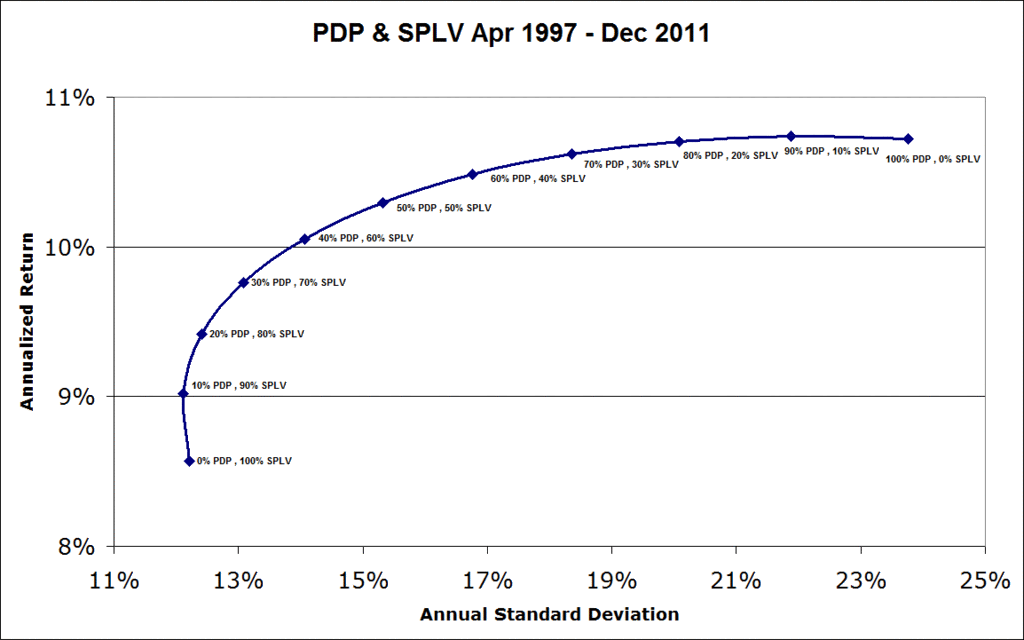
One of the big advantages of factor exposure is that some factors offset one another beautifully. We’ve written before about the nice efficient frontier that is created by combining relative strength and low volatility. (You can see the chart below.) These factors work well together because the excess returns are uncorrelated.

pdp 9 1 Factor Investing

Source: Dorsey Wright (click to enlarge to full size)

In short, there’s more to portfolio construction than asset allocation and style boxes. Factor exposure should be considered as well if the result is a better portfolio for the client.

See www.powershares.com for more information about PDP. Past performance is no guarantee of future returns. A list of all holdings for the trailing 12 months is available upon request.

Posted by:


Systematic RS Portfolios: Q1 Commentary

April 4, 2012

Click here for our Q1 Commentary.

q1commentary Systematic RS Portfolios: Q1 Commentary

Posted by:


Where Did My Return Go?

April 4, 2012

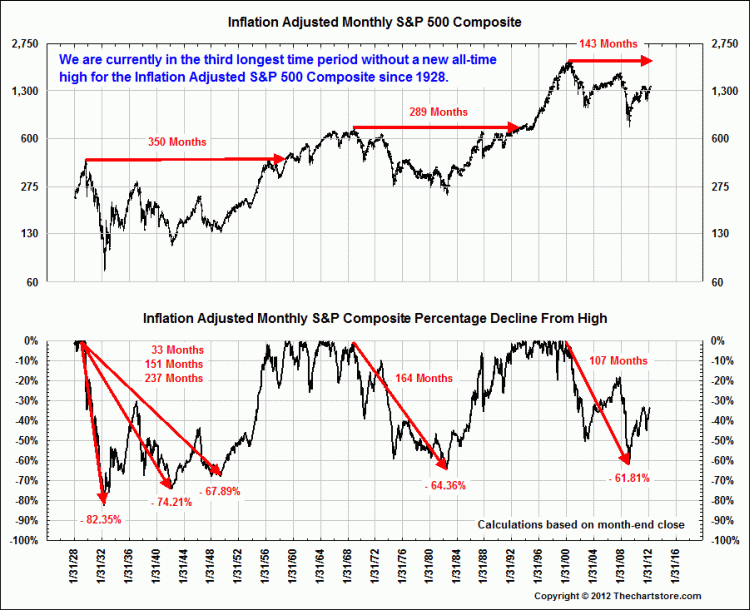
Barry Ritholtz at the Big Picture had an interesting post about real returns, that is, returns adjusted for inflation. (He illustrated his point with some amazing graphics from The Chart Store, produced by its proprietor, Ron Griess.) Barry apparently loves Ron’s work, and for good reason. Very long term charts are great for perspective. It’s kind of a “YOU ARE HERE” experience.

One of the charts, in particular, struck me. It was a chart of the S&P 500 real return. It shows how far in time and distance we are from the all-time index highs, as well as what has happened in past declines.

RealSNP Where Did My Return Go?

Source: The Big Picture/ The Chart Store (click to enlarge)

The real take-away here is that nominal returns can be quite deceptive. Just because the dollar amount on your statement keeps growing does not mean your purchasing power has been maintained. And your wait for real returns may be measured in decades!

It also suggests that it is important to look across a broad group of assets to try to capture returns wherever they are. Investing in stocks has the possibility of augmenting your purchasing power greatly, but there are also long, long periods where market indexes have remained stagnant. Plenty of individual stocks may have done well, but it’s also possible that the best opportunities were in asset classes outside of equities. A realistic investment policy will pursue returns wherever they are available.

Posted by:


Theory versus Practice

April 3, 2012

In finance there is often a marked difference between theory and practice. Advisor Perspectives carried an excellent commentary from Loomis Sayles on an alternative way to think about financial markets. It points out, very clearly, that what is often lost in theory is the human element.

In an often cynical world, standard financial and macroeconomic quantitative models give people the benefit of the doubt. Fundamental economic theory assumes the best of us, supposing that human beings are perfectly rational, know all the facts of a given situation, understand the risks, and optimize our behavior and portfolios accordingly. Reality, of course, is quite different. While a significant portion of individual and market behavior can be modeled reasonably well, the human emotions that drive cycles of fear and greed are not predictable and can often defy historical precedent.

Economic historian Charles Kindleberger can offer some insight. In his book Manias, Panics, and Crashes, Kindleberger explores the anatomy of a typical financial crisis and provides a framework that considers the impact of the powerful human dynamics of fear and greed. Economic historian Charles Kindleberger can offer some insight. In his book Manias, Panics, and Crashes, Kindleberger explores the anatomy of a typical financial crisis and provides a framework that considers the impact of the powerful human dynamics of fear and greed.

Kindleberger famously dubbed this sequence a “hardy perennial,” probably because the galvanizing human conditions of fear and greed are more often than not prone to overshoot fundamental values compared to the behavior of a rational individual, which exists only in macroeconomic theory.

Loomis Sayles contends that Kindleberger provides the qualitative framework for Hyman Minsky’s pioneering work on boom and bust cycles. Their graphic is remarkable in its simplicity and explanatory power—and in its distance from traditional economic equilibrium models. (You can see the image in the article.)

The cycles that Loomis Sayles discusses are driven by behavior, and often not behavior that would be considered ”rational” in the classic economic sense. Relying on precedent—the last time that happened, this happened—may or may not work. In fact, each time there is a paradigm shift, precedent will fail. Overshoots can be significant, so it’s important that an investing approach be adaptive enough to reflect changes in the environment. Most importantly, investing needs to take human behavior into account. Asset prices are a reflection of that behavior, suggesting that paying attention to prices may be far more useful than paying attention to economic theory.

Posted by:


The Dual Role of Price in Financial Markets

March 26, 2012

Price has a dual role in financial markets.

  • Price represents the intersection of supply and demand. It is the point at which buyers and sellers can agree on a value at which to exchange. Everyone in the financial markets knows this. Even economists get it.
  • Price also stimulates demand. This price function is largely overlooked in the financial markets, but is the very reason why investors pile into strong stocks or strong assets. Relative strength can obviously be a great help in identifying what those strong assets are. Economists don’t understand how higher prices can drive demand, and just think investors are irrational.

If you are not convinced, here’s an excerpt from a Bloomberg article today:

Hedge funds trailing the Standard & Poor’s 500 (SPX) Index for the last five months are giving up on bearish bets and buying stocks at the fastest rate in two years.

The reason is obvious, and also mentioned in the article:

The benchmark gauge for U.S. equities is on track for the best first-quarter gain since 1998, according to data compiled by Bloomberg.

Yep. A strong market stimulates demand for equities. This tends to be true of all financial markets.

This runs counter to the traditional economic theory of supply and demand, where lower prices are expected to stimulate demand. Traditional economic theory is correct in a special case—only if there is a concrete end use for the product. For example, if gasoline prices went to $1.25 per gallon, users might be tempted to put tanks in their driveway and fill them up to take advantage of the low price, knowing they will use the gasoline later. The same thing will be true of canned goods, toothpaste, and toilet paper. People will buy as much as they can use before it spoils to take advantage of low prices.

Stocks are different. Financial assets are intangible. You can’t eat stock certificates or fuel your car with them. Their end use is performance. Performance is intangible, but performance depends on rising prices (assuming you are long, anyway). When prices are rising strongly, it is a market signal that this asset may be useful for performance—and that is what stimulates additional demand. Relative strength is like a neon sign in this respect.

Hedge funds and institutional investors are particularly subject to performance pressures, so they are very sensitive to market signals. When markets are trending, they tend to go after the strongest assets first. This is entirely rational economic behavior when continued poor performance can put you out of business. Money flows follow performance.

neon sign The Dual Role of Price in Financial Markets

Source: GlassGiant.com

[Endnote: It is entirely possible, of course, to buy stocks when they are out of favor and make money too. This is exactly what contrarian, value investors do. One of the appeals of value investing is that buyers have very little competition when buying out-of-favor assets. Yet even a value investor needs demand fueled by rising prices to ultimately profit. It may be true that for every asset there is some "fair" or "intrinsic" value, but it's probably also true that the asset is correctly priced only twice each cycle---once on the way up, and once on the way down.]

Posted by:


From the Archives: Ken French Should Check His Website

March 26, 2012

A new paper from Eugene Fama and Ken French is circulating, suggesting that active mutual fund managers don’t add value. Articles, like the one here at MarketWatch, have been appearing and the typical editorial slant is that you should just buy an index fund.

I have a bone to pick with this article and its conclusions, but certain things are not in dispute. Fama and French, in their article Luck versus Skill in the Cross Section of Mutual Fund Returns, look at the performance of domestic equity funds from 1984 to 2006. (You can find a summary of the paper here.) They discover that the funds, in aggregate, are worse than the market by 80 basis points per year–basically the amount of the fees and expenses. (After backing out fees and expenses, the funds are 10 basis points per year above the market.) After that, Fama and French run 10,000 simulations with alpha set to zero to see if the distribution of returns from actual fund managers is any different from the distribution of returns from the random simulations. They conclude it is not very different and suggest that any fund manager that outperforms is simply lucky.

Let me start my critique by pointing out that, based on their sample and their goofy experimental design, their conclusions are probably correct. Existing mutual funds in aggregate pretty much own the market portfolio and underperform by the amount of fees and expenses. There clearly are some above-average mutual fund managers, but as Fama and French point out, it’s difficult to tell statistically from just performance data if they are good or simply lucky. Within a big sample of funds like they had, after all, a few are bound to have good performance just because the sample is so large.

This is quite a quandary for the individual investor, so let’s think about the realistic scenarios and their outcomes–in other words, let’s take actual investor behavior into account.

Scenario 1. Buy a mutual fund after its good performance is advertised somewhere and bail out when it has a bad year. Continue this behavior throughout your investment lifetime. According to Dalbar’s QAIB and other data, this is what actually happens most of the time. Not a good outcome–underperformance by a large margin, often 500 basis points or more annually.

Scenario 2. Buy a decent mutual fund and make the radical decision to leave it alone, come hell or high water. Do not be tempted by the blandishments of currently hot funds or panicked by underperformance in your fund when it inevitably happens. Close eyes and hold on for dear life. Continue your ostrich-with-its-head-in-the-sand routine throughout your investment lifetime. Your outcome, as Fama and French point out, will probably be market returns less the 80 basis point per year in fees. Your returns will probably be 400 basis points annually or more better than Scenario 1.

Scenario 3. Throw active management overboard entirely. Buy an S&P 500 index fund or a total market index fund and proceed as in Scenario 2. Your outcome might be 60-70 basis points per year better from reduced costs than the investor in Scenario 2. (Your cost is that you don’t get to brag at cocktail parties on the occasions when your actively managed fund has a good year.) On the other hand, you are no less likely to succumb to Scenario 1 than an actively managed mutual fund investor. Unfortunately, index mutual funds tend to show the same pattern of lagging returns due to investor behavior as actively managed funds.

Scenario 4. Visit Ken French’s own website. Look for factors that are tested and that have outperformed consistently over time. Hint: relative strength. (Academics tend to call it ”momentum,” I suspect because it would be very deflating to have to admit that anything related to technical analysis actually works.) Find a manager that exposes a portfolio to the relative strength factor in a disciplined fashion over time. Buy it and pretend you are Rip Van Winkle. Continue this dolt-like behavior for your entire investment lifetime. Your outcome, according to Ken French’s own website, is likely to be market outperformance on the magnitude of 500 basis points per year or more. (You can link to an article showing a performance chart back to 1927 here, and the article also includes the link to Ken French’s database at Dartmouth University.)

I prefer Scenario 4, but maybe that’s just me. Since it is well-known even to Eugene Fama and Ken French that momentum has outperformed over time, what is their study really saying? It’s saying that essentially no one in the mutual fund industry is employing this approach. That’s more a problem with the mutual fund industry than it is with anything else. (Mutual fund firms are businesses and they have their reasons for running the business the way they do.) One option, I guess, is to throw up your hands and buy an index fund, but maybe it would make more sense to seek out the rare firms that are employing a disciplined relative strength approach and shoot for Scenario 4.

Their flawed experimental design makes no sense to me. Although I am still 6’5″, I can no longer dunk a basketball like I could in college. I imagine that if I ran a sample of 10,000 random Americans and measured how close they could get to the rim, very few of them could dunk a basketball either. If I created a distribution of jumping ability, would I conclude that, because I had a large sample size, the 300 people would could dunk were just lucky? Since I know that dunking a basketball consistently is possible–just as Fama and French know that consistent outperformance is possible–does that really make any sense? If I want to increase my odds of finding a portfolio of people who could dunk, wouldn’t it make more sense to expose my portfolio to dunking-related factors–like, say, only recruiting people who were 18 to 25 years old and 6’8″ or taller? In the same fashion, if I am looking for portfolio outperformance, doesn’t it make a lot more sense to expose my portfolio to factors related to outperformance, like relative strength or deep value, rather than to conclude that managers who add value are just lucky? No investigation of possible sub-groups that were consistently following relative strength or deep value strategies was done, so it is impossible to tell. Fama and French are right, I think, in their assertion that plenty of luck is involved in year-to-year performance, but their overall conclusion is questionable.

In short, I think a questionable experimental design and possible sub-groups buried in the aggregate data (see this post for more information on tricks with aggregate data) make their conclusions rather suspect.

—-this article originally appeared 12/3/2009. It turned out to be one of the blog readers’ favorite rants, so I am reprising it here. I still think active management can add value over time through disciplined exposure to a reliable return factor.

Posted by:


From the Archives: Capturing Trends

March 19, 2012

Intuitively, investors feel like the more nimble they are, the better they will do. They put tremendous pressure of themselves to capture every wiggle in the market. Yet, much of the time, going faster is counterproductive.

In this blog post, “Understanding How Markets Move,” noted psychologist and trader Brett Steenbarger uses the simple example of a moving average system applied to the S&P 500. The more you speed up the moving average, the worse it does. That seems counter-intuitive, but you have to keep in mind that trends are what make money and trends are often slow. The faster you go, the more noise you capture, and thus, the worse you do.

We find exactly the same process at work when using relative strength. Reacting to short-term relative strength does not perform well over time. The best-performing models follow intermediate to long-term relative strength—and just tough out the periods that are rocky. Many clients have trouble sitting still when going through a rocky period, but as Steenbarger points out in his post, you have to deal with the asset you’re trading. Stocks have their own time frames for trends and an impatient investor isn’t going to speed it up. If you want to trade financial assets, you have to work with them on their own terms.

—-this article originally appeared 12/16/2009. Repeat after me: going faster is counterproductive. The last nine months or so have been lousy for trends, so it’s prime time for thinking that trends could be captured if only one were more nimble. Tough periods don’t last. The market will trend again when it feels like it!

Posted by:


Relative Strength-A Critical Portfolio Management Tool

February 13, 2012

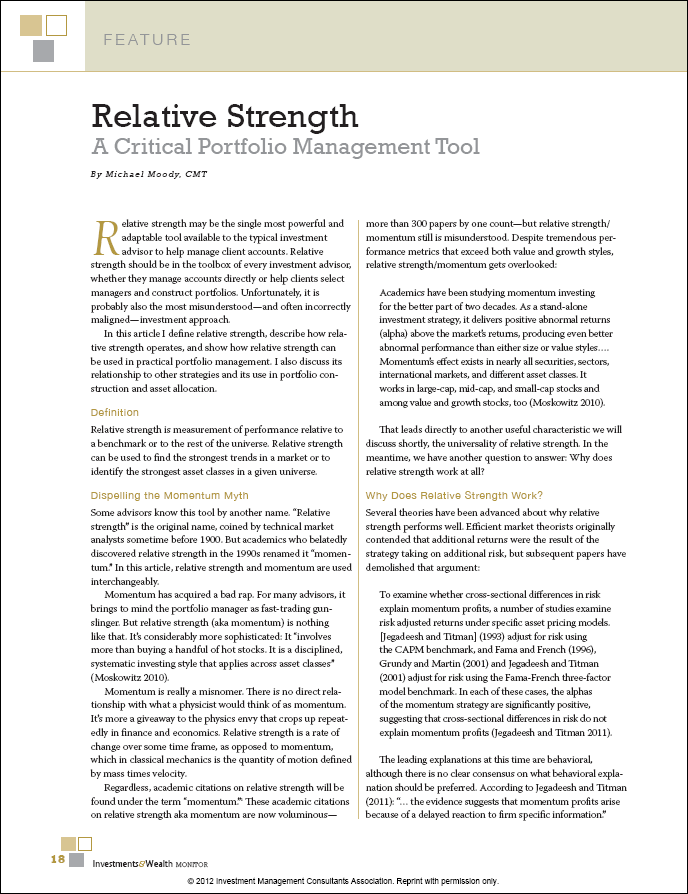
Mike Moody’s Relative Strength-A Critical Portfolio Management Tool now appears in the current issue of IMCA’s Journal of Investment Consulting. Whether you are managing relative strength portfolios yourself or you are employing relative strength strategies, this article answers the essential questions:

  • What is relative strength?
  • Why does it work?
  • Where does it work?
  • What have been the results?
  • What are its drawbacks?
  • How does it fit in an asset allocation?

Click here to read the article.

imca2 Relative Strength  A Critical Portfolio Management Tool


Posted by:


Quote of the Month #2

February 13, 2012

Individuals who cannot master their emotions are ill-suited to profit from the investment process.—-Benjamin Graham

Posted by:


Your Two Cents Might Cost a Dollar

February 6, 2012

Joel Greenblatt of Gotham Asset Management is well-known for his Magic Formula investing approach. He wrote a recent commentary that appeared on Morningstar about his experience offering his methodology to retail investors over the last two years. He writes:

Wow. I recently finished examining the first two years of returns for our Formula Investing U.S. separately managed accounts. The results are stunning. But probably not for the reasons you’re thinking. Let me explain.

Formula Investing provides two choices for retail clients to invest in U.S. stocks, either through what we call a “self-managed” account or through a “professionally managed” account. A self-managed account allows clients to make a number of their own choices about which top ranked stocks to buy or sell and when to make these trades. Professionally managed accounts follow a systematic process that buys and sells top ranked stocks with trades scheduled at predetermined intervals. During the two year period under study[1], both account types chose from the same list of top ranked stocks based on the formulas described in The Little Book that Beats the Market.

Let’s put it another way: on average the people who “self-managed” their accounts took a winning system and used their judgment to unintentionally eliminate all the outperformance and then some!

Mr. Greenblatt analyzed the data and explains exactly how it happened. Consider these the four deadly sins.

1. Self-managed investors avoided buying many of the biggest winners.

2. Many self-managed investors changed their game plan after the strategy underperformed for a period of time.

3. Many self-managed investors changed their game plan after the market and their self-managed portfolio declined (regardless of whether the self-managed strategy was outperforming or underperforming a declining market).

4. Many self-managed investors bought more AFTER good periods of performance.

I didn’t even have to add the bold type—Mr. Greenblatt did it for me. He has useful discussions about why each of these things happen, but this is absolutely typical investor behavior, stuff we have written about over and over again. Investors on their own, I suspect, could figure out a way to perform poorly even if they had tomorrow’s Wall Street Journal. Implied in Greenblatt’s commentary is a strong argument in favor of hiring a disciplined and systematic investment advisor.

Think about this: all of the excess return that typical investors are giving away is available to investors who are 1) willing to implement a strategy even when it is uncomfortable, 2) willing to stick with a solid long-term investment strategy, and 3) add money during periods of weakness. If your advisor is willing to do that, they are probably worth every penny.

Posted by:


The Profit Motive is Not the Problem

February 3, 2012

Justin Fox has an article in the Harvard Business Review assailing the profit motive in financial services. I don’t deny that some banks and brokerage firms have behaved badly—but the logic of the critics is (I think) all wrong. There is a behavior problem that needs fixing perhaps, but I think it can be approached more elegantly. Mr. Fox’s thesis is this:

If you let the financial services industry do exactly what it wants, the financial services industry will eventually get itself — and by extension the economy — into staggering amounts of trouble. If you force it to behave, it might just thrive.

I don’t think you can ever force anyone to behave. I was never successful forcing my kids to behave when they were four years old, and I have no more success now that they are teenagers. This thesis leads to some bad logic. Mr. Fox continues:

I thought about this while listening Tuesday to David Swensen, the legendary manager of Yale University’s endowment, arguing that acting as a fiduciary for other people’s money and maximizing profits are incompatible activities. “A fiduciary would offer low-volatility funds and encourage investors to stay the course,” he said. “But the for-profit mutual fund industry benefits by offering high-volatility funds.”

Swensen said this at a Bloomberg Link conference held in honor of that great fiduciary, Vanguard founder Jack Bogle.

I have a few issues with this. First, the data argues that low-volatility funds are not the answer. If low volatility were the answer, customers would hold their low-volatility bond funds longer than they hold their high-volatility stock funds—but they don’t. Holding periods, according to DALBAR data, are only marginally different, around three years in each case, so that argument goes up in flames. Second, investment firms always encourage investors to stay the course, sometimes to a fault. (And they usually end up getting criticized for it later by some Congressional panel with 20/20 hindsight.) Seriously, did you ever read material produced by any reputable investment firm suggesting day-trading or short-term speculation?

Mr. Fox extols Jack Bogle and Vanguard for being great guardians of the investor, yet Vanguard is one of the biggest players in exchange-traded funds, something Mr. Bogle has decried as a terrible product that encourages speculation! Does that make Vanguard evil? (I don’t agree with that either. ETFs don’t kill people; investors shoot themselves.) Reality is a lot messier than an idealogical paradigm.

It all boils down to incentives. Human beings are not all that tractable. It’s certainly not easy to get investors to behave rationally either, and it’s not for lack of pleading by the investment companies. Believe me, every firm would rather you keep your account there permanently! But rather than “forcing” someone to behave, why not give them incentives to behave?

An anecdote might illustrate my point. I worked many years ago at Smith Barney, Harris Upham when it was still private. Share ownership was widely distributed and many people—partners and aspiring partners—felt like they had a stake in how things worked. It was viewed in the industry as a stodgy firm that was not willing to take big risks, which was pretty much true. The partners didn’t want to take big risks with the firm’s money because the firm’s money was their money! Eventually the partners sold out to a public company. The first convertible bond underwriting client that was engaged after the firm became public went bankrupt before it made its first semi-annual interest payment. I can’t prove it, but I suspect that the partners weren’t as concerned about the underlying credit quality of the issuer when it wasn’t their money at stake anymore. (In an interview, John Gutfreund of the old Salomon Brothers said using other people’s money was the beginning of the end.) How many toxic mortgages would have been securitized if the partners’ personal money were at stake, or if even public firms had been required to retain substantial amounts of each pool? Surely much less monkey business would have gone on. (Stupidity you can’t regulate. But if someone knows they have a grenade, they’re not happy about playing catch with it.) Intelligent structuring of incentives will solve many of the problems that Mr. Fox rightly points out.

And, one could argue that incentives are already having an effect. Mr. Fox mentions in passing some good actors in the industry (and I’m sure there are others):

Some of these for-profit advisers (Capital Group and T. Rowe Price spring to mind) have built a reputation for looking out for investors’s interests.

And guess what? These firms are now huge because they realized they would have the best chance at sustainable, long-term growth by looking out for investors. Enlightened consideration of their incentives led them to behave in ways that maximized their long-term growth. There are other firms in the industry that have marketed celebrity portfolio managers, or have pushed performance when they were hot, or have launched all manner of ill-conceived products, but they have generally come to grief in the longer run. (Short-termism, by the way, is not limited to for-profit enterprises.)

Could the industry incentivize even better behavior? Possibly, and that is certainly a goal worth pursuing. But to lay the blame for industry problems on the profit motive is just lazy thinking, in my opinion.

HT to Abnormal Returns

Posted by:


Why Capitalism Works

January 25, 2012

Incentives! I first saw this story on Carpe Diem, the blog of economist Mark Perry at the University of Michigan. He excerpts a story from NPR‘s Planet Money that details a secret contract that Chinese farmers made in 1978, during a period of communist rule. Everyone in a small village essentially agreed to become capitalists! And the results were remarkable. From NPR:

In 1978, the farmers in a small Chinese village called Xiaogang gathered in a mud hut to sign a secret contract. They thought it might get them executed. Instead, it wound up transforming China’s economy in ways that are still reverberating today.

The contract was so risky — and such a big deal — because it was created at the height of communism in China. Everyone worked on the village’s collective farm; there was no personal property.

“Back then, even one straw belonged to the group,” says Yen Jingchang, who was a farmer in Xiaogang in 1978. “No one owned anything.”

At one meeting with communist party officials, a farmer asked: “What about the teeth in my head? Do I own those?” Answer: No. Your teeth belong to the collective.

In theory, the government would take what the collective grew, and would also distribute food to each family. There was no incentive to work hard — to go out to the fields early, to put in extra effort, Yen Jingchang says.

“Work hard, don’t work hard — everyone gets the same,” he says. “So people don’t want to work.” In Xiaogang there was never enough food, and the farmers often had to go to other villages to beg. Their children were going hungry. They were desperate.

So, in the winter of 1978, after another terrible harvest, they came up with an idea: Rather than farm as a collective, each family would get to farm its own plot of land. If a family grew a lot of food, that family could keep some of the harvest.

This is an old idea, of course. But in communist China of 1978, it was so dangerous that the farmers had to gather in secret to discuss it.

One evening, they snuck in one by one to a farmer’s home. Like all of the houses in the village, it had dirt floors, mud walls and a straw roof. No plumbing, no electricity.

“Most people said ‘Yes, we want do it,’ ” says Yen Hongchang, another farmer who was there. “But there were others who said ‘I don’t think this will work — this is like high voltage wire.’ Back then, farmers had never seen electricity, but they’d heard about it. They knew if you touched it, you would die.”

Despite the risks, they decided they had to try this experiment — and to write it down as a formal contract, so everyone would be bound to it. By the light of an oil lamp, Yen Hongchang wrote out the contract. The farmers agreed to divide up the land among the families. Each family agreed to turn over some of what they grew to the government, and to the collective. And, crucially, the farmers agreed that families that grew enough food would get to keep some for themselves.

The contract also recognized the risks the farmers were taking. If any of the farmers were sent to prison or executed, it said, the others in the group would care for their children until age 18.

The farmers tried to keep the contract secret — Yen Hongchang hid it inside a piece of bamboo in the roof of his house — but when they returned to the fields, everything was different.

Before the contract, the farmers would drag themselves out into the field only when the village whistle blew, marking the start of the work day. After the contract, the families went out before dawn. “We all secretly competed,” says Yen Jingchang. “Everyone wanted to produce more than the next person.”

It was the same land, the same tools and the same people. Yet just by changing the economic rules — by saying, you get to keep some of what you grow — everything changed. At the end of the season, they had an enormous harvest: more, Yen Hongchang says, than in the previous five years combined.

Listening to this story makes me much more optimistic about the possibility for eventual intelligent economic reform. The power of incentives to transform behavior is truly remarkable! Thoughtful incentives make the economy better for everyone. I hope it is not lost on policymakers that a 15% tax on the huge harvest generates more revenue than a 70% tax on the lousy harvest. (Even bad incentives, I suppose, make the economy better for certain groups while making it worse for others. Relative strength is a good way to detect who is benefiting and who is being held back.)

HT to FT Alphaville.

Posted by:


Your Inner Beardstown Lady

January 19, 2012

Most of the whippersnappers in the business don’t even remember the Beardstown Ladies. They were grandmotherly-looking members of an investment club in Beardstown, Illinois who had generated 23% returns on the investment pool for many years. According to an 1998 story in the Wall Street Journal:

The Beardstown Ladies are members of a famous investment club formed in the early 1980s. The ladies rose to prominence in the mid-1990s after the club proclaimed fantastic investment results. For 10-years ending 1993, the club reported a compounded return of 23.4% in their stock portfolio versus 14.9% for the S&P 500. The ladies bought stocks of companies they knew, like McDonald’s and Coke. The investment success propelled the ladies into stardom. They appeared on TV shows and in commercials, spoke on radio programs, and not to miss a moneymaking opportunity, published best selling books on the subject of personal finance and investing. The world changed for the Beardstown ladies in late 1997. A reporter from the Chicago magazine noticed something peculiar about their published investment results. After calculating the numbers several times, he concluded that a gross error had been made. The error was so large, that the accounting firm of Price Waterhouse was called in to clear the air. In the final tally, the clubs worst fears were realized. The ladies’ actual return was only 9.1%, far below the 23.4% they reported, and well below the S&P 500. For years the ladies deposited monthly dues into their account and classified it as an investment gain, rather than additional capital. An embarrassed treasurer blamed the error on her misunderstanding of the computer software the club was using.

Unfortunately it’s not just the Beardstown Ladies who can’t do math. No one questioned the returns initially because they wanted to believe it was true. The exact same error is repeated by most 401k investors who often count their contributions as part of their performance. Even in the absence of contributions, the rest of us favorably mis-remember our results anyway. Psychology Today explains:

What was your portfolio return last calendar year? How did you perform relative to market indexes and other investors? Most investors don’t know the answers to these questions. But their belief in their performance is quite flattering to themselves!

Two interesting studies illustrate this point. In the first study, William Goetzmann and Nadav Peles surveyed a group of investors belonging to the American Association of Individual Investors (AAII) and a group of architects about their retirement plan investment returns. The AAII investors are presumably very knowledgeable about investing from their participation in the association. When asked about their return the previous year, they overestimated their performance by 3.4% (= estimate - actual). Architects are very intelligent with a high degree of education, though they may not be knowledgeable investors. They overestimated their return by 8.6%. Both groups were also asked about their performance relative to a benchmark made up of the same asset allocation. The groups overestimated their relative performance by 5.1% and 4.2%, respectively.

Markus Glaser and Marin Weber also conclude that investors have biased views of their portfolio performance in the past. They surveyed individual investors from a German online brokerage firm and compared their self-assessments to their actual returns over four years. They reported a belief of an annual return mean of 14.9% over the period. Their actual return was more like 3.3%. Now that is overconfidence! In fact, there was no correlation between the actual return and the beliefs about the returns in the sample.

Cognitive dissonance strikes again. According to Goetzmann and Peles in the Psychology Today article:

The authors attribute this to a psychological phenomenon called cognitive dissonance. The investors are mentally distressed by the conflict between a good self-image and empirical evidence of poor choices. To reduce the discomfort, investors adjust their memory about that evidence and those choices. This is then selectively re-enforced by noticing the returns of just their good performing stocks and mutual funds in the portfolio and not the poor ones.

Self-image wins every time. A keen observer will note that investors never vastly underestimate their aggregate returns!

What can we learn from this, other than Germans are the most confident investors on the planet? I’ve bolded the return estimates, just so you can see clearly how large the gap in perception created by cognitive dissonance really is. The bottom line is that we all want to imagine we are getting or can get fantastic returns.

Right now we are smack in the middle of crazy season, where investors are examining their prior year returns and determining whether to stay with their current mutual fund or investment manager. As an investment professional, one of the things you quickly realize is that you are being compared with imaginary numbers-what the client believes you should have done, or what they imagine they would have done! Of course, as discussed above, the imaginary numbers are always terrific.

Cognitive dissonance, I believe, accounts for a lot of the manager turnover in the industry, not just volatility and style rotation. As evidence, consider that according to DALBAR, the average holding period for mutual fund investors is about three years-whether they own a stock fund or a bond fund. The volatility of the average bond fund is probably not enough to shake investors out, but when comparing the bond manager’s actual returns with imaginary returns, investors can only handle three consecutive years of disappointment! Ok, I’m being a little sarcastic here, but this corresponds perfectly with studies of black-box trading systems, which indicate that investors who purchase even a profitable system abandon it after three consecutive losses. (For fans of Markov probability chains, an average of only fourteen coin flips is required to get three heads in a row.)

When it comes to returns, we are all Beardstown Ladies at heart. Our imagined returns are always going to be significantly higher than what we actually get. Keep in mind that, according to the Psychology Today article, there was no correlation between the actual return and the beliefs about the returns. Instead of being bamboozled by your inner Beardstown Lady, step back and really think about your investments. Do they meet your needs? Is the underlying return factor still sound? Keep in mind that the only investment acumen required to actually earn the mutual fund NAV returns is to hold the fund! You don’t have to condemn yourself to DALBAR-type returns. Sure, if something has gone really wrong, you might need to make a gradual change in course-but more often than not, if the return over a multi-year period is in the ballpark, you’re quite possibly better off leaving it alone. If you want to be a successful investor, you need to learn to deal with the real world and not imaginary returns.

Reject your inner Beardstown Lady!


Posted by:


Manager Insights: Fourth Quarter Review

January 6, 2012

ManagerInsights 1 Manager Insights: Fourth Quarter Review

[click to read full size]

Posted by:


What Still Works on Wall Street?

November 29, 2011

The early editions of James O’Shaughnessy’s bible What Works on Wall Street identified two combination strategies that were so good that mutual funds were formed to implement the strategies. Cornerstone Value was a large cap dividend strategy, while Cornerstone Growth combined value with relative strength. The funds have been around since 1996 or so. CXO Advisory poses the question:

Has 14 years of out-of-sample performance of these two mutual funds confirmed the motivating backtests?

HFCVX [Hennessy Cornerstone Value] underperforms both its benchmark Russell 1000 Value Index and the S&P 500 Index. The fund underperforms the S&P 500 Index by about 0.5% per year, compared to the backtested average annual outperformance of about 7%. Also, its standard deviation of annual returns (20.1%) is higher than that for the benchmark Russell 1000 Value Index (18.7%). Backtested outperformance has not persisted over a 14-year out-of-sample implementation.

HFCGX [Hennessy Cornerstone Growth] outperforms both its benchmark Russell 2000 Index and the S&P 500 Index. The fund outperforms the S&P 500 Index by about 2.5% per year, compared to the backtested average annual outperformance of about 10%. Its standard deviation of annual returns (21.2%) is about the same as that for the benchmark Russell 2000 Index (21.1%). Backtested outperformance has persisted at a subdued level over a 14-year out-of-sample implementation.

whatstillworksonwallstreet What Still Works on Wall Street?

Relative Strength still works on Wall Street

Source: CXO Advisory

In other words, the dividend strategy has not been able to beat the market over the last 14 years, while the relative strength strategy has outperformed in real life. This mirrors CXO’s findings earlier. I might note that the outperformance of the Cornerstone Growth strategy comes despite the Q3-Q4 2008 - Q1-Q2 2009 performance of relative strength, which was a big historical outlier. The underperformance of relative strength was epic during that brief period—and Cornerstone Growth outperformed anyway. I would further note that the 2.5% annual outperformance is after fees.

Evidence suggests that relative strength is a strategy worth implementing.

Posted by:


The #1 Investment Return Factor No One Wants to Talk About-Still

November 22, 2011

I noticed another article on alternative beta indexes in Advisor Perspectives the other day. In it, Jason Hsu of Research Affiliates extols the virtues of a variety of alternatively constructed indexes. He concludes:

While the Fundamental Index strategy remains very close to our heart, we are very encouraged by the increasing innovation in the field of alternative betas. Despite often very different approaches, their respective results validate the entire idea of deviating from the binary active–passive world of the past. Some of the most compelling attributes of both are embedded in alternative betas. Like active managers, these methods can produce excess returns and produce different market exposures than mainstream indices, resulting in lower volatility and increased Sharpe ratios. Like traditional indices, most will have lower management costs, many will have similarly skinny implementation costs, and all will have lower governance/monitoring costs than active strategies. Furthermore, some of the most scalable approaches efficiently capture the value and small-cap effects without the long/short requirement, monthly maintenance, and illiquidity of a true Fama–French implementation.

Most investors make their biggest bets on equities, comprising more than 50% of their asset allocation. Accordingly, they have sought to diversify risk within equities by style, size, and geography. We assert that investors should go to greater lengths to diversify their equity portfolio. The past 10 years have brought considerable pain to both sides of the equity active–passive aisle. The third choice of alternative betas—even the simplest such as Equal-Weighting—would have resulted in a far better outcome. Will history repeat? Nobody knows. However, we think the evidence is far too compelling to ignore. We suggest moving alternative betas up your to-do list.

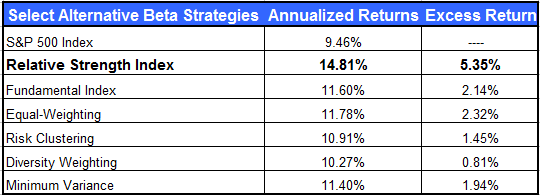
A wide variety of alternative indexes are discussed in the article—with the exception of relative strength. For some reason, no one ever wants to talk about it. However, for your convenience, we are including a table from a prior post that compares relative strength indexing to other methods.

index2 The #1 Investment Return Factor No One Wants to Talk About  Still

Source: Dorsey Wright Money Management

I understand why proponents of other indexing methods don’t like to discuss it—but it’s a good reason for investors to take a close look at it.

Posted by:


Quote of the Month

November 14, 2011

I believe the innovations of the 1970s and ’80s such as CAPM, alpha and beta–which started off being such useful intellectual tools–are now in danger of becoming obstacles to further innovation in financial mathematics. I would argue that too much current research effort, both academic and commercial, in this field has become–to paraphrase John Maynard Keynes–enslaved to some defunct, or not even defunct, economist.—-David Harding

It’s hard to exaggerate how entrenched efficient markets, MPT, and similar ideas have become in finance. For some, acceptance of these ideas has led to a reluctance to even investigate other approaches. When your mind is closed, things have gone too far. For the brave few willing to actually work with the data, relative strength and tactical asset allocation have been a rich source of returns.


Posted by:


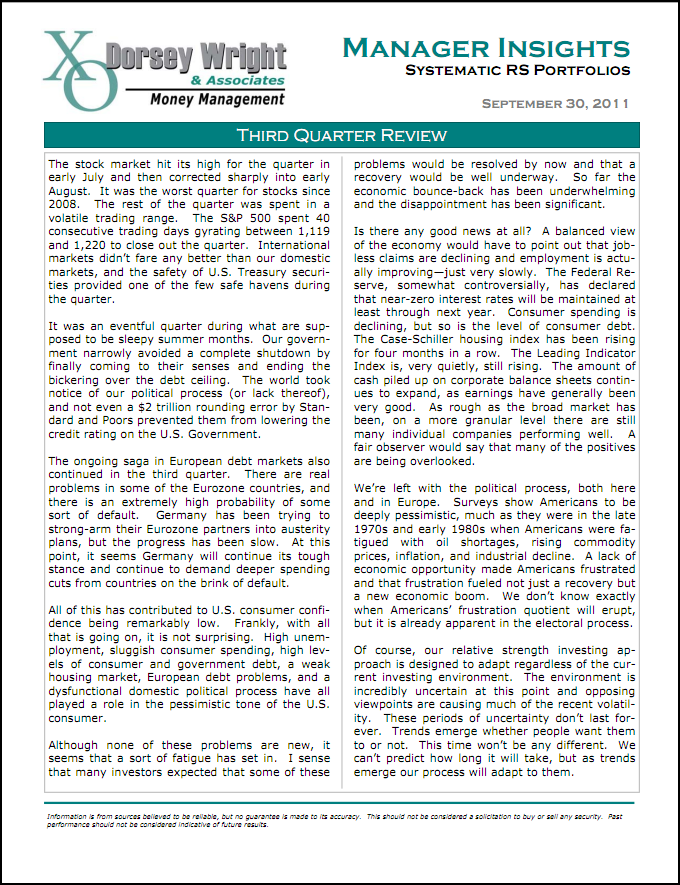
Third Quarter Review

October 4, 2011

Please click image below.

Q3Commentary Third Quarter Review

Posted by:


Slouching Towards Debt-lehem…

July 29, 2011

Markets are undergoing a lot of changes in traditional relationships right now. For example, Barron’s reports that corporates are the new Treasurys:

U.S. government debt is priced in the credit-default swap (CDS) market as having a higher-default risk than 22% of investment-grade corporate bonds. This means the CDS market, which influences the prices of corporate bonds, stocks, and the implied volatility of equity options, perceives Treasuries to be riskier than bonds issued by companies including Coca-Cola (ticker: KO), Oracle (ORCL) and Texas Instruments (TXN).

“This suggests corporates are the new sovereigns,” Thomas Lee, J.P. Morgan’s equity strategist, advised clients in a research note late last week, referring to corporate debt.

The phenomenon is also evident in Europe. J.P. Morgan’s Lee notes that 100% of corporate-debt issuers in Spain, Greece, and Portugal trade inside their government CDS spreads, while 60% of Italian corporate bonds trade inside that government’s spreads.

Historically, sovereign debt –bonds issued by governments – were considered low risk because governments can raise taxes or print money to pay their bills. During the credit crisis of 2007, governments all over the world printed money, and slashed interest rates to rescue the financial system, and are now saddled with massive debts. Now, some corporations might be financially healthier than governments.

There are also sharp changes in historical relationships going on in the commodity world, according to Reuters:

According to fund flows research company EPFR Global, commodity sector funds that invest in physical products, futures or the equities of commodity companies such as miners, attracted $1.465 billion in net inflows globally in the first two weeks of July.

The push into commodities in July reverses a trend in the second quarter, when investors pulled a net $3.9 billion out of commodities, according to Barclays Capital.

The move explains a divergence of stocks and commodities, with correlation dropping from more than 80 percent positive to around 40 percent negative over the past two weeks.

“Commodities could be seen in some ways as the least-worst option, given what is happening with other markets,” said Amrita Sen, an oil analyst at Barclays Capital who looks closely at fund allocations into commodities. “Some investors have not liquidated positions in commodities, while they have exited some other asset classes such as equities.”

All of the machinations with the debt ceiling and the associated market dislocations have posed a number of important questions for investors.

Q1) What happens to traditional asset allocations when traditional relationships break down?

Q2) How can we tell if the dislocations are a result of temporary factors or represent a permanent paradigm shift?

No one has all of the answers, least of all me, but a couple of things occur to me.

A1) The same thing that always happens when these ephemeral relationships change—your allocation doesn’t behave anything like you thought it would. Although the current uncertainties have highlighted the issues above, this kind of thing happens all the time. In the current investment hierarchy, debt is seen as safer than equity because it is higher up in the capital structure—but that’s only true for a corporate balance sheet. Sovereign debt always depends on the willingness of the sovereign to repay it. Anyone who is old enough to be familiar with the term “Brady Bonds” knows what I am talking about. If 100% of the corporate debt issuers in Spain trade inside the government debt spread, it’s not inconceivable for the same thing to happen in the US. In other words, there’s no a priori reason for government debt to be safer than other debt.

What about commodities then? Strategic asset allocation usually treats them like poor cousins, giving them a small seat at the children’s table. What if they really are the “least worst option” and deserve a major slice of the portfolio due to their performance? After all, commodities are at least tangible and do not rely on the willingness of a sovereign to be worth something. What if the correct safety hierarchy is a) high-grade corporate debt, b) equity in companies with growing revenues, earnings, and dividends, c) commodities, and d) sovereign debt, especially in countries with a ton of obligations and a sketchy political process?

A2) We can’t. That’s one of the issues with a paradigm shift—at the beginning, you can’t tell if it is temporary or permanent. Around 1900, it looked like the US might supplant the UK as the world’s industrial power. That turned out to be lasting. Around 1990, it looked like Japan might supplant the US as the world’s industrial power. That turned out to be temporary. Around 2010, it looked like China might supplant the US as the world’s industrial power—and we have no idea right now if that is a temporary conceit or will become a permanent feature of the landscape.

Constantly changing relationships along with an inability to distinguish between a temporary and a permanent state of affairs, to me, argues strongly in favor of tactical asset allocation. It simply makes sense to go where the returns are (or where the values exist, depending on your orientation). Money always goes where it is treated best, and if you wish to win the battle for investment survival, you would be well-advised to do the same thing.

Posted by:


DWA Q2 Commentary

July 5, 2011

Click below for our review of the second quarter and our take on why this is likely a good environment to add to relative strength strategies.

Posted by:


The #1 Investment Return Factor No One Wants to Talk About

June 29, 2011

Relative strength is the #1 investment return factor no one wants to talk about. The reasons are not entirely clear to me, but perhaps it is because it is too simple. It does not require a CFA to forecast earnings or to determine an economic moat. It does not require a CPA to attempt to assess valuation. It does not require an MBA to assess strategic business decisions. In short, it does not play to the guild mentality wherein only certain masters of the universe have the elevated intellect, knowledge, and background to invest successfully.

Although relative strength is simple, I am not suggesting that relative strength is easy to implement. Losing weight is simple too: eat less, exercise more. That does not make it easy to do. Relative strength, probably like most successful investment strategies, requires an inordinate amount of discipline—and tolerance of a fair amount of randomness. Like most games that are easy to learn, but difficult to master—chess would be an apt example—proficient use of relative strength also requires deep study and experience.

Yet relative strength has been used successfully by practitioners for many generations. George Chestnutt of the American Investors Fund began using it to run money in the 1930s and said it had been in use by others for at least a generation before that. Relative strength has been shown to work in many asset classes, across many markets for more than 100 years. Since the early 1990s, even academics have gotten in on the act.

And for all that, relative strength remains ignored.

I was reminded of its apparent obscurity again this week when reading an excellent article on indexing by the macrocephalic Rob Arnott. He had a very nice piece in Advisor Perspectives about the virtues of alternative beta indexes.

In recent years, a whole new category of investments—called “alternative betas”—has emerged. Some of these alternative beta strategies, including the Fundamental Index® approach, use various structural schemes to select and/or weight securities in the index. In that sense, they fall between traditional cap-weighted approaches and active management: they pick up broadly diversified market exposure (beta) but seek to produce better results than cap-weighted indexes (what is desired from active managers).

Our CIO, Jason Hsu, and research staff have replicated the basic methodologies of many of these rules-based alternative betas, ranging from a simple equal-weighted approach to the straightforward Fundamental Index strategy to the truly exotic such as risk clustering and diversity weighting.7 The potential rewards are promising. Of the 10 non-cap-weighted U.S. equity strategies studied, all outperformed the passive cap-weighted benchmark. The range of excess returns by alternative beta strategies was between 0.4% and 3.0% per annum—matching a reasonable estimate of the top quartile of active managers—that is, the small cadre of managers who generally are successful at beating the benchmark (see Table 1). The bottom line: investors can obtain top-quartile performance with far less effort than is required to research and monitor traditional active equity managers.

Mr. Arnott has a very good point—and the numbers to prove it. Lots of alternative beta strategies are available that can potentially offer top-quartile performance relative to other active managers and that may also outperform traditional passive cap-weighted benchmarks. He is no doubt proselytizing on behalf of his firm’s Fundamental Index approach to some extent, but I think his underlying thesis is correct. He offers the following table as evidence that alternative beta strategies can outperform, using data from 1964- 2009:

index3 The #1 Investment Return Factor No One Wants to Talk About

Source: Advisor Perspectives, Research Affiliates (click to enlarge)

I would like to offer a slight modification of this table, since it is only a listing of “select” alternative beta strategies. Relative strength has been inexplicably excluded. Below, I present the same table of alternative beta strategies now including relative strength, the #1 investment return factor no one wants to talk about. (I have my own theory about why other indexers don’t want to talk about relative strength, but I will let you reach your own conclusions.) The relative strength returns presented in the table are for the exact same time period, 1964 through 2009. They are taken from Professor Ken French’s database and show the results of a simple relative strength selection process when using the top third (as ranked by relative strength) of the large cap universe.

index2 The #1 Investment Return Factor No One Wants to Talk About

Source: Research Affiliates, Dorsey Wright (click to enlarge)

Are you surprised that relative strength blows away the other alternative beta strategies?

You shouldn’t be. There are plenty of academic and practitioner studies attesting to the power of relative strength. In short, I agree with Mr. Arnott that alternative beta indexes are worth a close look. And I think it would be particularly prudent to consider relative strength weighted indexes.

See www.powershares.com for more information on our three DWA Technical Leaders Index ETFs (PDP, PIE, PIZ).

Click here for disclosures. Past performance is no guarantee of future results.

Posted by: