The Duh Files: Supply and Demand Edition

March 14, 2012

A recent academic paper investigated the relationship between gold, silver, platinum, and palladium prices and demand from precious metals exchange-traded products.

The empirical findings of this study suggest that there is a strong statistical significant positive contemporaneous relationship between the inflows and outflows in the precious metals ETPs and the returns of the underlying metals.

Who knew? Supply and demand causes the prices of precious metals to go up and down. Duh.

I am always amazed when academics “discover” what practitioners have known for generations. Academia does generate some real insights in finance, but this does not seem to be one of them.

Posted by:


Dorsey Wright Polo Shirt Winner

March 6, 2012

Thanks to all who participated for the last few months in the bi-weekly Dorsey, Wright Client Sentiment Surveys. Today, we’d like to announce this quarter’s winner of the polo shirt - Ms. Irene McGrath. Ms. McGrath has been utilizing Dorsey Wright’s research and money management services for over 10 years now. Here’s a highlight from her info page:

Since 2001 Irene has been named every year to RBC Wealth Management’s President’s Council for her outstanding performance and record of superior client service.

Again, we appreciate everyone who participated in the surveys, especially those who keep coming back week after week. We are approaching our two-year anniversary next week, so look for some more detailed posts in the coming weeks.

Thanks again!

Posted by:


Market Politics

March 6, 2012

A reminder from our finger-pointing friends in Washington.

marketpolitics Market Politics

Source: The Big Picture/Saturday Morning Breakfast Cereal

Posted by:


Quote of the Month

March 1, 2012

Everyone is a market timer. Some people buy when they have money, and sell when they need money, while others use methods that are more sophisticated.—-Marian McClellan, co-inventor of the McClellan Oscillator and Summation Index

This is a good reminder that any transactions you make are inextricably linked with time. While there is no way to ever know where the exact top or exact bottom is, there are plenty of diffusion indexes that can usefully identify oversold markets that present good buying opportunities. (For one example, see here.) You might as well try to be intelligent about your purchase decisions.

HT: Tom McClellan, Bollinger Markets List

Posted by:


Become an Investment Guru!

February 16, 2012

In a very funny, and sad, commentary on how much financial media is done these days, Bill Conerly at Forbes has explicit instructions on how to become an investment guru in six easy steps. I’ve excerpted the steps below, but you need to read the whole article to appreciate his wit.

  1. Abandon all humility.
  2. Create a straw man.
  3. Invent a secret method.
  4. Communicate.
  5. Brag.
  6. Ignore all criticism.

Obviously we’re doing it wrong!

Posted by:


Sports Illustrated Swimsuit Indicator

February 14, 2012

…is bullish this year, according to Bespoke Investment Group. Somehow, I doubt that the Sports Illustrated editors take the stock market into account when selecting the cover model!

Posted by:


Thanks, Bank of America!

February 8, 2012

Funny or Die put out a video that encapsulates how consumers felt about the proposed $5 debit card fee. Then it veers off and gets really ridiculous. In truth, financial advisors everywhere-including at Bank of America/Merrill Lynch-are very client-friendly or they wouldn’t be able to make it in the business. Senior managements are sometimes temporarily tone deaf. In real life, the fee idea was dumped, but it did result in this over-the-top video!

Thanks, Bank of America! - watch more funny videos

Source: Funny or Die/Clusterstock

HT: Clusterstock

Posted by:


Market Timing

February 7, 2012

A funny take on market timing by J.J. Abodeely, echoing a similarly tongue-in-cheek assessment of whiskey by Noah Sweat in 1952. You can see the full article here. The relevant part on market timing follows.

My friends, I had not intended to discuss this controversial subject at this particular time. However, I want you to know that I do not shun controversy. On the contrary, I will take a stand on any issue at any time, regardless of how fraught with controversy it might be. You have asked me how I feel about market timing. All right, here is how I feel about market timing: If when you say market timing you mean the loser’s game, the fool’s errand, the speculator’s effort that separates savers from their capital, turns investors into gamblers, lines the greedy pockets of brokers, strategists, and newsletter writers, challenges the irrefutable logic of efficient markets, yea, literally plunders the wealth from widows and retirees; if you mean the evil action that disrupts the well counseled man and woman from the pinnacle of appropriate strategic asset allocation, balanced objectives, long-term orientation into the bottomless pit of fear, and greed, and meaningless noise, high expenses, and tax inefficiency, and short-termism, then certainly I am against it.

But, if when you say market timing, you mean assessing fundamental value compared to price, favoring undervalued assets while avoiding overvalued ones, always demanding a margin of safety and being in cash when none exists; if you mean being opportunistic and forward looking, buying low and selling high; if you mean the activity which saves investors from catastrophic and permanent losses of capital, achieving positive absolute returns, the endeavor that avoids following the herd up the mountain of excess and over the cliff of despair, favoring instead consistent compounding of modest returns, and the ability to sleep well at night; if you mean that undertaking which has provided capital as the gasoline for the engines of economic growth and prosperity, protected purchasing power and met future liabilities, funded robust retirements, sustainable wealth transfer, and philanthropic endowments, then certainly I am for it.

This is my stand. I will not retreat from it. I will not compromise.

JJ Abodeely, 2011

I guess it’s all a matter of perspective!

Posted by:


From the Archives: Supply & Demand is Everywhere

February 1, 2012

NPR has a great story about monkey economics and how special skills in short supply translate into higher monkey income. I first saw this on Greg Mankiw’s blog. Even monkeys bow down to supply and demand!

—-this article was originally published 11/12/2009. Human economics and monkey economics are exactly the same-scarcity creates value. The story is quite funny too.

Posted by:


Getting Professional Guidance

January 26, 2012

Lots of studies show that investors do better when they have qualified professional help. David Edwards of Heron Capital wrote a clever piece in Advisor Perspectives that puts a humorous twist on investors’ tendency to panic and try to do everything themselves. He wrote:

We recently developed a series of scenarios for our clients and prospective clients to consider as a way to establish how they really feel about investment risk.

Scenario 1:

You’re on a plane preparing land at LaGuardia Airport in New York City during a thunderstorm. With minutes to go before landing, the plane is suddenly rocked by violent down drafts. Do you:

  • Buckle your seatbelt tighter, clutch your armrests and toss a prayer to your personal deity.
  • Rush down the aisle, kick open the cockpit door and seize controls of the plane yourself.

Scenario 2:

You’re at the dentist having root canal. Suddenly, you feel acrid dust on your tongue and smell smoke. Do you:

  • Ask for a moment to rinse your mouth and clear your throat (this will be over soon.)
  • Grab the drill and finish the operation yourself.

Scenario 3:

You’re a defendant in a major product liability case. If you lose, you could be out $500,000. After two weeks of trial, the case could go either way. During the final summation do you:

  • Rely on your attorney to finish the trial – win or lose, he’s the one who went to law school.
  • Address the judge and jury yourself.

Scenario 4:

Your three year old car develops a case of “mushy” brakes and won’t stop as quickly as you expect. Do you:

  • Take the car into the dealer for a thorough inspection.
  • Tinker with the master cylinder, calipers and brake pads yourself.

Scenario 5:

Stock prices have fallen 20% over the last 6 months, and leveraged investors everywhere are vomiting up securities. On the television, investment analysts soberly explain how you must hedge your portfolio by “loading up on the UltraProShares Triple-Short ETF.” Your brother-in-law is buying gold and dividing his cash up among 6 different banks, in case one of them fails. Do you:

  • Hang tight, knowing that you won’t draw on your assets in stocks for at least five years, and think about maxing out your 401K contributions a bit early this year.
  • Fire your investment advisor (“that idiot!”) and convert all your stocks to cash.

If you would select option “B” in any of these scenarios, please write a few sentences as to why.

A good tongue-in-cheek reminder of why it sometimes makes sense to take professional advice and stick with a well thought out strategy!

Posted by:


Big Mac Index

January 18, 2012

From time to time, The Economist runs a chart of the Big Mac Index. It may be the only market index named after a hamburger!

They use it to illustrate purchasing power parity, the idea that the same item should cost about the same amount in every currency. The graphic is below:

BigMacIndex Big Mac Index

Source: The Economist

One of the stunning things, to me, was that despite an absolute pummeling of the Euro lately, the Big Mac is still more expensive in Euros! Despite the weakness we’ve seen already, maybe there is more to go. It’s cheapest to clog your arteries in China and Russia, which is a potential argument that the yuan is still too low.

BigMacburger Big Mac Index

Source: Fox News

I have to admit I’m actually a little hungry after writing this post! Next time I suppose I should leave out the picture of the burger.


Posted by:


Happy Holidays

December 23, 2011

Posted by:


There Will Always Be Trends

December 20, 2011

From Financial Advisor Kid:

kid There Will Always Be Trends

If it’s not one thing, it’s another thing. There will never be a shortage of trends!

Posted by:


From the Archives: Look Who’s In Counseling

November 30, 2011

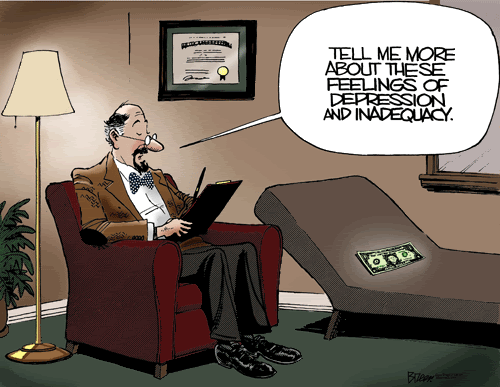
20091025 cow From the Archives: Look Whos In Counseling

—-this was originally published 10/26/2009. Although the US dollar has recently held up relatively well versus the Euro (until today!), there is still significant concern about its long-term status.

Posted by:


The Pizza Lobby

November 17, 2011

While the Super Committee is busy working on a debt fix, the rest of Congress is focused on the nutritional value of school lunches. According to a story at TheStreet.com:

Congress determined that pizza should remain an option for school lunches because the tomato paste on the food counts as a serving of vegetables. The United States Department of Agriculture had wanted to discount tomato paste as a vegetable, but food companies protested the change, according to The Associated Press.

The USDA required a half-cup of tomato paste be on each slice of pizza in order to count it as a vegetable, but after a $5.6 million food-company lobby, the department knocked that number down to two tablespoons of paste, according to Talking Points Memo, a political news organization.

Obviously tax reformers and debt-reducers need to hire someone in the tomato paste business because the debt fix doesn’t seem to be going so well.

Posted by:


From the Archives: Entitlement Society

November 4, 2011

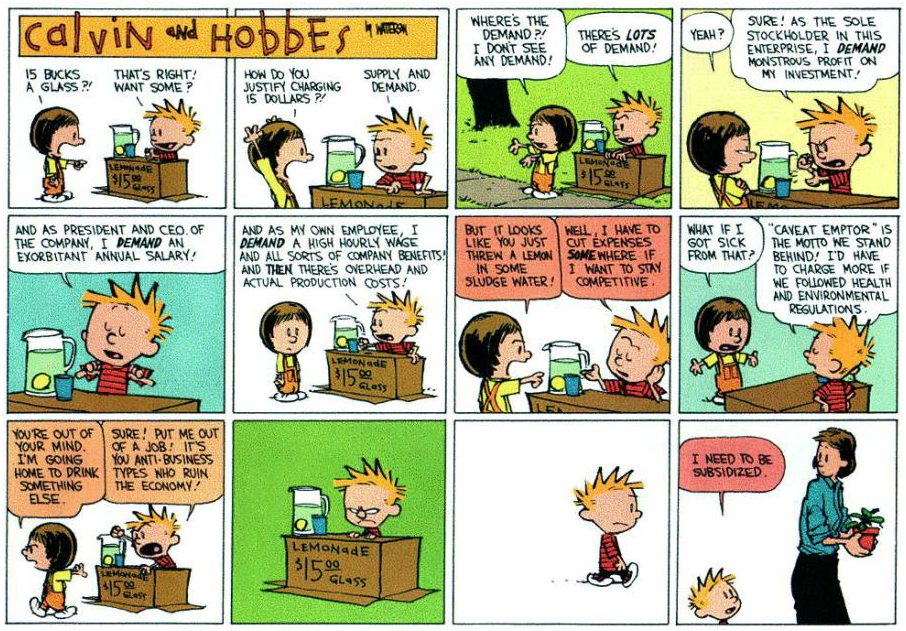
Entitlement From the Archives: Entitlement Society

Click to enlarge

—-this article was originally published 9/3/2009. Calvin and Hobbes demonstrate a keen understanding of economics as currently practiced by some companies.

Posted by:


Occupy Wall Street

October 11, 2011

From Josh Brown at The Reformed Broker, his top ten suggestions for a new Ben & Jerry’s ice cream flavor to honor the Occupy Wall Street movement:

10. Occu-pie a la mode

9. Mud n’ Rocks

8. Kleptocracy Krunch

7. 99 Percent Vanilla

6. Class W-Oreo

5. Zuccotti Biscotti

4. Marching Powder

3. Protest Parfait

2. Drummer’s Delight

1. Unemploy-Mint

occupy wallstreet header2 Occupy Wall Street

Source: Ben & Jerry’s

Posted by:


From the Archives: The Secret is Out

October 7, 2011

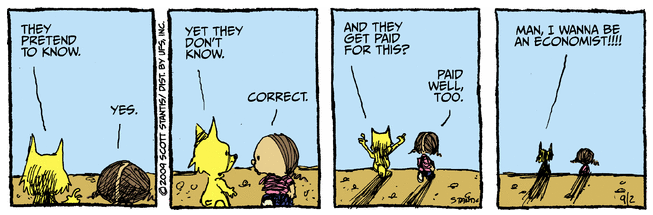
economists From the Archives: The Secret is Out

(Click to Enlarge)

Via: Greg Mankiw’s Blog

—-this originally appeared 9/2/2009. This has been sadly true in retrospect!

Posted by:


An Overlooked Investment Opportunity

September 23, 2011

Yes, it’s a college degree. According to an article in the Atlantic:

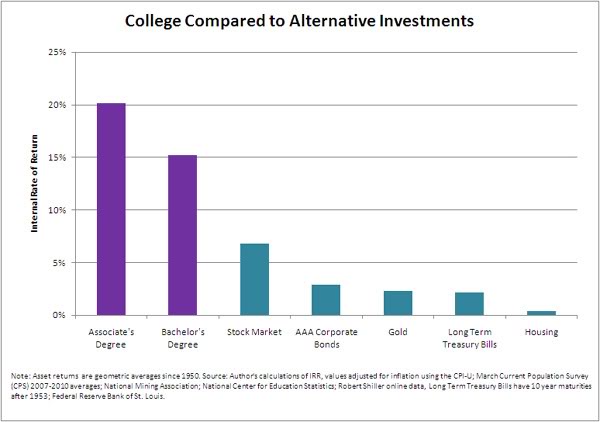
The typical college graduate earns $570,000 more than the average person with only a high school diploma over her lifetime. That makes college the best big investment on the market, Michael Greenstone and Adam Looney find in this remarkable report on the value of a higher education.

Let’s say you’re deciding where to invest $100,000 at age 18. Maybe you think to put it in gold, corporate bonds, U.S. government debt, or hot company stocks. It turns out the best investment — by far — is college. “The $102,000 investment in a four-year college yields a rate of return of 15.2 percent per year,” the authors report, “more than double the average return over the last 60 years experienced in the stock market” and more than five times the return in corporate bonds, gold, long-term government bonds, or housing.

college An Overlooked Investment Opportunity

Source: The Atlantic

Now imagine if you take those enhanced earnings and invest them in the stock market…

Posted by:


Theory versus Practice

September 13, 2011

I saw this cartoon on Greg Mankiw’s blog. Whether it’s efficient markets, modern portfolio theory, or economic stimulus, economists haven’t had much luck with their theories lately! The way in which supply and demand moves prices is usually a better indicator of reality than whatever the underlying economic theory is.

(Click to enlarge) Source: gocomics.com/Wiley Ink

Posted by:


A Rare Bright Spot in the Economy

September 10, 2011

Manufacturers of downward arrows! Clever article and worth clicking the link for a laugh.

Source: Borowitz Report

Posted by:


Quote of the Month

September 7, 2011

The whole world is simply nothing more than a flow chart for capital—-legendary trader Paul Tudor Jones

And money goes where it is treated best.

Posted by:


Raging Bull

August 31, 2011

This from First Trust’s chief economist Brian Wesbury, by way of Real Clear Markets:

We use a capitalized profits model to value stocks, dividing corporate profits by the 10-year Treasury yield. We compare the current level of this index to that from each quarter for the past 60 years to estimate an average fair-value. Not only are 10-year yields low (2.2%), but corporate profits are growing strongly. As a result, and hold onto your hats, this top down model says that the fair-value for the Dow is currently 40,000.

However, we think the Treasury market is in a bubble. So, instead of a 2.2% yield, we use a more conservative discount rate of 5% for the 10-year Treasury. This generates a “fair value” of 18,500 on the Dow and 1,940 for the S&P 500. In other words, the US equity markets are currently undervalued by about 65%.

So what does our model say if profits revert to the historical mean of about 9.5% of GDP? Even in that scenario, and assuming a 5% yield on the 10-year Treasury, equities are about 21% undervalued, with fair value at 1430 for the S&P 500 and 13,700 for the Dow.

The problem with this scenario is that it takes the worst of both worlds: a major decline in profits and a surge in interest rates. In the real world, a large decline in profits would normally be accompanied by a drop in bond yields. In other words, our model says the risk of investing in equities today is very low.

I have no idea if he is right or not, but I feel better after reading it! Market sentiment has been so negative lately that I think I just like reading something where we aren’t all on the way to hell in a handbasket.

Source: caglecartoons.com

Posted by:


Transparency

August 23, 2011

This might really be the public’s view of what goes on at a hedge fund—and at least at some, like Galleon, maybe it was uncomfortably close to the truth.

Source: Scott Adams, www.dilbert.com

Our Global Macro separate account, on the other hand, uses ETFs and is completely transparent. It doesn’t use leverage, but can rotate among a broad range of assets. I think an argument can be made that it is a reasonable substitute for a hedge fund in the part of your portfolio dedicated to alternative assets.

To obtain a fact sheet and prospectus for the Arrow DWA Tactical Fund (DWTFX), click here.

To receive a brochure for our Systematic RS portfolios, please click here. Click here for disclosures from Dorsey Wright Money Management. Past performance is no guarantee of future results.

Posted by:


Federal Budget 101

August 22, 2011

This comes from an unusual source, a memo written by an attorney in Louisiana. But the analysis is really clarified by taking away all of the zeroes!

The U.S. Congress sets a federal budget every year in the trillions of dollars. Few people know how much money that is so we created a breakdown of federal spending in simple terms. Let’s put the 2011 federal budget into perspective:

  • U.S. income: $2,170,000,000,000
  • Federal budget: $3,820,000,000,000
  • New debt: $1,650,000,000,000
  • National debt: $14,271,000,000,000
  • Recent budget cut: $38,500,000,000

It helps to think about these numbers in terms that we can relate to. Let’s remove eight zeros from these numbers and pretend this is the household budget for the fictitious Jones family.

  • Total annual income for the Jones family: $21,700
  • Amount of money the Jones family spent: $38,200
  • Amount of new debt added to the credit card: $16,500
  • Outstanding balance on the credit card: $142,710
  • Amount cut from the budget: $385

I think Visa or Mastercard would have cut this family off long before they ran up $142,000 on their credit card! And a $385 cut in spending is not much when the overspending is $16,500. Being considered a AA credit might be generous.

The most amazing thing is that the US is better off than many of the countries in Western Europe.

HT: DO, HP

Posted by: