The whole world is simply nothing more than a flow chart for capital—-legendary trader Paul Tudor Jones
And money goes where it is treated best.
This from First Trust’s chief economist Brian Wesbury, by way of Real Clear Markets:
We use a capitalized profits model to value stocks, dividing corporate profits by the 10-year Treasury yield. We compare the current level of this index to that from each quarter for the past 60 years to estimate an average fair-value. Not only are 10-year yields low (2.2%), but corporate profits are growing strongly. As a result, and hold onto your hats, this top down model says that the fair-value for the Dow is currently 40,000.
However, we think the Treasury market is in a bubble. So, instead of a 2.2% yield, we use a more conservative discount rate of 5% for the 10-year Treasury. This generates a “fair value” of 18,500 on the Dow and 1,940 for the S&P 500. In other words, the US equity markets are currently undervalued by about 65%.
So what does our model say if profits revert to the historical mean of about 9.5% of GDP? Even in that scenario, and assuming a 5% yield on the 10-year Treasury, equities are about 21% undervalued, with fair value at 1430 for the S&P 500 and 13,700 for the Dow.
The problem with this scenario is that it takes the worst of both worlds: a major decline in profits and a surge in interest rates. In the real world, a large decline in profits would normally be accompanied by a drop in bond yields. In other words, our model says the risk of investing in equities today is very low.
I have no idea if he is right or not, but I feel better after reading it! Market sentiment has been so negative lately that I think I just like reading something where we aren’t all on the way to hell in a handbasket.
Source: caglecartoons.com
This might really be the public’s view of what goes on at a hedge fund—and at least at some, like Galleon, maybe it was uncomfortably close to the truth.
Source: Scott Adams, www.dilbert.com
Our Global Macro separate account, on the other hand, uses ETFs and is completely transparent. It doesn’t use leverage, but can rotate among a broad range of assets. I think an argument can be made that it is a reasonable substitute for a hedge fund in the part of your portfolio dedicated to alternative assets.
To obtain a fact sheet and prospectus for the Arrow DWA Tactical Fund (DWTFX), click here.
To receive a brochure for our Systematic RS portfolios, please click here. Click here for disclosures from Dorsey Wright Money Management. Past performance is no guarantee of future results.
This comes from an unusual source, a memo written by an attorney in Louisiana. But the analysis is really clarified by taking away all of the zeroes!
The U.S. Congress sets a federal budget every year in the trillions of dollars. Few people know how much money that is so we created a breakdown of federal spending in simple terms. Let’s put the 2011 federal budget into perspective:
- U.S. income: $2,170,000,000,000
- Federal budget: $3,820,000,000,000
- New debt: $1,650,000,000,000
- National debt: $14,271,000,000,000
- Recent budget cut: $38,500,000,000
It helps to think about these numbers in terms that we can relate to. Let’s remove eight zeros from these numbers and pretend this is the household budget for the fictitious Jones family.
- Total annual income for the Jones family: $21,700
- Amount of money the Jones family spent: $38,200
- Amount of new debt added to the credit card: $16,500
- Outstanding balance on the credit card: $142,710
- Amount cut from the budget: $385
I think Visa or Mastercard would have cut this family off long before they ran up $142,000 on their credit card! And a $385 cut in spending is not much when the overspending is $16,500. Being considered a AA credit might be generous.
The most amazing thing is that the US is better off than many of the countries in Western Europe.
HT: DO, HP
From Carl Richards:
He explains in Your Neglected Stock Market Backup Plan:
The stock market is doing what stock markets do. Yet we run around like it’s such a shock. We don’t know when it will happen, and often it’s hard to tell why, but the fact that the market went down shouldn’t have surprised anyone.
To be clear: this is not a problem with the market. This is a problem with us. How in the world can you invest your hard-earned money without a plan for both the good and the bad days? Any plan needs to account for the reality that markets go down as well as up.
Carl’s blog at the New York Times is full of humor and insight, but he often hits the nail on the head when discussing behavioral issues!
From Louis Woodhill at Forbes. Funny stuff. An excerpt to give you the flavor of the “interview.”
Below is the transcript of an exclusive Unconventional Logic (UL) interview with the elusive Mr. World Financial Markets (WFM) himself.
UL: Thank you for taking the time to speak with us today. What do your friends call you? Can I just call you “World” for short?
WFM: I’m nobody’s friend, and you can call me “Mr. Markets”.
UL: Yes. Right. Well. Moving right along, Mr. Markets, there are a lot of pretty anxious people out there wondering just what on earth is going on. The Dow went down 635 points one day, and up 430 the next. We were hoping that you could shed some light on this.
WFM: Look, I tell you everything I know every second of every trading day. The answers to all of your questions are in the numbers I give you. What is going on should be obvious.
Mr. Markets seems to be a fan of our “in price there is knowledge” thesis! And:
WFM: Hey, do you know what this job is like these days? Not only do I have to guess what stocks, bonds, and commodities are worth, but I also have to try to guess what your stupid paper dollar is worth. And, it all changes every millisecond! Forty-five years ago, when you had a gold standard, all I had to do was value stocks and commodities. And, those values didn’t change very much, or very fast. A few points on the Dow was a big deal. And, no foreign currency work at all. Fixed exchange rates! Ah, those were the days.
If I can find his phone number, perhaps Mr. Markets will also be interested in opening a Global Macro account.
The world is indeed more complicated than a generation ago. Money goes where it is treated best and with increased globalization and computerization, the money can now go into just about any asset class anywhere, electronically.
…according to Bespoke Investment Group. In a recent article, they discussed the amazing volatility the market has exhibited lately:
…the S&P 500 has averaged a daily hi/lo spread of 5.33% over the last five trading days. It’s been a truly remarkable trading period, and efficient market theorists are currently in hiding.
Source: Bespoke
You can look at the volatility in a couple of ways.
First, I think it shows how important it is to try to distinguish the underlying trend from the noise. When markets get very choppy like this, you’ve got to have an intermediate to long-term model. Otherwise you just get whipsawed to death.
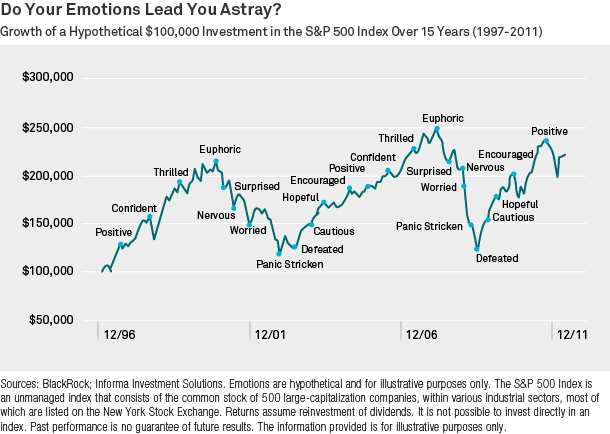
Second, as Bespoke remarks, if the market were actually efficient it wouldn’t whip around nearly this much. The underlying value of the companies is obviously not changing nearly as rapidly as the market price. What’s going on is pure psychology—market participants trying to handicap supply and demand.
Strategic asset allocation relies on assumptions for returns, correlations, and volatility to generate the optimal pie chart. If you’re just a little off on some of the factors, your allocation can be way, way off. It’s safe to say that a few volatility estimates might have been revised over the past couple of days.
In contrast, tactical asset allocation driven by relative strength does not make any assumptions about returns, correlations, or volatility. It just tries to stay with the strongest trends at any given time. Simple, and effective too.
It’s hard to repeal the economic law of supply and demand. In many parts of the world, the family of the bride has to pay a dowry to obtain a suitable husband. But in a role reversal, men returning from war in South Sudan have to pay to obtain a suitable wife! From BusinessWeek:
Like many countries, South Sudan, which won its independence on July 9, is grappling with inflation. Only here the rise in costs is measured in the cattle needed to pay the bride price—what a young man gives a young woman’s family for her hand in marriage. It’s a reversal of the dowry payment by the bride’s family, a practice once widespread in the West.
With hostilities over, thousands of men have returned home, driving bride prices up 44 percent since 2005.
It’s not just financial markets that adjust for supply and demand—all kinds of changes are reflected in prices. Price is worth paying attention to, especially when it is different from normal expectations.
From Business Insider:
According to the latest daily statement from the U.S. Treasury, the government had an operating cash balance of $73.8 billion at the end of the day yesterday.
Apple’s last earnings report (PDF here) showed that the company had $76.2 billion in cash and marketable securities at the end of June.
In other words, the world’s largest tech company has more cash than the world’s largest sovereign government.
Kind of funny. Kind of not.
Worth checking out, just to get a visual sense for the magnitude of US debt, is this article.
Amazing, isn’t it?
Financial Planning ran a recent article discussing the brutally honest market view of Greggory Warren, a senior analyst at Morningstar. To wit:
Warren said the movement into bonds by investors was beginning to resemble the attitude towards real estate in the last decade. “You have people saying now that ‘bonds don’t go down’ just like they used to say about housing.”
Asked what he thought it would take to change this attitude, noting that the price of bonds fall as yields rise, he summed it up by saying, “a rise in interest rates.”
In other words, Morningstar is pointing out that the attitude of bond investors will change only after they get hammered in bonds. Comical (or sad, depending on how you look at it) as it is, that’s the retail investor experience with pretty much every asset class.
They love it as long as it’s working, and hate it after they’ve been drilled—there’s rarely any nuanced or logical middle ground. How about considering a systematic investment process driven by relative strength, instead of waiting until you’ve taken one in the chops?
Source: www.areyougame.com
Perhaps I should preface this post by saying that some of my best friends are fundamental analysts. This excerpt is taken from a funny article on Wall Street dress codes by Josh Brown of The Reformed Broker.
Prospective sell-side analysts should pretty much come in with a brown bag over their heads, eyeholes cut out of course. You will spend the next decade blowing people up with nonsensical calls like “overweight” or “strong neutral”. Your price targets will be based on discounted cash flow analysis which doesn’t really mean anything in the actual supply and demand-based stock market. Getting used to hiding and wearing a bag to cover your shame is probably a great idea, start early.
As he points out, the actual stock market is based on supply and demand. Found at the intersection of Supply Street and Demand Avenue: price.
Until you realize taking a beating is a normal part of long-term investing, you’ll hurt the overall performance of your portfolio—Matthew McCall, Index Universe
This doesn’t require much explanation! Staying with your strategy during a pullback is difficult, and it never gets any easier. But it’s got to be done.
Bloomberg has a great article on intelligent indexing, specifically on Rob Arnott’s RAFI Index and how well it has done since inception. Witchcraft enters the conversation only because of a comment by John Bogle:
Arnott debuted in 2005 a new type of indexing that uses fundamental measures such as cash flow to pick stocks — a methodology that the father of indexing would later denounce as “witchcraft” in an interview with Morningstar Inc. (MORN) because of its similarity to active management and higher costs. By 2011, the innovator’s brand of stock indexing had produced better returns than Bogle’s.
The RAFI index intelligently tries to exploit the value return factor, given that its fundamental weighting scheme has a value tilt. This makes perfect sense to me. When a known return factor is available, why not exploit it, especially when it can be done rather efficiently and for relatively low cost in an ETF format?
The Technical Leaders Index (PDP), also sponsored by PowerShares, attempts to exploit the relative strength return factor in exactly the same fashion. In fact, over the time period that both indexes have existed in common, since March 1, 2007, both the RAFI 1000 (PRF) and the Technical Leaders Index (PDP) have had comparable price returns, +3.97% for PRF and +7.63% for PDP. They are exploiting completely different factors, which may be dominant at very different times, but both have outperformed Vanguard’s S&P 500 fund over that stretch.
There’s certainly no guarantee what will happen over a longer time period—maybe cap weighting is due for a comeback. But trying intelligently to exploit return factors that are omnipresent in the data makes perfect sense. It will be a good sign for intelligent indexing if Jack Bogle is eating Rob Arnott’s dust for many years to come.
Click to enlarge. Source: stockcharts.com
Over dozens of posts, we’ve reiterated a major theme on this blog, which is that even the most robust and sophisticated of strategies are tough to implement and stick with, and are likely to underperform the market a certain percentage of the time. Investment managers who can outperform by even a couple of percentage points annually are often household names.
However, a recent study of stock transactions by the same small group of people from 1985 to 2001 found “significant positive abnormal returns,” averaging outperformance of around +6% per year.
What narrow group of investors can consistently and legally outperform the broad stock market? Why members of Congress, of course!
Man, I love SNL skits! This one with two inmates discussing Eurozone issues with DSK has some great lines, including the following:
“You know what the biggest Greek export is? Hard Workin Greeks!”
Enjoy.
Louis Woodhill of Unconventional Logic gives us ten secret inflation warning signs.
1. You are filling your car up with gas and you notice that the “price per gallon” digits are going up faster than the “gallons” numbers.
2. McDonalds announces that they are freezing the price of their most popular burger, but that they are renaming it the “Quarter Ouncer.”
3. You go to a restaurant in San Diego, and you are relieved to find that the prices on the menu look like bargains. Then you realize that they are denominated in pesos.
4. The Fed announces that they are now basing policy on a new price statistic called “Core Core Inflation”. This new price index excludes food, energy, and everything that went up in price that month.
5. Procter & Gamble complains that the U.S. Bureau of Engraving and Printing is competing unfairly with “Charmin.”
6. People with silver fillings are afraid to smile.
7. The Fed’s Quantitative Easing XLVI arrives before Super Bowl XLVI.
8. Street beggars start demanding euros.
9. Airlines begin requiring that passengers bring their own jet fuel.
10. The Fed announces that they are going to be basing policy on an even newer price index, called “Core Core Core Inflation”. This one excludes everything.
Now that you know what to look out for, you won’t have to worry about being caught unawares by inflation.
Always laugh when you can. It is cheap medicine. — Lord Byron
From Marketplace, a visual display of food that you can buy for a dollar. Is it more or less than you thought?
Here at Dorsey, Wright Money Management, we are lucky enough to have the resources to do a little more research than might be expected from your typical money managers. Specifically, we have agents in the field doing the real work behind the scenes to get us the edge we need to stay ahead in the game.
One of our agents acquired the following slip of paper during some routine “research.” Based on handwriting analysis and the DNA analysis of the tear stains on the paper (it was soaked), we’ve come to the conclusion that this is DEFINITELY Ben Bernanke’s diary…
Dear Diary,
Man o man. March has been so brutal I can’t even take it…testifying on Capitol Hill to those jokers in Congress has done nothing good for my blood pressure. Lucky for me I have been flying to Los Angeles for acting classes so I can speak with a straight face without bursting into tears or rage, depending on who is grilling me. The breathing exercises I learned in class have really really helped me…I hope nobody finds out I’m moonlighting as a thespian just to handle my real job.
The thing that really pisses me off…no wait, there’s three things that really piss me off that nobody can just leave me alone about. The first is obviously the US dollar. I mean I know it’s going to go straight down, but somehow I trick myself into believing that it won’t…that it’ll turn around. It’s an acting trick I learned called Method Acting where I really have to “believe” it’s true, and then it will become true. Or is that The Secret? I get the two confused, but the point is Mind Over Matter. Anyway, everybody knows that as long as we keep buying our own debt and printing cash, each individual dollar’s worth is going to go down. Everybody knows that, right? But then I have to turn around and say something completely different, on TV to a panel of sleeping beauties. It’s rough.
Then there are the jokers in Congress. They complain all day about debt, debt, debt, and then what do they do? Spend more, and then more, and then some more. And this is all somehow my fault? Did I draft the laws that fueled the housing bubble? The way they talk out of both sides of their mouth at the same time is just sick. But, at the same time, they’ve taught me SO MUCH about how to blatantly lie, saying one thing while doing another. They’re a tricky bunch, like I said…I’ve learned a lot from them, but I wish they would get off my back about problems that they started and refuse to own up to.
And then of course there’s the ace in the hole – inflation. Gas prices are going up and food prices are going crazy…lucky for me I like to just chop those two things out of my reports because their prices are a little too volatile for the public to pay attention to (they won’t notice!). Don’t even get me started on gold and silver.
It’s getting kinda late and I have to get up tomorrow really early and go over to Timmy’s house and play some racquetball. Man—it was so hilarious when he got caught not paying his taxes. I ribbed him on that one for weeks.
Sure hope things get better for me soon. Wish me luck, Diary!
I think the paperwork came from an office in Smallville, Kansas. Well, not exactly. But it might not be out of the realm of possibility. In a sign that even popular culture is embracing globalization, Superman renounces his US citizenship in his most recent comic. According to a CNBC story:
Superman has started a stir with a declaration in the new issue of “Action Comics” that he intends to renounce his U.S. citizenship…The Man of Steel, who emigrated to earth as a child from Krypton and was adopted by the Kents in Smallville, Kan., comes to the conclusion that he’s better off serving the world at large…
“‘Truth, justice and the American way’ — it’s not enough anymore,” he says. “The world’s too small, too connected.”
At least that’s his story. I think he’s just upset about the declining dollar.
Source: www.theunexplainedmysteries.com
From FT Alphaville, an incredibly well-produced and entertaining piece on the economic theories of Keynes and Hayek. Trust me, you’ve never seen anything like it!
Source: www.michaelcovel.com, www.garyvarvel.com
Even budding entrepreneurs are wise to US fiscal and monetary policy!