Rediscovering Passion for Europe

February 24, 2014

The WSJ reports on the resurgent demand for European equities:

U.S. fund managers are rediscovering their passion for Europe—and not just as a vacation destination.

Since the start of the year, American investors have ramped up their bets on European stocks, spurred on by a brightening economic outlook and low interest rates.

The continent’s stock markets became a favored destination last year as the region emerged from a bruising recession. This year, with U.S. stock indexes treading water after a rip-roaring 2013, interest in European stocks has grown further, fund managers say.

Investors have sent $24.3 billion into European equity funds this year through Feb. 19, according to fund tracker EPFR Global. U.S. stock funds have seen $5 billion in outflows.

In the exchange-traded-fund world, three of the top four stock-based funds in terms of investor inflows in 2014 are the Vanguard FTSE Europe, the iShares MSCI EMU and the Vanguard FTSE Developed Markets ETFs—all of which have heavy exposure to Europe. The three have seen a combined $4.23 billion in new money this year, while $19.1 billion has flowed out of the largest U.S. stock ETF, the SPDR S&P 500 fund.

My emphasis added. All three of the ETFs referenced above are cap-weighted ETFs. To those three, I have added the PowerShares DWA Developed Markets Momentum ETF (PIZ), which had better performance in 2013 and is also ahead of those three so far in 2014:

Europe perf1 Rediscovering Passion for Europe

(click to enlarge)

Source: Dorsey Wright; YTD performance through 2/21/14; Performance does not included dividends or any transaction costs

While PIZ is not exclusively focused on Europe, it is certainly heavily weighted to that region:
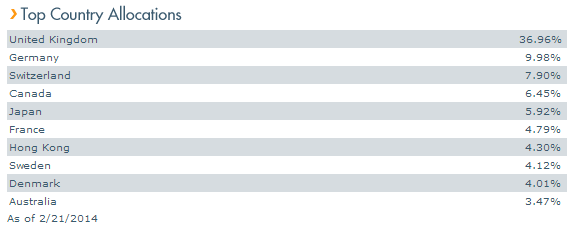
piz alloc Rediscovering Passion for Europe

(click to enlarge)

Source: PowerShares

PIZ has had inflows of $360 million over the past year and now has $671 million in assets.

Past performance is no guarantee of future returns. Dorsey Wright is the index provider for PIZ. Dorsey Wright also currently owns EZU. All past holdings for the trailing 12 months is available upon request.

Posted by:


Improving Sector Rotation With Momentum Indexes

January 21, 2014

Sector has been a popular investment strategy for many years. The proliferation of sector based exchange traded funds has made it quick and easy to implement sector bets, but has also added a level of complexity to the process. There are now many different flavors of ETF’s for each macro sector ranging from simple capitalization weightings to semi-active quantitative models to construct the sector index. The vast array of choices in each sector allows investors to potentially add additional performance over time versus a simple capitalization based model.

Dorsey, Wright has a suite of sector indexes based on our Technical Leaders Momentum factor. These indexes are designed to give exposure to the securities with the best momentum characteristics in each of the 9 broad macro sectors (Telecomm is split between Technology and Utilities depending on the industry group). Long time readers of our blog should be aware of all of the research that demonstrates how effective the momentum factor has been over time providing returns above a broad market benchmark. Using indexes constructed with the momentum factor have the potential to add incremental returns above a simple capitalization weighted sector rotation strategy just like they do on the individual stock side.

The sector SPDRs are the most popular sector suite of exchange traded products. When investors make sector bets using this suite of products they are making a distinct sector bet and also making a bet on large capitalization stocks since the sector SPDRs are capitalization weighted. There are times when large cap stocks outperform, but there are also times when the strength might be in small cap, value, momentum, or some other factor. By not considering other weighting methodologies investors are potentially leaving money on the table.

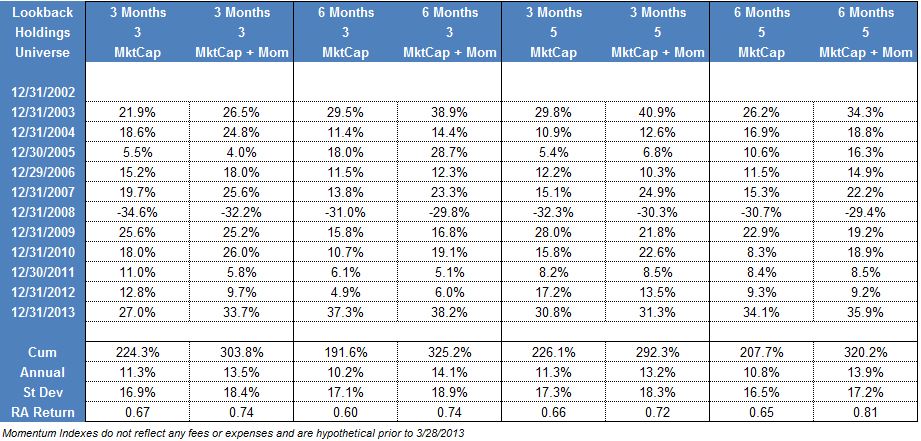
We constructed several very simple sector rotation models to determine how returns might be enhanced by implementing a sector rotation strategy with indexes based on momentum. The base models were created with either 3 or 5 holdings from the sector SPDR universe. Each month a trailing 3 or 6 month return was calculated (based on the model specification) and the top n holdings were included in equal weights in the portfolio. Each month the portfolio was rebalanced with the top 3 or 5 sector SPDRs based on the trailing return. This is an extremely simple way to implement a momentum based sector rotation strategy, but one that proves to be surprisingly effective.

The second group of portfolios expanded the universe of securities we considered to implement the strategy. All of the momentum rankings were still based on the trailing returns of the sector SPDRs, but we made one small change in what was purchased. If, for example, the model selected Healthcare as one of the holdings we would buy either the sector SPDR or our Healthcare Momentum Index. The way we determined which version of the sector to buy was simple: whichever of the two had the best trailing return (the window was the same as the ranking window) was included in the portfolio for the month. In a market where momentum stocks were performing poorly the model would gravitate to the cap weighted SPDRs, but when momentum was performing well the model would tend to buy momentum based sectors. Making that one small change allowed us to determine how important implementing the sector bet actually was.

Capture zps07daf1e3 Improving Sector Rotation With Momentum Indexes

(Click Image To Enlarge)

The table above shows the results of the tests. Trials were run using either 3 or 6 month look back windows to rank the sectors and also with either 3 or 5 holdings. In each case, allowing the model to buy a sector composed of high momentum securities was materially better than its cap weighted counterpart. Standard deviation also increased, but the returns justified the increased volatility as the risk adjusted return increased in each case.

This is one simple case illustrating how implementing your sector bests with different sector construction philosophies can be additive to investment returns. The momentum factor is one of the premier investment anomalies out there, and using a basket of high momentum stocks in a specific sector has shown to increase returns in the testing we have done.

The performance numbers are not inclusive of any commissions or trading costs . The Momentum Indexes are hypothetical prior to 3/28/2013 and do not reflect any fees or expenses. Past performance is no guarantee of future returns. Potential for profit is accompanied by potential for loss. The models described above are for illustrative purposes only and should not be taken as a recommendation to buy or sell any security or strategy mentioned above. Click here for additional disclosures.

Posted by:


DWA Technical Leaders Webinar: Q1 Updates

January 20, 2014

On Wednesday, January 16th, Tom Dorsey, Founder and President of DWA, Tammy DeRosier, Chief Operating Officer, and John Lewis, Senior Vice President and Portfolio Manager, conducted a webinar around the most recent quarterly rebalances across the DWA Technical Leaders Indexes, as well as practical implementation ideas for using the four Momentum ETFs that track these indexes.

Follow this link for a replay of this webinar.

bw012114  DWA Technical Leaders Webinar: Q1 Updates

Posted by:


Is Sector Rotation a Crowded Trade?

January 16, 2014

As sector ETFs have proliferated, more and more investors have been attracted to sector rotation and tactical asset allocation strategies using ETFs, whether self-managed or implemented by an advisor. Mark Hulbert commented on sector rotation strategies in a recent article on Marketwatch that highlighted newsletters using Fidelity sector funds. All of the newsletters had good returns, but there was one surprising twist:

…you might think that these advisers each recommended more or less the same basket of funds. But you would be wrong. In fact, more often than not, each of these advisers has tended to recommend funds that are not recommended by any other of the top five sector strategies.

That’s amazing, since there are only 44 actively managed Fidelity sector funds and these advisers’ model portfolios hold an average of between five and 10 funds each.

This suggests that there is more than one way of playing the sector rotation game, which is good news. If there were only one profitable sector strategy, it would quickly become so overused as to stop working.

This is even true among those advisers who recommend sectors based on their relative strength or momentum. Because there are so many ways of defining these characteristics, two different sector momentum strategies will often end up recommending two different Fidelity sector funds.

Another way of appreciating the divergent recommendations of these top performing advisers is this: Of the 44 actively managed sector funds that Fidelity currently offers, no fewer than 22 are recommended by at least one of these top five advisers. That’s one of every two, on average, which hardly seems very selective on the advisers’ part.

Amazing, isn’t it? It just shows that there are many ways to skin a cat.

Even with a very limited menu of Fidelity sector funds, there was surprisingly little overlap. Imagine how little overlap there would be within the ETF universe, which is much, much larger! In short, you can safely pursue a sector rotation strategy (and, by extension, tactical asset allocation) with little concern that everyone else will be plowing into the same ETFs.

Posted by:


DWA Technical Leaders Index Trade Profiles

January 6, 2014

The Dorsey, Wright Technical Leaders Index is composed of a basket of 100 mid and large cap securities that have strong relative strength (momentum) characteristics. Each quarter we reconstitute the index by selling stocks that have underperformed and by adding new securities that score better in our ranking system. We began calculating the index in real-time at the end of 2006. Over the last seven years there have been quite a few deletions and additions as the index has adapted to some very dynamic market conditions.

Any relative strength or momentum-based investment strategy is a trend following strategy. Trend following has worked for many years in financial markets (although not every year). These systems are characterized by a several common attributes: 1) Losing trades are cut quickly and winners are allowed to run, 2) there are generally a lot of small losing trades, and 3) all of the money is made by the large outliers on the upside. When we look at the underlying trades inside of the index over the years we find exactly that pattern of results. There is a lot going on behind the scenes at each rebalance that is designed to eliminate losing positions quickly and maintain large allocations to the true winners that drive the returns.

We pulled constituent level data for the DWATL Index going back to the 12/31/2006 rebalance. For each security we calculated the return relative to the S&P 500 and how many consecutive quarters it was held in the index. (Note: stocks can be added, removed, and re-added to the index so any individual stock might have several entries in our data.) The table below shows summary statistics for all the trades inside of the index over the last seven years:

TLTable zps9d3df2ae DWA Technical Leaders Index Trade Profiles


The data shows our underlying strategy is doing exactly what a trend following system is designed to accomplish. Stocks that aren’t held very long (1 to 2 quarters), on average, are underperforming trades. But when we are able to find a security that can be held for several quarters, those trades are outperformers on average. The whole goal of a relative strength process is to ruthlessly cut out losing positions and to replace them with positions that have better ranks. Any investor makes tons of mistakes, but the system we use to reconstitute the DWATL Index is very good at identifying our mistakes and taking care of them. At the same time, the process is also good at identifying winning positions and allowing them to remain in the index.

Here is the same data from the table shown graphically:

TLChart zps7c20d6fe DWA Technical Leaders Index Trade Profiles


You can easily see the upward tilt to the data showing how relative performance on a trade-level basis improves with the time held in the index. For the last seven years, each additional consecutive quarter we have been able to keep a security in the Index has led to an average relative performance improvement of about 920 basis points. That should give you a pretty good idea about what drives the returns: the big multi-year winners.

We often speak to the overall performance of the Index, but we sometimes forget what is going on behind the scenes to generate that return. The process that is used to constitute the index has all of the characteristics of a trend following system. Underperforming positions are quickly removed and the big winning trades are allowed to remain in the index as long as they continue to outperform. It’s a lot like fishing: you just keep throwing the small ones back until you catch a large one. Sometimes it takes a couple of tries to get a keeper, but if you got a big fish on the first try all the time it would be called “catching” not “fishing.” I believe part of what has made this index so successful over the years is there is zero human bias that enters the reconstitution process. When a security needs to go, it goes. If it starts to perform well again, it comes back. It has no good or bad memories. There are just numbers.

The performance numbers are pure price return, not inclusive of fees, dividends, or other expenses. Past performance is no guarantee of future returns. Potential for profit is accompanied by potential for loss. A list of all holdings for the trailing 12 months is available upon request.

Posted by:


Q1 2014 PowerShares DWA Momentum ETFs

January 2, 2014

Each quarter, the PowerShares DWA Momentum Indexes are reconstituted. These indexes are designed to evaluate their respective investment universes (U.S Mid and Large-Cap equities, U.S. Small-Cap equities, Developed International Market equities, and Emerging Market equities) and build an index of stocks with superior relative strength characteristics. This quarter’s allocations are shown below.

PDP

pdp Q1 2014 PowerShares DWA Momentum ETFs

DWAS

DWAS Q1 2014 PowerShares DWA Momentum ETFs

PIZ

PIZ Q1 2014 PowerShares DWA Momentum ETFs

PIE

pie Q1 2014 PowerShares DWA Momentum ETFs

Source: PowerShares, MSCI, and Standard & Poor’s

While capitalization-weighted indices will tend to have relatively stable sector/country allocations from one quarter to the next, our momentum indices can are designed to adapt to leadership changes. The charts below show allocations to two sectors/countries from each of our indices to give you a sense for some of the key areas of leadership and weakness.

PDP

pdp alloc Q1 2014 PowerShares DWA Momentum ETFs

DWAS

dwas alloc Q1 2014 PowerShares DWA Momentum ETFs

PIZ

piz alloc 2 Q1 2014 PowerShares DWA Momentum ETFs

PIE

pie alloc 2 Q1 2014 PowerShares DWA Momentum ETFs

The PowerShares DWA Momentum ETFs finished 2013 with $2.8 billion in assets. 2013 performance is shown below:

tl perf 01.02.14 Q1 2014 PowerShares DWA Momentum ETFs

The performance numbers are pure price return, not inclusive of fees, dividends, or other expenses. Past performance is no guarantee of future returns. Potential for profit is accompanied by potential for loss. A list of all holdings for the trailing 12 months is available upon request.

See www.powershares.com for more information. The Dorsey Wright SmallCap Momentum Index is calculated by Dow Jones, the marketing name and a licensed trademark of CME Group Index Services LLC (“CME Indexes”). “Dow Jones Indexes” is a service mark of Dow Jones Trademark Holdings LLC (“Dow Jones”). Products based on the Dorsey Wright SmallCap Momentum IndexSM, are not sponsored, endorsed, sold or promoted by CME Indexes, Dow Jones and their respective affiliates make no representation regarding the advisability of investing in such product(s).

Posted by:


PDP In The News

January 2, 2014

ETF Trends says PDP might be A Right Place, Right Time Momentum ETF:

Recent data (and the Federal Reserve’s tapering announcement) indicate the U.S. economy is improving and the current economic expansion is maturing.

Assuming that the recovery is moving into late cycle stages, investors may want to consider momentum-based strategies.

“When positioning portfolios for mid to late cycle economic activity, the momentum factor historically had a stronger track record of performance than either small cap or value in generating return,” according to PowerShares, the fourth-largest U.S. ETF sponsor. “It appears that the maturity of the economic cycle may benefit companies which are showing price strength and are able to leverage economic conditions present in a mature economic expansion.”

Past performance is no guarantee of future returns. See www.powershares.com for more information.

Posted by:


Negative Economic Factors Plague Indonesia

January 2, 2014

Tom Lydon reports on some of the economic challenges facing Indonesia:

Indonesia exchange traded funds have been among the worst performers in the emerging market category as both external and internal factors weigh on the economy, and some observers believe it could get worse next year.

The iShares MSCI Indonesia ETF (NYSEArca: EIDO) has declined 25.5% this year and Market Vectors Indonesia Index ETF (NYSEArca: IDX) is down 24.7% year-to-date.

Within Indonesia, flip-flopping public policies, corruption charges, widening disparity between the rich and poor, and surging inflation are pressuring the economy, writes Arno Maierbrugger for Investvine.

Moreover, the government implemented a protectionist policy, requiring foreign investors to reduce their stakes in mining operations within 10 years and capping foreign exposure in financial institutions.

The country’s growing current account deficit, depreciating currency and high external debt have also weighed on the market. The rupiah currency depreciated 20% since the start of 2013 and touched a 5-year low against the U.S. dollar as capital flight from Asia gained momentum on speculation of an end to easy money.

The depreciating rupiah has exacerbated losses in Indonesia investments, along with rupiah-denominated securities in the Indonesia ETFs. Foreign-currency denominated securities take a hit if their currency depreciates since the investment would be worth less when converted in to U.S. dollars.

We have also seen a large drop in exposure to Indonesia in the PowerShares DWA Emerging Markets Momentum ETF (PIE). Indonesian exposure is shown below:

Indonesia Negative Economic Factors Plague Indonesia

PIE, which is rebalanced quarterly, went from over 15% exposure to Indonesia in Q3 2013 to 0.95% exposure in Q4 2013 and now has 0% exposure in Q1 2014.

Meanwhile, overweights for PIE are now South Africa, Taiwan, Thailand, Malaysia, Turkey, and the Philippines.

pie1 Negative Economic Factors Plague Indonesia

Source: PowerShares and MSCI, as of 1/1/14

A list of all holdings for the trailing 12 months is available upon request. Past performance is no guarantee of future returns. See www.powershares.com for more information.
Posted by:


Britain’s Ascendancy

December 26, 2013

A noteworthy overweight in the PowerShares DWA Developed Markets Momentum ETF (PIZ) is the United Kingdom:

piz alloc 12.26.131 Britains Ascendancy

Source: PowerShares

For some insight into why the United Kingdom may be so strong, consider this post by The Capital Spectator:

‘Tis the season for predictions and all the usual caveats apply. But amid the din of forecasts as the year winds down is one outlook that’s worth a closer a look for what it says about the UK, the Eurozone, and the price tag for embracing a deeply flawed monetary policy inside a misguided currency union.

“The UK is forecast to be the second most successful of the Western economies after the US,” advises the Centre for Economics and Business Research (CEBR) in a new report published today. “Positive demographics with continuing immigration, rather less exposure to the problems of the Eurozone than other European economies combine with relatively low taxes by European standards to encourage faster growth than in most Western economies.” As it travels along the road to recovery, Britain will edge out France to become the fifth-largest economy on the planet in five years, pushing aside Germany to become Europe’s leading economy by 2030, CEBR projects. It seems that the sun is no longer setting on the British Empire in macro terms.

A lot can change between now and five years, to say nothing of what will unfold over the next three decades. But CEBR’s forecast certainly sounds plausible based on what we know about Britain’s economy this year. If you’ve been following the macro news for the UK, you know that it’s been posting encouraging numbers for months. There’s a fierce debate about why Britain’s economy is recovering. There’s also plenty of skepticism about whether the rebound is sustainable or even healthy—some analysts say that it’s overly reliant on a housing boom, for instance.

But there’s no denying that the UK’s generating numbers that stand in sharp relief with the Eurozone—particularly for the Eurozone ex-Germany. If you consider the upbeat economic numbers of late for the US and Japan, Europe’s troubles stand out even more. What explains the difference? Surely monetary policy is a big part of the answer, as Ambrose Evans-Pritchard of The Telegraph explains:

The crippled eurozone alone has chosen to stagger on defiantly without monetary crutches. The result has been a double-dip recession of nine quarters, the longest since the Second World War. The austerity regime has been self-defeating even on its own crude terms. Debt ratios have ratcheted up even faster.

It doesn’t help that the euro has been imposed in a region that falls short of Robert Mundell’s standards for defining an optimal currency area. But the euro isn’t going away, at least not for the immediate future. So, what could change? Perhaps the European Central Bank will embrace monetary stimulus in a more aggressive form in 2014, although it’s clear that policy choices to date have been far too modest to make a dent in the lingering troubles that continue to afflict France, Italy and Spain.

In absolute terms, Britain’s ascendancy of late can be attributed to internal economic momentum, supported by the simple fact that the UK still has its own currency and therefore has dodged the macro headwinds that weigh on countries tethered to the euro. In relative terms vis-à-vis the Eurozone, however, Britain’s strength speaks volumes about the self-inflicted problems on the Continent.

“The UK’s rebound is not because fiscal cuts have been milder than in Europe,” observes Evans-Pritchard. “The squeeze has been roughly comparable over the past three years. The difference is monetary policy. Kudos to the Bank of England, rising to a historic challenge once again.”

HT: Abnormal Returns

A list of all holdings for the trailing 12 months is available upon request. See www.powershares.com for more information.
Posted by:


Momentum as a Growth Replacement

December 23, 2013

Let’s say that you have reviewed enough of the body of work on momentum to have concluded that momentum is able to generate excess returns over time and that you want to employ it in your investments. Now what—where does it fit in an allocation? As much of the research indicates, momentum is more highly correlated to growth than it is to value. Therefore, you might think of it in terms of a way to diversify your portfolio from value.

Further insight comes from this study published by RBC Capital Markets in 2011 that points out that since the 1930s, momentum has outperformed value, growth, and the S&P 500. Value also outperformed the S&P 500, but growth underperformed them all.

RBC Study Momentum as a Growth Replacement

Yet, how many allocations remain diversified between growth and value when they might be better off by replacing their growth exposure with momentum?

For example, consider the growth of two sample portfolios from July 1995 - November 2013. One portfolio is 50% Russell 1000 Growth and 50% Russell 1000 Value. The other portfolio is 50% Momentum and 50% Russell 1000 Value.

momentum 12.23.13 Momentum as a Growth Replacement

Source: Russell Investments, Ken French Data Library: Momentum Portfolio is Top Half Market Cap, Top Third Momentum

Over this period of time, the Growth/Value portfolio had an annualized return of 8.84% while the Momentum/Value Portfolio had an annualized return of 11.25%. It is also noteworthy that the standard deviation was virtually identical for this time frame: 15.85% for the Growth/Value portfolio and 15.84% for the Momentum/Value Portfolio. For comparison, the S&P 500 had an annualized return of 8.72% and standard deviation of 15.61% over this same time frame.

So where does momentum fit in a portfolio? Try replacing your growth exposure with momentum and see if your results don’t improve over time.

Dorsey Wright is the index provider for a suite of Momentum ETFs with PowerShares.

Past performance is no guarantee of future returns. All results above include dividends, but do not include any transaction costs.

Posted by:


Developed Int’l Markets (PIZ) Hit Their Stride

December 19, 2013

Developed International Markets have been among the standouts in 2013 and the PowerShares DWA Developed Markets Momentum Portfolio (PIZ) has been particularly strong-outperforming its benchmark by 16%. Out of a universe of approximately 1000 stocks, this index is designed to select the 100 stocks with the best momentum characteristics (rebalanced quarterly).

PIZ pnf 12.19.13 Developed Intl Markets (PIZ) Hit Their Stride

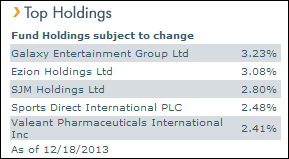
Through 12/18/2013, PIZ is +29.79% YTD, while its benchmark, the MSCI EAFE Index (EFA) is +13.79%. Top holdings of PIZ are shown below:

PIZ 12.19.131 Developed Intl Markets (PIZ) Hit Their Stride

Galaxy Entertainment Group Ltd (Hong Kong)

Galaxy Entertainment Group Limited, through its subsidiary, operates casino, hotel and other entertainment facilities in Macau. The company also manufactures sells and distributes construction materials.

Ezion Holdings Ltd (Singapore)

Ezion Holdings Limited, an investment holding company, develops, owns, and charters offshore assets; and provides offshore marine logistics and support services to the offshore oil and gas industries. It owns multi-purpose self-propelled jack-up rigs, which are used in well-servicing, commissioning, maintenance, and decommissioning of offshore platforms.

SJM Holdings Ltd (Hong Kong)

SJM Holdings Limited is the holding company of Sociedade de Jogos de Macau S.A. (“SJM”), one of the six companies authorised to operate casino games of fortune and other games of chance in casinos, under the terms of a concession granted by the government of the Macau Special Administrative Region in March 2002. SJM is the only casino gaming concessionaire with its roots in Macau, and is the largest in terms of gaming revenue and number of casinos.

Sports Direct International PLC (United Kingdom)

Sports Direct is the UK’s leading sports retailer by revenue and operating profit, and the owner of a significant number of internationally recognized sports and leisure brands. They operate about 400 sports stores in the UK.

Valeant Pharmaceuticals International (Canada)

Valeant Pharmaceuticals International, Inc., a specialty pharmaceutical company, develops, manufactures, and markets pharmaceutical products and medical devices in the areas of neurology, dermatology, and branded generics.

More information about PIZ can be found here. Performance shown above is price return only and does not includes any transaction charges. A list of all holdings for the trailing 12 months is available upon request. Past performance is no guarantee of future returns.

Posted by:


PowerShares & Dorsey Wright Expand Momentum ETFs

December 19, 2013

Building upon the success of our current line-up of Momentum ETFs, PowerShares announces a new suite of Momentum Sector ETFs and a Nasdaq Momentum ETF:

On December 17th, the Board of Trustees approved name, investment objective, underlying index, and investment policy and strategy changes for the following ETFs. These changes are scheduled to take effect on February 19, 2014:

Momentum PowerShares & Dorsey Wright Expand Momentum ETFs

(click to enlarge)

“As with our existing PowerShares DWA Momentum ETF lineup, these portfolios will be based on momentum strategies as measured by Dorsey Wright’s definition of relative strength characteristics, which can be a powerful tool for stock selection,” said Lorraine Wang, Invesco PowerShares global head of ETF products and research. “The momentum indexes were developed by Dorsey Wright who we believe remains a leader in relative strength investing.”

Very exciting news! We will be talking much more about these new ETFs in the coming weeks.

Posted by:


PIZ In The News

November 25, 2013

From “A Momentum ETF Searches for More Upside” by ETF Trends:

Exchange traded funds using intelligent indexing or so-called smart beta strategies have come into the limelight this year as investors have poured over $45 billion into such ETFs and that was as of the end of October.

While “smart beta” may appear to be a new buzz-phrase, many of the ETFs that subscribe to non-market capitalization-weighted strategies have been around for a while. The PowerShares DWA Developed Markets Momentum Portfolio (PIZ) is a prime example.

PIZ follows the same relative strength methodology as other well-known PowerShares ETFs that track Dorsey Wright indices, such as the PowerShares DWA Emerging Markets Momentum Portfolio (PIE) and the PowerShares DWA SmallCap Momentum Portfolio (DWAS) , one of this year’s most successful small-cap ETFs. [Use This ETF for Rising Rates Protection]

PIZ has already surged 26% this year, but this ex-U.S. developed markets play may have more upside to come.

PIZ11 PIZ In The News

Past performance is no guarantee of future returns. See www.powershares.com for more information.

Posted by:


Momentum in Rising Rate Environments

November 19, 2013

The latest PowerShares Connection report is out. There is a nice writeup about the PowerShares DWA Small Cap Momentum ETF and what happens to high momentum securities during rising rate environments. You can view the report here.

PSConnection zps6dc00387 Momentum in Rising Rate Environments

Posted by: