Relative Strength Spread

April 24, 2012

The chart below is the spread between the relative strength leaders and relative strength laggards (universe of mid and large cap stocks). When the chart is rising, relative strength leaders are performing better than relative strength laggards. As of 4/23/2012:

Spread 23 Relative Strength Spread

RS leaders and RS laggards have had similar performance over the past couple of years. History would strongly suggest that we will eventually see RS leaders resume their outperformance.

Posted by:


The Largest Market Inefficiency

April 20, 2012

Jeremy Grantham on “the largest market inefficiency”:

The central truth of the investment business is that investment behavior is driven by career risk. In the professional investment business we are all agents, managing other peoples’ money. The prime directive, as Keynes knew so well, is first and last to keep your job. To do this, he explained that you must never, ever be wrong on your own. To prevent this calamity, professional investors pay ruthless attention to what other investors in general are doing. The great majority “go with the flow,” either completely or partially. This creates herding, or momentum, which drives prices far above or far below fair price. There are many other inefficiencies in market pricing, but this is by far the largest.

Going with the flow in an unsystematic way is likely to lead to poor results, but capitalizing on this market inefficiency in a systematic manner has demonstrated the ability to provide superior performance over time.

Posted by:


High RS Diffusion Index

April 11, 2012

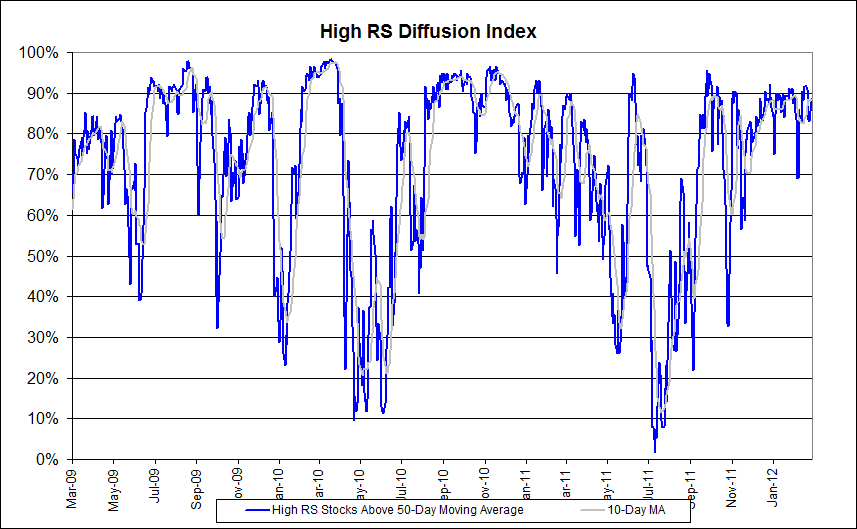
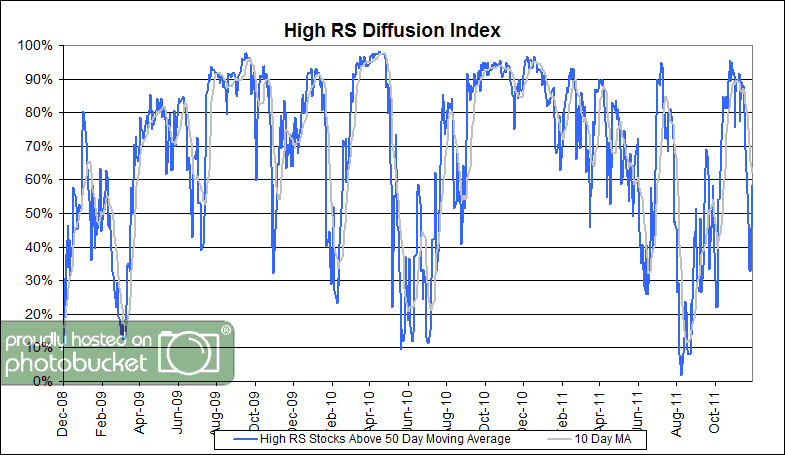
The chart below measures the percentage of high relative strength stocks that are trading above their 50-day moving average (universe of mid and large cap stocks.) As of 4/3/12.

HighRS High RS Diffusion Index

The 10-day moving average of this indicator is 77% and the one-day reading is 43%. The high RS universe has taken a hit over the last week.

Posted by:


Relative Strength Spread

April 10, 2012

The chart below is the spread between the relative strength leaders and relative strength laggards (universe of mid and large cap stocks). When the chart is rising, relative strength leaders are performing better than relative strength laggards. As of 4/9/2012:

spread 21 Relative Strength Spread

RS leaders and RS laggards have had similar performance over the past couple of years. History would strongly suggest that we will eventually see RS leaders resume their outperformance.

Posted by:


PowerShares DWA Technical Leaders Video

April 6, 2012

March 1, 2007 was the day that Tom Dorsey rang the bell at the New York Stock Exchange as PowerShares launched the PowerShares DWA Technical Leaders ETF (PDP). Later that year, two international versions of the index were launched (PIE and PIZ). So, how have they done? Click here to find out (financial professionals only). This video makes the case for relative strength, explains how we construct the PowerShares DWA Technical Leaders Indexes, and provides some ideas for how to include them in an asset allocation.

TechnicalLeaders4412 1 PowerShares DWA Technical Leaders Video

See www.powershares.com for more information.

Posted by:


Q1 RS Factor Review

April 4, 2012

Earlier this quarter we updated our white paper on using relative strength to invest in stocks. If you haven’t read the paper you can find it here. In this post I will be recapping the performance of various relative strength (momentum) factors using the same methodology used in the paper.

The S&P 500 had a great first quarter ending up about 12% (price only). Relative strength strategies did OK. The best performing factors during Q1 were actually the factors that performed the worst over a long time horizon (see the white paper for details). Several of the best long-term winning factors had a tough time in Q1.

RSFactors2012Q1 Q1 RS Factor Review

(Click To Enlarge)

The graph above shows the returns for all 100 trials for each of the time-based RS factors we track. A trailing 18 month and 36 month window to compute RS worked very well. These worked well because those models didn’t rotate into low volatility names at the end of last year, and then rotate back out of them during Q1. In effect, the long time horizon allowed them to capitalize on the laggard bounce that was so prevalent during the first part of the quarter. The very short-term windows also did well. They were able to quickly rotate into the high beta names that were the leadership. But, more importantly, that trend was sustainable so the short-term mean reversion effect didn’t hurt those factors in Q1. The 6 month and 9 month factors performed very poorly. The main reason is these intermediate term factors rotated into low beta and high dividend stocks at the end of last year. Those were the laggards during Q1, and it took some time for those models to rotate into the new leadership. Keep in mind, however, that these two factors are two of the best performing over long time horizons.

The laggard bounce was most pronounced in January and February. By March things had settled back down and the intermediate term factors were performing well. The better performance was the result of the market rewarding intermediate term momentum, and the models having a chance to shed the laggards and re-position themselves into the current leadership.

January Performance

RSFactors2012Jan Q1 RS Factor Review

(Click To Enlarge)

February Performance

RSFactors2012Feb Q1 RS Factor Review

(Click To Enlarge)

March Performance

RSFactors2012Mar Q1 RS Factor Review

(Click To Enlarge)

The turnaround for intermediate term momentum strategies wasn’t enough to totally reverse the underperformance during the first two months of the year. But it is very good to see the intermediate term factors getting back into gear! We noticed the same thing in our managed portfolios too. Things definitely picked up in the last part of the quarter for high RS stocks.

All of the factors in this post are simple, time based relative strength (momentum) factors. These are the factors that match what we published in the white paper. We do track other RS factors though. It is interesting to note, that the underperformance of the intermediate term factors was most pronounced in the simple, time based factors. Intermediate term factors we track that use some sort of smoothing or multiple time periods performed much better than the 6 and 9 month factors. The only explanation I have for that is that the 6 month ranking window was the perfect time to maximize your whipsaw into low volatility and back out again. The smoothed and compound factors did a much better job this quarter at avoiding that whipsaw.

Posted by:


The Rise of Tactical Allocation

March 29, 2012

Portfolio construction has typically relied on strategic asset allocation to help control volatility. The idea is that if you combine assets with low correlations, you can significantly reduce the volatility of your returns. Lately, however, correlations have become a problem. Jeff Benjamin, writing in Investment News, discusses the problem:

Asset classes have become so highly correlated over the past few years that many traditional diversification strategies have lost their effectiveness.

For example, take the link between growth and value stocks.

For the decade ended December 2000, the correlation between the Russell 1000 Growth Index and the Russell 1000 Value Index was just 57%. During the decade ended this past December, it jumped to 92%.

For a more extreme case, compare the correlation of the MSCI Emerging Markets Index with the Russell growth index. The former was negatively correlated to the latter by 6% — which was great for those seeking diversification — in the decade through December 2000, but the correlation spiked to 89% in the following decade.

You can see the issue—drastically changing correlations will move your efficient frontier far from where you imagined it was.

Some of the observers Mr. Benjamin quoted were blunt:

“Traditional diversification is like a seat belt that only works when you’re not in a car accident,” said Michael Abelson, senior vice president of investments at Genworth Financial Wealth Management Inc.

“Depending on risk tolerance, we might recommend allocating half a portfolio to a diversified strategic strategy and then 30% to 35% to a tactical strategy and 15% to 20% to alternatives,” Mr. Abelson said.

Besides having a knack for a fine turn of phrase, Mr. Abelson mentions something that we have noticed more and more in recent years. It used to be the case that tactical allocation was used as a satellite strategy and might get only a 10% slice of a portfolio. Now, we often see the tactical strategy with a 35-50% weight. Some advisors are even using the tactical allocation as the core strategy and arranging alternatives and other asset classes as strategic overweights.

With the rise of tactical allocation come new challenges. Chief among them is how to manage the tactical portion of the portfolio. All-in/all-out timing decisions are notoriously difficult to get right. Overweighting and underweighting based on valuation requires sophisticated modeling that must be constantly updated. In addition, many assets are resistant to traditional valuation methods.

One method that does work over time is tactical asset class rotation using relative strength. We’ve chosen that path for our Global Macro strategy because it allows a very large and diversified universe to be ranked on the same metric. That, and because it works.

Click here and here for disclosures. Past performance is no guarantee of future returns.

Posted by:


High RS Diffusion Index

March 28, 2012

The chart below measures the percentage of high relative strength stocks that are trading above their 50-day moving average (universe of mid and large cap stocks.) As of 3/20/12.

HighRS 3 High RS Diffusion Index

The 10-day moving average of this indicator is 88% and the one-day reading is 88%.

Posted by:


Relative Strength Spread

March 27, 2012

The chart below is the spread between the relative strength leaders and relative strength laggards (universe of mid and large cap stocks). When the chart is rising, relative strength leaders are performing better than relative strength laggards. As of 3/26/2012:

RSSpread 4 Relative Strength Spread

RS leaders and RS laggards have had similar performance over the past couple of years. History would strongly suggest that we will eventually see RS leaders resume their outperformance.

Posted by:


From the Archives: Ken French Should Check His Website

March 26, 2012

A new paper from Eugene Fama and Ken French is circulating, suggesting that active mutual fund managers don’t add value. Articles, like the one here at MarketWatch, have been appearing and the typical editorial slant is that you should just buy an index fund.

I have a bone to pick with this article and its conclusions, but certain things are not in dispute. Fama and French, in their article Luck versus Skill in the Cross Section of Mutual Fund Returns, look at the performance of domestic equity funds from 1984 to 2006. (You can find a summary of the paper here.) They discover that the funds, in aggregate, are worse than the market by 80 basis points per year–basically the amount of the fees and expenses. (After backing out fees and expenses, the funds are 10 basis points per year above the market.) After that, Fama and French run 10,000 simulations with alpha set to zero to see if the distribution of returns from actual fund managers is any different from the distribution of returns from the random simulations. They conclude it is not very different and suggest that any fund manager that outperforms is simply lucky.

Let me start my critique by pointing out that, based on their sample and their goofy experimental design, their conclusions are probably correct. Existing mutual funds in aggregate pretty much own the market portfolio and underperform by the amount of fees and expenses. There clearly are some above-average mutual fund managers, but as Fama and French point out, it’s difficult to tell statistically from just performance data if they are good or simply lucky. Within a big sample of funds like they had, after all, a few are bound to have good performance just because the sample is so large.

This is quite a quandary for the individual investor, so let’s think about the realistic scenarios and their outcomes–in other words, let’s take actual investor behavior into account.

Scenario 1. Buy a mutual fund after its good performance is advertised somewhere and bail out when it has a bad year. Continue this behavior throughout your investment lifetime. According to Dalbar’s QAIB and other data, this is what actually happens most of the time. Not a good outcome–underperformance by a large margin, often 500 basis points or more annually.

Scenario 2. Buy a decent mutual fund and make the radical decision to leave it alone, come hell or high water. Do not be tempted by the blandishments of currently hot funds or panicked by underperformance in your fund when it inevitably happens. Close eyes and hold on for dear life. Continue your ostrich-with-its-head-in-the-sand routine throughout your investment lifetime. Your outcome, as Fama and French point out, will probably be market returns less the 80 basis point per year in fees. Your returns will probably be 400 basis points annually or more better than Scenario 1.

Scenario 3. Throw active management overboard entirely. Buy an S&P 500 index fund or a total market index fund and proceed as in Scenario 2. Your outcome might be 60-70 basis points per year better from reduced costs than the investor in Scenario 2. (Your cost is that you don’t get to brag at cocktail parties on the occasions when your actively managed fund has a good year.) On the other hand, you are no less likely to succumb to Scenario 1 than an actively managed mutual fund investor. Unfortunately, index mutual funds tend to show the same pattern of lagging returns due to investor behavior as actively managed funds.

Scenario 4. Visit Ken French’s own website. Look for factors that are tested and that have outperformed consistently over time. Hint: relative strength. (Academics tend to call it ”momentum,” I suspect because it would be very deflating to have to admit that anything related to technical analysis actually works.) Find a manager that exposes a portfolio to the relative strength factor in a disciplined fashion over time. Buy it and pretend you are Rip Van Winkle. Continue this dolt-like behavior for your entire investment lifetime. Your outcome, according to Ken French’s own website, is likely to be market outperformance on the magnitude of 500 basis points per year or more. (You can link to an article showing a performance chart back to 1927 here, and the article also includes the link to Ken French’s database at Dartmouth University.)

I prefer Scenario 4, but maybe that’s just me. Since it is well-known even to Eugene Fama and Ken French that momentum has outperformed over time, what is their study really saying? It’s saying that essentially no one in the mutual fund industry is employing this approach. That’s more a problem with the mutual fund industry than it is with anything else. (Mutual fund firms are businesses and they have their reasons for running the business the way they do.) One option, I guess, is to throw up your hands and buy an index fund, but maybe it would make more sense to seek out the rare firms that are employing a disciplined relative strength approach and shoot for Scenario 4.

Their flawed experimental design makes no sense to me. Although I am still 6’5″, I can no longer dunk a basketball like I could in college. I imagine that if I ran a sample of 10,000 random Americans and measured how close they could get to the rim, very few of them could dunk a basketball either. If I created a distribution of jumping ability, would I conclude that, because I had a large sample size, the 300 people would could dunk were just lucky? Since I know that dunking a basketball consistently is possible–just as Fama and French know that consistent outperformance is possible–does that really make any sense? If I want to increase my odds of finding a portfolio of people who could dunk, wouldn’t it make more sense to expose my portfolio to dunking-related factors–like, say, only recruiting people who were 18 to 25 years old and 6’8″ or taller? In the same fashion, if I am looking for portfolio outperformance, doesn’t it make a lot more sense to expose my portfolio to factors related to outperformance, like relative strength or deep value, rather than to conclude that managers who add value are just lucky? No investigation of possible sub-groups that were consistently following relative strength or deep value strategies was done, so it is impossible to tell. Fama and French are right, I think, in their assertion that plenty of luck is involved in year-to-year performance, but their overall conclusion is questionable.

In short, I think a questionable experimental design and possible sub-groups buried in the aggregate data (see this post for more information on tricks with aggregate data) make their conclusions rather suspect.

—-this article originally appeared 12/3/2009. It turned out to be one of the blog readers’ favorite rants, so I am reprising it here. I still think active management can add value over time through disciplined exposure to a reliable return factor.

Posted by:


From the Archives: Beating Buy-and-Hold, Again

March 16, 2012

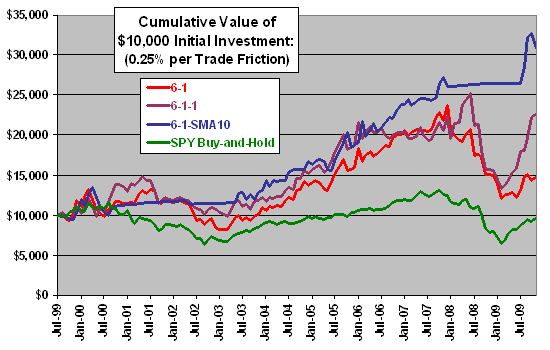
Although it always seems counterintuitive for incredibly simple momentum strategies to be able to beat the market, yet more evidence is provided in a brief article from CXO Advisory. (Relative strength is often called “momentum” in academic literature.)

Their method was simple. They used the nine domestic sector SPDRs, held the top one based on a simple momentum ranking, and revisited the ranks monthly, switching if necessary. Three simple models were used: 1) top 6-month return, 2) top 6-month return ending 1 month ago, and 3) top 6-month return or cash if the top sector SPDR was below its 10-month moving average (a la Mebane Faber’s paper).

You can see the equity curve below, although there is better detail in the original article. (The model that can go to cash was obviously helped by two big bear markets in the last ten years; in an up market decade it might be different.)

 From the Archives: Beating Buy and Hold, Again

Now, I’m not sure any compliance department would sign off on a strategy that only held one sector at a time, but it is certainly eye-opening that all three strategies outperformed the market. This finding is rampant throughout many, many academic and practitioner studies, including ones archived on our website. Systematic use of relative strength works.

—-this article was originally published 12/22/2012. Evidence for the effectiveness of relative strength continues to pile up, most recently in the five-year performance of PDP.

Posted by:


From the Archives: RS Primer

March 9, 2012

Good primer on relative strength by CSS Analytics:

I have done a lot of research in this area and the first conclusion I can make is that it should be a major portion of any trader or investor’s portfolio strictly because it is so durable and robust. Whether it’s asset classes, sectors, stocks, commodities, currencies—-you pick a time frame over the last 40-50 years and this simple method of buying strength and selling weakness has outperformed traditional buy and hold strategies. This outperformance or alpha is also robust to most transaction cost assumptions.

Four-stage model depicting how relative strength occurs:

Based on my own observation and theory I feel that a simple four-stage model best depicts how relative strength occurs and why it takes time to develop rather than occuring instantaneously. The relative strength effect is driven by behavioural feedback loops where investors sequentially pour money into the asset du jour for a plethora of reasons including positive perceived fundamentals, psychological beliefs such as fear or greed, or for positive economic or default risk factor sensitivity. Essentially it starts when certain investors create a theory such as: “emerging markets will outperform because of the accelerated pace of development” and begin to accumulate investments in assets tied to this theory (Stage 1: the early adopters). As time goes on the theory itself becomes more widely known and the rationale becomes more widely accepted. Others quickly catch on and start investing in the same idea (Stage 2: recognition and acceptance). The next stage (and longest stage) is where initial investors wait for hard proof that the idea or theory is supported by tangible evidence in a variety of forms whether economic indicators, qualitative or anecdotal accounts to mention a few. (Stage 3: validation). The “Validation Stage” tends to last long as the early investors are looking for ongoing proof that supports or refutes their theory. The nature of economic data and other information sources is that they require multiple readings to establish that a trend is in fact statistically valid. This is why it is impossible for markets to adjust instantaneously even with purely rational investors. There are two paths the validation stage can take—either the evidence to refute the theory is strong, and as a consequence momentum will fail as early investors bail out. Or if the evidence continues to support and even exceed expectations, the early investors will add to their positions alongside the second stage investors. This added money flow cements the trend and the relative strength begins to really accelerate. At this point we reach the final stage where everyone agrees that a given market is and should go up and people are hopping on the bandwagon simply because the market is going up. This is both the fastest stage and the most rewarding per unit of time (Stage 4: mania).

—-this article originally appeared 12/29/2009. It’s still a good reminder of how robust and durable relative strength is. Human nature doesn’t change much.

Posted by:


RS White Paper: SSRN’s Top Ten Downloaded

February 17, 2012

We were just notified that John Lewis’ white paper Relative Strength and Portfolio Management was recently listed on SSRN’s Top Ten downloaded list for All SSRN Journals! Click here to access the paper.

This is not just another academic white paper on relative strength (although those are certainly also of value). Rather, this white paper details our Monte Carlo-based testing process that has been instrumental in understanding and verifying the robust nature of relative strength.

SSRN RS White Paper: SSRNs Top Ten Downloaded

Posted by:


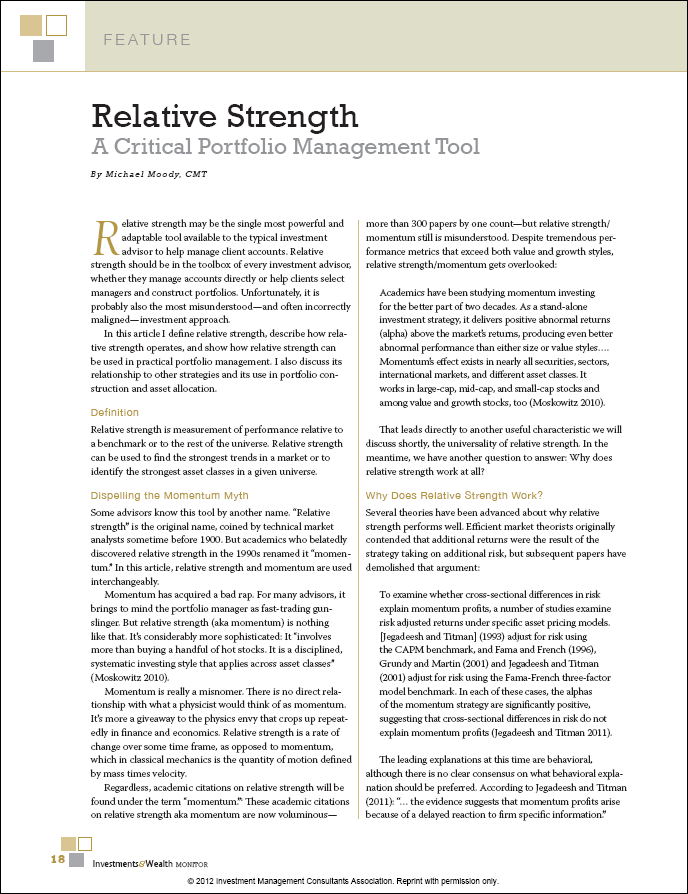
Relative Strength-A Critical Portfolio Management Tool

February 13, 2012

Mike Moody’s Relative Strength-A Critical Portfolio Management Tool now appears in the current issue of IMCA’s Journal of Investment Consulting. Whether you are managing relative strength portfolios yourself or you are employing relative strength strategies, this article answers the essential questions:

  • What is relative strength?
  • Why does it work?
  • Where does it work?
  • What have been the results?
  • What are its drawbacks?
  • How does it fit in an asset allocation?

Click here to read the article.

imca2 Relative Strength  A Critical Portfolio Management Tool


Posted by:


Relative Strength And Portfolio Management

February 3, 2012

Years ago we developed a testing protocol to help us determine how robust a strategy really is. We wanted to determine how much of the strategy’s tested returns were a result of luck and how much of the return was due to the underlying factor performance. We have run all of our strategies through that process over the years, and we published some of those results back in 2010. The data was just updated through the end of last year and the updated can be found here.

When testing a model it is always difficult to determine if the results you are achieving are repeatable or not. If you are testing a high relative strength model, for example, are the results coming from one or two stocks that make the whole test look fantastic? If that is the case I would have my doubts about how that strategy would perform in real-time. But if the results are truly from an underlying factor performance (regardless of the individual securities in the portfolio) then you have something you can work with.

The way we determine if a model is lucky or not is to run multiple simulations based on a random draw of securities. In a relative strength model we might break our universe into ten different buckets. Out of the highest bucket we might draw 50 stocks at random. We hold those stocks until they are no longer classified as high relative strength securities. Once they fall below a specific rank we sell the security and buy another one at random. If we run 100 trials we get 100 different portfolios over time. What we are trying to determine is if the individual securities in the test really matter, or is just the concept of buying high relative strength securities over time what causes the outperformance.

As it turns out, what stocks go in to the portfolio aren’t as important as exploiting the factor. A disciplined approach is that consistently drives the portfolio to strength is what drives the returns over time.

12MoRandom Relative Strength And Portfolio Management

(Click To Enlarge)

The table shows the results from one of the factors tested in the paper. You can see the range of outcomes each year as well as how each model did over the 16 year test period. Sometimes the models outperform, sometimes the underperform, and some years you have mixed results. But over 16 years, all of the models outperformed! All we did was pick stocks at random out of a high relative strength basket. There is nothing complicated about it. The main thing is that the process is systematic and extremely disciplined.

More details about the testing process and results can be found in the paper (click here).

Posted by:


Momentum Travels

February 2, 2012

That’s the title of a Forbes article detailing research on relative strength in international markets. The research was done by the asset management firm Gerstein Fisher and encompassed 21 developed markets from 2004-2011. The summary:

Momentum works. Seminal research by Narasimhan Jegadeesh and Sheridan Titman in 1993 first identified momentum as a systematic source of risk for equity investors. Their research—corroborated by numerous subsequent academic studies—revealed that, historically, momentum investing had provided excess stock returns over a market index.

…..

Overall, momentum returns outperformed market returns by an average of 3.13 percentage points on an annualized basis.

You can see the results on a country-by-country basis below.

GersteinFisher Momentum Travels

Source: Forbes/Gerstein Fisher

Leaving aside the ridiculous statement about momentum being first identified in 1993, their study is important because it shows that momentum returns are universal. Based on their study and others, we agree. Dorsey Wright has been running a Systematic RS International portfolio since 2006 and the results have been excellent. Our net returns have exceeded the EAFE benchmark by a similar amount to what Gerstein Fisher found-not surprising given the substantial overlap in time frames.

To receive the brochure for our Separately Managed Accounts, click here.

Click here and here for disclosures. Past performance is no guarantee of future returns.

Posted by:


Harnessing the Power of Momentum

January 27, 2012

That’s the title of a recent article in Advisor Perspectives about relative strength investing. (Academics call it momentum.) The article was written by a principal at a Canadian money management firm, Michael Nairne, so it’s nice to see a little cross-border validation. From the article:

Numerous academic studies have confirmed that, when measured in periods of approximately three to 12 months, past investment winners tend to keep on outperforming while past losers tend to keep underperforming.

Momentum is not simply a US phenomenon. A recent study2 covering equities in 23 countries from November 1989 to September 2010 found evidence of strong momentum returns in North America, Europe and Asia Pacific; only Japan was an exception. Another study tracking the largest 100 stocks in the British market from 1900 to 2009 found that a portfolio comprised of the 20 best performers over the prior 12 months outperformed the worst performers by 10.3% annually3. The same authors found momentum in 18 out of 19 markets, dating back to 1975 in larger European markets and 1926 in the US.

Momentum is not confined to portfolios of individual stocks – it exists in a variety of asset classes. A recent study4 has found that momentum exists in government bonds, commodities and currencies as well as country equity indexes. Momentum has also been found in corporate bonds5 as well as the financial futures market6.

The article is well-footnoted. I recommend you read the original, which I linked to above. The article does a good job discussing both the pros and cons of relative strength. For example, the author points out that:

…there are prolonged periods where stocks with positive momentum underperform the market. Despite an overall annualized premium of 3.9%, there have 22 periods where stocks with positive momentum have underperformed the market by greater than 5%, with durations as long as several years.

Although investors have a marked tendency to abandon strategies when they underperform for a period of time, that might not be a good idea with relative strength. Despite periods of underperformance, long-term results have been remarkable:

The $1.00 investment in momentum stocks grew to $67,309, nearly 30-times larger than the $2,321 earned in the S&P 500. [August 1927 to July 2011] For long-term investors, this outperformance has been remarkably enduring. In 99.6% of the 10-year rolling periods since July 1937, momentum stocks have outperformed the S&P 500. [my emphasis]

Investors have a lot of choices when it comes to selecting an investment strategy, but not many have been as well validated over as long a period of time in multiple markets as relative strength.

Posted by:


It’s Not You, It’s Me…..

January 12, 2012

It’s not you, it’s me…. I think everyone has used that line at some point, but nobody does it better than George Costanza!

I have been putting data together to update our white papers. It’s no secret that running a Global Tactical Asset Allocation (TAA) strategy was difficult last year. But when I looked at the data it was very clear that the problem wasn’t the strategies. The real problem was how the market behaved during 2011. It’s not you, it’s me. It’s not your trend following strategy, it’s what you’re trying to follow. The market was essentially a psycho, stage 5 clinger last year!

The data I will reference in this post is an extension of the data we published last year in two white papers. If you haven’t read them you can find them here. Our research process for this dataset takes a diverse universe of ETF’s and creates 100 different equity curves for a number of different momentum factors. The universe has a number of different asset classes represented including Equities (Domestic & Foreign), Bonds, Commodities, Currencies, and Real Estate. The results provide a good idea about how a momentum-based, global TAA strategy would have performed. By creating 100 different equity curves we are taking luck out of the equation and showing a realistic range of outcomes from buying high relative strength securities out of our universe.

Most of the momentum factors we follow underperformed last year. The factors we are showing refer to the lookback period to do our rankings. The 1MORET factor (1-month return) means we used 1 month of data to calculate our momentum ranks (all securities are held until they fall out of the top of the ranks, which might be as short as one week or as long as a couple of years). The 12MORET factor uses the prior 12 months of price data to rank the securities. The 3-month factor actually performed the best in 2011, but only 40 out of the 100 trials outperformed the S&P 500, so you needed some luck to outperform. The 6-month factor was the next best, but only 1 trial outperformed so you needed to be really lucky. All the other trials were very poor. There was so much short-term volatility back and forth last year that the very short 1-month formulation period was deadly. It paid not to be too quick on the trigger last year!

GM2011 Its Not You, Its Me.....

Full Year 2011

(Click To Enlarge)

But looking at 2011 in aggregate doesn’t really tell the whole story. The beginning of the year was good for these strategies. That person you were dating held it together pretty well for the first couple of dates! Through the end of April, most of the strategies were outperforming the S&P 500 on average. The 6-month factor was doing great as all 100 trials were outperforming. Ironically, the factor doing the worst was the 3-month factor.

GM1H2011 Its Not You, Its Me.....

2011 Through April

(Click To Enlarge)

The problems for trend following strategies began in May. There were a series of sharp trend reversals in a number of different assets: Bonds, Stocks, Precious Metals, Currencies (Yen & Swiss Franc). No matter what factor you were using from May to the end of the year it was difficult. It was tough to get traction anywhere. The only factor that did even so-so was the 3-month factor, and that was the worst factor through April. That’s just one of many examples of how crazy the 2011 market was!

GM2H2011 Its Not You, Its Me.....

2nd Half 2011

(Click To Enlarge)

So where do we go from here? Well, the, “It’s not you, it’s me…” line always leads to a breakup. That’s probably not a bad idea when dealing with something that doesn’t change. Does that psycho, stage 5 clinger ever get any better? Nope. It only gets worse.

But markets change, and TAA based on momentum is very adaptive. We will not be in a choppy, range bound environment forever. Trends will emerge. (If they don’t, it will be the first time in history.)

Investors were euphoric about momentum-based TAA strategies in the first part of the year. Looking at the data you can see why - they were working exceptionally well. After the last few months, people are certainly not as excited. In reality, now is the time to be really excited about relative strength strategies, not back in April. Now is the time you want to be adding money.

Posted by:


Casting Out = Upgrading

January 3, 2012

From the New York Times, a look at how DAL Investments has managed to beat the market:

DAL, which manages $1.3 billion, has been using data like this to make its investment decisions. It calls this strategy “upgrading,” an approach that it has been advocating in its newsletter since the 1970s.

The strategy looks at one-, three-, six- and 12-month fund returns. The belief, which began with Burt Berry, DAL’s founder, in the 1970s, was that market trends could not be forecast and were clear only in retrospect. But the trends lasted long enough so that you could capitalize on it. Call it the hot hand of investing.

DAL applied its strategy to the funds in this study, starting with the top 15 in 1989 and tracking their one-, three-, six- and 12-month returns. When a fund dropped out of the top third — below 99 — it sold the fund and reinvested the money in the top-ranked fund that it did not own.

DAL calls it “upgrading;” the academic literature typically calls it “casting out.” Whatever you call it, our Systematic RS portfolios follow exactly the same process. Sell it when the rank drops and replace it with the best-ranked item you don’t already own. DAL used a composite measure of relative strength—as we’ve mentioned before, many methods will work as long as the portfolio gets exposed to the strong performers.

The article actually had a little broader mandate. DAL looked at a range of funds for the New York Times to try to determine what worked and what didn’t. Here’s what they found:

The best-performing funds over time were not necessarily the ones with the lowest fees, run by the best-known managers or focused on any particular strategy, according to more than 20 years of data examined by DAL Investments, an investment adviser and publisher of the NoLoad FundX newsletter in San Francisco. DAL analyzed the returns on 306 mutual funds for The New York Times.

Janet M. Brown, president of DAL Investments, said the deep dive was motivated as much by trying to figure out what worked as by testing the effectiveness of the firm’s own unconventional strategy. (More about that later.)

“The overall challenge of mutual fund investing is selecting funds in advance that people think will do well in the future,” Ms. Brown said. “The easiest thing would be to buy and hold or to select a manager with a good long-term track record and buy it and forget it. That was not an effective way of selecting funds.”

I added the bold. It’s important because most investors select funds using exactly the process that DAL found ineffective! (See Andy’s note on this same problem!)

What DAL found is that the funds that beat the benchmark changed over time. As Ms. Brown said, “In my view, it has less to do with the brilliance of the portfolio manager as when their styles are in sync with the market,” she said. This makes perfect sense. Not one of the funds outperformed all the time. In fact, the average fund lagged the benchmark one-third of the time. Some funds lagged more years than they outperformed, but still had market-beating returns. Other funds outperformed two-thirds of the time, but still fell behind the benchmark.

Because the styles that work keep changing, good portfolio management adapts. That is one of the essential traits of relative strength: it does not discriminate and adapts to whatever is working.

Posted by:


Quote of the Month

December 27, 2011

Tim Hartford on forecasting:

Professional pundits are not usually paid to make correct forecasts. They are paid to sound convincing, whether they are columnists or figureheads for asset managers.

I agree that sounding convincing is essential in order to win and keep business. However, I also believe that intellectual honesty is an important part of the long-term success of a business. Forecasting is not just challenging…it’s impossible. We have chosen to do our homework, gain a deep understanding of relative strength, and make every effort to convincingly make the case to investors for using relative strength as part of their asset allocation. It’s also a nice benefit that the data is on our side.

crystal ball2 Quote of the Month

HT: Abnormal Returns

Posted by:


When To Get Out

December 19, 2011

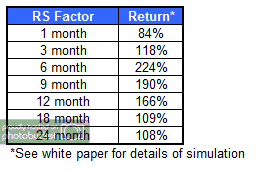
Any time a strong asset class goes through a short-term period of underperformance the question always comes up, “Is the trend over?” This is generally when I pull out my crystal ball. In reality, every trend follower must decide the sell criteria for each trade. Will it be based on the trader’s discretion (not recommended), or based on some objective rule set? Using relative strength rank stops is a topic that is covered in the white paper Relative Strength And Asset Class Rotation by John Lewis. For the purposes of the white paper, relative strength ranks were used to determine when to get out of a given trade. One of the most revealing results for the study is just how much different the results are over time by using different relative strength look-back periods for portfolio formation. For example, if you use a 3-month look-back period for your relative strength factor, the results were very different over time than if you used a 6-, 9-, or 12-month look-back period. In fact, the white paper detailed the results of using 1-, 2-, 3-, 9-, 12-, 18-, and 24-month look-back periods for portfolio formation.

Please read the white paper to see the details of the Monte Carlo testing process used for this study. This simulation was done on a universe of ETFs from a variety of asset classes over an 11-year period of time (2000-2010). However, the cumulative mean results are as follows:

whitepaper121911 When To Get Out

What conclusion can be drawn? The best results over the 11-year period of time came from using a 6-month look-back relative strength factor. For the purposes of the white paper, percentile ranks were used to determine when to get out of a a given trade. Getting out of a position every time its relative strength has a bad month or even bad three months of price performance did not lead to as good of performance over time as using an intermediate relative strength ranking stop.

This underscores the importance of understanding how to thoroughly test a set of decision rules so that you can be best prepared to run those decision rules in real time and with real money! It is human nature to want to bail out of a position after it looks like the trend may be turning. In hindsight, we may well see that indeed we would have been better to get out much earlier. Of course, we may also see that the relative strength stabilized and then moved higher.

The goal with any trend following system is to capitalize on long-term trends. Relative strength is ideally suited to help you accomplish that goal. However, it won’t come without some discomfort along the way. Today, the question may be about gold, but tomorrow the same question will be asked about a different asset class. Relative strength provides a clear process for determining when to get in and when to get out.

Posted by:


The Results Are In

November 30, 2011

James O’Shaughnessy’s book What Works On Wall Street is required reading for every investment professional as it provides a detailed look at the results of different investment strategies over time. The fourth edition was just released and has the benefit of data that now goes back to 1926, whereas the previous editions only went back to 1963. Any quantitative manager (or user of quantitative strategies) needs to know the historical merits of focusing on different return factors.

O’Shaughnessy details the results of relative strength from 1926-2009:

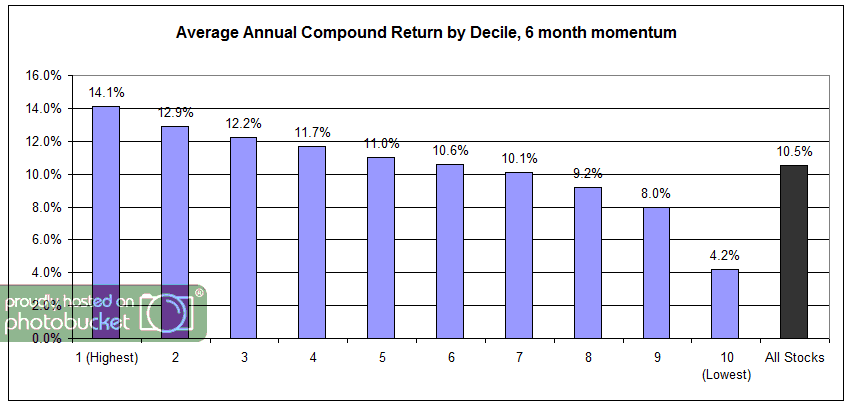
A $10,000 investment on December 31, 1926, in the decile of stocks from All Stocks with the best six-month price appreciation is worth $572,831,563 at the end of 2009, a compound return of 14.11 percent a year. This return dwarfed an investment in the All Stock universe, which turned $10,000 into $38,542,780 over the same period, an average annual compound return of 10.46 percent.

It is also important to point out that O’Shaughnessy found that this relative strength portfolio outperformed the benchmark in 68% of single-year returns, 79% of rolling 3-year returns, 87% of rolling 5-year returns, 95% of rolling 7-year returns, and 98% of rolling 10-year returns.

Also, keep in mind that this is just a generic relative strength strategy based on a 6-month return factor with annual rebalances. His book also showed that using a 12-month relative strength factor also outperformed the benchmark with an compound return of 12.34 percent.

In case you were wondering, a strategy based on buying stocks with the worst 6-month returns and then holding for a year had an annualized return of 4.15 percent! As stated in the book, “If you’re looking for a great way to underperform the market, look no further [than buying relative strength laggards].”

O’Shaughnessy on the symmetry for the relative strength deciles:

The decile returns for All Stocks by six-month price appreciation reveal a perfect staircase, with the performance of decile 1-containing the best six-month price performing stocks-at the top and returns of the other deciles descending in step to the tenth decile, which contains the worst six-month price performers. The top six deciles all beat All Stocks, with the bottom four all underperforming the universe.

oshaughnessy2 The Results Are In

Source: What Works On Wall Street

The results are in and they are highly favorable for relative strength investing.

Posted by:


What Still Works on Wall Street?

November 29, 2011

The early editions of James O’Shaughnessy’s bible What Works on Wall Street identified two combination strategies that were so good that mutual funds were formed to implement the strategies. Cornerstone Value was a large cap dividend strategy, while Cornerstone Growth combined value with relative strength. The funds have been around since 1996 or so. CXO Advisory poses the question:

Has 14 years of out-of-sample performance of these two mutual funds confirmed the motivating backtests?

HFCVX [Hennessy Cornerstone Value] underperforms both its benchmark Russell 1000 Value Index and the S&P 500 Index. The fund underperforms the S&P 500 Index by about 0.5% per year, compared to the backtested average annual outperformance of about 7%. Also, its standard deviation of annual returns (20.1%) is higher than that for the benchmark Russell 1000 Value Index (18.7%). Backtested outperformance has not persisted over a 14-year out-of-sample implementation.

HFCGX [Hennessy Cornerstone Growth] outperforms both its benchmark Russell 2000 Index and the S&P 500 Index. The fund outperforms the S&P 500 Index by about 2.5% per year, compared to the backtested average annual outperformance of about 10%. Its standard deviation of annual returns (21.2%) is about the same as that for the benchmark Russell 2000 Index (21.1%). Backtested outperformance has persisted at a subdued level over a 14-year out-of-sample implementation.

whatstillworksonwallstreet What Still Works on Wall Street?

Relative Strength still works on Wall Street

Source: CXO Advisory

In other words, the dividend strategy has not been able to beat the market over the last 14 years, while the relative strength strategy has outperformed in real life. This mirrors CXO’s findings earlier. I might note that the outperformance of the Cornerstone Growth strategy comes despite the Q3-Q4 2008 - Q1-Q2 2009 performance of relative strength, which was a big historical outlier. The underperformance of relative strength was epic during that brief period—and Cornerstone Growth outperformed anyway. I would further note that the 2.5% annual outperformance is after fees.

Evidence suggests that relative strength is a strategy worth implementing.

Posted by:


High RS Diffusion Index

November 29, 2011

The chart below measures the percentage of high relative strength stocks that are trading above their 50-day moving average (universe of mid and large cap stocks.) As of 11/28/11.

diffusion 22 High RS Diffusion Index

This index has dropped to the middle of the distribution over the last couple of weeks. The 10-day moving average of this indicator is 62% and the one-day reading is 58%.

Posted by:


Momentum Over Multiple Cycles

November 23, 2011

In a recent interview, Jim O’Shaughnessy made the case for following quantitative strategies that have performed well over multiple market cycles:

The average investor does significantly worse than a simple index … It’s literally because of the way our brains are wired. As [neuro-finance researchers] look at super-fast scans of the brain making decisions under uncertainty, we see that even with a so-called professional investor making the choice, it is not the rational centres of the brain that fire when they’re making those choices. It is the emotional centres of the brain.

That’s one of the reasons why finding good strategies that have performed well over multiple market cycles – and then having the ability to stick with them through thick and thin, even when they’re not working for you – is the key to good long-term success.

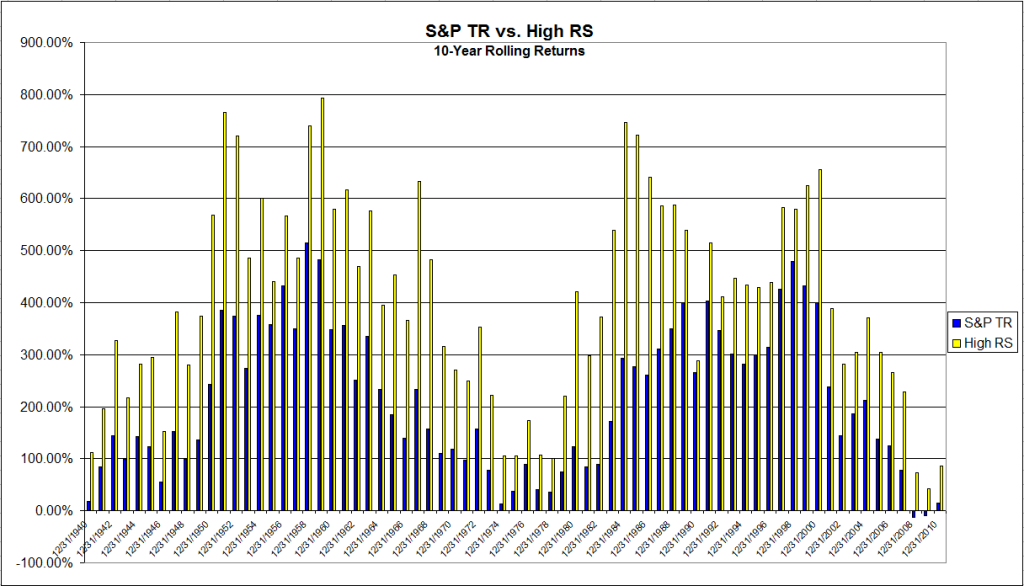
Which brings me to the long-term performance of relative strength strategies. We tracked down total return data for the S&P 500 going back to 1930 and compared it to the momentum series on the website of Ken French at Dartmouth (top half in market cap, top 1/3 in momentum). The chart below shows 10-year rolling returns, which is why it starts in 1940. The average ten-year returns? 405% for relative strength and 216% for the S&P 500, a near doubling! That’s without the momentum series getting any credit for dividends. Even more impressive, the ten-year rolling return of the relative strength series outperformed in 100% of the time periods.

 Momentum Over Multiple Cycles

Click to enlarge

Source: J.P. Lee, Dorsey, Wright Money Management

Results such as these should provide more than enough confidence to stick with relative strength through the thick and thin.

Posted by: