Underfunded Pension Plans

February 4, 2013

Many large corporations still carrying defined benefit plans for their workers have underfunded pension plans. For example, here’s an excerpt from a Wall Street Journal article on the issue today:

“It is one of the top issues that companies are dealing with now,” said Michael Moran, pension strategist at investment adviser Goldman Sachs Asset Management.

The drain on corporate cash is a side effect of the U.S. monetary policy aimed at encouraging borrowing to stimulate the economy. Companies are required to calculate the present value of the future pension liabilities by using a so-called discount rate, based on corporate bond yields. As those rates fall, the liabilities rise.

If you think that underfunded pension plans are only a corporate or government problem, you would be wrong. Chances are that the underfunded pension plan is a personal problem, even if (or especially if) you have a defined contribution plan like a 401k. In a corporate plan, the corporation is on the hook for the money. If you have a 401k plan, you are on the hook for the money. And, since there is a contribution cap on 401ks, it may well be that you need to set aside additional money outside your retirement plan to make sure you hit your goals.

Figuring out whether your retirement is funded or not depends on some assumptions—and those assumptions are a moving target. The one thing you know for sure is how much you have saved for retirement right now. You might also have a handle on your current level on contributions. What you don’t know exactly is how many years it will be until you retire, although you can generate scenarios for different ages. What you don’t know at all is what the return on your retirement savings will be in those intervening years—or what the inflation rate will be during that time.

As interest rates fall, pensions are required to assume that their investment returns will fall too. That means they have to contribute much more to reach their funding goals.

Guess what? That means you should assume that you, too, will see lower returns and will need to save more money for retirement. When stock and bond yields are low, it’s realistic to assume that returns will be lower going forward. Investors right now, unfortunately, are stuck with rates that are near 50-year lows. It puts a big burden on investors to get cracking and save as much as they can while they are working. A qualified advisor should be able to give you some sense of your funding level so that you can plan for retirement.


Posted by:


Are You the Millionaire Next Door?

January 31, 2013

Clients, in general, are bad about even trying to figure out what their retirement number is—that is, the pool of assets they will need to maintain their standard of living in retirement. Even more difficult is figuring out if they are on track. One simple method is mentioned in The Millionaire Next Door, by Thomas Stanley and William Danko. From Yahoo! Finance:

Thomas Stanley and William Danko, authors of the bestselling book “The Millionaire Next Door,” suggest that you simply take your age and multiply it by your current annual income before taxes from all sources (except for inheritances, which are only paid once). Divide the total by 10, and the quotient is what your net worth should be at that point in your life.

So, for example, if you are making $80,000 per year and you are now 45 years old, this simple formula suggests that to stay on track your net worth should be about $360,000. There are a lot of assumptions that go into this, obviously, and there are better and more accurate ways to figure out if you are on track (for example, we use a % funded spreadsheet), but it’s a start. Given current return expectations, this simple formula might understate what you will require, but anything that will motivate clients to get moving in the right direction is a help.


Posted by:


401k Abuse

January 18, 2013

With the elimination of traditional pensions in many workplaces, Americans are left to their own devices with their 401k plan. For many of them, it’s not going so well. Beyond the often-poor investment decisions that are made, many investors are also raiding the retirement kitty. Business Insider explains:

Dipping into your 401(k) plan is tantamount to journeying into the future, mugging your 65-year-old self, and then booking it back to present day life.

And still, it turns out one in four workers resorts to taking out 401(k) loans each year, according to a new report by HelloWallet –– to the tune of $70 billion, nationally.

To put that in perspective, consider how much workers contribute to retirement plans on average: $175 billion per year. That means people put money in only to take out nearly half that contribution later.

That’s not good. Saving for retirement is hard enough without stealing your own retirement money. Congress made you an investor whether you like it or not—now you need to figure out how to make the best of it.

Here are a couple of simple guidelines:

  • save 15% of your income for your entire working career.
  • if you can max out your 401k, do it.
  • diversify your portfolio intelligently, by volatility, asset class, and strategy.
  • resist all of the temptations to mess with your perfectly reasonable plan.
  • if you can’t discipline yourself, for heaven’s sake get help.

I know—easier said than done. But still, if you can manage it, you’ll have a big headstart on a good retirement. Your 401k is too important to abuse.

Posted by:


Extolling the Power of Compound Interest

January 7, 2013

Carl Richard’s latest sketch simply and effectively conveys the nature of compound interest:

Compound Interest1 Extolling the Power of Compound Interest

You’ve probably heard that starting early is one of the best investing decisions you can make. That’s because investing done right is short-term boring but long-term exciting.

The reason? The reality of compound interest. Let me explain.

Many people talk about the power of compound interest. Albert Einstein is rumored to have called it the most powerful force in the universe.

Now, I suspect he probably didn’t really say that, but whether he did or not, it’s a point that we often miss in the discussion about compound interest. Despite it being one of the most powerful forces in the universe, it’s not one of the most exciting – at least in the short term. Nothing really great happens until after years and years of discipline and patience.

Take this silly (but true!) story that’s often told to demonstrate how powerful compound interest is: If you start with one penny and double it every day for 30 days, you’ll end up with $5,368,709.12.

I should add a disclaimer here that if anyone offers you an investment that will double in value every day, you should run as fast as you can in the other direction. But let’s get back to the main point. Sure, compound interest has a powerful outcome, but it takes an awfully long time to become fun and exciting.

Now take a look at our penny example again. One penny doubled is 2 cents. Two cents turns to $0.04, $0.04 to $0.08, $0.08 to $0.16, $0.16 to $0.32, $0.32 to $0.64, and $0.64 to $1.28. Nothing very exciting there.

But when you stick with it, it’s that last few times when the figure doubles that it gets very, very exciting. You’re looking at $1,342,177.28 becoming $2,684,354.56, and $2,684,354.56 doubling to $5,368,709.12.

That’s the case with our investments, too. It’s not very exciting at the beginning, but compounding becomes a powerful force after years of patience and discipline.

In case you want to see the penny example in spreadsheet form:

compounding Extolling the Power of Compound Interest


Posted by:


Seven (Obvious) Steps to a Sound Retirement

December 11, 2012

When I first read this retirement article by Robert Powell at Marketwatch, I thought the advice was useful, but obvious. Subsequent experience has led me to believe that while it may be obvious to a financial professional, it’s not always obvious to clients. Clients, it seems, have pretty fuzzy thinking about retirement.

Here’s a retirement step that to me is obvious—but a lot of clients haven’t done it, or haven’t thought about it in a very complex way. From Mr. Powell’s article:

1. Quantify assets and net worth

The first order of business is taking a tally of all that you own — your financial and non-financial assets, including your home and a self-owned business, and all that you owe. Your home, given that it might be your largest asset, could play an especially important part in your retirement, according to Abkemeier.

And at minimum, you should evaluate the many ways you can create income from your home, such as selling and renting; selling and moving in with family; taking out a home-equity loan; renting out a room or rooms; taking a reverse mortgage; and paying off your mortgage.

Another point that sometimes gets lost in the fray is that assets have to be converted into income and income streams need to be converted into assets. “When we think of assets and income, we need to remember that assets can be converted to a monthly income and that retirement savings are important as a generator of monthly income or spending power,” according to SOA’s report. “Likewise, income streams like pensions have a value comparable to an asset.”

One reason retirement planning is so difficult, according to SOA, is that many people are not able to readily think about assets and income with equivalent values and how to make a translation between the two. Assets often seem like a lot of money, particularly when people forget that they will be using them to meet regular expenses.

Consider, for instance, the notion that $100,000 in retirement savings might translate into just $4,000 per year in retirement income.

I put in bold a section that I think is particularly important. With some effort, clients can usually get a handle on what their expenses are. If they have pension income or Social Security benefits, it’s pretty easy to match income and expenses. But if they have a lump sum in their 401k, it’s very difficult for them to understand what that asset means in terms of income.

After all, if they are just looking for an additional $3,000 per month in supplemental income, their $400,000 401k balance looks very large in comparison. They figure that it will last at least ten years even if they just draw the funds out of a money market, so 20 years or more should be no problem with some growth. At least I can only assume that’s what the thought process must be like.

Sustainable income is an entirely different matter, as clients almost never factor inflation into the thought process—and they are usually horrified by the thought of slowly liquidating their hard-earned assets. No, they want their principal to remain intact. They are often shocked when they are informed that, under current conditions, some practitioners consider a 4% or 5% income stream an aggressive assumption.

And, of course, all of this assumes that they have tallied up their retirement assets and net worth in the first place. Lots of retirement “planning,” it turns out, works on the “I have a pretty good 401k, so I think I’ll be all right” principle. I have a couple of thoughts about this whole problem. What is now obvious to me is that clients need a lot of help understanding what a lump sum means in terms of sustainable income. I’m sure that different advisors work with different assumptions, but they are still often not the assumptions your client is making.

Some practical steps for advisors occur to me.

  1. Encourage clients to track their assets and net worth, maybe quarterly, either on paper or on a spreadsheet. At least they will know where they stand. A surprising number of clients nowadays are carrying significant debt into retirement—and they don’t consider how that affects their net worth.
  2. Talk to them about what you consider reasonable assumptions for sustainable income. Maybe you’re still using the good old 4% rule, or perhaps you’ve moved on to more sophisticated methods. Whatever they are, start the conversation long before retirement so the client has a chance to build sufficient savings.

Sound retirement isn’t obvious, and planning for it isn’t simple or easy.

Note: The rest of the article is equally worthwhile.

Posted by:


Quote of the Week

October 22, 2012

No strategy can make up for inadequate savings or premature retirement.—-Rob Arnott, Research Affiliates

I like this quote a lot. It gets at some of the factors that allow clients to achieve wealth, along with intelligent investment management.

  1. Savings, and
  2. Time.

Savings is usually more important than investment strategy, especially when a client is just beginning to accumulate capital. Without some savings to begin with, there’s no capital to manage.

Time is important to allow compounding to occur. This is often lost on young investors, who sometimes do not realize what a jump they will get by starting a portfolio early. How many of us in the industry have met with the 55-year-old client who has just finished putting the kids through college and is now ready to start saving for retirement—only to realize they will need to save 115% of their current income to reach the retirement goal they have in mind? Oops.

Save early and often, and give your capital lots of time to grow.

Posted by:


Affluent Investors Settle Down

October 17, 2012

According to a Merrill Lynch survey of affluent investors, they are beginning to adapt to the current economic and market situation as the new normal, as opposed to looking at it as a temporary period of high volatility. Perhaps because they’ve now made that psychological leap, affluent investors are beginning to feel that their situation is more stable. From a Penta article:

To prepare for a more volatile environment, this affluent group also is making efforts to control what they can by spending less, paying down debt, and generally “putting their lives in check,” Durkin said. Of the families surveyed, 50% said they’ve taken steps to gain greater control of their finances, like sticking to a budget (32%), making more joint investment decisions with a spouse (29%), and setting tangible goals (28%). One third of respondents said they’re living “more within their means.”

In other words, the affluent are adapting by toggling back their lifestyle and saving more.

Making that psychological shift is critical because it allows a lot of good things to happen. It’s also perhaps a realization that although you can’t control the markets, there is a lot you can control that will impact your eventual net worth—namely, living beneath your means and saving more. Being affluent, in and of itself, won’t build net worth.

Once a client has good habits in place, compounding kicks in and net worth tends to grow more rapidly than clients expect. Clients are usually delighted with this discovery!

Posted by:


What is the Back-Up Plan?

October 17, 2012

A useful consideration for retirement planning should include evaluating the backstop in the case of a funding shortfall. In other words, if there are insufficient assets to support the desired standard of living in retirement who or what is the back-up plan?

Bob Collie’s article A Perspective on Retirement Security published in the September/October 2012 issue of IMCA’s Investments & Wealth Monitor contrasts two extreme cases:

Most approaches set money aside to back the targeted retirement income. The amounts vary considerably. At one extreme are employment-based pensions provided to federal employees before 1986 under the Civil Service Retirement System (CSRS). A significant part of these promises have not been pre-funded; they are paid when they fall due out of current federal government revenues. Despite a substantial unfunded liability of roughly $750 billion as of September 30, 2010 (OPM, undated), these pensions are backed by the full faith and credit of the U.S. government. The funding arrangement is exceptionally weak, but the backstop is exceptionally strong.

By contrast, consider the assets that must be set aside to fund benefits paid by insurance companies. Insurance companies are required to hold reserves against their book of annuity business based on cautious assumptions about interest rates and mortality. Those required reserves are materially larger if the assets are invested in anything other than the safest investments. This approach reflects the fact that insurance companies have no backstop, nowhere to turn for additional funding in the event of a shortfall. So if the insurance industry is to survive through thick and thin, it must take a cautious and long-term approach to funding and investment.

Notice how the lack of backstop for insurance companies dramatically affects their savings rate! This is a useful context for considering the backstop for each individual and it will likely be different for each client. Some clients will have the backstop of the federal government, some the backing of the Pension Benefit Guaranty Corporation (in the case that their Defined Benefit Plan fails), but many will have no formal backstop. I suspect that the degree of engagement in implementing a serious savings and investment plan will change dramatically for those who begin to contemplate the prospects of either materially reducing their standard of living in retirement or turning to children for help.

Posted by:


Retirement Income Karma Boomerang

October 11, 2012

From time to time, I’ve written about karma boomerang: the harder you try to avoid getting nailed, the more likely it is that you’ll get nailed by exactly what you are trying to avoid. This concept came up again in the area of retirement income in an article I saw at AdvisorOne. The article discussed a talk given by Tim Noonan at Russell Investments. The excerpt in question:

In [Noonan's] talk, “Disengagement: Creating the Future You Fear,” he observed that lack of engagement in retirement planning is leading people toward the very financial insecurity they dread. What they need to know, and are not finding out, is simply whether they’ll have enough money for their needs.

I added the bold. This is a challenge for investment professionals. Individuals are not likely on their own to go looking for their retirement number. They are also not likely to go looking for you, the financial professional. They may realize they need help, but are perhaps intimidated to seek it—or fearful of what they might find out if they do investigate.

Retirement income is probably not an area where you want to tempt karma! Retirement income is less secure than ever for many Americans, due to under-funded pension plans, neglected 401k’s, and a faltering Social Security safety net. The only way to secure retirement income for investors is to reach out to them and get them engaged in the process.

Mr. Noonan, among other suggestions, mentioned the following:

  • “Personalization” is tremendously appealing. “Tailoring” may be an even more useful term, since “people don’t mind if the tailor reuses the pattern,” Noonan explained. They may even enjoy feeling part of an elite group.
  • “Tactical investing” is viewed positively. “People know they should be more adaptive, but they aren’t sure what of,” said Noonan. Financial plans should adapt to the outcomes they’re producing, not to hypothetical market forecasts.

Perhaps personalization and tactical investing can be used as hooks to get clients moving. To reach their retirement income goals, they are going to need to save big and invest intelligently, but none of that will happen if they aren’t engaged in the first place.

Posted by:


Are 401k Investors Making a Mistake with Hybrid Funds?

September 26, 2012

I think this is an open question after reading some commentary by Bob Carey, the investment strategist for First Trust. He wrote, in his 9/11/2012 observations:

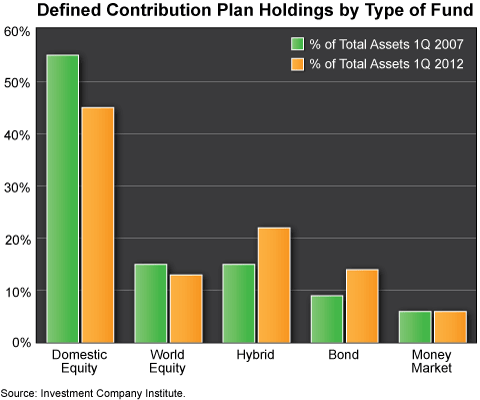
  • Hybrid funds, which tend to be comprised primarily of domestic and foreign stocks and bonds, but can extend into such areas as commodities and REITs, saw their share of the pie rise from 15% in Q1’07 to 22% in Q1’12.
  • One of the more popular hybrid funds for investors in recent years has been target-date funds. These funds adjust their asset mix to achieve a specific objective by a set date, such as the start of one’s retirement.
  • In 2010, target-date fund assets accounted for 12.5% of all holdings in employer-sponsored defined-contribution retirement accounts. They are expected to account for 48% by 2020, according to Kiplinger.
  • Plans are shifting away from the more traditional balanced funds to target-date funds for their qualified default investment alternative (QDIA).

There’s a nice graphic to go along with it to illustrate his point about the growing market share of hybrid funds.

hybrid Are 401k Investors Making a Mistake with Hybrid Funds?

Are 401k Investors Making a Mistake?

Source: First Trust, Investment Company Institute (click to enlarge)

He points out that 401k assets in hybrid funds are rising, but the growth area within the hybrid fund category has been target-date funds. It troubles me that many 401k plans are moving their QDIA option from balanced funds to target-date funds. QDIAs are designed to be capable of being an investor’s entire investment program, so the differences between them are significant.

There is a huge advantage that I think balanced funds have-much greater adaptability to a broader range of economic environments. Balanced funds, particularly those with some exposure to alternative assets, are pretty adaptable. The manager can move more toward fixed income in a deflationary environment and more toward equities (or alternative assets) in a strong economy or during a period of inflation.

Most target-date funds have a glide path that involves a heavier and heavier allocation to bonds as the investor ages. While this might be worthwhile in terms of reducing volatility, it could be ruinous in terms of inflation protection. Inflation is one of the worst possible environments for someone on a fixed income (i.e. someone living off the income from their retirement account). Owning bonds just because you are older and not because it is the right thing to do given the market environment seems like quite a leap of faith to me.

Asset allocation decisions, whether strategic or tactical, should be investment decisions.

Posted by:


Millionaire Status Is Fleeting

September 24, 2012

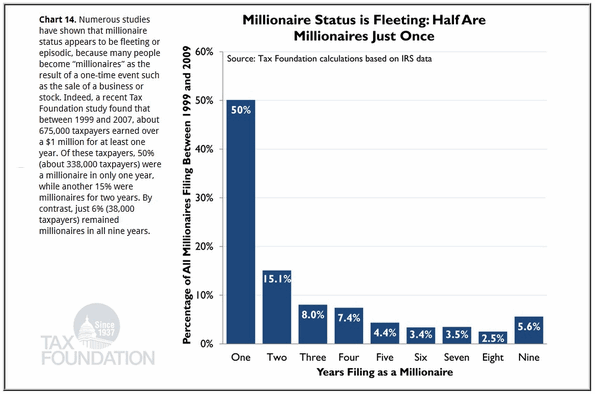
Interesting data on millionaires published by James Pethokoukis of the American Enterprise Institute:

taxfoundation Millionaire Status Is Fleeting

Numerous studies have shown that millionaire status appears to be fleeting or episodic, because many people become “millionaires” as the result of a one-time even such as the sale of a business or stock. Indeed, a recent Tax Foundation study found that between 1999 and 2007, about 675,000 taxpayers earned over $1 million for at least one year. Of these taxpayers, 50% (about 338,000 taxpayers) were a millionaire in only one year, while another 15% were millionaires for two years. By contrast, just 6% (38,000 taxpayers) remained millionaires in all nine years.

This data made me think of the saying that “neither success nor failure is permanent.” Of course, many of these people could have dropped below millionaire status, but remained very high earners. That said, this does underscore the importance of not squandering a big pay day. Sadly, this seems to have been lost on many professional athletes as one recent study estimated that 78% of NFL players are bankrupt or in severe financial distress within two years of retirement and 60% of NBA players are broke within five years of retirement.

Posted by:


Retirement Income Failure Rates

September 13, 2012

Retirement income is the new buzzword. New sales initiatives are being planned by seemingly every fund company on the planet, and there’s no end in sight. Every week sees the launch of some new income product. There are two, probably inter-related, reasons for this. One is the buyers right now are generally leery of equities. That will probably be temporary. If the stock market gets going again, risk appetites could change in a hurry. The second reason is that the front-end of the post-WWII baby boom is hitting retirement age. The desire for retirement income in that demographic cohort probably won’t be temporary. The trailing edge of the baby boom will likely keep demand for retirement income high until at least 2030.

Much retirement income planning is done with the trusty 4% withdrawal rule. Often, however, investors don’t understand how many assumptions go into the idea that a portfolio can support a 4% withdrawal rate. The AdvisorOne article Retirement in a Yield-Free World makes some of those assumptions more explicit. The 4% rule is based on historical bond yields and historical equity returns—but when you look at the current situation, the yield is no longer there. In fact, many bonds currently have negative real yields. Stock market yields are also fairly low by historical standards, leading to lower expected future returns. Here’s what the author, professor Michael Finke, had to say:

Estimating withdrawal rate strategies without real yield is a gruesome task. So I asked my good friend, occasional co-author and withdrawal rate guru Wade Pfau, associate professor at the National Graduate Institute for Policy Studies, to calculate how zero real returns would impact traditional safe withdrawal rates.

When real rates of return on bonds are reduced to zero, Pfau estimates that the failure rate of a 4% withdrawal strategy increases the 30-year failure rate to 15%, or just over one out of every seven retirees. This near tripling of retirement default risk is disturbing, but it is not technically accurate because we also assume historical real equity returns.

If we use a more accurate set of equity returns with a market-correct risk-free rate of return, the results are even more alarming. The failure rate of a 4% strategy with zero bond yield and a zero risk-free rate on equities is 34% over a 30-year time horizon. If real bond rates of return do not increase during a new retiree’s lifetime, they will have a greater than one in three chance of running out of money in 30 years.

The bottom line is that low expected returns may not support a 4% withdrawal rate as easily as occurred in the past. (There may be a couple of more efficient ways to withdraw retirement income than the 4% rule, but the basic problem will remain.)

The practical implication of lower expected returns for future retirees is that they will have to save more and invest better to reach their goals. Retirement income will not be so easy to come by, and behavioral errors by investors will have a greater impact than ever before.

We may not like what Bill Gross calls the “new normal,” but we’ve got to deal with it. What can clients and advisors do proactively to ensure the best shot at a good retirement income stream?

  • encourage savings. Maybe boost that 401k contribution a few percentage points and hector the client for regular investment contributions.
  • diversify by asset class, investment strategy, and volatility. Don’t put all your eggs in one basket. It may become important to pursue returns wherever they are, not just in stocks and bonds. Diversifying your equity return factors may not be a bad idea. We love relative strength, but value and low volatility mix well. And it’s probably not a good idea to put all of your assets into cash or highly volatile categories.
  • get help. There’s a wealth of evidence that good advisors can make a big difference in client outcomes. A steady advisor may also reduce the chance of bad investor behavior, which can be one of the biggest barriers to good long-term returns.

Investing, even in good times, is not an easy endeavor. With low or non-existent real yields, it may be even tougher for a while.

Posted by:


Wealth Drivers in 401k Accounts

September 10, 2012

Putnam Investments recently completed a study in which they examined the wealth drivers in 401k plans for individuals. (I first saw the discussion of their study in this article at AdvisorOne. The full Putnam study is here.) What they did was very clever: they built a base case, and then made various modifications to see what changes had the most impact in driving wealth. Here was their base case:

They assumed that a 28-year-old in 1982 earned $25,000 per year with a 3% cost-of-living increase. The worker contributes 3% of gross salary to a 401(k) plan that receives a 50-cent match on the dollar up to 6% and has a conservative asset allocation across six asset classes. The hypothetical 401(k) also invests in funds in the bottom 25% of their Lipper peer group. By the time the worker turns 57 in 2011, income is $57,198, and the 401(k) balance is $136,400.

Then Putnam examined three sets of wealth drivers to see how they impacted the base case:

  1. They changed the 4th quartile mutual funds to 1st quartile funds, but kicked out funds after three years if they fell out of the 1st quartile.
  2. They looked at the effect of adding more equities to the mix, so they boosted stocks from 30% of the account to 60% and to 85%.
  3. They looked at quarterly rebalancing of the account.

The results were pretty interesting. Picking “better” funds, in concert with the replacement strategy, was actually $10,000 worse than the base case! The portfolios with more equities had their balances boosted by $14,000 and $23,000 respectively—but, of course, they were also more volatile. Rebalancing added $2,000 to the base portfolio balance, but slightly reduced the volatility as well.

All of these strategies—fund selection, asset allocation, and rebalancing—are commonly offered as value propositions to 401k investors, yet none of them really moved the needle much. (Even a “crystal ball” strategy that predicted which funds would become 1st quartile funds only helped balances by about $30,000.)

Then Putnam explored three variations of a mystery strategy. The first version improved the final balance by $45,000; the second version boosted the balance by an additional $136,000; and the third version blew away everything else by adding another $198,000 to the $136,000 base case, for a final balance of $334,000!

What was this amazing mystery strategy? Saving more!

The three variations simply involved moving the 401k deferral rate up from 3% to 4%, 6%, and 8%. That’s it.

The mathematics of compounding over time are very powerful. Because this study looked at the 1982-2011 time period, higher contributions had time to compound. Even moving up the contribution rate by 1% dominated all of the investment gyrations.

The power of compounded savings is often overlooked, almost always by clients and even frequently by advisors. Often one of the best things you can do for your clients is just to get them to boost their deferral rate by a percent or two. They might squawk, but in six months they will usually not even notice it. Then it’s time to get them to boost their deferral rate again! Over time, people are often shocked at how much they can save without really noticing.

Clients often obsess over their fund selection and investment strategy, when they really should be paying attention to their savings rate.

Posted by:


More on the Value of a Financial Advisor

September 5, 2012

I noticed an article the other day in Financial Advisor magazine that discussed a study that was completed by Schwab Retirement Plan Services. The main thrust of the study was how more employers were encouraging 401k plan participation. More employers are providing matching funds, for example, and many employers have instituted automatic enrollment and automatic savings increases. These are all important, as we’ve discussed chronic under-saving here for a long time. All of these things together can go a long way toward a client’s successful retirement.

What really jumped out at me, though, was the following nugget buried in the text:

Schwab data also indicates that employees who use independent professional advice services inside their 401(k) plan have tended to save twice as much, were better diversified and stuck to their long-term plan, even in the most volatile market environments.

Wow! That really speaks to the value of a good professional advisor! It hits all of the bases for retirement success.

  • boost your savings rate,
  • construct a portfolio that is appropriately diversified by asset class and strategy, and
  • stay the course.

If investors were easily able to do this on their own, there wouldn’t be any difference between self-directed accounts and accounts associated with a professional advisor. But there is a big difference—and it points out what a positive impact a good advisor can have on clients’ financial outcomes.

Posted by:


The Risks of the “Pay-Day” Approach to Retirement Planning

August 30, 2012

One of the primary reasons that we hold small business owners in such high regard in this country is our admiration for their courage. It takes real courage to strike out on your own and to invest in yourself and your own idea. I saw this numerous times with my father while I was growing up. He succeeded as a small business owner of Chevron gas stations and of a community bank. He has no shortage of confidence in his ability to succeed by working harder and smarter than the competition. Investing in himself has paid off nicely over time.

However, this inclination to invest in yourself runs some risks. As detailed in the WSJ article “The Economy Stole My Retirement,” many small business owners have spent decades reinvesting their profits in their businesses—some entirely at the expense of diversifying into other investments. The plan was to sell their business for a big pay day as they approached retirement. Then came the Great Recession.

Baby boomers, in many cases, were blindsided by the recession and its effect on their retirement plans, says George Vozikis, director of the Institute for Family Business at California State University in Fresno.

“Boomer entrepreneurs grew up believing in the American dream that you could start a business and eventually sell it for a good return or pass it onto your kids,” adds Aaron Chatterji, associate professor at Duke University’s Fuqua School of Business in Durham, N.C. “Because of the financial crisis and subsequent recession, that is more difficult today.”

Many small business owners are insulted and shocked to find that they can sell their businesses for just a fraction of what they could have prior to the economic malaise of recent years. Their options are fairly limited at this point; they can keep working and wait it out or they can sell at the discounted prices and adjust to the realities of a more modest retirement.

One piece of advice that my father followed throughout his life, and he instilled in me from an early age, is to save 15% of every dollar you ever earn. The result of this practice is accumulating sizable financial assets in addition to ownership of the small business. Following that advice increases the odds of an enjoyable retirement and reduces the stress surrounding the one-time pay day approach to retirement planning.

boomer The Risks of the Pay Day Approach to Retirement Planning

Source: CNN Money

Posted by:


How Your 401k Really Grows: Savings

August 16, 2012

CNBC ran an interesting article on the 401k market today. Fidelity Investments handles about 12 million 401k accounts which they report on, in aggregate, periodically. Here’s what I found most interesting from their recent release:

Over the past 10 years, about two-thirds of annual increases in account balances have been due to workers’ added contributions and company matches, with one-third the result of investment returns.

Surprised? You shouldn’t be. While investment performance is important, so is savings. In a very slow decade for the market, the bulk of 401k growth came from new contributions. Even in a stronger market for financial assets, it would not be surprising to see most of the increase in balances coming from savings since the average 401k balance is only $72,800, according to the article.

The savings rate is another area with plenty of room for improvement. The article notes:

The average employee contribution in Fidelity-administered 401(k) plans has remained steady at around 8 percent of annual pay for the past three years.

8% is a good start, but most experts recommend something closer to 15%. Given the current low-yield environment, seeking out investment returns wherever they can be found and saving as much as possible are going to be critical keys to 401k success.

401k 1 How Your 401k Really Grows: Savings

Posted by:


Making the Most of Savings Opportunities

August 3, 2012

Forbes breaks down millionaires in the US:

There are only two ways to save more – increase earnings and cut spending. Many people assume the only way to retire young is to own a start-up company, but surprisingly 17% of millionaires in the U.S. are not owners of companies but managers, and even more surprisingly, 12% are educators. Though starting a business can be a great way to create wealth, it’s not the only way since business owners make up only 6% of millionaires in the US. Simply make the most of opportunities wherever you work to increase your income and then save the difference.

Pretty much takes away the excuses for the rest of us since educators are not generally the highest earners in our society.

Posted by:


Five Ways to Draw Retirement Income

July 20, 2012

Figuring out how to turn your portfolio into retirement income is a tricky thing because there are two unknowns: 1) you don’t know how the investments will perform, and 2) you don’t know how long you need to draw income. A recent article from the Wall Street Journal discussed how to optimally tap a nest egg. It references a study by Morningstar (a link to the Morningstar paper is included in the WSJ article) that compares five different methods.

The authors also propose a metric to determine how “efficient” the retirement income distribution method is. Some of the methods are fairly heavy on math and count on the investor to use a mortality table and to determine portfolio failure rates using Monte Carlo simulation. Others, like the 4% rule, are pretty basic.

The math-heavy methods work well, but in practice it might be a little more difficult to get a client to specify if they would prefer the calculation be made for a 50% chance of outliving their money or a 10% chance of outliving their money! In my experience, clients are much more interested in methods that offer a 0% chance of outliving their money. Actuarial methods are somewhat dependent on the Monte Carlo simulation having a return distribution similar to what has been experienced in the past. These methods might struggle in the case of a paradigm shift.

As far as simple methods go, the RMD (1/life expectancy or distribution horizon) method and the endowment method are both preferable to the 4% rule. The RMD (required minimum distribution) method is easy to calculate and simple to adapt to whatever time horizon you choose. The endowment method (taking a constant % of the portfolio) has the advantage of being relatively efficient over a wide range of asset allocations—not to mention that it has been tested in practice for decades. Of course, both of these methods take into account the changes in the portfolio’s value, so your distribution may not rise every year. In practice, endowments often smooth the portfolio value to reduce the income volatility.

The traditional 4% rule (withdraw 4% of the portfolio each year and adjust for inflation) is the worst of the rules tested. It’s pretty easy for capital to be depleted if a difficult market occurs early in the retirement period because the withdrawals keep accelerating as the market value declines.

The robust methods (RMD and endowment) significantly reduce your chances of ever running out of money, but you have less certainty about year-to-year income as a result. It’s what I would opt for, but every client’s situation is different.

With thousands of baby boomers hitting age 65 every day now, the Morningstar study deserves a close reading and a lot of thought.

nestegg Five Ways to Draw Retirement Income

Source: greatfreepictures.com

Posted by:


Advisors to the Rescue: Savings Edition

July 16, 2012

There’s already lots of evidence that individuals on their own don’t do very well investing. Compounding your net worth is extra difficult when you also don’t know how much to save. (As we’ve shown before, savings is actually much more important than investment performance in the early years of asset growth.)

An article at AdvisorOne discussed a recent survey that had some surprising findings on consumer savings, but ones that will be welcome for advisors. To wit:

The survey found that, regardless of income level, more than 60% of consumers who work with an advisor are contributing to a retirement plan or IRA, compared with just 38% of those without an advisor.

Furthermore, 61% of consumers who work with an advisor contribute at least 7% of their salary to their plan. Just 36% of consumers without an advisor save at this rate.

The guidance and education that advisors provide their clients to bring on these good saving habits translate to higher confidence, too. Of non-retired consumers with an advisor, half said their advisor provided guidance on how much to save. More than 70% of Americans with an advisor say they’re confident they’re saving enough. Just 43% of consumers without an advisor felt the same.

The differences in savings are really shocking to me. Less than half of the consumers without an advisor are even contributing to a retirement plan! And when they do have a retirement plan, only about a third of them are contributing 7% or more!

Vanguard estimates that appropriate savings rates are 12-15% or more.

I find it interesting that many consumers point out that their advisors gave them guidance on how much to save. It is pretty clear that even simple guidance like that can add a lot of value.

Posted by:


The Big Trend: Professional Asset Management Within the 401k

July 10, 2012

According to a Vanguard report, one of the big trends in the 401k market is the move toward professional asset management. An article at AdvisorOne on this topic says:

One-third of all Vanguard 401(k) plan participants invested their entire account balance in a professionally managed asset allocation and investment option in 2011, according to Vanguard’s How America Saves 2012, an annual report on how U.S. workers are saving and investing for retirement.

The report notes that “the increasing prominence of so-called professionally managed allocations—in a single target-date or balanced fund or through a managed account advisory service—is one of the most important trends in 401(k) and other defined contribution (DC) plans today.”

Two things concerned me about the report. I’m not at all surprised by more and more 401k participants moving toward professionally managed allocations. QDIAs (qualified default investment alternatives) make sense for a lot of participants because they are legally allowed to be your entire investment program. I was surprised about the make-up of the account allocations, given the problems encountered by target-date funds during the last bear market.

In 2011, 33% of all Vanguard participants were invested a professionally managed allocation program: 24% in a single target-date fund (TDF); 6% in a single traditional balanced fund, and 3% in a managed account advisory program. The total number is up from 9% at the end of 2005.

I am amazed that target-date funds are preferred to balanced funds. No doubt target-date funds are an improvement over investors hammering themselves by trading in and out, but target-date funds have some well-publicized problems, not the least of which is that they tend to push the portfolio more toward bonds as the target date nears. That could end up exposing retirees to significant inflation risk right at the time they can least cope with it. It seems to me that a balanced fund with some ability to tactically adjust the portfolio allocation over time is a much better solution.

The other significant problem I see is that savings rates are still far too low. Consider these statements from the AdvisorOne article:

The average participant deferral rate rose to 7.1% and the median (the median reflects the typical participant) was unchanged at 6%.

and then…

Vanguard’s view is that investors should save 12% to 15% or more.

I added the emphasis, but it’s easy to see the disconnect. Investors are saving 6%, but they probably need to be saving more than 15%!

Advisors, for the most part, have very little control over their client’s 401k plans. Clients sometimes ask for advice informally, but advisors are often not compensated for the advice and firms are sometimes reluctant to let them provide it for liability reasons anyway. (A few advisors handle client 401k’s through the independent brokerage window, but not every plan has that option and not every firm lets advisors do it. It would be great if the financial powers-that-be could figure out a way to reverse this problem, but the recent Department of Labor regulations appear to be going in the other direction.)

If you’re an advisor, it’s probably worthwhile to have a serious discussion with your clients about their 401k plans. They may not be handling things in the optimal way and they could probably use your help.

401k The Big Trend: Professional Asset Management Within the 401k

Your client may need your help

Source: investortrip.com

Posted by:


Social Security Strategies

July 5, 2012

The early part of the Baby Boomer wave is hitting retirement age. For some people, Social Security may be an important (hopefully not primary) source of retirement income. This article at Smart Money is a good introduction to a couple of simple strategies to maximize your benefits. I’m sure there are other sources of good advice on the web as well.

The strategies described in this article are relevant for married couples—and the writer points out that often couples get it exactly wrong. Social Security benefits are actually a lot more complicated than at first glance, so getting somewhat familiar with clients’ options may be of great value to advisors.

I suspect there are relatively few people who are really experts on the Social Security system, and I also suspect that clients will want help with it.

Social Security Social Security Strategies

Maximize your Social Security benefits

Posted by:


New Study on Retirement Reality

June 21, 2012

A new study by Aon Hewitt weighs in on how much savings you should have for retirement:

To have enough money for retirement, Aon Hewitt says, people will need savings on their retirement day that are 11 times their old annual pay.

With that level of savings, the researchers say, each year of retirement people can replace 85 percent of the pay a person was used to receiving annually when working. This assumes an average lifetime to age 87 for men and 88 for women.

Besides savings from 401(k) plans, the researchers assumed people would also receive Social Security. So Aon Hewitt figures the average retirement will require your savings and Social Security to provide 15.9 times your last year on the job. The calculations were based on methodology from the 1981 President’s Commission on Pension Policy and the Aon/Georgia State University Replacement Ratio study.

People preparing to replace 85 percent of their pre-retirement annual income per year would get 29 percent of their living expenses from Social Security and 56 percent from savings.

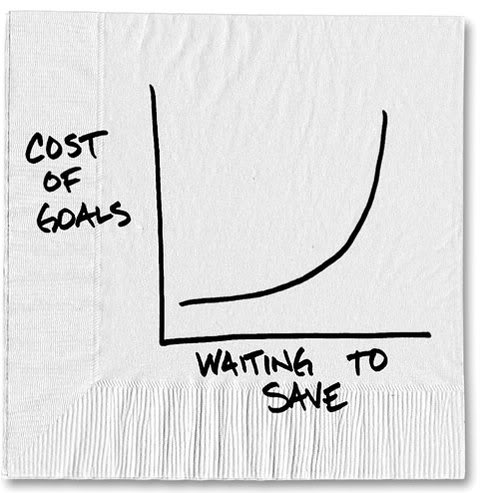
Having 11 times your old annual pay at the point of retirement doesn’t happen by accident. The image below says it all-commit early to be a consistent saver.

07252011bucks carl sketch blog480 New Study on Retirement Reality

Source: Carl Richards

HT: iShares

Posted by:


How Safe Is Your Pension?

May 31, 2012

From “How Safe Is Your Pension?” in the July 2012 Consumer Reports, comes a stark assessment of the current pension landscape:

If you’re counting on a traditional defined-benefit pension, there’s reason to worry that you might not get everything you’ve earned. About 80 percent of the 29,000 private-sector defined-benefit plans insured by the federal Pension Benefit Guaranty Corp. have been underfunded by $740 billion. State and local public employee pensions were recently in a $1 trillion hole.

Instead of beefing up plan assets, many companies have cut benefits. Employers can change their pension rules going forward using a variety of tactics, including tinkering with benefit formulas so that your eventual payout will be reduced, “freezing” the plan to stop further accruals, or terminating an underfunded plan.

“Vested” pension assets—those that legally become your property after a period of time—are generally safe thanks to federal law. But if the plan is terminated, the PBGC, which itself is $26 billion in the red, is required to pay vested benefits only up to a certain amount, which varies by the employee’s age and the year in which the plan is terminated.

Pensions of government workers aren’t covered by the agency but are often protected by state constitutions or laws. Still, 26 states have squeezed benefits for new hires, some other workers, and retirees.

Finding ways to back out of promised retirement benefits and/or reducing benefits for new hires is going to be a dominant theme in the pension world for many years to come. For a flavor of current pension reform efforts consider the current proposal for public employees in Illinois:

Gov. Pat Quinn is proposing to raise the retirement age to 67 from 55; cap retirees’ annual cost-of-living increases at the lesser of 3% or half of the consumer price index; and increase workers’ pension contributions by three percentage points. But what makes these reforms bolder than most other states’ is that they would apply to current employees in addition to future hires.

As financial advisors, we are in a unique position to help people deal with these realities. Right at the top of the list of things that we can do to truly help our clients is to help them come to terms with the pension reforms that are and will be taking place in the coming years and adopt an appropriate savings and investment plan that accounts for these changes. The pressures to scale back pension benefits will be like nothing seen by the last generation of retirees.

Posted by:


Retiree Inflation

May 3, 2012

A very interesting tidbit from an article on retirement distributions in Financial Planning:

To find out, he [financial planner Jim Shambo] looked at inflation calculations by the Bureau of Labor Statistics and found something interesting: Inflation tends to strike retirees harder than preretirees. Most notably, health care costs are rising faster than the inflation rate.

Beyond that, the CPI calculation factors out cost increases that are attributable to improvements in the goods and services you purchase. A car may cost 4% more this year than last, but if there are new fancy electronics in the standard model, the government may decide that inflation only counts for a half-percent of the increase. Of course, if you buy the car, you still have to pay the full higher cost. Add it all up, and people aged 65 to 74 appear to be experiencing an inflation rate that is a remarkable 1.11 percentage points a year higher than CPI, and this grows to 2.09 percentage points (a year!) when retirees get past age 75.

That’s rather remarkable. The rule of thumb that you should be able to retire on 70% of your working income appears to have a big hole in it. Inflation is even worse for retirees than we thought.

Posted by:


A Can-Do Attitude Toward Savings

May 2, 2012

Your excuse for not saving just went out the window with this article from the Wall Street Journal on Tin Can Curt. Here’s the gist:

To the outside world, Curt Degerman was a poor can collector.

The aged Swede, known as “Tin Can Curt,” spent 30 years roaming the streets of Skelleftea in northern Sweden in his blue jacket and ragged pants, collecting tin cans and bottle for cash. He was, in the eyes of most people, an ordinary street bum.

Yet when he died he left more than $1.4 million to his cousin.

How did he do it? Thrift and smart investing.

It turns out that in between collecting cans, Mr. Degerman spent a lot of time in the local library reading business papers and studying the stock market.

“He knew stocks inside and out,” said his cousin.

He used his tin-can earnings to buy mutual funds. He also bought 124 gold bars and also grew his cash with a savings account.

Amazing. Mr. Degerman passed away at only age 60, yet managed to amass $1.4 million. Imagine if he had lived another ten or twenty years (like Warren Buffett), or had another bull market to help his compounding rate!

Advisors have to deal with investors that have undersaved all the time—and yet still hope to retire with their working income. I’m sure Mr. Degerman followed classic principles: 1) keep your expenses down, 2) live beneath your means, 3) save like crazy, and 4) invest for growth and let compounding work its magic. If Tin Can Curt can do it, so can you.

Posted by: