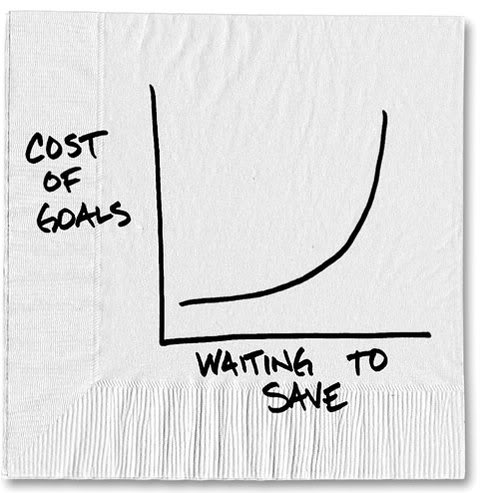
The Golden Years?

January 13, 2012

From the Washington Post, an article about older Americans in the workforce:

Though the recession has thinned the ranks of other generations in the workforce, more people older than 55 are employed than ever before, according to the latest figures from the Bureau of Labor Statistics.

The reasons for the surge of older workers are complex, experts said, but one of the primary economic forces behind it is the growing fear among older Americans that they lack the means to support their retirement needs.

The phenomenon is closely linked to the broad shift in the United States that began in the ’80s away from reliance on company pensions toward the adoption of 401(k) plans and other personal savings.

“Fear is a wonderful motivator,” said Alicia Munnell, director of the Center for Retirement Research at Boston College. “Some of these people are just clinging by their fingernails to jobs.”

Fear is a wonderful motivator? It’s horrible that people have relied on cultural guidance to spend, instead of the guidance of a qualified financial advisor to save and invest. As the article mentions, many people are still working only because they have not saved enough, whether in their 401k or in their personal accounts.

If you are a financial advisor, here is a way for you to have a huge positive impact on the lives of your clients-become their savings and investment coach and you will never lack for business.

Posted by:


401k Millionaires

January 12, 2012

Smart Money ran a short piece about the 0.2%.

The 0.2% are the fraction of investors that have more than $1 million in their 401k plan. Are they doing anything differently than other employees?

“The one characteristic that differentiates the winners from the non-winners here is contribution rate — a high percentage of those million-dollar savers had constant participation and high contribution rates,” he [Jack VanDerhei, Employee Benefit Research Institute's research director] says.

This is probably worth a New Year’s resolution. Call your HR department or whoever handles the 401k in your office and bump up your contribution rate. Combined with intelligent financial management, something that a qualified advisor should be able to help you with, it shouldn’t be that difficult to get to $1 million over the course of a working career.

Posted by:


Saving the New Year

December 28, 2011

Saving the New Year is the title of Megan McArdle’s excellent article on saving.

If your neighbors aren’t saving much (and trust me, they aren’t), that means a less productive economy in the future-and more people trying to claim a very limited supply of public funds. You don’t want to be among them.

The whole article will make you think twice about the legitimacy of your rationalizations for failing to adequately save.

Posted by:


Your Shrinking Nest Egg

December 27, 2011

Alicia Munnell, writing in Smart Money, discusses the retirement preparedness of the Baby Boom generation. The highlights:

…while the boomers have been accumulating wealth at much the same pace as their parents, the world has changed in four important ways.

1) The prevalence of defined benefit pension plans has declined dramatically over the last 25 years.

2) Real interest rates have fallen significantly, so a given amount of wealth will now produce less retirement income.

3) Life expectancy has increased, so accumulated assets must support a longer period of retirement.

4) Health care costs have risen substantially and show signs of further increase, indicating a need for greater accumulation of retirement assets.

So, yeah, it’s somewhat discouraging to think that you will have to save even more since the onus of retirement has now been put entirely on your shoulders. It just points out the need to find a competent advisor early and get cracking. It might make a good resolution for the New Year.

Posted by:


Long Horizon Investing

November 28, 2011

Institutional pension funds and foundations-most obviously-have long-term investment horizons. What is less well-appreciated in the investment industry is that individuals have long-term horizons too. If anything, an individual’s task is more complex, since it is broken into a long capital accumulation phase and then, possibly, into a capital distribution period. (If capital accumulation is extraordinarily successful, some accounts never have a distribution phase. The portfolio sometimes just continues to accumulate because the spending never approaches the fecundity of the portfolio.)

Like a institutional pension fund, an individual’s retirement savings has a very long life span—because it is, in fact, your pension fund. A recent article by Andrew Ang of Columbia University and Knut Kjaer points out some of the chief advantages of long horizon investing:

Long horizon investors have an edge. They can ride out short-term fluctuations in risk premiums, profit from periods of elevated risk aversions and short-term mispricing, and they can pursue illiquid investment opportunities. The turmoil we have seen in the capital markets over the last decade has increased the competitive advantage of a long investment horizon. Unfortunately, the two biggest mistakes of long horizon investors—procyclical investments and misalignments between asset owners and managers—negate the long horizon advantage. Long horizon investors should harvest many sources of factor risk premiums, be actively contrarian, and align all stakeholders so that long horizon strategies can be successfully implemented. Illiquid assets can, but do not necessarily, play a role for long horizon investors, but investors should demand high premiums to compensate for bearing illiquidity risk and agency issues.

I put their recommendations in bold. For individuals, aligning stakeholders shouldn’t be a huge problem. You’re the only stakeholder, which is another advantage over an institution.

It makes perfect sense to harvest multiple factor risk premiums. Historically, relative strength is among the largest of these, but lots of them are worthwhile. Value is a well-known factor and minimum volatility also seems promising. A big benefit of these two factors is that the excess returns are often negatively correlated with relative strength. You can build better equity exposure by combining uncorrelated factors.

Finally, they suggest being actively contrarian. I read this as being willing to add to a strategy when it is out of favor, something they euphemistically term as “short-term fluctuations in risk premiums.” When relative strength has underperformed, add to it. When value has underperformed, plump up your portfolio in that area. Although the fluctuations can often be hair-raising, they are very correct about what a big mistake procyclical investments can be. (Procyclical is just a fancy word for buying high and selling low.)

Their conclusion is also worth reiterating: The turmoil we have seen in the capital markets over the last decade has increased the competitive advantage of a long investment horizon.

As an individual investor, you have some handicaps relative to institutions. But if you work from the standpoint of a long investment horizon, you also have a big potential competitive advantage. Whether you turn that potential into reality or not is a function of how successfully you implement their recommendations-constructing a portfolio to capture several return factors and adding to a strategy on dips.

Posted by:


Safe Withdrawal Rates

November 17, 2011

We’ve written before that there is no guarantee that market returns going forward will look anything like the past. Things change. In an article in Advisor Perspectives, Wade Pfau discusses safe withdrawal rates in an international context.

Conventional wisdom states that, when it comes to retirement planning, the 4% “safe withdrawal rate” (SWR) rule is the platinum standard. That rule, dating back to William Bengen’s 1994 article in Journal of Financial Planning, says that a new retiree can safely withdraw 4% of their savings in the first year of retirement and adjust this amount for inflation in subsequent years. Bengen found that this strategy is safe in the sense that the strategy will not lead the retiree to exhaust all of his or her remaining assets for at least 30 years.

The 4% rule has been widely adopted by the popular press and financial planners as an appropriate general rule of thumb for retirees. Since Bengen’s paper, numerous researchers have developed strategies to allow retirees to safely exceed a 4% withdrawal rate. Though the SWR fluctuates a bit from study to study, depending on the dataset and assumptions used for its calculation, my own research suggests a safe withdrawal rate for the US of 4.02%. That was the highest amount that could be sustained in the worst-case retirement year. I find that using the Dimson, Marsh, Staunton Global Returns Data for 17 developed market countries since 1900.

The problem with SWR research based on historical data, however, is that most every study has been based on the same Ibbotson Associates dataset on US financial market returns since 1926. The time period covered by such data may have been a particularly fortuitous one for the United States that will produce dangerously overinflated SWRs if asset returns fail to be so stunning in the future.

Indeed, over the time period in question the US consistently enjoyed among the highest inflation-adjusted returns and lowest volatilities for stocks, bonds, bills and inflation.

From an international perspective, the US enjoyed a particularly favorable climate for asset returns in the twentieth century, and to the extent that the US may experience mean reversion in the current century, SWRs as presently calculated may no longer seem so safe.

The results have shown that from an international perspective, a 4% withdrawal rate has been problematic. The calculated SWR exceeds 4% in only three of the other 16 countries: Canada, Sweden, and Denmark. As for other countries, the most unfortunate retiree of all was a Japanese person retiring in 1940, whose maximum SWR was a miserably low 0.47% as high inflation and low real returns plagued Japan during and after the war. Six countries experienced withdrawal rates below 3%: Spain, Italy, Belgium, France, Germany, and Japan. In Italy, the 4% rule failed 62.5% of the time, and in Japan, such high withdrawals were sustainable for only three years in the worst-case scenario.

I’ve excerpted some of the important conclusions of the article and bolded a crucial point. The US markets dataset that has typically been used to calculate withdrawals included some very, very good markets. It seems to be more the historical exception rather than the rule. If we really do have low prospective returns to look forward to in the US—think about a Japan-type scenario—that 4% number is going to be too high.

What conclusions can we draw from all this?

  • Save as much as you can. There’s no guarantee that US returns will be as high as they have been historically. You might need a cushion.
  • If US returns are not as high as they have been historically, you are going to get killed buying a straight index fund of whatever variety.
  • If US returns are not as high as they have been historically, you should strongly consider a more global, tactical investment policy. You’re going to have to grab returns wherever and whenever you can find them.
  • Withdrawal concepts based on fecundity may be a better way to go, rather than a straight percentage withdrawal based on history unlikely to repeat.
  • Markets simply give you the opportunity to compete; you are not entitled to a positive outcome. Earning even a “gentleman’s C” is difficult in the financial markets.

Posted by:


Real Millionaires

October 28, 2011

I’ve been meaning to post on this book for a while, but this morning’s report on the consumer savings rate falling back to the lowest level since December 2007, got me off the dime.

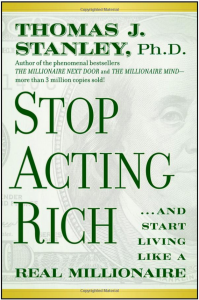
Thomas Stanley’s book Stop Acting Rich…And Start Living Like A Real Millionaire offers some fascinating data on the behaviors of millionaires. The great thing about his book is that the conclusions made are all data-driven (Dr. Stanley has spent decades intensively studying the affluent in America).

I suspect that many would be very surprised by the following points made in his book:

  • More than two-thirds of those who are country club members are not millionaires.
  • Real millionaires pay about $16 (tip included) for a haircut.
  • The median price paid for motor vehicles among millionaires surveyed was $31,367.
  • 70% of millionaires in America have never owned a boat or a yacht or even a raft.
  • 64% of millionaires did not own a second home.
  • Most millionaires do not live in homes that have a market value of $1 million or more. About 90 percent live in homes valued at under $1 million.
  • The majority of millionaires report that their spouse is more frugal than their frugal husband (in the case where the males were the bread winners).
  • Only 7 percent of millionaires own a bottle of wine that costs more than $100.
  • 67 percent of millionaires own wine that costs somewhere in the range of $10-$25.
  • Millionaires usually pay $19.59 (median) for the dinner that they order at their favorite restaurant.
  • Toyota make of automobile was found to be the number one in market share among millionaires (10.9 percent).

The reality is that it is ultimately those individuals that embrace a frugal lifestyle who are able to enjoy a life of financial independence. As discussed in Dr. Stanley’s book, the affluent understand that what brings happiness in life is not the watch on your wrist, but life activities, relationships, the peace of mind associated with financial independence, and the ability to donate to charitable causes.

stanley 199x300 Real Millionaires

Finally, I did enjoy the following quote from his book (a philosophy taken at face value by so many…)

Anyone who lives within their means suffers from a lack of imagination. -Oscar Wilde

Posted by:


Erosion Of Financial Smarts With Age

October 27, 2011

Robert Powell of MarketWatch writes about a critical, but very sensitive topic in his article “Our Financial Smarts Erode Quickly After Age 60.”

Regardless of gender or education level, Americans become considerably less literate about all things money after age 60, according to a new study.

The scores on a test measuring knowledge of investments, insurance, credit and money basics fell about 2% each year starting after age 60, falling from about 59% correct — hardly a passing grade — for those in their 60s to a dismal 30% for those 80 and older, according to Michael Finke, an associate professor at Texas Tech University and a co-author of the study.

Here’s what’s even worse: Our confidence in our financial decision-making abilities rises with age. We are not older and wiser. Rather, we are older, less smart and overconfident.

This notion of confidence rising while financial literacy is falling spells trouble for that group of Americans that now represents more than 12% of the population and controls half of all the financial wealth in America, according to Finke, who is also head of Texas Tech University’s Ph.D. in financial-planning program.

Obviously, there are noteworthy exceptions to this tendency. In fact, it is likely that each of us could immediately think of a number of people who seem to defy this trend. However, it would be unwise to disregard these results. The very population with the bulk of the financial wealth in this country is also the population that can benefit most from good financial advice and money management.

Posted by:


Sustainable Withdrawal Rates

October 19, 2011

Can a retirement portfolio sustain 4% withdrawals in retirement? That’s the generally accepted rule of thumb, but Dr. Wade Pfau, writing in the Journal of Financial Planning, points out some of the complications in that theory.

Bottom line: current valuations might have a big impact on the withdrawal rates, since what happens early in retirement is much more critical than what happens after a portfolio has had an opportunity to grow for many years.

Dr. Pfau’s findings dovetail nicely with work from James Garland. I do think that it’s useful to consider withdrawals in a relative sense. From an earlier article here at Systematic Relative Strength:

Sustainable spending is a tricky concept. Dozens of studies have been performed on historical data that suggest that the proper spending rate is 3 to 5%. A lot of endowments use 4%, for example. In reality, I think the sustainable spending level depends quite heavily on financial conditions at the time. A stock market with a 6% dividend yield is going to support more spending than a market yielding 3%. In other words, I tilt toward a relative calculation first developed by James Garland. He shows that you can generally spend more than just your dividend and interest income, but far less than your total earnings yield. His rule of thumb is that sustainable spending is about 130% of the yield on the major stock indexes. (You can use this link to find the current dividend yield on the major stock indexes.)

Recommended reading for all advisors with clients hoping to retire!

Posted by:


Have 401k? Get Help!

October 17, 2011

The self-destructive tendencies of retail investors are well-documented. In the 1950s and 1960s, people used their “play money” in the stock market—their defined benefit pension is what they were counting on for their retirement. Fast forward to today and you will find that everyone is responsible for their own retirement through their 401k balance. All of a sudden everyone has to be an expert in asset allocation and investment selection. Clearly, that’s not going to happen. Most people are ill-suited, either by temperament, interest, or background, to manage their own retirement plans.

But you can usually get help. According to an article in Financial Planning, that would be a very good idea.

Investors who relied on professional help in the form of target-date funds, managed accounts and advice earned nearly three percentage points more than those that did not, according to an analysis of eight large defined contribution plans between 2006 and 2010 by Aon Hewitt and Financial Engines. The plans covered 400,000 participants with $25 billion in assets.

The study found that in those five years, worked who received some form of professional experienced higher returns averaging 2.92 percentage points, net of fees, than those individuals who managed their 401(k) on their own. According to Aon Hewitt and Financial Engines’ projections, a 45-year-old participant who invests $10,000 and receives professional help will have a portfolio valued at $71,400 at age 65, compared to $42,100 for someone who doesn’t get any help.

Interestingly, only about 30% of the plan participants got help. You should strongly consider being one of them.

Posted by:


Michael Lewis on Financial Planning

October 3, 2011

Michael Lewis concluded his recent Vanity Fair article “California and Bust” with the following:

When people pile up debts they will find difficult and perhaps even impossible to repay, they are saying several things at once. They are obviously saying that they want more than they can immediately afford. They are saying, less obviously, that their pres­ent wants are so important that, to satisfy them, it is worth some future difficulty. But in making that bargain they are implying that, when the future difficulty arrives, they’ll figure it out. They don’t always do that. But you can never rule out the possibility that they will. As idiotic as optimism can sometimes seem, it has a weird habit of paying off.

His whole article is a fascinating read about the factors that have led California to its present level of over-indebtedness. The article is also great food for thought about the timeless topic of current vs. future consumption and prudent financial planning on both the government and individual levels. Great articles, such as this one by Michael Lewis, have the power to change behavior by all those open to avoiding the unpleasant realities of an underfunded retirement because they allow the reader to visualize the end-game (see the part of the article on Vellejo, CA).

Posted by:


Retirees’ Unrealistic Expectations

September 20, 2011

At Marketwatch, columnist Robert Powell has some commentary on a recent article by Dan Ariely about asset allocation and retirement expectations. For me, one of the interesting things was the way in which Mr. Ariely quantified retiree expectations:

But according to research conducted by Dan Ariely, people need 135% of their final income to live the way they want in retirement. The reason for this astounding difference has to do largely with the way Ariely, a professor of economics and behavioral finance at Duke University, did his research.

Instead of asking people to ballpark how much of their final salary they will need, he asked the following questions: How do you want to live in retirement? Where do you want to live? What activities do you want to engage in? And similar questions geared to assess the quality of life that people expect in retirement.

Ariely then took the answers and “itemized them, pricing out their retirement based on the things that people said they’d want to do and have in their retirement.” Using those calculations, he found that people want to retire to a standard of living beyond what they currently enjoy. (Who wouldn’t if money were no object?) Read Ariely’s blog post on the topic here.

When retirees’ desires were actually priced out, they clearly desired to have their standard of living increase! It takes a lot of capital to do that, capital that most retirees do not have. The old rule of thumb was that retirees needed 70% of their working income to retire. But no one knows who came up with that number or how they ballparked it!

Having spoken with many advisors over the years about this topic, my experience suggests that a more realistic estimate is that clients are comfortable when they have closer to 100% of their working income when they retire. Some expenses do go down, but other expenses, particularly travel and healthcare, tend to go up.

In some cases, when expenses go down, it’s not voluntary! Expenses go down because they have to—the retiree simply does not have enough income and is forced to cut back.

The retirement predicament really cries out for advisors to get to their clients early, get them started on a savings plan, and stay very focused on their investment performance throughout their working careers. It’s going to be tough to meet goals otherwise. The best time to get started is when you take your first job. The second-best time to get started is today!

Posted by:


The Cost of Retirement: More Than You Think

September 16, 2011

Moshe Milevsky, a professor at York University in Canada, has written a lot of articles discussing lifetime income. He is an advocate of annuities, although that is a somewhat controversial position in the industry. (Some argue that the default risk of the insurance company itself is somewhat of a wild card. Hello, AIG.) He discusses annuities in this article from Advisor One too, but what struck me most was just the raw cost of retirement income.

If you are retiring at the age of 65 and would like a $1,000 monthly income stream until life expectancy, which is age 84.2 — after which, I presume, you plan to shoot yourself — and this money is invested at a real rate of 1.5%, then you need a nest egg of a little over $200,000 at retirement. So says the math.

….

Now I deliberately selected 1.5% as the investment return in the above paragraph, since it is the best rate you can actually guarantee in today’s environment on an after-inflation basis. Note that in late July 2011, long-term inflation-linked (government) bonds are yielding 1.5%. We all might believe this is artificially low, but it is the best you can get if you want something that is guaranteed. The mighty bond market speaks.

Of course, if you worry about events that have probabilities smaller than 50% — like living beyond life expectancy — and you plan your retirement to the 75th percentile, which is age 90, then you need a retirement nest egg of approximately $251,000. This will generate the $1,000 monthly income for the extra six years. Stated differently, the present value of $1,000 per month until the age of 90 is $251,000 when discounted at 1.5%. And, if you worry about events with probabilities smaller than 25% and you plan to the 95th percentile of the mortality table, which is age 97, then you need a nest egg of $306,000 to generate the $1,000 of monthly income. Big numbers. Low rates.

He includes a table of returns in his article, but anyway you cut it, $250-300,000 to generate only $1000 of monthly income is a lot! Many retirees are planning—or maybe “hoping” is the appropriate word—to retire with the same level of income as they are currently earning.

Many retirees would be delighted to get $6000 per month in income, but turn green when they realize they will need a minimum portfolio size of $1.5 million. One of the big risks this can create, according to Mr. Milevsky, is a thinking error, often perpetuated by some retirement planning software:

Assuming a more aggressive portfolio, in the hopes that you can move to the upper right-hand corner of the table — and hence require a smaller nest egg for retirement — is a mirage. You can’t tweak expected return (a.k.a. asset allocations) assumptions until you get the numbers that you like.

Boosting your expected return by adjusting your asset allocation must also consider the possibility that you won’t achieve your expected return! After all, there is no guarantee of results in any market.

The safest and best way to avoid a retirement shortfall is simply to save more, save longer, and invest better. If your assumptions are conservative and your investment results are favorable, you might end up with extra capital. That’s a high-class problem to have. If your assumptions are too aggressive, you’ll end up like all of the public and corporate defined benefit plans: under-funded. The further you are away from collecting Social Security, the less likely it is you’ll see all of it, so you can’t count on that to bail you out.

It’s time to roll up your sleeves and start saving.

Meal Planning for the Bad Saver

Posted by:


Escaping Failed Asset Allocation

September 3, 2011

Dan Ariely recently went off on the standard practice of constructing an asset allocation based on the expressed risk tolerance of an investor:

We also asked people to tell us how much risk they were willing to take with their money, on a ten-point scale. For some people we gave a scale that ranges from 100% in cash on the low end of the risk scale and 85% in stocks and 15% in bonds on the high end of the risk scale. For other people we gave a scale that ranges from 100% in bonds on the low end of the risk scale and buying only derivatives on the high end of the risk scale. And what did we find? People basically looked at the scale and said to themselves “I am a slightly above the mean risk-taker, so let me mark the scale at 6 or 7.” Or they said to themselves “I am a slightly below the mean risk-taker, so let me mark the scale at 4 or 5.” In essence, people have no idea what their risk attitude is, and if they are given different types of scales they end up reporting their risk attitude to be very different. (my emphasis added)

Source: Stephen Cohen

Anyone involved in this business can attest to the fact that the expressed risk tolerance of the same individual can vary, even dramatically, over time.

Source: Peak Wealth

What can be done to minimize the problems associated with being too bullish at the top and too bearish at the lows? For starters, it makes zero sense to rely on an investor’s expressed risk tolerance when constructing an asset allocation-as pointed out above by Dan Ariely. Furthermore, reliance on an investor’s age also presents another set of problems (bonds can also have horrific drawdowns.) Also popular is the practice of reliance on long-term historical inputs, such as variance, expected return, and correlation, in order to construct the “optimal” portfolio. We’ve frequently dealt with the fallacies of modern portfolio theory.

What does that leave us with? Our preferred method of helping clients avoid the problems associated with emotional asset allocation is “the bucket approach” as we discuss in The Upside of Mental Accounting. Furthermore, I would submit that a core piece of that allocation should be invested in a global tactical asset allocation strategy, driven by relative strength. Unlike portfolio construction based on expressed risk tolerance, age, or historical modern portfolio theory inputs (all of which are based on things that the market doesn’t necessarily care one bit about), relative strength-driven asset allocation has the benefit of an increased likelihood of performing well in a variety of market environments. Importantly, relative strength-driven asset allocation will result in market leadership being represented in the portfolio. This means that the portfolio may have heavy exposure to currencies, precious metals, and fixed income at some parts of the market cycle and heavy exposure to domestic and international equities and real estate at another part of the market cycle (or many other portfolio combinations). The essential point is that allocation changes will be driven by relative strength, not some other factor.

Click here to view a 14-minute video on our approach to global tactical asset allocation.

To receive the brochure for our Global Macro strategy, click here. For information about the Arrow DWA Tactical Fund (DWTFX), click here.

Click here and here for disclosures. Past performance is no guarantee of future returns.

Posted by:


Abnormal Volatility?

August 22, 2011

Is the market volatility over the past decade higher than that seen historically? Apparently, not so:

Brightman said the annualized standard deviation of monthly stock-market returns was 15% for the past decade, up from about 10% in the 1990s and 1960s. Still, he said, “the average recent volatility of 14% to 15% is only slightly higher than the 13% to 14% level during the 1970s and 1980s.” Since 1831, the average is 14.5%.

-MarketWatch, Aug. 16, 2011

It always feels like the present must be so much different than the past, but in terms of volatility, it’s just not the case. Markets are always full of both opportunity and peril. There’s no need to wait for the stars to align before getting serious about your investment plan. Of course you should allocate a sufficient percentage of your earnings to liquid investments to be able to weather the inevitable economic storms, but in order to preserve purchasing power throughout your potentially long life, you must realize that the biggest long-term threats to your financial health are inadequate savings and inflation, not volatility.

financial markets 1 Abnormal Volatility?

Source: Druta Soutions

Posted by:


Good Advice on Retirement Calculators

August 22, 2011

Figuring out what you need to retire is not as simple as it seems. Calculating your “number” is as straightforward as punching a few numbers into a calculator, but understanding the context of the inputs and the output is more complicated. This article from Advisor Perspectives, by way of dshort.com, is the best discussion of retirement calculators I have seen.

After covering some of the issues with assumptions, Todd Tresidder summarizes with six rules for using retirement calculators:

Below are 6 rules for getting the most value of retirement calculators and not being deceived:

  1. The Map Is Not The Territory: Never delude yourself into believing your retirement estimate is accurate. It is simply a calculated projection of the assumptions used. If any assumptions are incorrect the estimate will be similarly wrong.
  2. Walk-forward Process: Don’t perform the retirement savings goal exercise once, put it on a shelf and forget it. Instead, check back every few years and see what assumptions proved valid and which ones did not. Adjust the assumptions, recalculate, and shift your plans accordingly. Rinse and repeat every few years. This way you will hit your retirement target like a rocket ship that constantly course corrects toward its target.
  3. Errors Multiply: Small errors in estimates compound into large errors in results. Retirement savings are built and spent over multiple decades. A 2% error in inflation or investment return that is manageable over 5-10 years is a complete disaster when compounded over 30-40 years. Small details make big differences so pay close attention to the details.

In short, retirement calculators should not be used as commonly practiced. You should never take a guess at the required assumptions, create a fictitious number, and plan your financial future based on it. That is a dangerous mistake even though it’s exactly what most people do.

After years of working with clients as a retirement planning coach, certain techniques have emerged that are extremely valuable in providing viable workaround solutions to the impossible-to-make assumptions. You can plan your finances into the future with confidence and security when retirement calculators are used as follows:

  1. Scenario Analysis: Use retirement calculators to test various retirement scenarios. For example, should you try to save your way to retirement with a traditional portfolio or pursue income-producing real estate as an alternative? Test both scenarios and see what the numbers indicate. How would a part-time hobby-business affect your retirement savings needs? What happens if you work 7 more years or convert your career into consulting for a phased retirement? Retirement calculators are fantastic tools for comparing the impact of various retirement planning scenarios. As you get creative applying various scenarios it usually becomes readily apparent what will work for your situation.
  2. Teach Principles: Retirement calculators are invaluable for teaching essential retirement planning principles. Users quickly grasp how real return net of inflation is the only number that matters after just a few quick scenario tests. They also see the importance of time in compounding their way to wealth versus trying to save their way to wealth. They understand how much they must save to support $1,000 per month in spending. Without a calculator these concepts are difficult to grasp, but with a calculator they become obvious for even a layman. Each lesson learned will affect how you plan your retirement.
  3. Confidence Interval: Since you can’t possibly estimate all the assumptions with accuracy, the next best thing is to use a range of plausible assumptions. Simulate one extreme by using all pessimistic assumptions like high inflation, low investment returns, and a very long life with prolonged medical expenses (just don’t have any razor blades nearby when you see the result). Then simulate the optimistic extreme with high investment returns, low inflation and a prompt, peaceful death without medical complications. You will be amazed. The pessimistic scenario can easily require 2-4 times the nest egg of the optimistic scenario. This can be a very instructive exercise for understanding the range of possibilities so you can plan accordingly.

Really, really good advice all around. You can’t just calculate your number once and then forget about it. It’s important to keep updating things as conditions evolve. Give yourself a margin of safety.


Posted by:


Adjusting Retirement Withdrawals for Inflation

August 16, 2011

Trying to figure out withdrawal strategies is quite tricky—and there are different schools of thought on how to set withdrawal rates. Here is a link to a useful article by Morningstar (through Yahoo! Finance) on the simple mathematics involved in adjusting retirement withdrawals for inflation.

Posted by:


Congress Is Not Alone

July 27, 2011

Apparently Congress is not alone in its profligate ways. According to US News:

More than 75 percent of advisers surveyed indicated that not saving enough was the major roadblock to their clients’ success. This is important because the amount saved is something that people can control, while investment performance or economic conditions are largely beyond our control.

Close behind, 73 percent of the advisers surveyed indicated that a client living beyond their means was the biggest obstacle to financial success. Again, an area that is within an investor’s control.

This is from a survey of more than 600 advisors done by Principal Financial. The two biggest barriers to client success were not saving enough and living beyond their means, two factors which are obviously closely related. If you are living beyond your means, clearly you are not going to be able to save enough. Americans’ compulsive overspending seems to be mirrored by America’s compulsive overspending.

I guess the good news is that overspending is a behavioral issue under our control. Willpower is hard. An automatic investment plan is probably the way to go, especially to get started. There are lots of good balanced funds around that can serve as a complete investment program. Of course, I am biased in favor of the Arrow DWA Balanced Fund (DWAFX).

To obtain a fact sheet and prospectus for the Arrow DWA Tactical Fund (DWTFX) or the Arrow DWA Balanced Fund (DWAFX), click here.

Click here for disclosures. Past performance is no guarantee of future results.

Living Beyond Their Means

Source: wikimedia.org

Posted by:


Simple. Boring. Solid Savings Advice.

July 25, 2011

Simple. Boring. Solid savings advice from Carl Richards in What to Do If You Haven’t Saved Anything Yet.

(Even if you are actively saving and investing, the article is good motivation to keep it up.)

07252011bucks carl sketch blog480 Simple. Boring. Solid Savings Advice.

Source: Carl Richards

Posted by:


The Silence of the Lambs

July 20, 2011

Vanguard‘s recent piece discusses the thumping that savers are getting at the hands of the Fed, otherwise known as financial repression:

…today’s near-zero interest rates are no laughing matter for many American savers—not just my kids. They are my parents, my friend saving for a down payment on a home, and my retired neighbors down the street. You may be one of the many Americans trying to live off of your well-earned savings, whether those funds are in money market or checking accounts. In my mind, savers—as opposed to investors—are the proverbial “sacrificial lambs” of monetary policy.

The Federal Reserve has held its interest rate target between 0% and 0.25% since late 2008. Adjusted for inflation, the yield on 3-month Treasury bills is actually negative, as illustrated in the chart below. Quite frankly, yields on such savings vehicles are likely to remain that way for some time, with the Fed expected to keep its target rate near 0% at least for another year—and possibly longer.

Since December 2007, personal interest income has declined by close to $100 billion. The modest economic growth the nation has experienced since 2008 has come, to some extent, at the price of a negative real rate of return for savers.

Vanguard includes a nice chart of real rates as well. You can see that the green line—the real rate of return—is below zero.

The Silence of the Lambs

(click to enlarge) Source: Vanguard

Most savers probably do not remember volunteering to be the sacrificial lambs of monetary policy, as Vanguard terms it. As an investor, you do not have to allow yourself to be shanghaied into a bad situation. If you want to sit still and be sheared, fine. But you have a choice in the matter, a choice to do something that might better your situation.

If the old axiom “money goes where it is treated best” is at all true, then tactical asset allocation driven by relative strength should be an efficient way to take advantage of that fact. Relative strength does nothing but push the portfolio holdings toward those areas that are rewarding investors with good returns. If the returns start to lag, the position is replaced with something more promising. There’s going to be more volatility involved, but you might have a chance to stay away from the shears.

Posted by:


Never Underestimate Inertia!

July 8, 2011

The law of unintended consequences strikes again. A few years ago, in 2006 to be exact, legislation enabling automatic employee enrollment in 401ks was passed in order to boost retirement savings. An article in the Wall Street Journal suggests that automatic enrollment might be having the opposite effect.

Under the law, companies are allowed to automatically enroll workers in their 401(k) plans, rather than require employees to sign up on their own. The measure was intended to encourage more people to bulk up their retirement nest eggs—a key goal in a country where millions of people aren’t saving enough.

But an analysis done for The Wall Street Journal shows about 40% of new hires at companies with automatic enrollments are socking away less money than they would if left to enroll voluntarily, the Employee Benefit Research Institute found.

More people were getting enrolled in the plan, but the initial contribution rates were set at lower levels than new enrollees typically selected on their own!

More than two-thirds of companies set contribution rates at 3% of salary or less, unless an employee chooses otherwise. That’s far below the 5% to 10% rates participants typically elect when left to their own devices, the researchers said.

Some of the plans have automatic escalation, but even these plans did not seem to go far enough.

An October study by EBRI and the Defined Contribution Institutional Investment Association found that, depending on their incomes, 54% to 73% of employees would fall short of amassing enough money to retire if they enrolled in their companies’ 401(k) plans at the default-contribution rate and were auto-escalated by 1% a year to a maximum of 6%.

The net result has been a mixed bag. Enrollment rates have climbed from 67% to 85%, but contribution rates have dropped!

Among plans Aon Hewitt administers, the average contribution rate declined to 7.3% in 2010, from 7.9% in 2006. The Vanguard Group Inc. says average contribution rates at its plans fell to 6.8% in 2010, from 7.3% in 2006. Over the same period, the average for Fidelity Investments’ defined contribution plans decreased to 8.2%, from 8.9%.

Vanguard estimates about half the decline “was attributable to increased adoption of auto-enrollment.”

Obviously, it’s not the auto-enrollment itself that’s the problem. It’s simply that most of the plans have the automatic enrollment savings rate or the top escalation rate set way, way too low—and Big Brother underestimated inertia.

The study found that if people were auto-enrolled at 3%, they were just too lazy to proactively change it to 10%, or whatever. If you are in charge of auto-enrollment at your firm, the obvious fix is to start it at 6% or so, and escalate it 1% annually, up to 15% or so. A few more people might opt out due to the higher initial rate, but—again, due to inertia—most people would leave it alone and thus have a chance at a decent retirement.

Don't let inertia get the best of you

Source: www.ebaumsworld.com

Financial advisors, on the other hand, know all about inertia. Advisors have to fight client inertia all the time. Inertia is closely related to the behavioral finance construct of fear of regret. Clients don’t want to make a mistake that they will regret, so they take no action at all. Philosophically, of course, taking no action is also taking an action, but clients tend not to see it that way, despite the fact that in the long run, opportunity cost usually dwarfs capital loss.

Markets offer infinite opportunities for error and regret (much of which is unfortunately actualized by the typical retail investor) but you can’t let a little thing like that dissuade you. That’s why one of the most important functions of a financial advisor is to get clients to do the right thing at the right time. Disciplined use of relative strength can often be a big help in that regard.

Posted by:


Our National Pastime: Tinkering With CPI

July 7, 2011

The WSJ reports on the most recent sign that retirement planning is increasingly up to the individual:

One proposal under serious consideration would slow the way tax, spending and entitlement programs shift with inflation each year. The switch to using a different measure of inflation, known as a “chained” consumer-price index, is endorsed by many conservative and liberal groups who believe that inflation estimates in the government’s budget are overstated and lead the government to expand spending programs and adjust tax brackets too quickly, resulting in more spending and less revenue.

The Moment of Truth Project, a group established to help push into law last year’s White House deficit-reduction-panel proposal, projected that establishing a chained CPI measure would save roughly $300 billion over 10 years.

The biggest savings—an estimated $112 billion—would be from slowing the growth in the cost-of-living adjustments for Social Security beneficiaries. Another $33 billion would be saved by reducing cost-of-living adjustments for other federal programs. The Moment of Truth Project estimated that a chained CPI “would cause tax-bracket thresholds and other parameters to grow more slowly and raise an extra $87 billion” in revenue over 10 years. (my emphasis)

Tinkering with the CPI calculation has become a national pastime. Let’s just hope that Americans adjust their savings rates accordingly…

Posted by:


The Three Biggest Drivers of Retirement Savings Success

July 7, 2011

Smart Money has an excellent article laying it all out. The data comes from a study of 3,000 workers by Putnam Investments. What they found is that behaviors matter more than anything else. To get right down to it, here are the three behaviors that brought the greatest success:

1. Employing a consistent, long-term savings and investing strategy.

2. Working with a financial adviser.

3. Saving money in your workplace retirement plan.

Having a consistent savings strategy was critical. And it truly was the behavior that was most important. From Smart Money:

The people who seemed most able to replace their current income in retirement – those who were on track to replace 100% or more of their current t income — and the people who seemed least able – those who were on track to replace less than 45% — had the same annual mean household income, $93,000. “A clear difference-maker appears to be behavior around savings,” not income, the survey concludes.

Having a good investing strategy like relative strength is important, but no investing strategy will get you to retirement successfully if you have no savings to invest. Successful savers were likely to have an automated savings plan, were likely to contribute heavily to their 401ks, and got help from a financial advisor to make sure they were on track.

I think one of the big values that a financial advisor can provide—besides helping clients select a reasonable investment strategy and discouraging them from emotional asset allocation—is to remind clients to save. And guess what? These behaviors are critical whether you are talking about retirement capital, or any other kind of capital. Savings is foundational for investment success.

Posted by:


The Woeful State of the American Saver

June 27, 2011

One of the biggest financial changes over the last generation has been the assumption of retirement savings risk by individuals. A generation ago, many workers in both the private and public sectors had defined benefit plans that were quite generous. (As we are finding out, the public pension plans were so generous that they are now bankrupting states, counties, and municipalities.) Even the private corporate pension plans had great benefits—often nice payouts along with retiree healthcare.

As automation and productivity increased, fewer workers were needed to reach the same production level and corporations found themselves with fewer current employees trying to support a large base of retirees. This is the same demographic situation that plans like Social Security find themselves in, by the way. The cost pressures became unbearable, especially if the corporations intended to survive in an increasingly competitive global economy.

Corporations looked for ways to shift the retirement cost burden and over the past generation have moved to defined contribution plans, most often 401k and profit-sharing plans. With a 401k plan, much of the onus of saving is shifted to the employee, although many of the best employers have excellent matching programs.

Alicia Munnell, the director of the Center for Retirement Research, recently penned an article in Smart Money that lays bare how Americans are doing on the path to retirement. She writes:

In theory, a typical worker who ends up at retirement with earnings of slightly more than $50,000 and who contributed 6 percent steadily with an employer match of 3 percent should have about $320,000.

In fact, the typical individual approaching retirement had only $78,000, far short of the simulated amount.

She pulls data from a number of other sources to support the $78,000 number as realistic, but whatever the actual number, it is clearly far short of $320,000. The amounts Americans have saved will produce a very meager retirement.

Using the SCF [Federal Reserve Survey of Consumer Finances] figure of $78,000, 401(k) balances will produce about $400 per month of income in retirement if the participant buys a joint-and-survivor annuity; $260 per month if the participant applies the “4-percent” rule.

$400 per month, even with some kind of Social Security benefit, is still going to put a lot of retirees squarely into the Alpo zone. And you’ve got to hope that the Social Security benefits will still be intact.

Not recommended for retirees

source: www.easyfoodandlaundry.com

This is not an outcome that is good for anybody. It’s not good for the retiree who is trying to eke out an existence on an insufficient level of income. And it’s not good for responsible savers who do have adequate assets—that’s the first place the government will look for money to redistribute.

What can you do to help your clients avoid this problem? As with most simple problems, the solution is fairly simple too.

1) Save more. 6%, as in the example, is probably not enough. Most experts recommend a minimum of 10% of your income be saved. I’d go for 15%. It would not be tragic if I had too much money saved for retirement and had to work down my balance by taking Mediterranean cruises, for example.

2) Invest for growth. You might have to embrace a little risk, but the ultimate payoff may be well worth it. Higher investment returns compounded over a long period of time can make a huge difference. (Hint: relative strength is an excellent return factor for growth.)

3) As you near the withdrawal phase, transition to a less volatile portfolio mix. Studies show that less volatile mixes provide steady income for a longer period of time.

None of this is new—the same policy prescription was advocated in Andy’s Short Course in Financial Planning way back in 2007, before the financial crisis was a gleam in Ben Bernanke’s eye. And eternal truths don’t change. Get your clients on the right track, and push to keep them there.

Posted by:


The Real Wealth of Nations

June 21, 2011

This article is about history that is still being written, and about a simple way to create a powerful, sustainable economy. It is about Lee Kuan Yew and the Singapore Central Provident Fund. Never heard of it? Neither had I, until I happened upon a story about it in the book Animal Spirits by George Akerlof and Robert Schiller. I was fascinated and dug in to do a little further research. The best thing about this story is that it is true—and therefore it is repeatable. It has critical lessons for the United States, if we want to remain a world power. And it is something we can easily do, if we make the choice to do it.

Most debates about the sluggish economy are conducted along Keynesian lines and argue that spending needs to be stimulated. If people would just spend more, the economy would grow. After all, the reasoning goes, consumer spending is 2/3 of the economy. This line of thinking led to citizens actually being sent spending money—stimulus checks—in the mail! The effect was pretty much what you would expect if you thought about it for more than fifteen minutes: minimal and temporary. Giving someone money does not create prosperity—note the effects of sudden money on lottery winners.

What we have is not a spending problem, but a savings problem. Savings is what creates dynamic economic growth. Exhibit 1 in my case for the power of savings is Singapore. Singapore became quasi-independent in 1955, after being a British possession since the 1820s (although it was occupied by the Japanese during World War II). For a period of time, it was also part of Malaysia, but became fully independent in 1965. Lee Kuan Yew had some training at the London School of Economics and took classical economists like Adam Smith seriously. Adam Smith emphasized the capital accumulation that comes from savings. With no natural resources whatsoever, except its people and their work ethic, Singapore resolved to save its way out of poverty.

Singapore skyline night 1 The Real Wealth of Nations

Singapore Skyline

Source: www.commons.wikimedia.org

Lee Kuan Yew started the Singapore Central Provident Fund in 1955 as a way for citizens to save for retirement. It has since been extended to include savings programs for housing and healthcare. According to Akerlof and Schiller:

Initially it required employees and employers each to contribute 5% of employees wage income to the fund, but then contribution rates were rapidly increased. They were steadily raised until 1983, when employer and employee were required to give 25% each (a total of 50%!). The contribution rates follow a complicated schedule, but even today high-wage employees age 25-50 pay 34.5% and their employers pay 20%. The system has not been “pay-as-you-go,” and the sums collected have really been invested. Largely because of the CPF, the gross national savings rate of Singapore has been in the vicinity of 50% for decades.

I put the important part in bold. This is completely unlike our Social Security system, where the employee and employer payroll contributions are deducted, but then spent immediately. As a result, in the US there is no actual surplus capital, only net debt which is an IOU on future generations. Singapore already has essentially privatized their Social Security system. Far from leading to fiscal disaster as some claim, the huge pool of enforced savings has not only secured the retirements of Singaporeans, it has allowed an enormous amount of capital investment.

Disciplined savings as a nation over a 50-year period literally transformed Singapore from a poor trading outpost that was kicked out of the Malaysian union to one of the wealthiest nations in the world. According to the Credit Suisse Global Wealth Report:

Household wealth in Singapore grew steadily and vigorously during the past decade, rising from USD 105,000 at the outset to more than USD 250,000 at the end. Most was due to domestic growth and asset price increases rather than favorable exchange rate movements. As a consequence, Singapore now ranks fourth in the world in terms of average personal wealth.

Wealth in Singapore is double the average wealth level in Taiwan and 20 times higher than in a neighbor like Indonesia—not to mention higher than in the US. Now, I suppose it is not entirely surprising that a high savings rate leads to wealth. What is more interesting, I think, is what it did to the Singaporean economy. What grew out of the immense savings was a capital investment boom unlike anything ever seen. And, the capital investment was not made with borrowed money, robbed from Peter today to pay Paul tomorrow, but was based on actual savings. Thus, the growth was sustainable. Coupled with the power of compounding, the results have been astonishing.

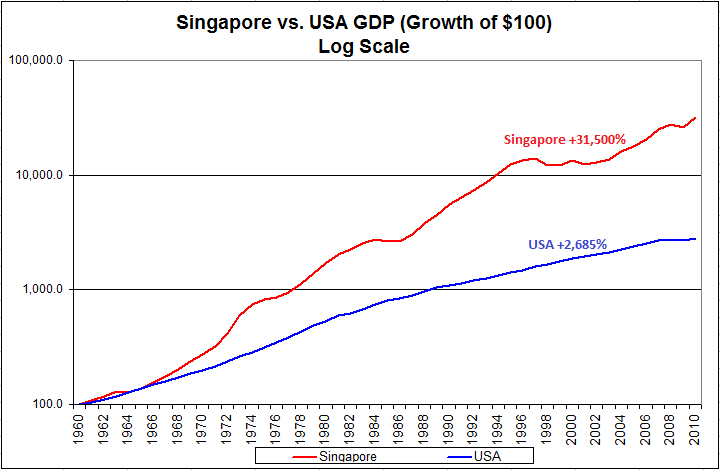
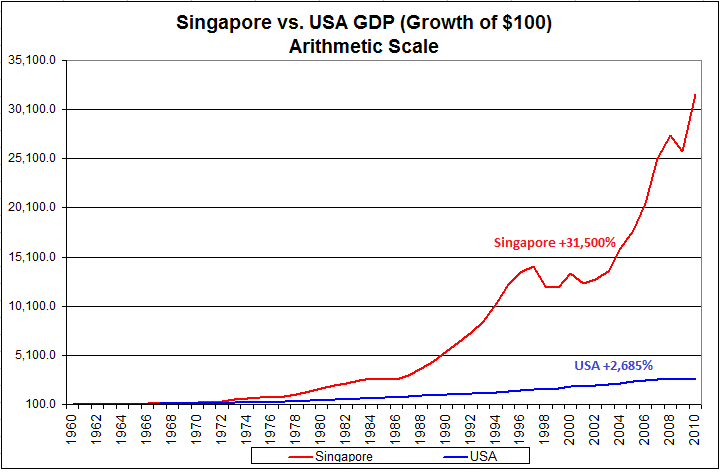
The able J.P. Lee did a little digging around for me and put together this graphic on the comparative GDP growth rates of the US and Singapore over the last 50 years. Shocking isn’t it?
LogScale The Real Wealth of Nations

arithmetic The Real Wealth of Nations

Click to enlarge. Source: St. Louis Fed; Dept of Statistics, Government of Singapore

The graph on the top is a logarithmic scale which shows how much more rapid the economic growth in Singapore has been. The magnitude of the compounded difference, though, isn’t really apparent until you take a look at the arithmetic chart below it! GDP growth in the US over the last fifty years has been a robust 6.8%, but it has been dwarfed by the growth rate in Singapore, which has averaged a stunning 12.2%! (If we could get even a fraction of this additional growth by privatizing Social Security, sign me up.)

Can you imagine what a national savings program could accomplish in the US? We have many economic advantages already, ranging from an excellent university system, a diversified economy, and abundant natural resources to an outstanding record of technological innovation. What we lack is savings. Intelligent incentives to save and invest, coupled with Social Security payroll deductions that are actually invested in accounts for the participants could have a mind-boggling impact down the road.

Personal savings is something quite different from government savings or spending. The US government seems addicted to deficit spending, but as a citizen you can’t do anything about that directly. On the other hand, your level of personal savings in entirely under your control. Like Singapore, most individuals have the ability to compound their savings for fifty years. Even if the US never adopts an intelligent enforced savings plan, there is nothing to stop you from doing it yourself.

Posted by: