Combining Relative Strength and Low Volatility

October 12, 2011

The power of relative strength as a return factor has been well documented and that evidence is the reason that relative strength drives all of our investment strategies. However, just because it is a winning return factor over time doesn’t mean that anyone should or will construct an asset allocation composed entirely of relative strength-based strategies. Financial advisors who are in a position to decide which strategies to include in an asset allocation must then decide how to find complementary return factors. We have previously written about the benefits of combining relative strength and value, for example.

However, it appears that value is not the only suitable complement for relative strength strategies. Another option would be to consider combining the recently introducted PowerShares S&P Low Volatility Portfolio (SPLV) with our own PowerShares DWA Techical Leaders Portfolio (PDP).

A description of each is as follows:

The PowerShares DWA Technical Leaders Portfolio (PDP) is based on the Dorsey Wright Technical Leaders™ Index (Index). The Fund will normally invest at least 90% of its total assets in securities that comprise the Index and ADRs based on the securities in the Index. The Index includes approximately 100 U.S.-listed companies that demonstrate powerful relative strength characteristics. The Index is constructed pursuant to Dorsey Wright proprietary methodology, which takes into account, among other factors, the performance of each of the 3,000 largest U.S.-listed companies as compared to a benchmark index, and the relative performance of industry sectors and sub-sectors. The Index is reconstituted and rebalanced quarterly using the same methodology described above.

The PowerShares S&P 500® Low Volatility Portfolio (SPLV) is based on the S&P 500® Low Volatility Index (Index). The Fund will invest at least 90% of its total assets in common stocks that comprise the Index. The Index is compiled, maintained and calculated by Standard & Poor’s and consists of the 100 stocks from the S&P 500 Index with the lowest realized volatility over the past 12 months. Volatility is a statistical measurement of the magnitude of up and down asset price fluctuations over time.

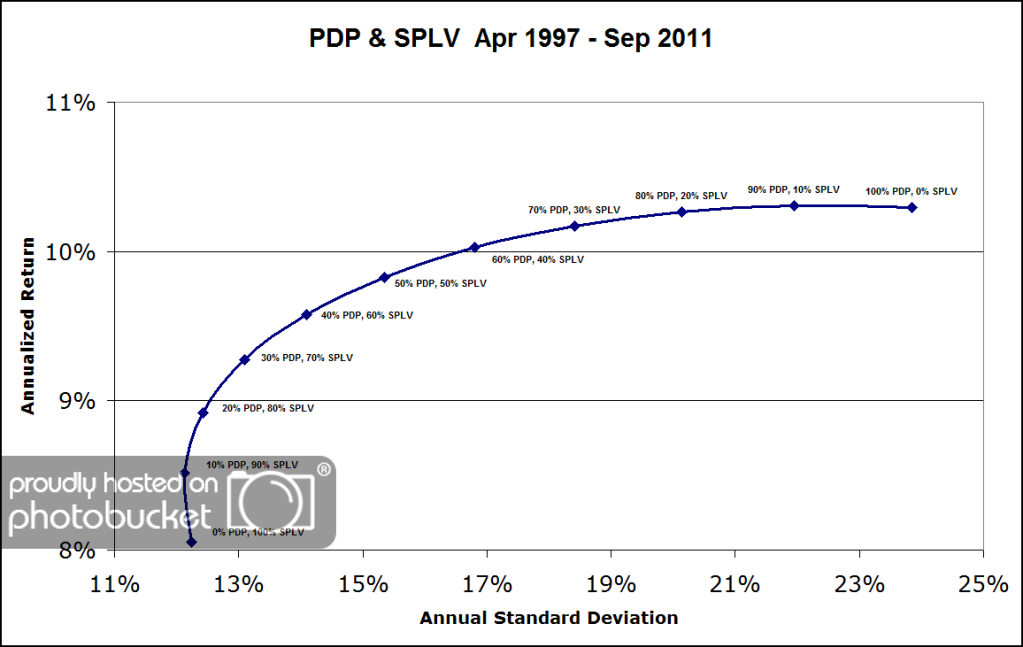
The efficient frontier below points out that combining the two can be an effective way to reduce the volatility and/or increase the return over using PDP or SPLV independently.
pdpsplv2 Combining Relative Strength and Low Volatility

(Click to enlarge)

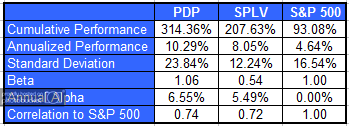
The table below is also for the period April 1997-September 2011. (The hypothetical returns for PDP only go back to April 1997.)
pdp3 Combining Relative Strength and Low Volatility

Perhaps most interesting to asset allocators is the fact that the correlation of excess returns of PDP and SPLV over this time period was -0.29. The goal of asset allocation is to not only add value, but to also construct an allocation that clients will stay with for the long-run. Rather than whip in and out of PDP, perhaps a more enlightened approach is to buy and hold positions in both PDP and SPLV for a portion of the allocation.

For the time periods when hypothetical returns were used, the returns are that of the PowerShares Dorsey Wright Technical Leaders Index and of the S&P 500 Low Volatility Index. The hypothetical returns have been developed and tested by the Manager (Dorsey Wright in the case of PDP and Standard & Poors in the case of SPLV), but have not been verified by any third party and are unaudited. The performance information is based on data supplied by the Dorsey Wright or from statistical services, reports, or other sources which Dorsey Wright believes are reliable. The performance of the Indexes, prior to the inception of actual management, was achieved by means of retroactive application of a model designed with hindsight. For the hypothetical portfolios, returns do not represent actual trading or reflect the impact that material economic and market factors might have had on the Manager’s decision-making under actual circumstances. Actual performance of PDP began March 1, 2007 and actual performance of SPLV began May 5, 2011. See PowerShares.com for more information.

Posted by:


Lowest Average Cost Wins

October 12, 2011

This piece of investment “wisdom” is attributed to Bill Miller at Legg Mason Funds. There’s a grain of truth in it, and also a catch. The catch is covered nicely in a piece from Greg Speicher at Ideas for Intelligent Investing:

In a 2004 interview in The Motley Fool, Bruce Greenwald gives an example which drives home the importance of having the patience and discipline to average down in order to optimize performance. Greenwald talks about Paul Sonkin, who, at that time, had averaged about 25% after fees for the previous four and a half years.

Greenwald observed that Sonkin would often make additional purchases if a stock declined after he bought it. Greenwald looked at Sonkin’s trades and determined that, of the 25% return, fully 22% was from purchases made after the initial purchase. Greenwald also notes that he was looking at the performance of legendary value investor Walter Schloss who averaged 15.3% over five decades. It appeared that much of Schloss’s returns came from the same practice and then selling on the way up. As Bill Miller says, “Lowest average cost wins.”

Takeaways:

  1. Follow-up purchases that lower the cost basis in a stock can have a powerful impact on returns.
  2. Caution! This strategy only works if you have a strong valuation methodology so you can avoid expensive “value traps” and “falling knives.”
  3. This approach requires having a certain self-mastery coupled with a proper orientation on how to think about market prices.

I put the caveat in bold. Even Bill Miller, who presumably does have a strong valuation methodology, has been hoisted on his own petard more than a few times, recently with Eastman Kodak.

The grain of truth is this: all other things being equal, it is better to buy on dips. By doing so, you are essentially doing the opposite of most retail investors, as measured by DALBAR, for example.

Buying dips is clearly a very risky idea if you are buying an individual stock—like Bill Miller, you could end up with a Kodak or equivalent. If you are a long-term investor in the market, however, it might not be so crazy if you are investing in a strategy. Think about it this way: by adding to a strategy on dips, you are letting market volatility work in your favor to reduce your average cost.

Let’s look at an example. I’ll illustrate the strategy with PDP, the Powershares DWA Technical Leaders Index. For a passive comparison, we’ll use SPY, the ubiquitous S&P 500 SPDR. PDP has been around since March 1, 2007, so we’ll use that as our start date. If you bought SPY at the close and held it, your passive return would be a negative 6.4%. It’s been a rough few years for the stock market! And it’s not that PDP was a whole lot better—buy and hold would result in a negative 2.4% return.

PDP has a couple of things going for it, however: 1) high relative strength has historically been a strong return factor, and 2) it’s pretty volatile. Let’s see if we can figure out a way to make volatility our friend.

Back in the 1990s, one of our senior portfolio managers, Harold Parker, published a paper on the NYSE high-low index that showed reversals at or below the 40% level were a pretty reasonable indication of a bottom. Not every signal is perfect (about 70% were accurate), and sometimes several reversals occur before a major bottom. Of course, you can’t know that ahead of time, so let’s just say that you bought more shares of PDP each time there was a reversal at or below the 40% area. That way any hindsight bias is removed.

You would have had 17 chances to buy on dips over the past 4 1/2 years. The first couple in 2007 were at higher prices because the market was still rising. The choppy markets in early 2008 created an additional five buying opportunities. Once the 2008 decline was in full force, there were five more chances to buy on dips not too far from what turned out to be the ultimate market low (ranging from 11/5/2008 to 4/16/2009). The swings throughout 2010 and 2011 have seen the NYSE high-low reverse up on five more occasions, including today.

If you had taken a nip on each of these occasions, your average price in PDP would be $20.68, versus a close yesterday of $23.17. Buying the dips has turned a negative return into a positive 12.0% return. (I’m assuming equal share amounts here; dollar-cost averaging would reduce your cost basis even further to $19.35 for a positive return of 19.7%.) Instead of lagging the benchmark by 6.5% annually—the DALBAR retail investor track record—you’re now running 3.9% ahead of the benchmark, primarily by consistently using volatility in your favor.

On any one occasion, you never know whether your purchase price will be somewhere near a low or if there is a greater decline ahead. You’re simply adding to the strategy on every dip, figuring that by reducing your average cost, you are increasing your odds of coming out ahead over time. There’s no guarantee that adding to a strategy on dips will work—there are no guarantees in the market, period. But by acting in a disciplined and consistent manner, you’ve certainly tilted the odds in your favor.

17 chances to reduce your average cost

Click on chart to enlarge, and to see the buy points marked with arrows.

Source: Dorsey Wright Money Management; John Lewis

See www.powershares.com for more information on our three DWA Technical Leaders Index ETFs (PDP, PIE, PIZ).

Click here for disclosures. Past performance is no guarantee of future results.

Posted by:


Fundamental Frustration

October 12, 2011

Russell Pearlman’s article “Dead Stocks Walking” provides a nice reminder of the importance of evaluating a stock’s technical health rather than solely focusing on a stock’s fundamental health.

If Alan Creech drives a few miles from his downtown Milwaukee office, he can reach no fewer than seven Wal-Mart stores. Their brightly lit, boxy interiors, giant parking lots and upbeat motto, “Save money. Live better,” all serve as an almost-inescapable reminder of one of the most vexing long-term investments the man has ever made.

Creech, who manages the $200 million Marshall Large-Cap Growth fund, bought Wal-Mart stock in 2004 and held on…and held on…and held on…as the retailing giant successfully navigated the long recession, increased its revenue by a staggering $150 billion and even doubled its earnings per share. And by the reckoning of nearly every Wall Street analyst who has covered the company over the past seven years, Creech’s devotion was a smart move: As many as 13 pros had buy ratings on the stock in 2004, and a near-equal enthusiasm can be found among securities analysts in virtually every quarter since. (Only one of them, during this stretch, has slapped a SELL on the stock, according to Zacks Investment Research, and even then, the rating lasted a mere two months.) But for all that outspoken boosterism, Wal-Mart’s shares, which were priced at about $50 when Creech first got in, never rose above $59, and these days, they’re trading at $52 — only 11 percent above the sticker price a full decade ago. “Every quarter, the company’s earnings march up, and the stock goes nowhere,” says Creech. “It’s frustrating.”

(Click to enlarge) Source: Yahoo! Finance

To the dismay of many, stock prices are under no obligation to respond in kind to improvements in fundamentals in any predictable time frame. Beside fundamentals, there are a host of other factors (rational and irrational) that influence the actions of buyers and sellers in the marketplace. A narrow focus on fundamentals can leave one “frustrated.”

Dorsey Wright does not currently have a position in WMT. A list of all holdings for the trailing 12 months is available upon request.

Posted by:


High RS Diffusion Index

October 12, 2011

Th chart below measures the percentage of high relative strength stocks that are trading above their 50-day moving average (universe of mid and large cap stocks.) As of 10/11/11.

Whoa, this index has been whippy as of late! The one-day measure is now 72% after reaching a low of 2% on August 8th.

Posted by:






