Warren Buffett vs. Gold

May 9, 2012

Warren Buffett reiterated at his recent “Woodstock for Capitalists,” otherwise known as Berkshire Hathaway’s annual meeting, that he much preferred productive assets to gold. Charlie Munger agreed. For the record, I’ve got nothing against productive assets. They produce earnings and sometimes dividends and that’s nice. However, a global tactical asset allocator should not be too eager to count out gold.

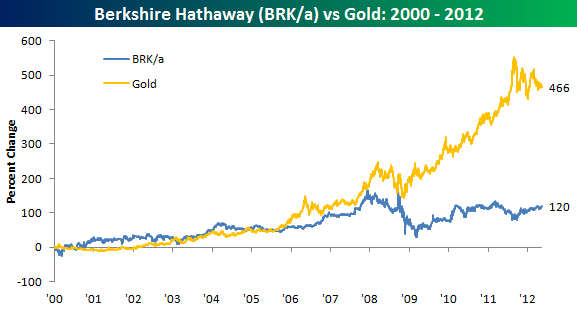
Gold has had good relative strength for much of the last decade—and as a result it has dramatically outperformed Warren Buffett. Bespoke took up this exact issue and had this to say:

Given the fact that BRK/A does not pay a dividend, no matter how much a holder ‘fondles’ or looks at their holdings, one share of BRK/A stock purchased twelve years ago is still one share today. Sure, you can sell it for more now than you bought it then, but the same is true of gold. In fact, your gain on gold is considerably more than your gain would be on BRK/A. Looking at the performance of the two assets since the start of 2000 shows that the value of gold has increased considerably more than the value of Berkshire Hathaway. In fact, with a gain of 466% since the start of 2000, gold’s gain has been nearly four times the return of BKR/A (466% vs 120%).

Their nifty graphic follows:
BRKvsGold Warren Buffett vs. Gold

Source: Bespoke (click on image to enlarge)

Relative strength has no axe to grind. One of the great benefits of using relative strength to drive tactical asset allocation is that it is objective and adaptive. Relative strength does not have a philosophical bias in favor of, or against, gold. If relative strength is high, perhaps it should be included in the portfolio. If relative strength is low, it’s out—period.

The point of investing is not to serve our biases, but to own the best-performing assets that we can identify.


It’s Hard Out There for a Bear

May 9, 2012

I’m not trying to pick on Paul Farrell, really. He’s one of the most read columnists on Marketwatch. From time to time, however, I archive articles that are wildly optimistic or wildly pessimistic to demonstrate how difficult it is not to be carried away with emotion. This article just happened to fall into that category.

This particular article appeared August 17, 2010. The market had just gone through a near 20% decline, as well as the flash crash a few months before. Here is the front end of the article:

Yes, it’s going to get worse, a whole lot worse … Bill Gross warns this is the “New Normal. Forget 10% returns. Think 5%”. … Economist Larry Kotlikoff, author of The Coming Generational Storm, warns: “Let’s get real. The U.S. is bankrupt. Neither spending nor taxing will help the country pay its bills” … Economist Peter Morici warns: “Unemployment is stuck near 10%. Deflation coming. Stock market threatens collapse. The Federal Reserve and Barack Obama are out of bullets. Near zero federal funds rates, central bank purchases, a $1.6 trillion deficit have failed to revive the economy.” … Simon Johnson, co-author of 13 Bankers, warns: “We came close to another Great Depression, next time we may not be so lucky.” Why? Because Wall Street’s already well into the next bubble/bust cycle — the “doom cycle.”

The doom cycle sounds pretty bad and we are warned that things are going to get a whole lot worse. I’m not exaggerating. The whole paragraph was in heavy bold type.

Since then, we’ve gone through another 20% correction. And the market is more than 25% higher. Yes, higher.

Before you smirk and think you are immune from getting carried away, think again. We are all susceptible to emotion—it’s just part of our wiring. And it’s not just on the downside. It’s equally easy to get carried away with “new era” thinking on the upside.

Sentiment swings, I think, demonstrate one of the very best reasons to use a systematic investment process. Our happens to be an adaptive one driven by relative strength, but I’m sure other styles could also be successful. The important thing is to define a profitable process and then stick to it through thick and thin.


High RS Diffusion Index

May 9, 2012

The chart below measures the percentage of high relative strength stocks that are trading above their 50-day moving average (universe of mid and large cap stocks.) As of 5/8/12.

The 10-day moving average of this indicator is 69% and the one-day reading is 50%.