Current Income

April 12, 2013

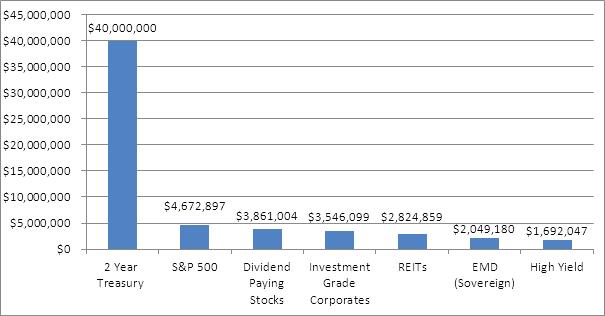
Investors lately are in a frenzy about current income. With interest rates so low, it’s tough for investors, especially those nearing or already in retirement, to come up with enough current income to live on. A recent article in Advisor Perspectives had a really interesting take on current income. The author constructed a chart to show how much money you would have to invest in various asset classes to “buy” $100,000 in income. Some of these asset classes might also be expected to produce capital gains and losses, but this chart is purely based on their current income generation ability. You can read the full original article to see exactly which asset classes were used, but the visual evidence is stunning.

100mIncome zps66939722 Current Income

Source: Advisor Perspectives/Pioneer Investments (click to enlarge)

There are two things that I think are important to recognize—and it’s hard not to with this chart.

  1. Short-term interest rates are incredibly low, especially for bonds presumed to have low credit risk. The days of rolling CDs or clipping a few bond coupons as an adequate supplement to Social Security are gone.
  2. In absolute terms, all of these amounts are relatively high. I can remember customers turning up their noses at 10% investment-grade tax-exempt bonds—they felt rates were sure to go higher—but it only takes a $1 million nest egg to generate a $100,000 income at that yield. Now, it would take more than $1.6 million, even if you were willing to pile 100% into junk bonds. (And we all know that more money has been lost reaching for yield than at the point of a gun.) A more realistic guess for the typical volatility tolerance of an average 60/40 balanced fund investor is probably something closer to $4.2 million. Even stocks aren’t super cheap, although they seem to be a bargain relative to short-term bonds.

That’s daunting math for the typical near-retiree. Getting anywhere close to that would require compounding significant savings for a long, long time—not to mention remarkable investment savvy. The typical advisor has only a handful of accounts that large, suggesting that much work remains to be done educating clients about savings, investment, and the reality of low current yields.

The pressure for current income might also entail some re-thinking of the entire investment process. Investors may need to focus more on total return, and realize that some capital gains can be spent as readily as dividends and interest. Relative strength may prove to be a useful discipline in the search for returns, wherever they may be found.

Posted by:


The Problem With Intrinsic Value

April 12, 2013

Howard Marks makes a compelling argument for using relative strength (without even referring to relative strength):

“If you are a value investor and you invest whenever you find a stock which is selling for one-third less than your estimate of intrinsic value, and you say, I don’t care about the macro, nor what I call the temperature of the market, then you are acting as if the world is always the same and the desirability of making investments is always the same. But the world changes radically, and sometimes the investing world is highly hospitable (when the prices are depressed) and sometimes it is very hostile (when prices are elevated).

“I guess what you are saying is we just look at the micro; we look at them one stock at a time; we buy them whenever they are cheap. I can’t argue with that. On the other hand, it is much easier to make money when the world is depressed, because when it stops being depressed, it’s like a compressed spring that comes back.

“…I think it is unrealistic and maybe hubristic to say, ‘I don’t care about what is going on in the world. I know a cheap stock when I see one.’ If you don’t follow the pendulum and understand the cycle, then that implies that you always invest as much money as aggressively. That doesn’t make any sense to me. I have been around too long to think that a good investment is always equally good all the time regardless of the climate.”

Buyers and sellers respond to the very same fundamental factors in very different ways depending on the environment. A stock can be cheap (and get cheaper) for a long period of time until which time as there are more buyers than sellers and the price begins to rise. Relative strength doesn’t even make an attempt to estimate intrinsic value. To a relative strength strategy, the concept of intrinsic value is meaningless. A security is worth whatever the market says it’s worth. Relative strength models simply allocate to the strongest trends in the market and therefore avoid the potential problems of sitting around waiting for the market to come around to your way of thinking.

As Marks correctly points out, the world changes radically over time. However, one constant is the law of supply and demand.

HT: Business Insider

Posted by:


Client Sentiment Survey - 4/12/13

April 12, 2013

Here we have the next round of the Dorsey, Wright Sentiment Survey, the first third-party sentiment poll. Participate to learn more about our Dorsey, Wright Polo Shirt raffle! Just follow the instructions after taking the poll, and we’ll enter you in the contest. Thanks to all our participants from last round.

As you know, when individuals self-report, they are always taller and more beautiful than when outside observers report their perceptions! Instead of asking individual investors to self-report whether they are bullish or bearish, we’d like financial advisors to weigh in and report on the actual behavior of clients. It’s two simple questions and will take no more than 20 seconds of your time. We’ll construct indicators from the data and report the results regularly on our blog–but we need your help to get a large statistical sample!

Click here to take Dorsey, Wright’s Client Sentiment Survey.

Contribute to the greater good! It’s painless, we promise.

Posted by:


Investment Manager Selection

April 12, 2013

Investment manager selection is one of several challenges that an investor faces. However, if manager selection is done well, an investor has only to sit patiently and let the manager’s process work—not that sitting patiently is necessarily easy! If manager selection is done poorly, performance is likely to be disappointing.

For some guidance on investment manager selection, let’s turn to a recent article in Advisor Perspectives by C. Thomas Howard of AthenaInvest. AthenaInvest has developed a statistically validated method to forecast fund performance. You can (and should) read the whole article for details, but good investment manager selection boils down to:

  • investment strategy
  • strategy consistency
  • strategy conviction

This particular article doesn’t dwell on investment strategy, but obviously the investment strategy has to be sound. Relative strength would certainly qualify based on historical research, as would a variety of other return factors. (We particularly like low-volatility and deep value, as they combine well with relative strength in a portfolio context.)

Strategy consistency is just what it says—the manager pursues their chosen strategy without deviation. You don’t want your value manager piling into growth stocks because they are in a performance trough for value stocks (see Exhibit 1999-2000). Whatever their chosen strategy or return factor is, you want the manager to devote all their resources and expertise to it. As an example, every one of our portfolio strategies is based on relative strength. At a different shop, they might be focused on low-volatility or small-cap growth or value, but the lesson is the same—managers that pursue their strategy with single-minded consistency do better.

Strategy conviction is somewhat related to active share. In general, investment managers that are willing to run relatively concentrated portfolios do better. If there are 250 names in your portfolio, you might be running a closet index fund. (Our separate accounts, for example, typically have 20-25 positions.) A widely dispersed portfolio doesn’t show a lot of conviction in your chosen strategy. Of course, the more concentrated your portfolio, the more it will deviate from the market. For managers, career risk is one of the costs of strategy conviction. For investors, concentrated portfolios require patience and conviction too. There will be a lot of deviation from the market, and it won’t always be positive. Investors should take care to select an investment manager that uses a strategy the investor really believes in.

AthenaInvest actually rates mutual funds based on their strategy consistency and conviction, and the statistical results are striking:

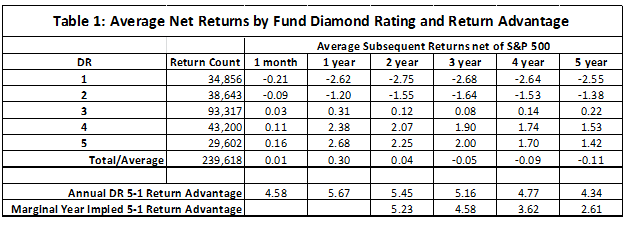
The higher the DR [Diamond Rating], the more likely it will outperform in the future. The superior performance of higher rated funds is evident in Table 1. DR5 funds outperform DR1 funds by more than 5% annually, based on one-year subsequent returns, and they continue to deliver outperformance up to five years after the initial rating was assigned. In this fashion, DR1 and DR2 funds underperform the market, DR3 funds perform at the market, and DR4 and DR5 funds outperform. The average fund matches market performance over the entire time period, consistent with results reported by Bollen and Busse (2004), Brown and Goetzmann (1995) and Fama and French (2010), among others.

Thus, strategy consistency and conviction are predictive of future fund performance for up to five years after the rating is assigned.

The bold is mine, as I find this remarkable!

I’ve reproduced a table from the article below. You can see that the magnitude of the outperformance is nothing to sniff at—400 to 500 basis points annually over a multi-year period.
diamondratings zps3970f53e Investment Manager Selection

Source: Advisor Perspectives/AthenaInvest (click on image to enlarge)

The indexing crowd is always indignant at this point, often shouting their mantra that “active managers don’t outperform!” I regret to inform them that their mantra is false, because it is incomplete. What they mean to say, if they are interested in accuracy, is that “in aggregate, active managers don’t outperform.” That much is true. But that doesn’t mean you can’t locate active managers with a high likelihood of outperformance, because, in fact, Tom Howard just demonstrated one way to do it. The “active managers don’t outperform” meme is based on a flawed experimental design. I tried to make this clear in another blog post with an analogy:

Although I am still 6’5″, I can no longer dunk a basketball like I could in college. I imagine that if I ran a sample of 10,000 random Americans and measured how close they could get to the rim, very few of them could dunk a basketball either. If I created a distribution of jumping ability, would I conclude that, because I had a large sample size, the 300 people would could dunk were just lucky? Since I know that dunking a basketball consistently is possible–just as Fama and French know that consistent outperformance is possible–does that really make any sense? If I want to increase my odds of finding a portfolio of people who could dunk, wouldn’t it make more sense to expose my portfolio to dunking-related factors–like, say, only recruiting people who were 18 to 25 years old and 6’8″ or taller?

In other words, if you look for the right characteristics, you have a shot at finding winning investment managers too. This is valuable information. Think of how investment manager selection is typically done: “What was your return last year, last three years, last five years, etc.?” (I know some readers are already squawking, but the research literature shows clearly that flows follow returns pretty closely. Most “rigorous due diligence” processes are a sham—and, unfortunately, research shows that trailing returns alone are not predictive.) Instead of focusing on trailing returns, investors would do better to locate robust strategies and then evaluate managers on their level of consistency and conviction.
Posted by:


Investors’ #1 Problem: Not Saving Enough

April 12, 2013

The Wall Street Journal had a small piece on Americans’ retirement readiness. In general, they’re not saving enough. Here’s an excerpt:

A separate study released today by investment firm Edward Jones finds that 79% of 1,008 U.S. adults surveyed in February said that they have committed a money mistake – and of those, 26% reported not having saved enough for retirement as their No. 1 problem. Also on the list: not paying attention to spending and making bad investments.

The EBRI research found that Americans are coming to grips with the dramatic improvements they need to make in their saving habits, with 20% of workers saying they need to save between 20 and 29% of their income to achieve a financially secure retirement, and 23% saying they need to save 30% – or more.

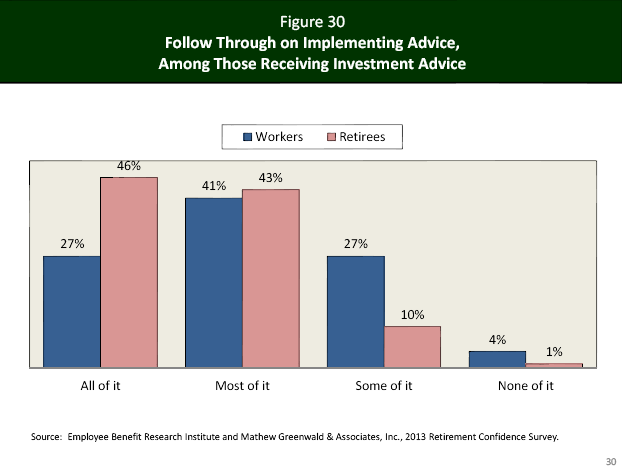
I added the bold. If you are a financial advisor, it’s really worth reading the entire EBRI research brief. It is absolutely eye-opening. You will discover that only 23% of workers ever obtained investment advice in the first place.

And, when they got advice, they ignored a lot of it! Here’s the graphic from EBRI on follow-through:

advice zps59e7514a Investors #1 Problem: Not Saving Enough

Only 27% fully implemented the advice. That makes about 6% of investors that got advice and followed it! (Elsewhere in the report, you will discover that a minority of investors have even tried to figure out what they might need in the way of retirement savings.) It seems obvious that you would have a large chance of falling short if you didn’t even have a goal.

As advisors, we often forget—as frustrated as we sometimes are with clients—that we are dealing with the cream of the crop. We work with investors who 1) have sought out professional advice and 2) follow all or most of it. We get cranky at anything less than 100% implementation, but many investors are doing less than that—if they bother to get advice at all.

So lighten up. Keep nudging your clients to save more, because you know it is their #1 problem. They might think you obnoxious, but they will thank you later. Help them construct a reasonable portfolio. And encourage them to get their friends and colleagues into some kind of planning and investment process. Their odds of success will be better if they get some help.

Posted by:


Sector and Capitalization Performance

April 12, 2013

The chart below shows performance of US sectors and capitalizations over the trailing 12, 6, and 1 month(s). Performance updated through 4/11/2013.

Numbers shown are price returns only and are not inclusive of transaction costs. Source: iShares

Posted by: